The Ultimate Tax Deduction Guide for Creative Professionals
Why Most Creative Professionals Overpay the IRS Every Single Year
This creative deduction maximization guide exists because most artists, filmmakers, designers, and content creators are quietly handing thousands of extra dollars to the IRS each year, not because they cheated, but because nobody showed them the full picture.
Here is a quick answer to what creative deduction maximization actually means in practice.
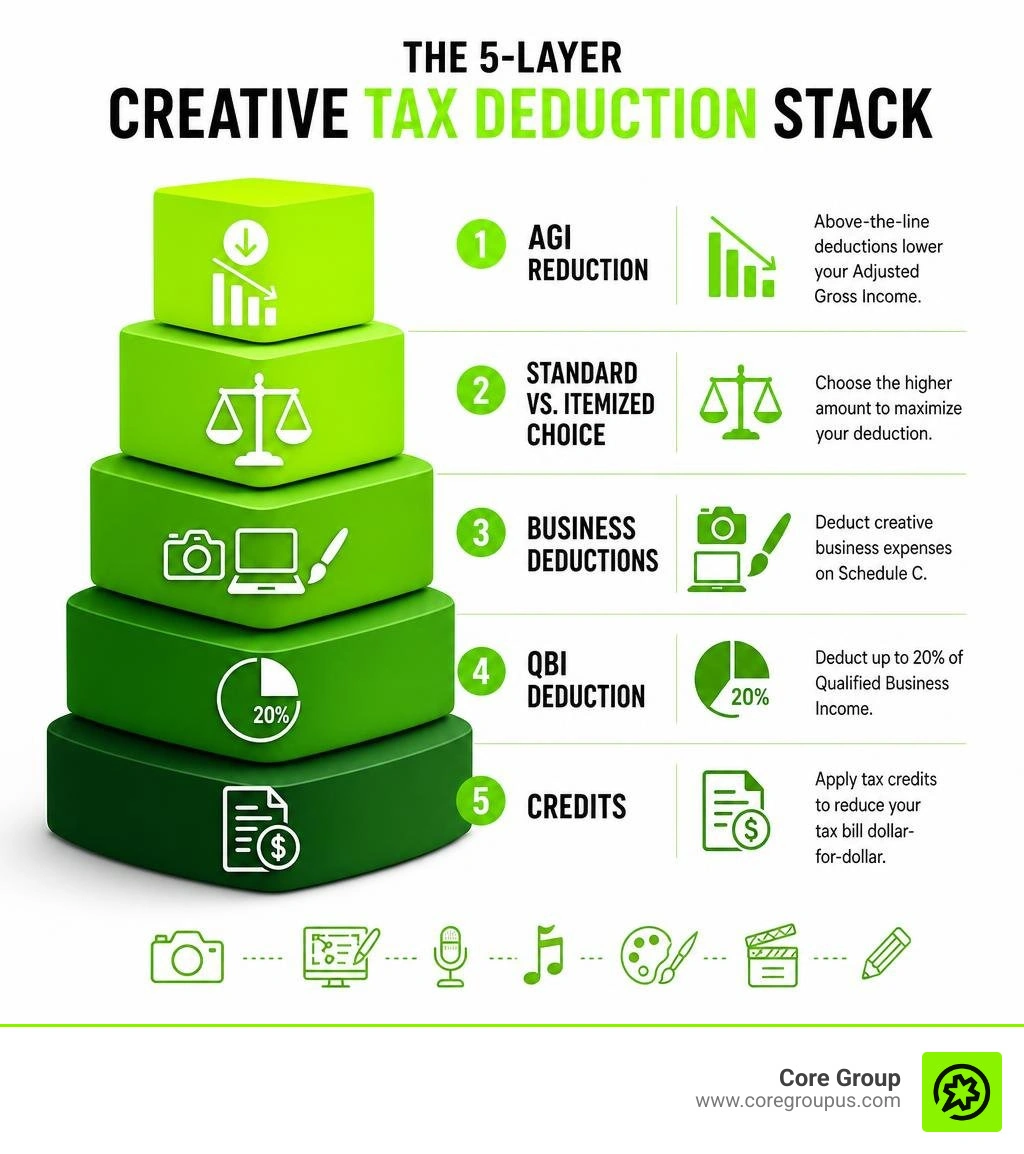
The Core Strategy at a Glance
- Claim every above-the-line deduction first (retirement contributions, HSA, self-employed health insurance) to lower your adjusted gross income
- Choose standard or itemized deductions based on whichever number is higher for your situation
- Stack creative business deductions including home studio, equipment, software, mileage, and professional development on Schedule C
- Apply the QBI deduction to shave up to 20% off qualified business income if you operate as a pass-through entity
- Use credits last to reduce your actual tax bill dollar-for-dollar after deductions are applied
A diligent creative professional using this approach can realistically unlock an additional $8,000 to $15,000 in savings per year. Real estate investors and business owners who layer in Section 179 and cost segregation strategies can reduce taxable income by $12,000 to $46,000 in their first year alone.
The challenge is that creative income is messy. Irregular payments, multiple revenue streams, royalties, licensing deals, gig-to-gig cash flow, these make tax planning harder than it is for a standard W-2 employee. And the tax landscape just got more complex, with the One Big Beautiful Bill Act (OBBBA) introducing significant changes to deductions, SALT caps, and new rules that affect how you should file starting with the 2025 tax year.
The good news is that the rules are actually generous for self-employed creatives, if you know how to use them.
This guide breaks down everything in plain language so you can stop overpaying and start keeping more of what you earn.
Navigating the New Tax Landscape Under the One Big Beautiful Bill Act
The passage of the One Big Beautiful Bill Act (OBBBA) has fundamentally reshaped how we approach tax legislation, standard deduction options, and itemized deductions. As we navigate the 2026 tax year, creative business owners must understand how these federal changes alter their total tax liability.
The OBBBA permanentized several shifts in the tax code while introducing new rules that directly impact creative entrepreneurs. Under this framework, the standard deduction has been adjusted to $15,750 for single filers and $31,500 for married couples filing jointly. This high threshold means that many taxpayers automatically default to the standard option without running the math. However, doing so can be a costly mistake, especially if you live in a high-tax state.
For those considering itemizing, the landscape has changed. To see how these changes play out in a high-tax environment, you can read this California SALT deduction analysis which details how West Coast homeowners can leverage the revised federal limits to their advantage.
Understanding the Enhanced SALT Cap and Phaseouts
One of the most significant victories for taxpayers under the OBBBA is the expansion of the State and Local Tax (SALT) deduction cap. The previous restrictive limit has been increased to $40,000 for single filers and married couples filing jointly, with a $20,000 limit for married individuals filing separately. This expansion allows you to deduct a much larger portion of your state income taxes, local sales taxes, and property taxes from your federal taxable income.
However, high earners need to watch out for the phaseout rules. The enhanced SALT deduction begins to phase out once your modified adjusted gross income (AGI) crosses the $500,000 mark.
State-level credits also play a massive role in this equation. For example, if you operate in the Southwest, reviewing the Arizona state tax credits guide can show you how to reduce your state tax liability directly, which in turn changes your federal deduction calculations. Similar state-specific opportunities exist across our other active states, such as the Deductions and Credits - Alabama Department of Revenue guidelines, which help Southern creatives navigate local rules.
Deciding Between the Standard Deduction and Itemizing
To make the right choice between the standard deduction and itemizing, you must compare the fixed standard deduction for your filing status against the sum of your allowable itemized expenses. These itemized expenses include your mortgage interest on up to $750,000 of debt, medical expenses that exceed the 7.5% AGI floor, and your charitable contributions.
Under the OBBBA, charitable giving has a new wrinkle. Itemizers now face a 0.5% AGI floor on charitable deductions, meaning you can only deduct charitable contributions that exceed 0.5% of your AGI. Conversely, non-itemizers can take advantage of a below-the-line deduction of up to $1,000 for individuals or $2,000 for married couples for cash donations.
Determining which path yields the lowest tax bill requires modeling both scenarios. We always recommend analyzing these numbers as part of your broader strategies to minimize taxes so you do not leave money on the table.
The Ultimate Creative Deduction Maximization Guide for Modern Entrepreneurs

When you run a creative business, your day-to-day expenses are the lifeblood of your tax-saving strategy. The IRS allows you to deduct ordinary and necessary expenses incurred in the course of carrying on your trade or business. For self-employed individuals and creative business owners, these write-offs are claimed on Schedule C, directly reducing both your income tax and your self-employment tax.
To get a complete handle on what you can write off, you should consult our comprehensive list of creative business expenses which covers everything from digital assets to studio utilities. You can also read more about structuring these claims in this Maximizing Tax Deductions, a Guide for Creative Business Owners resource.
Essential Write Offs for Artists and Filmmakers
If you are a painter, sculptor, or filmmaker, your physical space and tools are highly capital-intensive. You can deduct the cost of your studio space, whether you rent a commercial loft or maintain a dedicated home studio. If you use a portion of your home regularly and exclusively for your art, you can deduct a percentage of your rent, mortgage interest, utilities, and home insurance.
Equipment depreciation is another massive area of savings. High-end cameras, lenses, lighting rigs, and editing bays do not have to be written off slowly over many years. You can write them off immediately using accelerated depreciation.
For a deeper dive into industry-specific rules, check out our guide on filmmaker tax deductions as well as our accounting for artists complete guide to ensure your books are set up correctly from day one.
Leveraging a Creative Deduction Maximization Guide for Influencers and Designers
In the modern digital economy, influencers, content creators, and graphic designers face unique operational costs. Your social media presence requires continuous investment in marketing costs, website hosting, design software subscriptions, and advertising.
The tools you use to produce content are fully deductible. This includes your smartphone, internet connection, ring lights, and microphone. However, because these assets are often used for both personal and professional tasks, you must carefully document the business-use percentage.
To make sure you are capturing every single eligible design and promotion cost, review our breakdown of tax deductible expenses for influencers and our specialized advice on business expenses for videographers.
Strategic Timing and Expense Bunching to Lower Taxable Income
Tax planning is not a chore you perform in April. It is a year-round strategy. One of the most effective ways to lower your taxable income is through strategic timing of income and expenses. If your business utilizes the cash method of accounting, you record income when cash is received and expenses when they are paid. This gives you immense flexibility at the end of the calendar year.
If you expect to be in a higher tax bracket this year than next year, you should accelerate your deductible expenses into the current year. This can be done by paying for software subscriptions, prepaying rent, or purchasing equipment before December 31.
Conversely, you can defer income by delaying your client invoices until late December so the payments arrive in January. We discuss these tactical maneuvers extensively in our articles on tax planning strategies and how to save on taxes.
Implementing Multi Year Planning and Stacking Strategies
Deduction stacking is the art of combining multiple tax-saving moves in a single tax year to clear high deduction thresholds. This is especially useful for creative freelancers whose income fluctuates wildly from year to year.
If you have a banner year with high revenue, that is the year to bunch your expenses. You can combine a home office deduction, heavy equipment purchases, and large charitable donations into that single high-income year to drag yourself into a lower tax bracket. In the following year, when your income may be lower, you can take the standard deduction and keep your business expenses to a minimum.
This multi-year approach is the cornerstone of sustainable wealth building. For a tailored roadmap, read our guides on tax planning for freelancers and as a freelancer how do I plan for taxes.
Utilizing a Creative Deduction Maximization Guide for Retirement and HSA Contributions
Retirement accounts and Health Savings Accounts (HSAs) are some of the most powerful above-the-line deductions available. These contributions reduce your AGI dollar-for-dollar, regardless of whether you take the standard deduction or itemize.
As a self-employed creative, you are not limited to standard individual retirement account (IRA) limits. You can establish a Solo 401k or a Simplified Employee Pension (SEP) IRA. For the 2025 and 2026 tax years, a Solo 401k allows you to contribute up to $23,500 as an employee, plus an additional employer contribution, up to a combined maximum of $70,000.
An HSA is equally potent. If you have a high-deductible health plan, you can contribute up to $4,300 for an individual or $8,550 for a family in 2025. This money goes in tax-free, grows tax-free, and comes out tax-free when used for qualified medical expenses.
Demystifying Section 179 Expensing and Bonus Depreciation

When you buy expensive capital investments like cameras, computers, studio furniture, or vehicles, you generally cannot deduct the entire cost at once under standard accounting rules. Instead, you must spread the cost over the useful life of the asset. However, Section 179 and bonus depreciation allow you to bypass this slow process and write off the entire purchase price in year one.
These depreciation strategies are highly technical but incredibly rewarding. To see how these rules apply to S Corporations and LLCs, read our LLC tax deductions guide 2026.
Choosing Between Section 179 and Bonus Depreciation
While both methods allow for rapid expensing, they operate under different rules. Section 179 is capped at a maximum deduction of $2.5 million, and it cannot create a net business loss. If your business is already operating at a loss, you cannot use Section 179 to increase that loss.
Bonus depreciation, which returns to 100% under the OBBBA for qualified assets placed in service, does not have an income limitation. It can create or increase a net operating loss, which can then be carried forward to offset future income.
However, state conformity is a major issue. Some states, like California, do not conform to federal bonus depreciation rules, requiring you to add those deductions back on your state return. In Connecticut, you should look at the 179D Tax Deduction Connecticut - KBKG rules for energy-efficient commercial building updates if you own commercial studio space.
The table below highlights the key differences between these two powerful options.
| Feature | Section 179 Expensing | Bonus Depreciation |
|---|---|---|
| Annual Limit | Capped at $2.5 million | No dollar limit |
| Business Income Limit | Cannot exceed net business income | Can create a net operating loss |
| Asset Types | New and used tangible property | Qualified property with useful life under 20 years |
| State Conformity | Varies widely by state | Frequently disallowed at the state level |
Maximizing the Qualified Business Income Deduction
The Qualified Business Income (QBI) deduction, also known as Section 199A, allows eligible self-employed individuals and pass-through entities to deduct up to 20% of their qualified business income. This deduction is taken on your personal tax return, but it is based entirely on your business financial performance.
The QBI deduction is subject to phaseout limits based on your taxable income and whether your business is classified as a Specified Service Trade or Business (SSTB). Many creative professionals, such as writers, designers, and actors, fall into the SSTB category, meaning their QBI deduction begins to phase out at higher income levels.
Understanding how to navigate these thresholds is essential for creative entrepreneurs. We break this down in simple terms in our QBI deduction explained resource and our guide on business tax optimization.
Bulletproof Record Keeping and Audit Defense Strategies
An aggressive tax deduction strategy is only as good as the documentation backing it up. If the IRS selects your return for an audit, they will demand contemporaneous records to prove every dollar you claimed. Without receipts, mileage logs, and clear business explanations, your deductions will be disallowed, and you could face a 20% accuracy-related penalty.
To build an audit-proof financial system, you must establish robust daily habits. We outline the exact tools and processes you need in our bookkeeping for creatives complete guide.
Common Mistakes That Wipe Out Legitimate Deductions
The quickest way to trigger an IRS audit or lose a deduction is to make simple bookkeeping errors. The most common mistake we see is commingling personal and business funds. If you pay for your business software with your personal credit card, or buy groceries with your business debit card, you cloud the business purpose of your accounts.
Another major audit trigger is claiming 100% business use for mixed-use assets like your personal vehicle or cell phone without keeping a contemporaneous mileage log or call log. The IRS knows that you use your car for personal trips, and claiming a perfect 100% business split without proof is an instant red flag.
When to Partner with a Professional Tax Strategist
If your creative business is growing, your tax situation will quickly outgrow basic DIY software. Tax software is designed to look backward and record what already happened. It cannot build a proactive, multi-year strategy to save you money before the year ends.
You should consult a professional tax strategist if your AGI exceeds $150,000, if you have complex royalty or licensing agreements, if you operate in multiple states, or if you are considering restructuring your business from a sole proprietorship to an S Corporation.
For personalized support, check out our options for financial consulting for artists.
Frequently Asked Questions About Creative Tax Planning
Navigating the tax code can feel like learning a foreign language. Here are answers to some of the most common questions creative professionals ask us.
Should I choose the standard deduction or itemize my expenses
The choice depends entirely on your total allowable personal deductions. Add up your mortgage interest, your state and local taxes up to the new $40,000 SALT cap, and your charitable donations. If the total is greater than $15,750 for single filers or $31,500 for married couples, you should itemize. If it is less, take the standard deduction. Your business expenses on Schedule C are claimed regardless of which option you choose for your personal return.
For those living in specific states, make sure to check local rules. Residents of Arkansas can refer to the Arkansas Tax Deductions to Know for 2026 - RMP Law guide, while Colorado business owners should review the Enterprise Zone Tax Guide | Department of Revenue - Colorado Taxes for localized credits.
How do I safely claim the home office deduction
To safely claim the home office deduction, you must meet the regularly and exclusively test. This means the designated area of your home must be used only for your business. A desk in the corner of your bedroom can qualify, but a dining table that you also use for family meals does not.
You can calculate the deduction using the simplified method, which grants you $5 per square foot up to 300 square feet, for a maximum of $1,500. Alternatively, you can use the actual expense method, which allows you to deduct the exact percentage of your rent, utilities, and home repairs based on the square footage of your office relative to your entire home.
Can W2 employees still claim creative business deductions
Since the suspension of miscellaneous itemized deductions, W-2 employees can no longer deduct unreimbursed employee expenses on their federal tax returns. If you are an animator or designer employed full-time by a studio, you cannot write off your home computer or software subscriptions on your personal tax return.
To bypass this restriction, you should ask your employer to implement an accountable plan. An accountable plan allows the company to reimburse you for these business expenses tax-free, meaning the business takes the deduction and you get your money back without increasing your taxable income.
Alternatively, if you earn any side income as a freelancer or independent contractor, you can file a Schedule C for that secondary income stream and deduct your business expenses against those creative earnings.
Conclusion
Maximizing your tax deductions is not about finding loopholes or bending the rules. It is about claiming the legal incentives that the government has put in place to support small businesses and creative entrepreneurs. By implementing a proactive, multi-year strategy, keeping pristine records, and understanding how new legislation like the OBBBA affects your business, you can protect your hard-earned revenue.
At Core Group, we provide financial management, bookkeeping, and tax services specifically tailored for creative entrepreneurs. We operate in the financial services industry, and our unique selling proposition is a no-fluff, profit-first playbook that guarantees peace of mind and saves you time, allowing you to focus entirely on your creative work. We back our dedication to modern creatives with our MacBook Pro guarantee.
If you are ready to stop stressing over tax season and start optimizing your business for real, sustainable growth, explore our Core Group tax planning resources and let us build a custom strategy for your creative empire.