Over 50 and Saving? Here is Your 2026 401k Limit Guide
Your 2026 Catch-Up Contribution Limits at a Glance
The 2026 maximum 401k contribution over 50 just got a meaningful boost, and knowing your exact numbers is the first step to making the most of it.
Here is a quick answer if that is all you need right now.
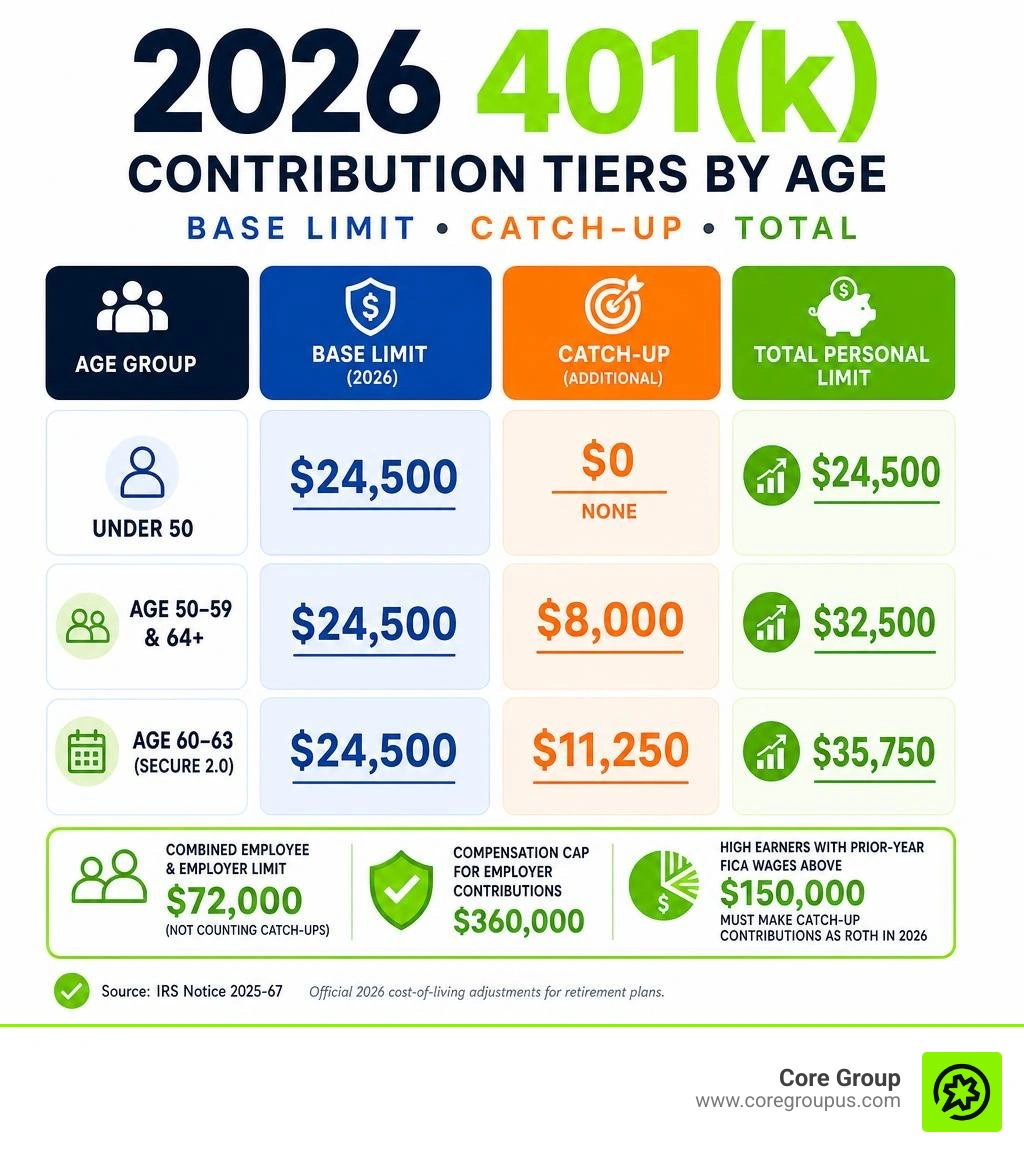
| Age Group | Base Limit | Catch-Up | Total Personal Limit |
|---|---|---|---|
| Under 50 | $24,500 | None | $24,500 |
| Age 50-59 and 64+ | $24,500 | $8,000 | $32,500 |
| Age 60-63 (SECURE 2.0) | $24,500 | $11,250 | $35,750 |
A few other key numbers worth knowing right away.
- The combined employee and employer limit is $72,000 (not counting catch-ups)
- The compensation cap used to calculate employer contributions is $360,000
- High earners with prior-year FICA wages above $150,000 must make catch-up contributions as Roth in 2026
These limits were confirmed by the IRS in Notice 2025-67, which announced the official 2026 cost-of-living adjustments for retirement plans.
If you are a creative professional running a business or working in film and media, retirement planning can feel like the last thing on your plate. But the rules changed significantly this year, especially if you are over 50. Missing these updates could mean leaving real tax savings on the table, or worse, making contributions that trigger penalties.
This guide breaks down everything clearly so you can act with confidence.
Understanding the 2026 Maximum 401k Contribution Over 50
When you cross the age 50 milestone, the Internal Revenue Service allows you to make extra contributions to your workplace retirement plan. These are known as catch-up contributions. They are designed to help workers accelerate their retirement savings as they enter their peak earning years.
For 2026, these rules have become slightly more complex due to the ongoing rollout of the SECURE 2.0 Act. The elective deferral limit represents the maximum amount an employee can contribute to their plan through salary reductions. If you want to see the details directly from the source, you can review the Official IRS announcement on 2026 limits.
Your age determines which limit applies to you during the calendar year. As long as you turn 50 by December 31 of 2026, you are eligible to make catch-up contributions for the entire year. You do not have to wait until your actual birthday to start saving at the higher rate.
Standard Catch Up Limits for Participants Age 50 and Older
For participants who are between the ages of 50 and 59, or who are age 64 and older, the standard catch-up rules apply.
In 2026, the base elective deferral limit is $24,500. This is the absolute maximum that any worker under 50 can contribute. However, if you qualify for the standard catch-up, you can contribute an additional $8,000.
This brings your total personal contribution limit to $32,500. This entire amount can be split between traditional pre-tax and Roth accounts, depending on your personal tax strategy and what your employer plan allows. When you receive your W-2 form at the end of the year, these contributions will be tracked in Box 12 using specific codes to ensure compliance with federal tax laws.
The SECURE 2.0 Super Catch Up for Ages 60 to 63
One of the most notable changes introduced by the SECURE 2.0 Act is the creation of a higher tier of catch-up contributions, often referred to as the super catch-up. This provision is specifically designed for workers who are in a critical pre-retirement sprint.
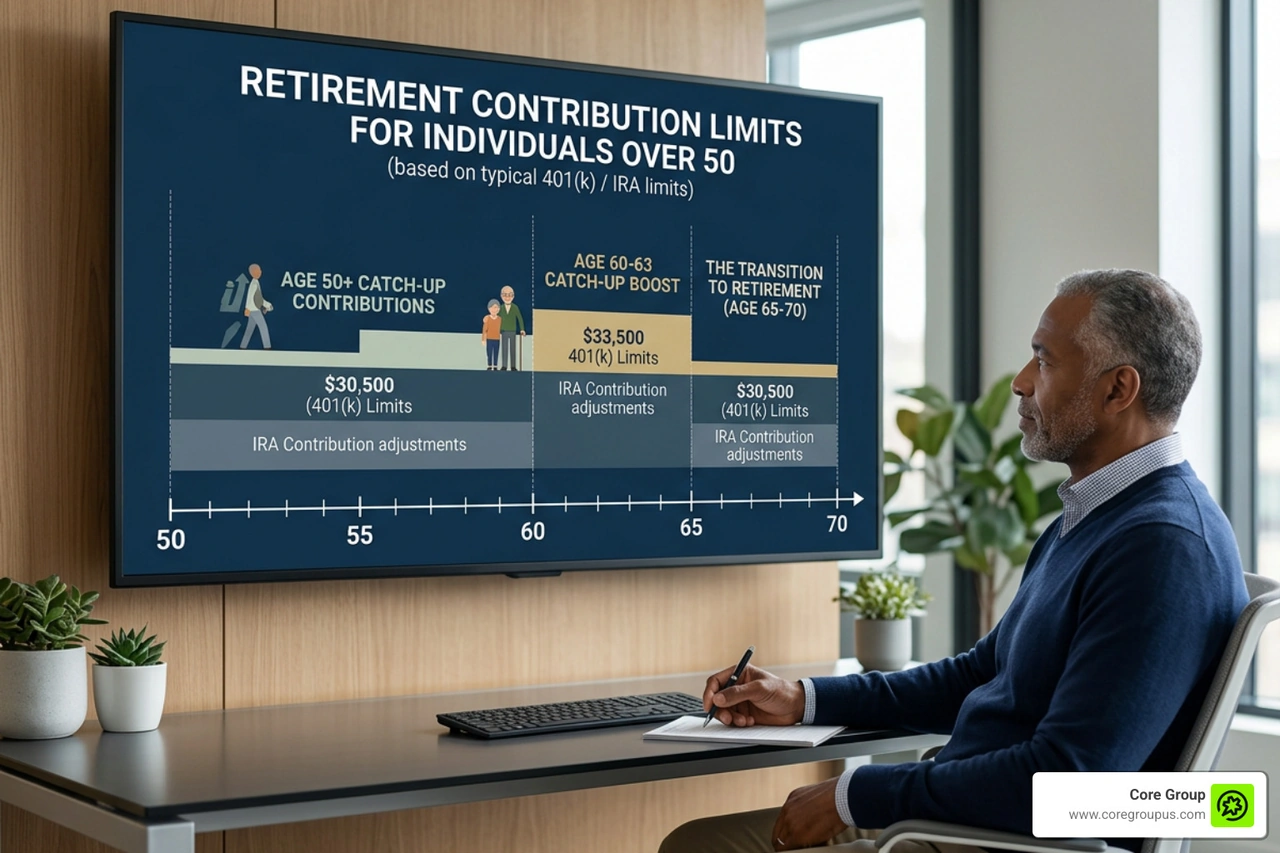
If you are exactly age 60, 61, 62, or 63 during the 2026 tax year, you qualify for an enhanced catch-up limit of $11,250. When combined with the $24,500 base limit, this allows you to defer a total of $35,750 of your salary into your workplace retirement plan.
Once you turn 64, this special super catch-up limit is no longer available, and your catch-up contribution limit reverts to the standard $8,000. This makes those four years incredibly valuable for maximizing your retirement nest egg.
Comparing 2026 and 2025 Contribution Limits
The IRS adjusts retirement limits annually based on inflation and cost-of-living metrics. Comparing the 2026 limits to the 2025 limits shows a steady upward trend, giving savers more room to build their portfolios.
In 2025, the base limit was $23,500, and the standard catch-up was $7,500, resulting in a total limit of $31,000 for those over 50. For 2026, the base limit rose by $1,000, and the standard catch-up rose by $500. Interestingly, the super catch-up limit for ages 60 to 63 remained flat at $11,250.
Here is a side-by-side comparison of the limits for both years.
| Contribution Category | 2025 Limit | 2026 Limit | Change |
|---|---|---|---|
| Base Deferral Limit | $23,500 | $24,500 | +$1,000 |
| Standard Catch-Up (50+) | $7,500 | $8,000 | +$500 |
| Super Catch-Up (60-63) | $11,250 | $11,250 | $0 |
| Total Limit (Ages 50-59) | $31,000 | $32,500 | +$1,500 |
| Total Limit (Ages 60-63) | $34,750 | $35,750 | +$1,000 |
These increases mean that if you are in your fifties, you can save an extra $1,500 compared to last year. If you are in your early sixties, you can save an extra $1,000.
The New Roth Catch Up Mandate for High Earners
While the contribution limits have gone up, the rules on how you can make these contributions have changed dramatically for high earners. This is due to a new mandate that requires certain catch-up contributions to be made as after-tax Roth contributions.
Under this rule, if your earnings exceed a certain threshold, you can no longer make your catch-up contributions on a pre-tax basis. Instead, they must go into a Roth 401k. This represents a major shift in tax planning for high-income professionals. For a complete look at these rules and how they might affect your filing, check out this Detailed guide on 2026 catch-up rules.
How the 150000 Dollar FICA Threshold Affects Your 2026 Maximum 401k Contribution Over 50
The trigger for this mandatory Roth rule is based on your prior-year wages. Specifically, if your FICA wages from your current employer exceeded $150,000 in 2025, any catch-up contributions you make in 2026 must be designated as Roth contributions.
FICA wages are tracked in Box 3 of your W-2 form. This is an important detail because FICA wages can differ from your adjusted gross income or your gross salary. If you are a high earner, this means you will lose the upfront tax deduction on your catch-up contributions. Instead, you will pay taxes on that money now, but the funds will grow tax-free and can be withdrawn tax-free in retirement.
This mandate complicates traditional tax bracket optimization. While you can still make your base contribution of $24,500 on a pre-tax basis to lower your current-year tax bill, the extra catch-up amount must be after-tax. For those trying to manage their tax exposure, it is helpful to understand How 401k contributions reduce MAGI and plan your overall savings strategy accordingly.
What Happens if Your Plan Lacks a Roth Option
This new rule presents a significant challenge for employers and plan administrators. To comply with the law, plans must be updated. If a plan has high-earning participants who are subject to the Roth mandate, the plan must offer a Roth 401k option.
If an employer's plan does not currently offer a Roth option, the consequences are severe. Under IRS guidelines, if a plan does not have a Roth feature, no one in that plan, regardless of their income, can make catch-up contributions. To avoid this, employers must work with their recordkeepers to complete plan document amendments and perform payroll system updates before the end of the year.
For business owners, ensuring your plan is fully compliant is essential. If you are looking to restructure or set up a plan that avoids these headaches while maximizing benefits, you can read our Safe harbor 401k complete guide to explore your options.
Total Annual Additions and Employer Match Strategies
Your personal salary deferral is only one part of the retirement equation. Many employers offer matching contributions or profit-sharing contributions. These combined funds are subject to a separate limit known as the Section 415 annual additions limit.
For 2026, the annual additions limit is $72,000, which is an increase from $70,000 in 2025. This limit includes all employee elective deferrals and all employer contributions. However, catch-up contributions do not count toward this $72,000 cap. This means that if you are age 50 or older, your total potential plan additions can actually reach $80,000, or up to $83,250 if you qualify for the super catch-up.
To maximize these limits, you must pay close attention to your employer's matching formula.

Many employers match a percentage of your contributions up to a certain limit. If you maximize your personal contributions too early in the calendar year, you might miss out on matching funds for the remaining pay periods. This happens because some payroll systems only calculate matches on a pay-period basis. To prevent this, look for plans that offer true-up contributions, which recalculate your match at the end of the year to ensure you receive the full amount.
Maximizing Your 2026 Maximum 401k Contribution Over 50 with Multiple Plans
If you work for multiple employers during the year or change jobs mid-year, managing your contribution limits requires extra care. The Section 402(g) limit, which governs your personal elective deferrals, applies to you as an individual taxpayer, not to each plan.
This means your total personal contributions across all 401k plans combined cannot exceed $32,500, or $35,750 if you are in the 60 to 63 age range. If you accidentally exceed this limit, you must request a corrective distribution of the excess deferrals before the April 15 deadline of the following year. Failing to do so will result in double taxation on the excess amount.
To protect your savings, it is wise to explore Safe 401k options that fit your specific employment structure, especially if you operate as a freelancer or a creative entrepreneur with multiple revenue streams.
Coordinating with IRAs and HSAs
A comprehensive retirement roadmap should look beyond your workplace 401k. Coordinating your workplace plan with other accounts can help you build a highly tax-efficient portfolio.
First, consider contributing to an Individual Retirement Account. For 2026, the standard IRA contribution limit is $7,500, with an extra $1,100 catch-up limit for those over 50, bringing the total to $8,600. If your income is too high to make deductible traditional IRA contributions or direct Roth IRA contributions, you can use a backdoor Roth IRA strategy to move funds into a tax-free Roth account.
Additionally, do not overlook Health Savings Accounts if you have a high-deductible health plan. HSAs offer a unique triple tax advantage. Contributions are tax-deductible, funds grow tax-free, and withdrawals are completely tax-free when used for qualified medical expenses. Once you turn 65, you can withdraw HSA funds for any purpose without penalty, paying only regular income tax, which essentially turns your HSA into another powerful retirement account.
Frequently Asked Questions About 2026 Limits
Navigating IRS regulations can be challenging. Here are clear answers to some of the most common questions regarding the 2026 guidelines.
What is the 2026 maximum 401k contribution over 50
If you are age 50 to 59, or age 64 and older, your maximum personal contribution limit is $32,500. This consists of a $24,500 base elective deferral and an $8,000 standard catch-up. If you are between the ages of 60 and 63, your maximum personal contribution limit is $35,750, which includes the $11,250 super catch-up.
What happens if I contribute too much to my 401k
If you exceed the annual limits, you have made an excess deferral. You must notify your plan administrator immediately and request a corrective distribution of the excess amount, along with any earnings on those funds, before April 15 of the following year. If you miss this deadline, the excess contribution will be taxed twice, once in the year you contributed it, and again when you withdraw it in retirement.
Does my employer match count toward the elective deferral limit
No, your employer's matching contributions do not count toward your personal elective deferral limit of $24,500, or your catch-up limits. Instead, employer matches count toward the Section 415 annual additions limit, which is $72,000 for 2026.
Conclusion
Maximizing your retirement savings as an older professional requires a clear understanding of changing IRS rules. The 2026 maximum 401k contribution over 50 offers incredible opportunities to build your wealth, but the new Roth catch-up mandates and age-based tiers mean you must plan carefully to avoid penalties.
At Core Group, we specialize in helping creative entrepreneurs, filmmakers, and business owners navigate these complex financial landscapes. We provide financial management, bookkeeping, and tax services designed to give you complete peace of mind. Our no-fluff, profit-first playbook is built to save you time so you can focus on your creative work, all backed by our MacBook Pro guarantee.
If you are ready to build a secure financial future and optimize your tax strategy, Plan your retirement with Core Group today.