How to Calculate Your Retirement Savings in Simple Steps
Calculate Your 401(k) Savings in Simple Steps
Use a 401 contribution calculator to enter your age, current balance, salary, contribution rate, employer match, and expected investment return. Set your retirement age, then compare contribution rates to see how much you could save and how your paycheck might change. For 2026, check your plan against the $24,500 employee contribution limit, plus any catch-up amount you qualify for.
I’m Christian Brim, and I’ll help you turn those numbers into a retirement savings plan that fits your cash flow.

Relevant articles related to 401 contribution calculator
How a 401 Contribution Calculator Works and Key Inputs Required
Planning for retirement does not have to feel like navigating a maze blindfolded. A 401(k) contribution calculator uses mathematical modeling to take the guesswork out of building your long-term nest egg. At its core, the tool calculates future value by compounding your regular salary deferrals along with any company contributions over your chosen investment horizon.
Compound growth works like a snowball rolling down a hill. Every time your payroll deduction hits your account, it buys shares in mutual funds or exchange-traded funds. Over time, those investments generate dividends and capital gains, which are immediately reinvested to generate their own returns. If you want to explore dynamic projection tools, you can review investment and retirement calculators to see how different rate-of-return assumptions alter your final wealth curve.
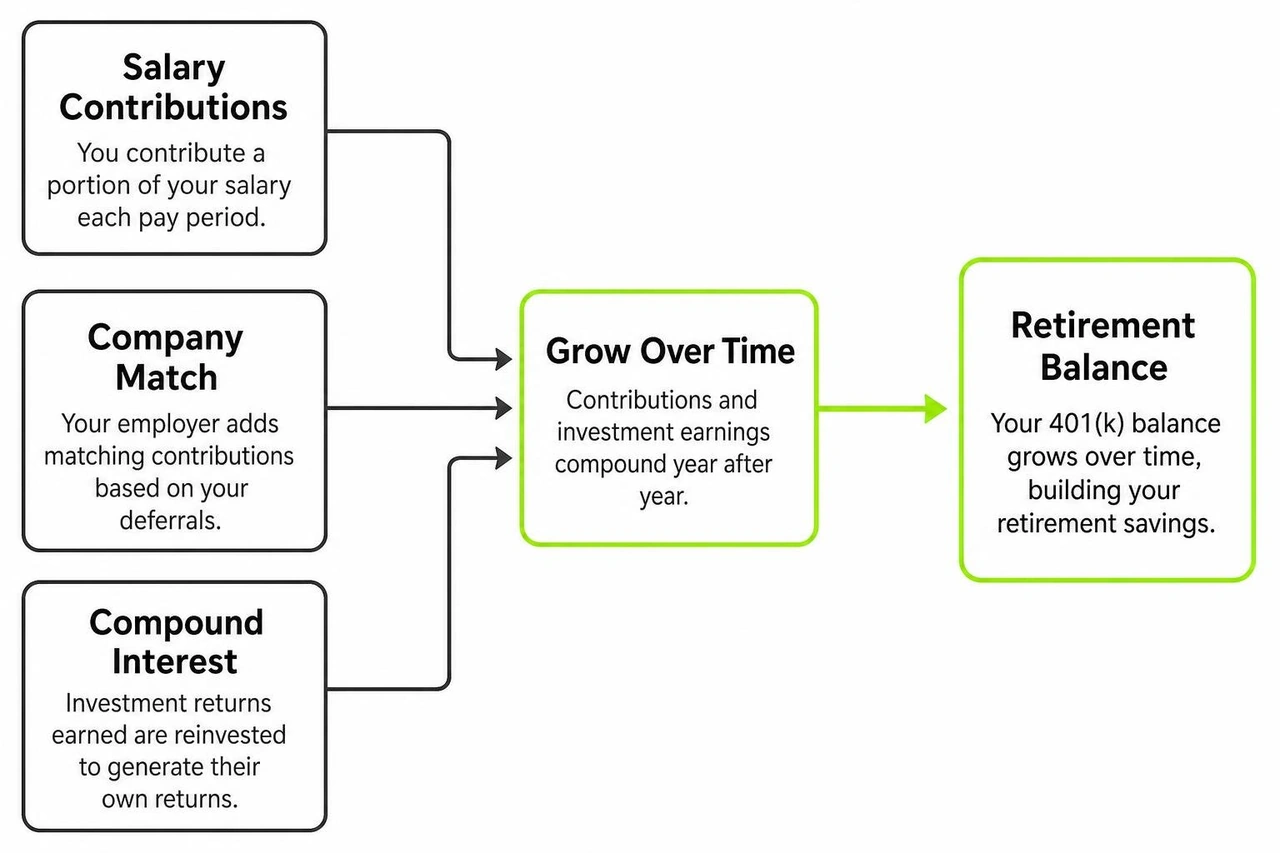
Core Inputs for an Accurate 401(k) Contribution Calculator Projection
To get realistic outputs, you need accurate inputs from your latest pay stub. A small tweak in your numbers today can shift your retirement date by several years.

Make sure you gather these fundamental details before running your numbers
- Current age and target retirement age to define your investment timeline.
- Current 401(k) account balance to set your compounding baseline.
- Annual gross salary and your pay frequency, whether biweekly, semi-monthly, or monthly.
- Desired employee contribution percentage or flat dollar amount per pay cycle.
- Employer matching formula, including match percentages and contribution caps.
- Expected annual salary increase rate, which accounts for natural wage growth over time.
- Estimated annual rate of investment return, typically modeled conservatively between 6% and 8% net of fees.
Traditional vs Roth 401(k) Calculations
When you run a calculation, choosing between traditional and Roth contributions shifts when you experience tax benefits. Traditional contributions are pre-tax, meaning they lower your taxable income in the year you make them. Your balance enjoys tax-deferred accumulation, but every dollar withdrawn in retirement is taxed as ordinary income.
Roth contributions use after-tax dollars. You pay income taxes upfront today, but your qualified distributions in retirement are 100% tax-free. When modeling these paths, compare your current marginal tax bracket against your expected tax rate during retirement. You should also look at analyzing whether your 401(k) contributions reduce MAGI to understand how traditional deductions might preserve other valuable tax deductions and credits.
| Feature | Traditional 401(k) | Roth 401(k) |
|---|---|---|
| Upfront Tax Deduction | Yes, lowers taxable wages now | No, funded with take-home pay |
| Investment Growth | Tax-deferred | Tax-free |
| Qualified Withdrawals | Taxed as ordinary income | Completely tax-free |
| Take-Home Pay Impact | Lower reduction due to immediate tax savings | Dollar-for-dollar reduction |
| RMD Treatment | Mandatory distributions apply | No RMDs during owner lifetime |
Factoring Employer Matching, Vesting, and Profit Sharing into Your Projections
Company matches are the closest thing to free money you will encounter in personal finance. A survey has shown that 43% of employees would prefer to take a pay cut for a higher employer contribution to their 401(k)s rather than the reverse. When you factor an employer match into a calculation, your wealth trajectory accelerates because every matched dollar begins compounding alongside your personal savings immediately.
How to Optimize Your Match with a 401 Contribution Calculator
Leaving match dollars behind is essentially refusing an instant wage increase. Consider a standard corporate match formula where an employer offers 50% on employee contributions up to 6% of pay. For a worker earning $75,000 annually who contributes 6% ($4,500), the employer deposits an extra $2,250 every year. That is an immediate 50% return on invested funds before any market appreciation occurs.
You can run your specific compensation numbers through a customized 401(k) employer match calculator to verify that your payroll elections capture every available dollar. For a complete strategic breakdown of match structures, check our 2026 employer match strategy guide.
Impact of Vesting Schedules and Discretionary Profit Sharing
Not all employer contributions belong to you right away. While 100% of your personal salary deferrals are always fully vested, employer matching and profit-sharing allocations often follow a vesting schedule.
- Cliff vesting requires you to work a specific period, such as two or three years, before gaining 100% ownership of company contributions. Leaving early means forfeiting the entire balance.
- Graded vesting releases ownership in increments, such as 20% per year over five years.
If your company offers discretionary year-end profit sharing, you can evaluate your potential allocation using a profit-sharing calculator. Business owners looking to eliminate testing headaches and provide instant ownership can explore Safe Harbor 401(k) plan structures, which require immediate vesting on mandatory company contributions.
Navigating 2026 IRS Contribution Limits and SECURE 2.0 Catch-Up Rules
The IRS periodically updates retirement plan caps for inflation, and keeping track of these figures ensures you avoid tax penalties.
Staying within legal thresholds while aiming for maximum funding requires knowing the latest statutory boundaries.
Elective Deferrals, Total Additions, and Annual Compensation Caps
For 2026, the employee elective deferral limit is $24,500 for traditional and Roth accounts combined. The overall additions cap, which includes your employee deferrals, employer matching, and discretionary profit-sharing contributions, is $72,000. Additionally, the IRS caps eligible compensation considered for retirement calculations at $360,000 in 2026. Reviewing our 2026 retirement contribution guide will help you monitor these thresholds throughout the tax year.
Catch-Up Contributions for Ages 50+ and Super Catch-Up for 60 to 63
The SECURE 2.0 Act introduced provisions for workers approaching retirement. Standard catch-up rules allow individuals aged 50 and older to contribute an extra $8,000 above the regular cap, bringing their total 2026 elective deferral limit to $32,500. You can review strategies for maximizing 401(k) over 50 catch-up opportunities to bridge any savings gaps.
Workers aged 60, 61, 62, and 63 qualify for a higher super catch-up limit of $11,250 in 2026, lifting their elective deferral limit to $35,750. That under SECURE 2.0 guidelines, high-wage earners above certain income thresholds must designate their catch-up contributions as Roth after-tax dollars.
How 401(k) Deductions Affect Take-Home Pay, Taxes, and Early Withdrawals
Many employees hesitate to increase their savings because they fear a major hit to their lifestyle. However, pre-tax contributions soften the blow on your wallet.

Pre-Tax Taxable Income Reductions vs The FICA Tax Reality
When you save in a traditional 401(k), every dollar contributed bypasses federal and state income tax withholding for that pay period. For an individual in a combined 28% marginal tax bracket, every $1 set aside in a pre-tax account effectively costs only $0.72 in lost take-home cash. On a $75,000 salary paid biweekly, setting aside $488 pre-tax reduces take-home pay by roughly $350. The missing $138 represents tax money you kept in your account rather than sending to the government.
To test your specific wages, use a pre-tax deduction calculator for 401(k), HSA, and FSA contributions.
A critical detail that surprise savers is that 401(k) contributions do not avoid FICA taxes. You still pay the standard 7.65% for Social Security and Medicare on your full gross earnings. Only Section 125 cafeteria plans, like Health Savings Accounts and Flexible Spending Accounts, provide complete FICA exemption.
The Real Cost of Early Withdrawals and RMD Penalties
Pulling money out of your account before retirement carries severe consequences. If you take a non-qualified distribution before age 59½, you will face ordinary income tax plus an immediate 10% federal early withdrawal penalty, along with applicable state penalties. More importantly, draining funds permanently wipes out the future compound growth that balance would have produced.
On the other end of the timeline, failing to take Required Minimum Distributions (RMDs) starting at age 73 triggers a federal excise penalty equal to 50% of the amount you failed to withdraw on time.
Frequently Asked Questions About 401(k) Retirement Calculators
How does increasing my contribution rate change my take-home pay?
Because traditional contributions reduce your gross taxable wages, your net take-home pay decreases by less than the full contribution amount. If you earn $75,000 and increase your biweekly pre-tax contribution by $100, your paycheck might only drop by $72 to $78 depending on your state and federal tax brackets.
Does contributing to a 401(k) lower my FICA taxes?
No. Traditional and Roth 401(k) contributions reduce federal and state income taxes, but they remain subject to Social Security and Medicare taxes.
What is the maximum total 401(k) contribution allowed in 2026?
For 2026, the employee elective deferral cap is $24,500. The combined limit for employee deferrals, employer matches, and profit-sharing allocations is $72,000. Individuals 50 and older can defer up to $32,500, while those aged 60 to 63 can defer up to $35,750 under the super catch-up provisions.
Conclusion
Building long-term wealth does not require complex financial gymnastics. By using a retirement calculator to map your contributions, capturing every dollar of employer match, and leveraging current IRS limits, you can construct a predictable roadmap to financial freedom.
At Core Group, we help entrepreneurs and creative professionals manage their cash flow, bookkeeping, and tax strategies using a clear, profit-first playbook that delivers total peace of mind. To ensure your savings strategy coordinates smoothly with your broader tax goals, explore how 401(k) contributions impact your modified adjusted gross income and start optimizing your financial future today.