All About 401(k) Catch-Up Contribution Limits for 2025 Over 60
Breakdown of 401k Contribution Limits Over 60 for 2026 and 2025
Navigating retirement rules can feel like trying to assemble furniture without the instruction booklet. Fortunately, current IRS guidelines for 2026 and recent 2025 figures offer remarkable opportunities for workers entering their sixties. When we look at 401k contribution limits 2025 over 60 alongside active 2026 rules, understanding how different buckets of money work together helps you squeeze every bit of value out of your retirement plan.
The Internal Revenue Service establishes annual limits to govern how much money employees can save on a tax-favored basis. These limits are divided into individual salary deferrals, age-based catch-up contributions, and overall plan addition limits that combine both worker and business contributions.
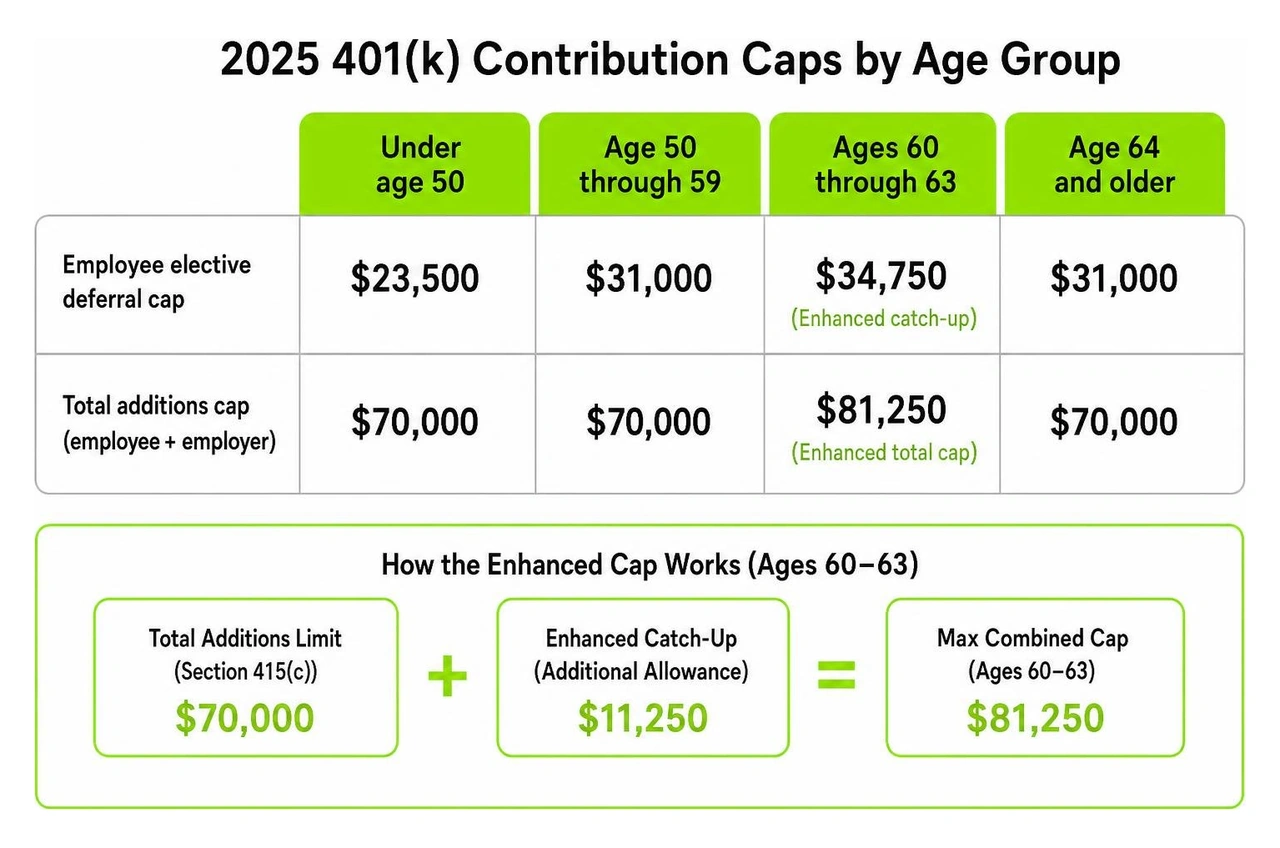
To keep everything clear, we can break down the numbers established in the Official IRS notice on 2025 plan limits and updated 2026 figures.
| Age group and contribution category | 2025 Annual Limit | 2026 Annual Limit |
|---|---|---|
| Under age 50 elective deferral cap | $23,500 | $24,500 |
| Age 50 through 59 elective deferral cap | $31,000 | $32,500 |
| Ages 60 through 63 elective deferral cap | $34,750 | $35,750 |
| Age 64 and older elective deferral cap | $31,000 | $32,500 |
| Total addition cap under age 50 (employee plus employer) | $70,000 | $72,000 |
| Total addition cap ages 60 through 63 (employee plus employer) | $81,250 | $83,250 |
Base Elective Deferrals and Standard Catch Up Contributions
The base level for employee elective deferrals stands at $24,500 in 2026, up from $23,500 in 2025. This is the maximum amount of money an employee under age 50 can contribute from their compensation into a traditional or Roth 401(k) account during the calendar year.
Once a worker reaches age 50, the tax code grants access to standard catch-up contributions. For 2026, the standard catch-up allowance increases to $8,000, compared to $7,500 in 2025. This brings the total allowable employee contribution for individuals aged 50 through 59 to $32,500 in 2026.
A key aspect of this rule is the calendar year milestone. You do not need to wait until your 50th birthday party to start saving at the higher rate. If you turn 50 on or before December 31 of the tax year, you are eligible to make the full standard catch-up contribution starting January 1 of that same year.
This rule creates a great runway for older employees who want to boost their savings rate as they get closer to retirement. You can also explore our guide on 2026 maximum 401k contribution over 50 to plan ahead for ongoing adjustments.
Standard Catch Up Rules and 401k Contribution Limits 2025 Over 60
For most older workers, standard catch-up contributions serve as the default mechanism for tax-advantaged saving. However, the introduction of special rules for specific age brackets makes reviewing 401k contribution limits 2025 over 60 and current 2026 options worth your time.
When evaluating your overall 401(k) plan, you must distinguish between your personal salary deferrals and the combined plan additions ceiling. Under Section 415(c) of the Internal Revenue Code, the total limit for all additions to a participant account is $72,000 in 2026 ($70,000 in 2025). Total additions include employee elective deferrals, employer matching dollars, and employer profit-sharing contributions.
Catch-up contributions sit on top of the Section 415(c) limit. That means a worker between ages 60 and 63 who contributes the full super catch-up amount can potentially receive maximum employer additions, leading to an overall total of $83,250 entering their account in 2026 ($81,250 in 2025).
The SECURE 2.0 Super Catch Up Rule for Ages 60 to 63
The SECURE 2.0 Act brought substantial updates to American retirement policy, with one of its most exciting features targeted directly at workers in their early sixties. Known colloquially as the super catch-up provision, this rule provides an elevated deferral tier designed to help individuals make a final surge toward their retirement goals.
As highlighted in the IRS announcement on 2025 retirement updates, Congress authorized a higher catch-up threshold equal to the greater of $10,000 or 150 percent of the standard catch-up limit for 2024, indexed for inflation. For tax years 2025 and 2026, that calculation sets the super catch-up amount at $11,250.
Who Qualifies and How Plan Adoption Works
Eligibility for the super catch-up rule is strictly tied to a four-year age window. To use the $11,250 enhanced catch-up limit, you must attain age 60, 61, 62, or 63 during the calendar year.
The calendar year rule works in both directions. If you turn 60 on December 31, you are eligible for the $11,250 super catch-up allowance for that entire tax year. On the flip side, if you turn 64 on December 31, you are no longer in the eligible window for that tax year and drop back down to the standard catch-up limit.
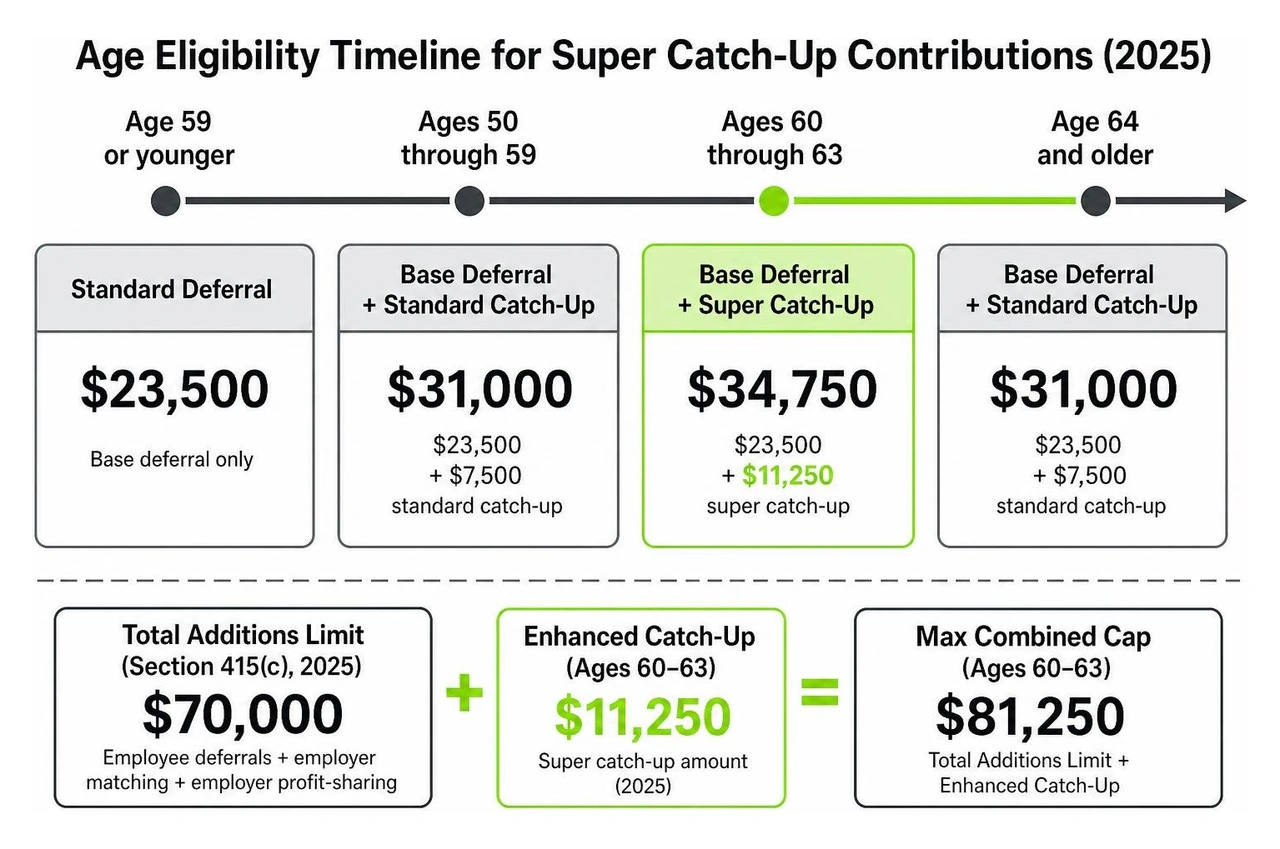
Another crucial point to keep in mind is that plan adoption by your employer is strictly voluntary. Employers are not legally forced to update their workplace 401(k) plans to accommodate the super catch-up provision. If an employer chooses not to adopt the higher limit, participants in that plan remain restricted to the standard catch-up ceiling regardless of their age.
For creative business owners running their own firms, adopting these expanded provisions inside a corporate plan or Solo 401(k) can provide significant tax relief while building business wealth. Understanding your company matching framework is equally valuable, which you can read about in our breakdown of the 401k company match limit.
High Earner Roth Catch Up Rules and Thresholds
When Congress created the SECURE 2.0 Act, it included a rule designed to offset the revenue impact of higher catch-up limits. This rule mandates that high earners must make all catch-up contributions into a Roth account using post-tax dollars rather than pre-tax dollars.
Under the original statute, high earners were defined as employees whose prior-year Medicare wages exceeded $145,000 from the employer sponsoring the plan. However, due to administrative challenges faced by plan providers and payroll software systems, the IRS issued administrative relief delaying mandatory implementation.
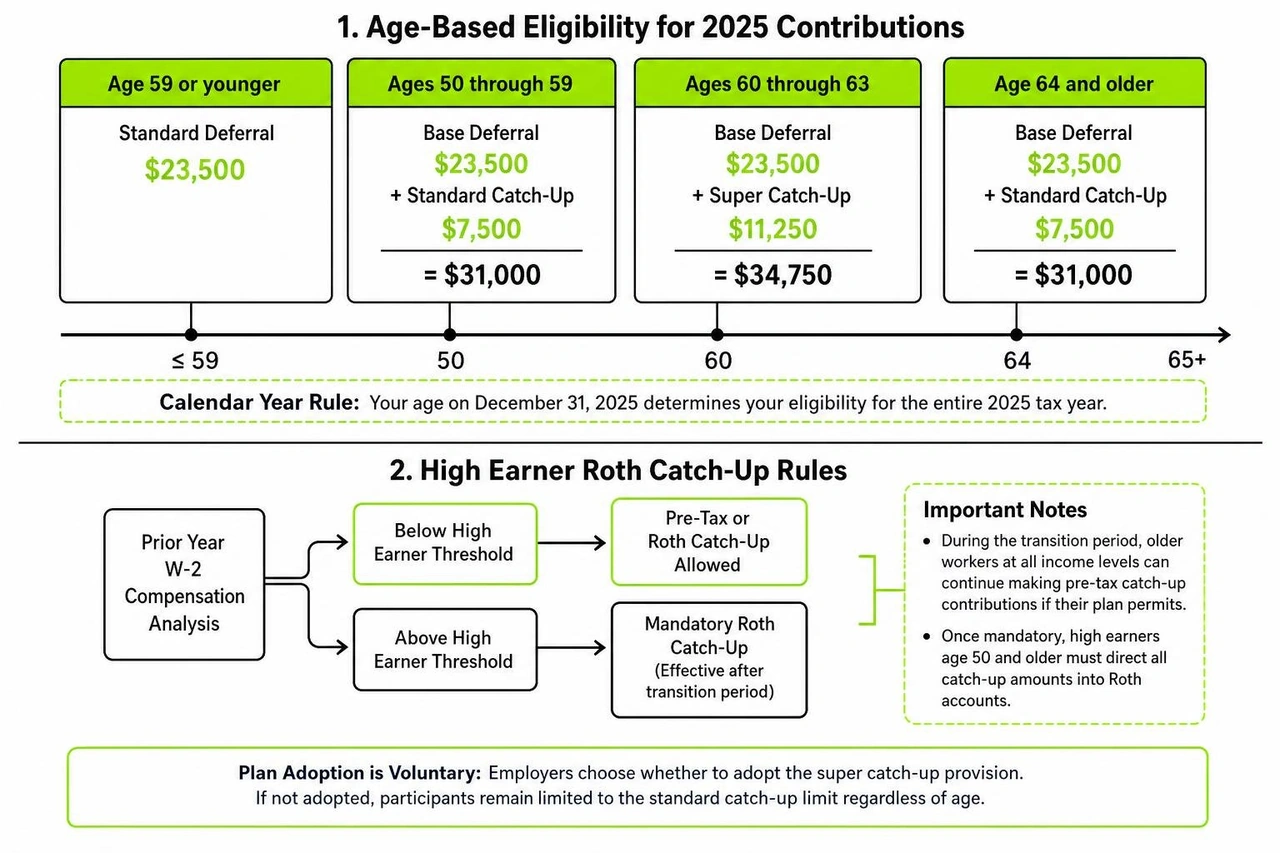
During transition periods, older workers at all income levels can continue making pre-tax catch-up contributions if their plan permits. Once the mandatory rule takes full effect, high-earning workers age 50 and older will need to direct all catch-up amounts into Roth accounts.
For creative entrepreneurs and high-income professionals, utilizing Roth options creates beneficial tax diversification in retirement. To explore more about non-pretax savings strategies, check out our guide covering 401k after tax contribution options.
Comparing 2025 and 2026 Contribution Limits for Older Savers
Retirement strategy is never static. Cost-of-living adjustments calculated by the IRS update the parameters almost every single year. Comparing 401k contribution limits 2025 over 60 with current figures for 2026 helps you plan long-term payroll adjustments without surprise bumps along the way.

For 2026, the basic elective deferral cap rises to $24,500, up $1,000 from the 2025 cap of $23,500. Standard catch-up contributions for individuals aged 50 and older also experience an increase, moving from $7,500 in 2025 up to $8,000 in 2026.
Interestingly, the super catch-up limit for ages 60 through 63 remains fixed at $11,250 for 2026. Because the base deferral increases while the super catch-up stays stable, total personal savings capacity for workers aged 60 through 63 moves from $34,750 in 2025 to $35,750 in 2026.
| Contribution parameter | Tax Year 2025 | Tax Year 2026 |
|---|---|---|
| Base Elective Deferral Cap | $23,500 | $24,500 |
| Standard Catch-Up (Age 50+) | $7,500 | $8,000 |
| Super Catch-Up (Ages 60-63) | $11,250 | $11,250 |
| Total Deferral (Ages 50-59) | $31,000 | $32,500 |
| Total Deferral (Ages 60-63) | $34,750 | $35,750 |
| Total Section 415(c) Plan Addition Limit | $70,000 | $72,000 |
| Max Aggregate Limit (Ages 60-63 with Employer Match) | $81,250 | $83,250 |
For a complete look at statutory figures, refer to our dedicated overview of the 401k maximum contribution 2026.
How to Maximize 401k Contribution Limits 2025 Over 60 and Beyond
Hitting the maximum limit requires intentional execution, especially when handling business cash flow or uneven salary payments. Here are practical steps to make sure you capture every dollar allowed by law.
- Review your current pay stub to calculate your active percentage deferral rate.
- Adjust payroll withholdings early in the tax year to spread deferrals evenly across paychecks.
- Enable automatic contribution escalation features offered by your plan recordkeeper.
- Confirm with your human resources department that your plan document supports super catch-up contributions for ages 60 through 63.
- Coordinate deferrals across multiple employers if you changed jobs during the tax year.
If you happen to hold two jobs or run a separate business on the side, individual elective deferral caps apply to you personally rather than per plan. Summing up deferrals across all 401(k), 403(b), and SIMPLE accounts in a single calendar year prevents overcontribution headaches down the road.
To stay on top of broader regulatory shifts affecting workplace retirement accounts, take a look at our article discussing 401k changes 2026.
Frequently Asked Questions About 401k Contribution Limits
Do all employer 401k plans offer the super catch up contribution for ages 60 to 63
No, workplace plans are not required to offer the super catch-up contribution. The provisions introduced under the SECURE 2.0 Act are voluntary for plan sponsors.
An employer must explicitly update its official plan documents to permit participants aged 60 through 63 to defer the elevated $11,250 amount. If your employer has not updated its plan terms, your catch-up contribution ceiling remains capped at the standard level ($8,000 in 2026 or $7,500 in 2025), even if you fall squarely into the eligible age range.
We always recommend contacting your plan administrator or human resources team to verify whether your specific workplace plan includes the super catch-up feature.
What is the total maximum contribution from both employee and employer for ages 60 to 63
For an employee aged 60 through 63 whose plan permits super catch-up contributions, the absolute theoretical maximum total contribution is $83,250 in 2026 ($81,250 in 2025).
This total is calculated by combining two distinct figures. First is the statutory Section 415(c) defined contribution additions limit ($72,000 in 2026), which includes base employee elective deferrals plus all employer matching dollars and employer profit-sharing contributions. Second is the $11,250 super catch-up contribution, which sits above the Section 415(c) limit.
To reach this ultimate cap, an employer profit-sharing contribution must bridge the gap between your personal salary deferrals and the plan ceiling.
What happens if an employee overcontributes across multiple 401k plans
If you contribute more than the allowable IRS elective deferral limit across multiple accounts in a single tax year, you generate an excess deferral. The base cap applies to you as an individual, regardless of how many different employers you work for during the year.
When an overcontribution occurs, you must notify one of your plan administrators and formally request a corrective distribution of the excess amount plus associated investment earnings. This request must be processed before the tax filing deadline, which is typically April 15 of the following year.
If you fail to correct the excess deferral before the deadline, the excess amount gets taxed twice. You pay income tax on the excess funds in the year contributed, and you pay income tax again when those dollars are eventually distributed from the plan in retirement.
Conclusion

Understanding 401k contribution limits 2025 over 60 alongside current 2026 guidelines empowers you to take complete ownership of your pre-retirement strategy. The window between ages 60 and 63 offers an unprecedented opportunity to move up to $35,750 in 2026 ($34,750 in 2025) in personal savings into a tax-advantaged account in a single year. When combined with employer match programs or business profit-sharing, older workers can significantly compress their wealth-building timeline.
At Core Group, we help creative entrepreneurs, agency owners, and business leaders build clarity around their finances. Through our no-fluff profit-first playbook, we eliminate administrative stress, optimize tax strategies, and ensure your business supports your personal financial future. Backed by our MacBook Pro guarantee, our team handles bookkeeping, payroll, and tax planning so you can stay focused on doing what you love.
To see how maximizing retirement contributions fits into your overall income tax picture, Learn how 401k contributions affect MAGI and tax strategy. Reach out to us today to streamline your financial management and secure complete peace of mind.