All About 401(k) Contribution Limits & Employer Match for 2026
2026 401(k) Contribution Limits and Employer Match
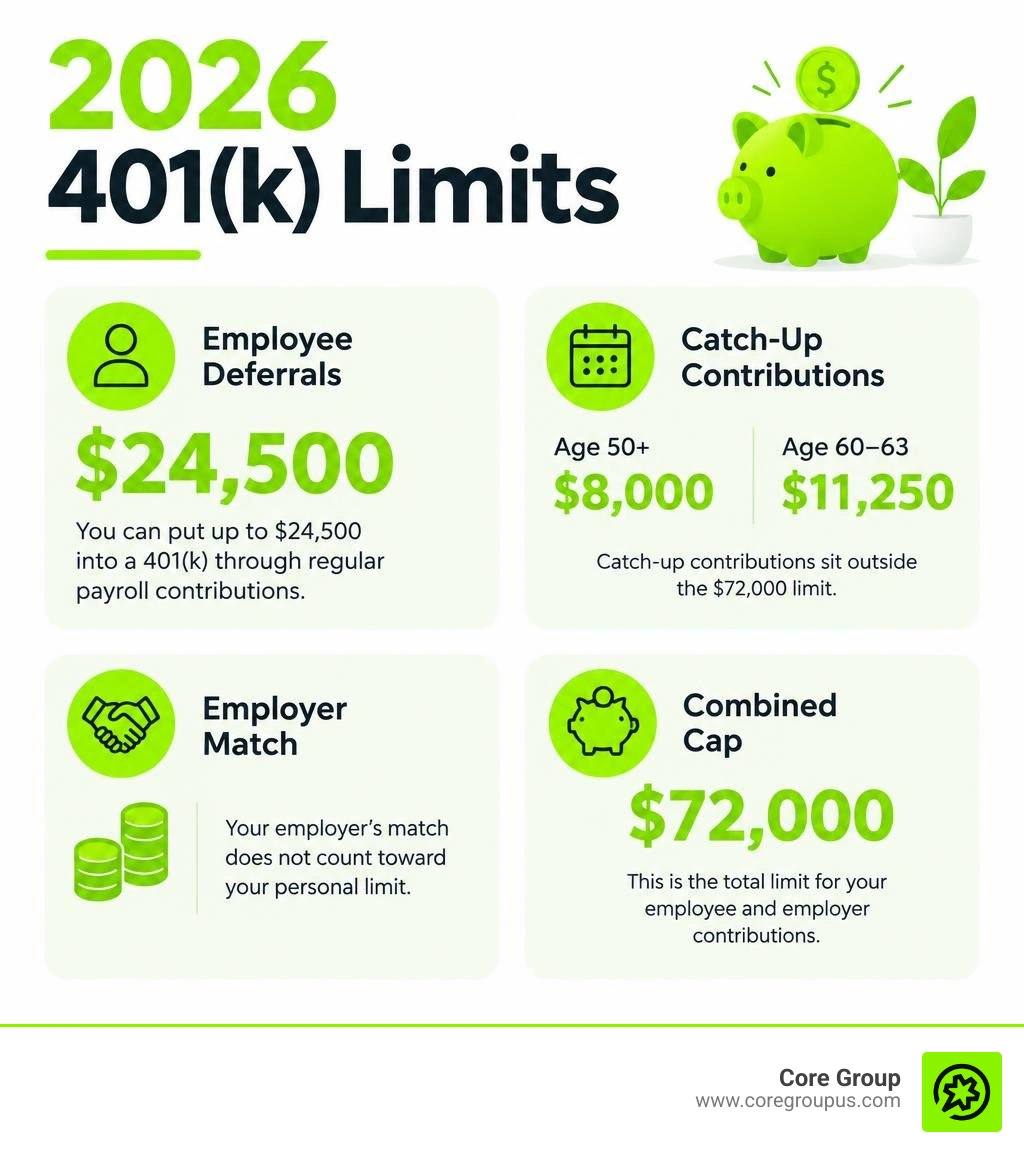
In 2026, you can put up to $24,500 into a 401(k) through regular payroll contributions. Your employer's match does not count toward that personal limit. It does count toward the $72,000 combined limit for employee and employer contributions. If you are 50 or older, you may be able to add a catch-up contribution of $8,000, or $11,250 if you are 60 to 63. Catch-up contributions sit outside the $72,000 limit.
The practical move is to check how much you must contribute to get your full match, then review your payroll settings before year-end. I'm Christian Brim, and I'll walk you through how the 2026 401(k) contribution limits and employer match rules work together with the plan provisions that can change what you actually receive.
To optimize your retirement strategy, you can calculate your potential savings with a 401k employer match calculator, explore the requirements for a safe harbor 401k, and review guidelines on the 401k maximum employer contribution.
Key 2026 Contribution Limits for Elective Deferrals and Catch-Up Provisions
Retirement plan caps adjust periodically to keep pace with inflation through IRS cost-of-living adjustments. Knowing the 401k maximum contribution 2026 guidelines helps you structure your savings early in the year so you capture every available tax benefit.
The official IRS retirement plan contribution limits distinguish between employee salary deferrals and the overarching annual additions limit governed by Internal Revenue Code Section 415(c).
| Category | 2025 Limit | 2026 Limit | Change |
|---|---|---|---|
| Employee Base Deferral (Under 50) | $23,500 | $24,500 | +$1,000 |
| Standard Catch-Up (Ages 50-59, 64+) | $7,500 | $8,000 | +$500 |
| Super Catch-Up (Ages 60-63) | $11,250 | $11,250 | $0 |
| Total Personal Deferral (Ages 50-59, 64+) | $31,000 | $32,500 | +$1,500 |
| Total Personal Deferral (Ages 60-63) | $34,750 | $35,750 | +$1,000 |
| Overall Section 415(c) Limit (All Sources) | $70,000 | $72,000 | +$2,000 |
| Annual Compensation Cap | $350,000 | $360,000 | +$10,000 |
Base Employee Deferrals vs. Section 415(c) Limits
Your base elective deferral is the portion of your salary that you choose to deposit into your plan directly from your paycheck. For 2026, that cap is $24,500 across pre-tax traditional and designated Roth 401(k) accounts.
Many people assume this $24,500 figure represents the absolute maximum amount that can enter their account in a calendar year. However, significant 401k changes 2026 apply to the total annual additions ceiling. The Section 415(c) total limit is $72,000. This broader cap encompasses your personal salary deferrals, employer matching dollars, non-elective profit-sharing contributions, and voluntary after-tax contributions.
Age 50+ Catch-Up and the SECURE 2.0 Super Catch-Up (Ages 60–63)
Savers approaching retirement have access to expanded deferral limits. The standard 401k over 50 catch up allowance is $8,000 for workers aged 50 to 59 and age 64 and older. This brings the personal contribution limit for these age groups to $32,500.
Under SECURE 2.0 legislation, a super catch-up tier is available for employees who reach ages 60, 61, 62, or 63 during the tax year. For eligible participants, the catch-up allowance reaches $11,250, setting the 2026 maximum 401k contribution over 50 for this bracket at $35,750. Once you turn 64, your catch-up ceiling reverts to the standard $8,000 amount. Catch-up contributions sit on top of the $72,000 annual additions ceiling, which pushes the absolute maximum 401(k) funding cap to $80,000 for workers 50 to 59 and $83,250 for those aged 60 to 63.
Mandatory Roth Catch-Up Rules for High Earners
A major operational shift taking effect requires plan sponsors and high earners to coordinate closely on catch-up contributions. If an employee earned more than $150,000 in Social Security FICA wages from the plan sponsor in the preceding calendar year (2025), all catch-up contributions in 2026 must be deposited into a designated Roth account using after-tax dollars.
This rule applies to both standard catch-up contributions and the enhanced tier for ages 60 to 63. High earners can still choose pre-tax or Roth treatment for their baseline $24,500 deferral, but any dollar above that threshold must be directed to a Roth sub-account. If a business does not offer a Roth feature within its retirement plan, high earners at that company are barred by statutory rules from making catch-up contributions altogether.
Understanding 2026 401(k) Contribution Limits and Employer Match Rules
Company matches serve as one of the most effective incentives to build wealth, functioning as immediate compensation beyond your base pay. Navigating our 401k employer match guide 2026 helps clarify how your workplace plan calculates its matching formula without exceeding statutory boundaries.

How the Combined Cap Works for Employee and Employer Contributions
Employer contributions do not reduce your personal $24,500 elective deferral room. Instead, company matches, profit-sharing deposits, and safe harbor allocations fill the remaining gap between your elective deferrals and the $72,000 total annual additions cap under Section 415(c).
If you are 42 years old and contribute your maximum base deferral of $24,500, your employer can contribute up to $47,500 through matching and profit-sharing allocations before triggering the 401k company match limit. This structure gives business owners and generous employers immense flexibility to reward key team members while taking a corporate tax deduction.
Common Match Formulas and the $360,000 Compensation Cap
Workplace matching formulas vary across industries, but most follow standardized designs.
- 50% up to 6% means the company contributes 50 cents for every dollar you defer, up to 6% of your gross pay. Contributing 6% yields a 3% employer match.
- 100% up to 3% plus 50% on the next 2% is the standard basic match under a safe harbor 401k complete guide, providing a maximum 4% match when you defer 5% of pay.
- 100% up to 4% or 6% represents enhanced formulas that offer a dollar-for-dollar match on your savings.
Under Internal Revenue Code Section 401(a)(17), compensation used to calculate retirement contributions is capped at $360,000 for 2026. If an executive earns $500,000 per year at a firm offering a dollar-for-dollar match up to 4%, the plan calculates the match only against the first $360,000 of earnings, producing a maximum employer match of $14,400.
True-Up Provisions and Vesting Schedules
When employees front-load their 401(k) contributions by maxing out early in the calendar year, they risk missing out on matching funds. If your plan calculates matching on a per-paycheck basis without an annual true-up provision, payroll will halt contributions and matching as soon as you hit the $24,500 limit. If that happens in August, you receive zero match for the remaining months of the year.
A true-up provision instructs the plan administrator to conduct a year-end audit, calculating your total annual salary against the full match formula and depositing the difference. Reviewing your plan summary ensures your matching dollars remain intact regardless of contribution timing.
Vesting schedules determine when you legally own your employer's contributions.
- Immediate Vesting means you own 100% of company contributions immediately upon deposit.
- Cliff Vesting means you own 0% of matched funds until completing a fixed period of service, such as 100% vesting after three years.
- Graded Vesting means ownership phases in incrementally, commonly increasing by 20% each year until full ownership is reached after five or six years.
Advanced Strategies for After-Tax Deferrals and the Mega Backdoor Roth
For high-earning creatives and business leaders who have already maxed out their base elective deferrals, voluntary after-tax contributions provide a practical mechanism to access the full $72,000 annual additions limit.

Maximizing Your Savings Under 2026 Contribution Limits and Employer Match Rules
Voluntary after-tax contributions differ from designated Roth deferrals. While Roth deferrals are capped within the $24,500 baseline limit, after-tax contributions are designed to fill the remaining space up to the 401k max per year Section 415(c) ceiling.
If an employee under age 50 defers $24,500 and receives an employer match of $10,500, total deposits reach $35,000. If the plan permits, the employee can contribute an additional $37,000 in voluntary 401k after tax contribution funds to hit the $72,000 cap.
In-Plan Roth Conversions and Rollovers
Leaving after-tax contributions in a standard account creates a tax liability because growth on those contributions is taxed as ordinary income upon withdrawal. To avoid this outcome, savers execute a mega backdoor Roth by converting after-tax funds immediately into a designated Roth 401(k) or rolling them out into a Roth IRA.
Executing conversions systematically ensures investment gains occur within a Roth shelter where qualified withdrawals are completely tax-free. Many modern plan providers allow automated in-plan conversions, processing each conversion on the same day the payroll contribution posts.
Plan Comparisons and Year-End Compliance Checks
Evaluating your company 401(k) alongside other common accounts ensures your comprehensive financial foundation remains balanced and compliant.
| Plan Type | 2026 Base Limit | Catch-Up Limit (Age 50+) | Super Catch-Up (60-63) | Combined Total Limit |
|---|---|---|---|---|
| 401(k) Plan | $24,500 | $8,000 | $11,250 | $72,000 |
| 403(b) Plan | $24,500 | $8,000 | $11,250 | $72,000 |
| 457(b) Governmental | $24,500 | $8,000 | $11,250 | $24,500 (Base) |
| Traditional / Roth IRA | $7,500 | $1,000 | N/A | $7,500 |
Comparing 401(k) Limits with 403(b), 457(b), and IRAs
A detailed 401k ira contribution guide 2026 highlights how different accounts interact. Elective deferral limits under Section 402(g) are aggregated across 401(k) and 403(b) plans, meaning you cannot contribute $24,500 to a 401(k) and another $24,500 to a 403(b) in the same calendar year.
Governmental 457(b) plans follow separate statutory rules under Section 457(e)(15). Public sector professionals can double their tax shelter by contributing $24,500 to a 403(b) or 401(k) and another $24,500 to a governmental 457(b).
Traditional pre-tax contributions also serve as a planning tool to manage tax brackets, which is why business owners frequently ask, do 401k contributions reduce magi? Traditional deferrals lower both adjusted gross income and modified adjusted gross income, potentially preserving deductions and credits that phase out at higher income tiers.
Handling Excess Contributions and the April 15 Deadline
Exceeding the annual contribution limit creates a serious tax compliance issue. Excess deferrals often occur when an individual switches employers mid-year and the second payroll system does not account for earlier contributions.

When excess contributions occur, you must notify your plan administrator and request a corrective distribution of the excess principal and associated earnings before April 15 of the following year.
Failing to withdraw the excess by April 15 results in double taxation. The excess amount is taxed in the year contributed and then taxed a second time as ordinary income when finally distributed in retirement. Earnings generated on the excess amount are reported on Form 1099-R and taxed in the year they are distributed.
Year-End Action Checklist for Maximizing Employer Match
- Audit your year-to-date deferrals to confirm you are on track to capture your complete company match.
- Verify whether your retirement plan includes an annual true-up provision if you front-loaded your savings.
- Confirm that your payroll provider has implemented Roth catch-up logic if your 2025 FICA wages topped $150,000.
- Review your current compensation against the $360,000 cap to model upcoming profit-sharing and matching amounts.
- Check if your plan permits voluntary after-tax contributions and in-plan Roth conversions to utilize unused space under the $72,000 limit.
- Monitor nondiscrimination testing results if you are classified as a Highly Compensated Employee earning $160,000 or more.
Frequently Asked Questions About 2026 401(k) Rules
Can I contribute to both a 401(k) and an IRA in 2026?
Yes. 401(k) plans and IRAs operate under separate statutory limits. In 2026, you can contribute up to $24,500 to a 401(k) and up to $7,500 to an IRA, plus applicable catch-up amounts. Deductibility for traditional IRA contributions phases out if your income exceeds federal thresholds and you are covered by a workplace retirement plan.
Does employer matching count toward the $24,500 employee limit?
No. Employer matching contributions, profit-sharing distributions, and safe harbor allocations do not count against your personal $24,500 salary deferral limit. They count toward the total annual additions limit of $72,000 under Section 415(c).
What happens if I change jobs mid-year in 2026?
The $24,500 elective deferral limit applies to you as an individual, not per employer. If you switch jobs mid-year, you must track your contributions across both payroll systems. New employers will not automatically know your previous deferrals, making it your responsibility to prevent an excess contribution.
Conclusion
Understanding annual contribution ceilings and employer match formulas gives you the clarity needed to build long-term wealth while minimizing current tax exposure. At Core Group, our mission is to eliminate financial confusion for creative entrepreneurs and growing business owners through a no-fluff, profit-first playbook that delivers genuine peace of mind and saves valuable time.
Whether you need support auditing payroll configurations, designing safe harbor plan structures, or optimizing executive contributions, our team provides proactive financial management, bookkeeping, and tax guidance backed by our MacBook Pro guarantee. Take control of your retirement strategy and discover how 401(k) contributions impact your MAGI to keep your financial plan running smoothly all year long.