How to Calculate Your 401k Employer Match in 3 Steps
Calculate Your 401k Employer Match Quickly
A 401k employer match calculator helps you find the extra retirement money your employer will add when you contribute from each paycheck. In most cases, multiply the portion of your salary you contribute by your employer's match rate, up to the plan's stated limit.
| If your plan says | You contribute | Your employer adds |
|---|---|---|
| 50% match up to 6% of pay | 6% of pay | 3% of pay |
| 100% match up to 3% of pay | 3% of pay | 3% of pay |
| 100% of first 3%, then 50% of next 2% | 5% of pay | 4% of pay |
For example, someone earning $60,000 with a 50% match up to 6% receives up to $1,800 a year in employer contributions. Contribute less than 6%, and part of that match stays unclaimed.
This matters because the match is part of your total compensation, and it can compound for decades. More than 85% of plans serviced by Fidelity offer some type of employer contribution, yet an estimated 20% to 25% of eligible workers do not contribute enough to receive their full match.
I'm Christian Brim, and the next sections will help you turn your plan's match language into a clear contribution target.
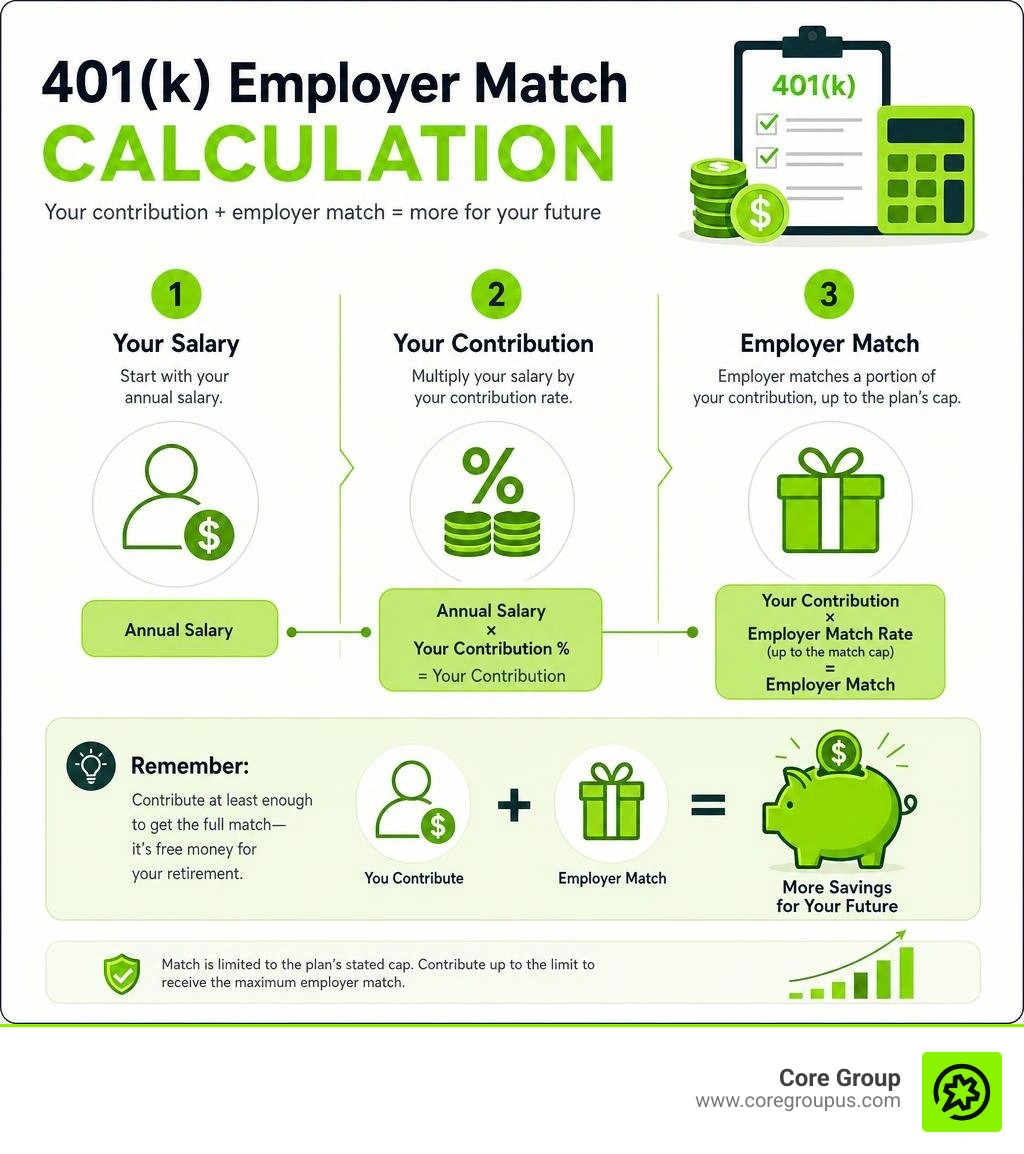
Key terms simplified
Understanding 401k Matching Formulas and Vesting
An employer match is essentially extra compensation deposited directly into your retirement account when you make pre-tax or Roth elective deferrals. Company contributions are structured to incentivize personal savings while giving businesses a tax-deductible way to reward employees. However, not every employer matching program uses the same rules.
To calculate your true matching dollars, you must understand how your plan defines its matching percentage, its cap on eligible salary, and the schedule that dictates when those company contributions become fully yours. Knowing your plan terms prevents you from leaving dollars behind and ensures you set your payroll deductions properly.
Tiered vs Simple Employer Matches
Employer matching formulas generally fall into two primary categories, simple matches and tiered matches.
A simple match applies a single percentage match rate up to a set portion of your salary. The single most common employer match formula in the United States is a 50% match on the first 6% of your salary. Under this setup, if you earn $80,000 and defer 6% ($4,800), your company contributes 3% ($2,400). Another straightforward setup is a dollar for dollar match up to 3% or 4% of compensation.
A tiered match split-levels the matching rate across different bands of your salary. A popular example is a 100% match on the first 3% of salary, followed by a 50% match on the next 2% of salary. To secure the maximum possible company match under this tiered structure, you must contribute at least 5% of your pay.
| Match Formula Type | Sample Plan Formula | Employee Deferral Needed | Employer Contribution |
|---|---|---|---|
| Simple Match (Partial) | 50% up to 6% of pay | 6% | 3.0% |
| Simple Match (Dollar for Dollar) | 100% up to 4% of pay | 4% | 4.0% |
| Tiered Match (Safe Harbor) | 100% on first 3%, 50% on next 2% | 5% | 4.0% |
| Generous Tiered Match | 100% on first 5%, 50% on next 2% | 7% | 6.0% |
When evaluating your plan, pay close attention to the 401k company match limit specified in your Summary Plan Description. The optimal contribution rate to unlock the full match is always the total of the salary cap percentages, not the sum of the match percentages.
Vesting Schedules and Keeping Your Money
While your own contributions belong to you instantly, employer matching dollars are subject to vesting schedules. A vesting schedule determines how much of the employer match you retain if you leave the company before reaching specific tenure milestones.
- Immediate Vesting. You own 100% of the matching contributions from day one. Plans operating under safe harbor 401k provisions generally require immediate vesting.
- Cliff Vesting. You own 0% of the matching funds until you hit a specific service threshold, such as three years of employment, at which point you jump directly to 100% ownership.
- Graded Vesting. Ownership increases incrementally over time. A standard six year graded schedule might vest 20% after year two, and add 20% each subsequent year until reaching 100% at six years.
If you change jobs or get laid off before becoming fully vested, unvested employer contributions return to the plan sponsor. Always verify your current vesting status before executing career transitions.
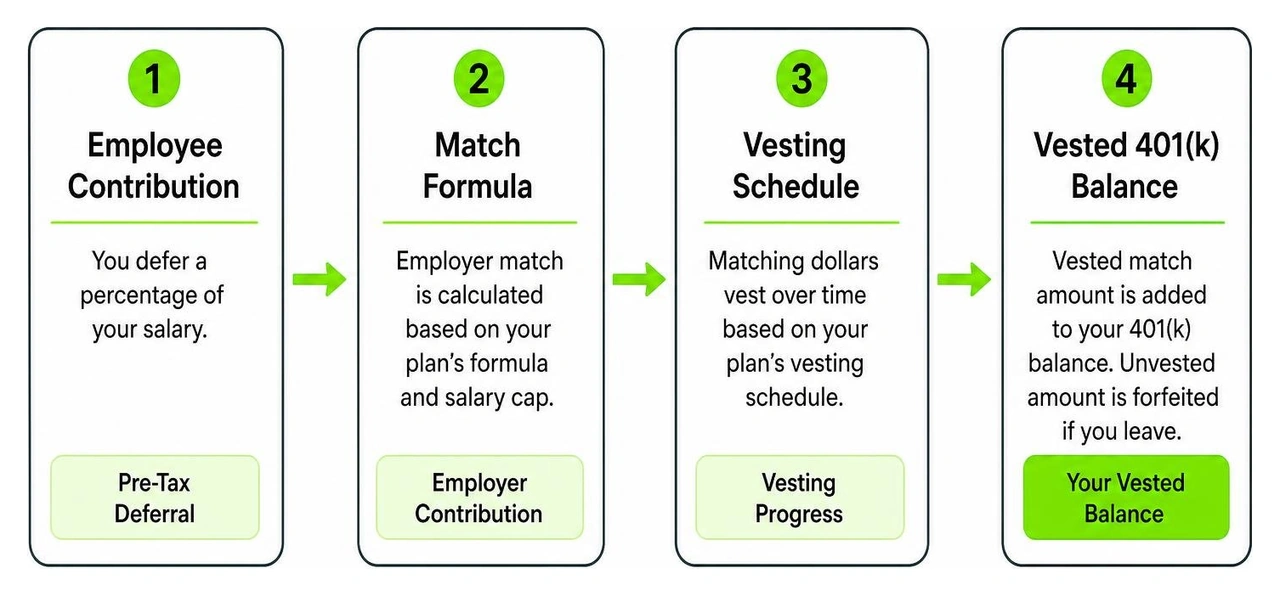
How to Use a 401k Employer Match Calculator in 3 Steps
Using a 401k employer match calculator takes the guesswork out of payroll deferrals. Instead of attempting manual math on variable paychecks, an online tool processes your salary, deferral rate, and plan formula to display your exact annual match dollars.
You can test different scenarios using an online 401(k) Employer Match Calculator or state-specific pay tools like the 2026 Alabama 401k Calculator - PaycheckCity to verify how tax withholding and matching align on your paycheck. Follow these three steps to run your calculation accurately.
Step 1 Input Salary and Formula into the 401k Employer Match Calculator
To begin, enter your gross annual pay into the calculator rather than your net take home pay. Employer matching formulas evaluate gross W-2 income prior to tax deductions.
Next, enter your company's matching rules. If your employer uses a simple match, input the match percentage and the salary cap percentage. If your company uses a tiered match, input both tier thresholds carefully. For instance, enter Tier 1 as 100% match up to 3%, and Tier 2 as 50% match up to 2%.
That IRS regulations limit the maximum salary eligible for 401k calculations. In 2026, the maximum compensation cap considered for matching is $360,000. If your salary exceeds this threshold, the calculator automatically caps eligible matching wages at $360,000.
Step 2 Calculate Your Optimal Contribution Rate
The primary objective of running a 401k employer match calculator is identifying your optimal contribution rate. This is the minimum payroll deferral percentage required to capture every dollar of available employer match.
If your calculator shows that your employer matches 50% up to 6% of pay, setting your deferral rate at 6% delivers an immediate 50% return on your invested capital. Lowering your deferral rate to 4% leaves 2% of potential salary match uncollected, forfeiting guaranteed compensation.
To make sure your calculations reflect actual payroll mechanics, you can cross-check your figures using tools like the 401(k) Contribution & Employer Match Calculator (Free) or the 401(k) Calculator with Employer Match - Free Tool | FinanceFlow.
Step 3 Project Long Term Wealth with a 401k Employer Match Calculator
The true value of an employer match is not just the immediate dollar amount added to your paycheck each year, but its long term compound growth over decades.
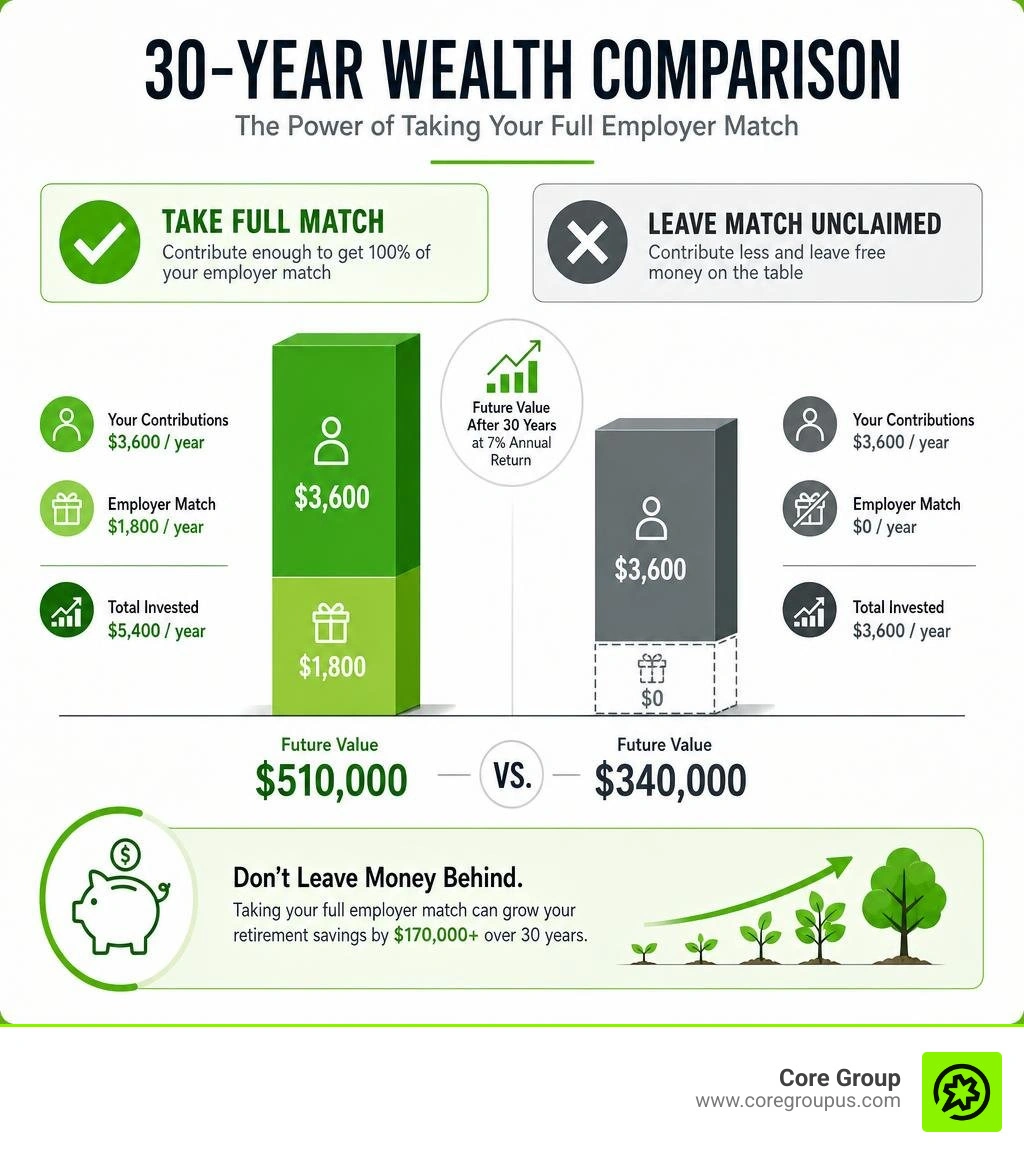
A annual employer match of $1,800, invested continuously at a conservative 7% average annual rate of return, grows to approximately $170,000 over 30 years. When combined with your personal 6% employee contributions of $3,600 per year on a $60,000 salary, your combined annual savings of $5,400 compounds into roughly $510,000 over the same 30 year window.
To explore how these figures scale across longer timelines, test your numbers on the 401(k) Calculator - Federated Hermes or the 401(k) Calculator.
2026 IRS Contribution Limits and Matching Rules
Planning your 401k contributions requires keeping up with IRS regulations. The IRS updates annual contribution caps to reflect inflation and adjustments from legislation such as the SECURE 2.0 Act.
It is important to remember that employee elective deferral limits apply only to the money you contribute from your salary. Employer matching contributions do not reduce your personal employee deferral ceiling. Check out the latest 401k changes 2026 to see how updated tax policies impact your long-term plan.
Employee Deferral Caps and Age Catch Up Provisions
For 2026, the standard employee elective deferral cap is $24,500 for workers under age 50. This represents the total limit you can defer across pre-tax and Roth 401k options during the calendar year.
Workers aged 50 and older can take advantage of catch up contribution provisions. Reviewing the rules for 2026 maximum 401k contribution over 50 helps older employees accelerate their retirement readiness.
- Under Age 50 Deferral Limit. $24,500
- Standard Catch Up Limit (Ages 50 to 59 and 64+). $8,000, allowing a total personal contribution of $32,500
- SECURE 2.0 Super Catch Up Limit (Ages 60 to 63). $11,250, boosting the total elective deferral ceiling to $35,750
You can evaluate state specific paycheck rules using tools like the 2026 Arizona 401k Calculator - PaycheckCity or the 2026 Connecticut 401k Calculator - PaycheckCity.
Total Combined Additions Cap
While employee salary deferrals are capped at $24,500 for those under 50, overall plan contributions are governed by Internal Revenue Code Section 415(c). This rule sets a broader ceiling on the total combined additions made to your account, including employee elective deferrals, employer matching contributions, and employer non-elective profit-sharing allocations.
In 2026, the total combined additions limit is $72,000 or 100% of employee compensation, whichever is less. For employees eligible for catch up contributions, the total ceiling increases accordingly to $80,000 for ages 50 to 59, and $83,250 for those aged 60 to 63.
You can model these comprehensive limits using the Free 2026 401(k) Calculator or the 401(k) Employer Match Calculator (2026) - Free & Tiered. For more details on overall caps, read our full guide on 401k maximum contribution 2026 and check your plan totals using the 401(k) Calculator with Employer Match 2026 | SmartRates.
Next Steps After Securing Your Full Match
Once you set your payroll deferral rate high enough to capture 100% of your employer match, you have unlocked the highest guaranteed return available in personal finance. The next question is where to direct your subsequent savings dollars.
Financial planners recommend following an investment priority ladder to optimize tax efficiency and flexibility.
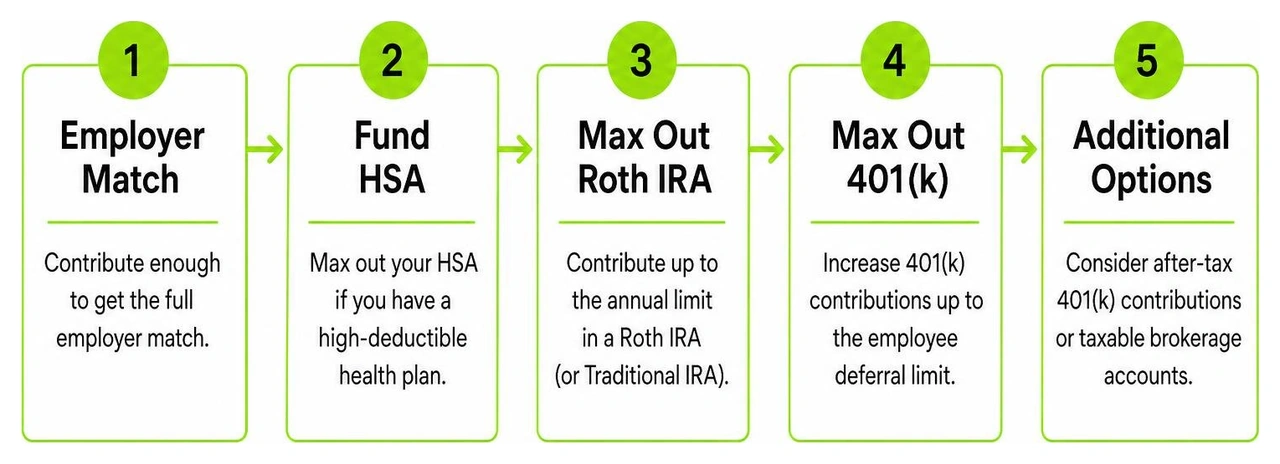
- Secure the Full Employer Match. Contribute enough to your 401k to claim every match dollar available.
- Fund a Health Savings Account (HSA). If you are enrolled in a high-deductible health plan, max out an HSA. HSAs offer a triple tax advantage, pre-tax contributions, tax-free growth, and tax-free withdrawals for qualified medical expenses.
- Max Out a Roth IRA or Traditional IRA. IRAs generally offer broader investment selections and lower expense ratios than workplace 401k plans.
- Return to Max Out Your 401k. Move toward the full $24,500 employee deferral cap in your 401k. Check 401k max per year for comprehensive strategies.
- Explore After-Tax 401k Contributions or Taxable Brokerage Accounts. High earners looking to save beyond standard caps can evaluate a 401k after tax contribution strategy to execute a mega backdoor Roth conversion.
If you are trying to balance workplace savings with outside investments, running numbers on regional tools like the 2026 Alaska 401k Calculator - PaycheckCity, 2026 Delaware 401k Calculator - PaycheckCity, or the 401k Savings Calculator | First Arkansas Bank & Trust can help clarify your net cash flow.
Frequently Asked Questions About 401k Matching
How much money do workers lose by missing the match
Roughly 20% to 25% of eligible employees do not contribute enough to claim their full company match. Passing up a 3% match on a $60,000 salary equals giving up $1,800 in direct compensation each year. Over a 30 year career, that unclaimed $1,800 annual match forfeits approximately $170,000 to $180,000 in potential compound growth assuming a 7% average return.
Do 401k contributions reduce MAGI
Yes, traditional pre-tax 401k contributions reduce your adjusted gross income (AGI) and modified adjusted gross income (MAGI) dollar for dollar. Lowering your MAGI can help you qualify for valuable tax credits, lower your federal tax bracket, and maintain eligibility for Roth IRA contributions. For a detailed breakdown of how retirement deferrals lower your taxable baseline, read do 401k contributions reduce magi.
How does an employer true up contribution work
A true up is an end-of-year employer contribution designed to make you whole if you missed out on matching dollars during the year. This often happens if you front-load your 401k contributions and hit the annual deferral cap early in the year.
If you max out your $24,500 limit by September, your salary deferral drops to 0% for the final three months. Without a true up provision, you lose the employer match for those remaining pay periods. A plan with a true up reconciles your annual contributions at year-end and deposits the missing match dollars into your account.
Conclusion
Calculating your 401k match and ensuring you claim every available dollar is one of the most effective steps you can take to secure your long-term financial future. By inputting your salary and matching formula into a 401k employer match calculator, setting your deferral rate at or above the full-match threshold, and taking advantage of 2026 IRS limits, you lay a rock-solid foundation for wealth accumulation.
At Core Group, we help creative entrepreneurs and business owners implement profit-first financial playbooks, navigate complex tax strategies, and streamline retirement planning. Whether you are evaluating workplace plan structures or working to manage your income tax exposure, aligning your retirement strategy with your overall business plan provides long-term clarity and financial peace.
For personalized guidance on optimizing your business tax strategy and managing retirement accounts alongside your income goals, explore our comprehensive guide on 401k and magi or reach out to our team today.