How to File 1099 for an LLC Without Penalties
Does an LLC Need a 1099 in 2026?
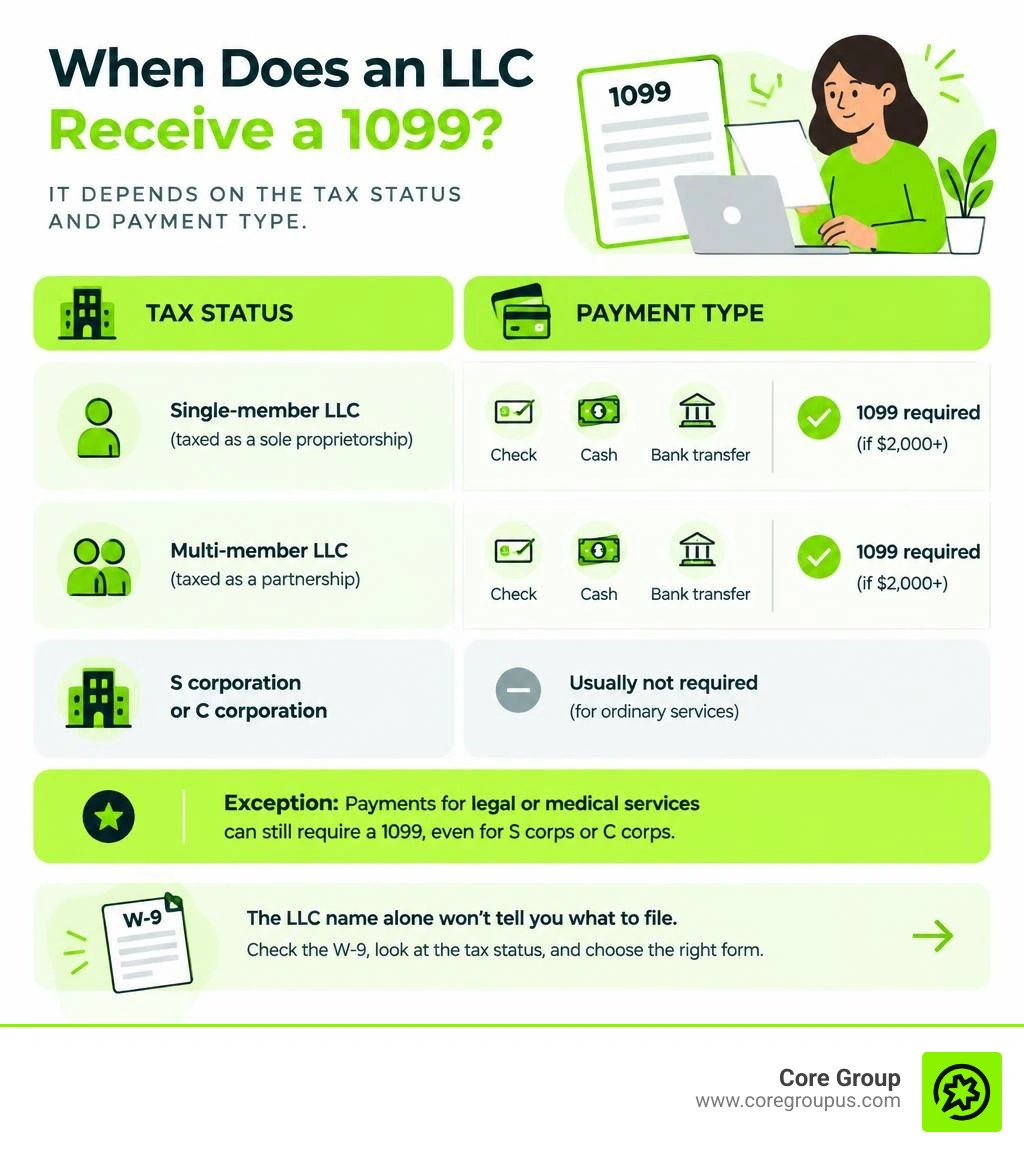
Sometimes. If you pay an LLC for services in your business, check its tax status on Form W-9. For payments made in 2026, you generally must file Form 1099-NEC if you pay a single-member LLC taxed as a sole proprietorship or a multi-member LLC taxed as a partnership $2,000 or more by check, cash, or direct bank transfer. LLCs taxed as S corporations or C corporations are usually exempt for ordinary services, but payments for legal or medical services can still require a 1099.
The LLC name alone won't tell you what to file. I'm Christian Brim, and I'll show you how to check the W-9, choose the right form, and avoid common filing mistakes.
Similar topics to does llc need 1099 include the LLC 1099 Compliance Guide, the LLC 1099 Income Guide, and the LLC 1099 Payment Guide.
When Does an LLC Need a 1099? Rules by Tax Classification
The letters LLC stand for limited liability company, which is a legal entity created under state law rather than a federal tax classification. The Internal Revenue Service views limited liability companies as chameleons. Depending on how many owners the company has and what elections it makes, the IRS may tax the company as a sole proprietorship, a general partnership, an S corporation, or a C corporation.
Because the IRS bases information reporting obligations on tax structure rather than state registration, you cannot rely on an entity name alone to determine whether a Form 1099 is necessary. When you hire an outside company, the primary document you must consult is Form W-9. Box 3 of this form reveals how the entity treats its earnings for federal tax purposes.
| LLC Tax Status | Form W-9 Classification | General 1099-NEC Requirement | Notable Exceptions |
|---|---|---|---|
| Single-Member LLC | Individual or Disregarded Entity | Required if paying $2,000 or more | Exempt if paid by credit card or third-party processor |
| Multi-Member LLC | Partnership | Required if paying $2,000 or more | Exempt if paid through payment settlement entities |
| S-Corp LLC | S Corporation | Exempt for ordinary services | Required for legal and health care services |
| C-Corp LLC | C Corporation | Exempt for ordinary services | Required for legal and medical payments |
Single-Member Entities and Disregarded Entity 1099 Rules
A single-member LLC with one individual owner defaults to being treated as a disregarded entity. The IRS ignores the corporate veil for income tax purposes and treats the business as a sole proprietorship. The business owner reports company earnings on Schedule C of their personal Form 1040.
If you make direct payments totaling $2,000 or more in 2026 to a disregarded entity for professional services, you must file a Form 1099-NEC. You can read our detailed breakdown on single-member LLC 1099 reporting to see how owner identification details should be reported properly on tax returns.
Corporate Classifications and 1099 Rules for S-Corp or C-Corp LLCs
An LLC can elect corporate tax treatment by filing Form 8832 for C corporation status or Form 2553 for S corporation status. Once approved, the IRS treats the business as an incorporated entity.
Payments made to corporate entities for standard professional services are generally exempt from information reporting. If an agency provides marketing or web development services and checks the S-Corp or C-Corp box on Form W-9, your business does not need to send them a Form 1099-NEC. Reviewing an individual, sole proprietor, or single-member LLC tax status helps clarify when these exemptions apply versus when you are working with an unincorporated vendor.
Multi-Member Partnerships and Corporate Exceptions
When an LLC has two or more members and does not elect corporate status, the IRS taxes it as a partnership by default. The business files Form 1065 to report its overall income and issues Schedule K-1 forms to its owners. Like sole proprietors, partnership LLCs must receive a Form 1099-NEC if you pay them $2,000 or more in nonemployee compensation during the year.
The general corporate exemption has critical carve-outs. Under federal tax law, payments made to attorneys and medical care providers must always be reported on an information return, even if the law firm or medical practice is organized as a C corporation or S corporation. You can confirm local reporting requirements through state 1099-NEC filing guidelines to remain compliant across different jurisdictions.

IRS 1099 Reporting Forms and the 2026 Threshold Updates
For payments made in 2026, the federal reporting threshold for nonemployee compensation increased from $600 to $2,000 under updated federal legislation. This higher figure cuts down on paperwork for small transactions while keeping significant service contracts fully transparent for tax reporting.
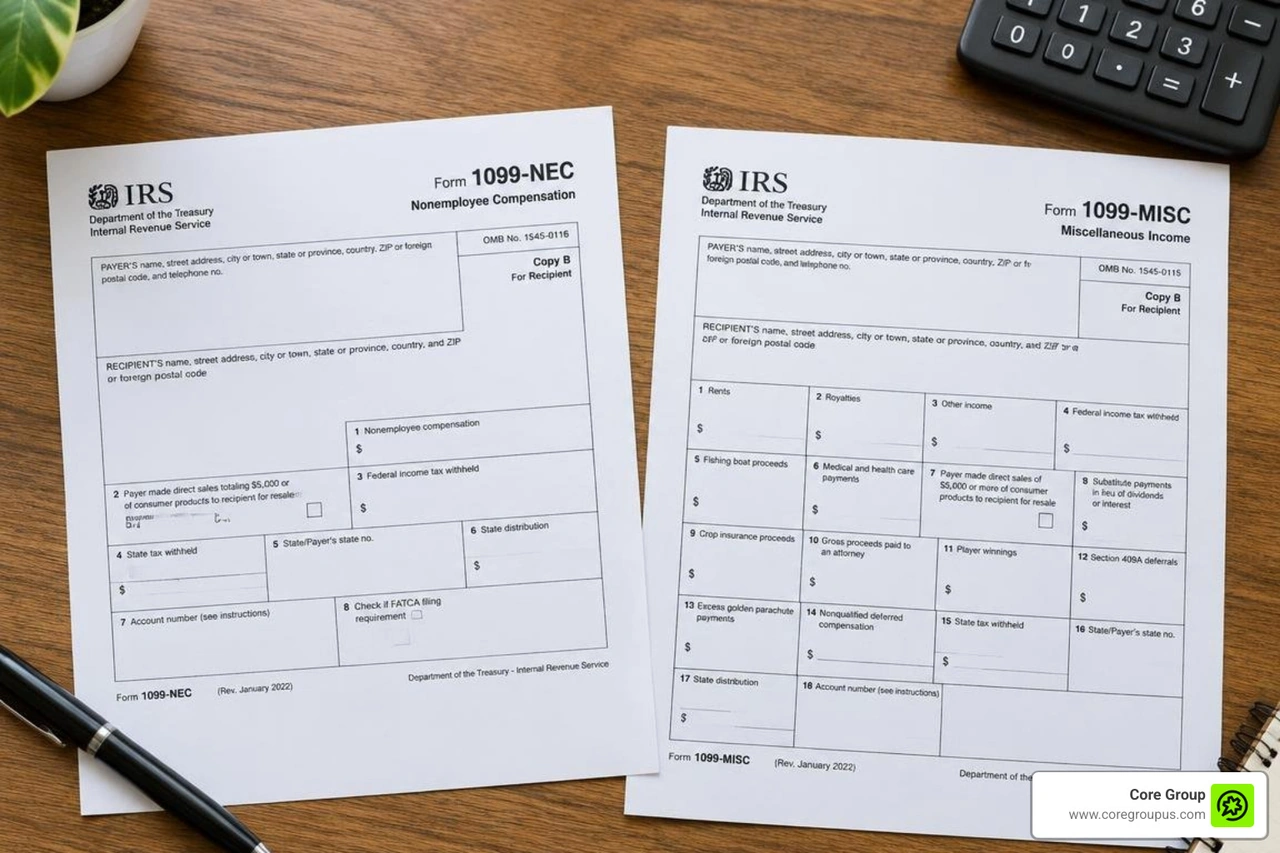
Understanding which IRS form applies to your payment stream prevents expensive submission corrections. Our team has Form 1099-NEC explained in depth so you can separate compensation from other payment types.
Form 1099-NEC vs 1099-MISC vs 1099-K
Businesses frequently confuse the three main forms used for business-to-business payments.
- Form 1099-NEC reports nonemployee compensation paid to independent contractors, freelancers, and unincorporated LLCs for services rendered in your trade or business.
- Form 1099-MISC reports miscellaneous income events such as office rent, royalties, prizes, awards, and gross proceeds paid to an attorney in connection with legal settlements.
- Form 1099-K is issued by payment settlement entities like credit card companies and online payment networks when gross payment volume exceeds specific statutory reporting limits.
Payment Method Rules for Credit Cards and Third-Party Processors
The method you use to deliver funds dictates your reporting obligations. When you pay a contractor with a credit card, debit card, PayPal, Stripe, or similar merchant platforms, the payment processor is legally responsible for reporting those earnings on Form 1099-K.
Do not issue a Form 1099-NEC for transactions settled through these third-party platforms. If you send both a 1099-NEC and the processor issues a 1099-K for the exact same invoices, the vendor's gross income will appear artificially doubled in the IRS system. Keep your 1099-NEC filings focused exclusively on direct payments like paper checks, automated clearing house transfers, wire transfers, and cash disbursements.
Step-by-Step Guide to Collecting W-9s and Filing 1099s for LLCs
A secure compliance process starts long before tax season arrives. We recommend making W-9 collection an mandatory part of your onboarding workflow before you disburse a single dollar to an outside vendor. Taking proactive steps allows you to avoid common LLC 1099 mistakes that lead to IRS inquiries.

Verifying Taxpayer Identification Numbers (TIN)
On Form W-9, a single-member LLC owner should write their individual legal name on Line 1 and may put their business name on Line 2. For a disregarded entity, the IRS prefers the owner's Social Security Number or individual Employer Identification Number on Part I instead of an entity-level EIN.
Multi-member LLCs and corporate LLCs list the company name on Line 1 and provide the company EIN. You can run these combinations through the IRS TIN Matching system before filing your returns. Validating name and identification pairings prevents IRS B-Notices, which require backup withholding when mismatched records are found.
Managing Non-Compliant Vendors and 24% Backup Withholding
If a vendor performs work for your business but refuses to supply a completed Form W-9, federal law requires you to implement backup withholding immediately.
You must withhold a flat 24% from all subsequent payments and remit those funds directly to the IRS using Form 945. Applying backup withholding protects your company from having to pay the vendor's tax liability out of pocket during an audit.
1099 Filing Deadlines, Electronic Submission Rules, and Penalties
Staying compliant requires keeping track of strict submission calendars and formatting mandates. For comprehensive details on current procedures, review our LLC 1099 compliance guide for 2026.
| Submission Timing | Penalty Per Form | Penalty For Intentional Disregard |
|---|---|---|
| Filed within 30 days of deadline | $60 | Not applicable |
| Filed after 30 days but by August 1 | $130 | Not applicable |
| Filed after August 1 or not filed | $340 | Not applicable |
| Intentional disregard of filing rules | $680 | Greater of $680 or 10% of total reported amount |
Deadlines and the 10-Return Electronic Mandate
Form 1099-NEC must be furnished to recipients and submitted to the IRS by January 31 of the year following the payment year. Because this form reports nonemployee compensation, the IRS does not provide an automatic 30-day extension. Check our schedule on when 1099s are due alongside our LLC 1099 deadline guide to ensure your records are complete well before the annual cutoff.
Under IRS electronic filing regulations, any business submitting 10 or more information returns across all categories in a calendar year must file electronically through the Information Returns Intake System. Paper forms are only permitted if your cumulative total across all 1099, W-2, and related information forms remains below 10 returns.
IRS Penalties for Late or Incorrect Filing
Failing to submit required information returns triggers automatic statutory fines. Penalties range from $60 per form for slight delays up to $340 per form for returns submitted after August 1. If the IRS determines that you willfully ignored your filing duties, the penalty rises to $680 per form with no maximum annual cap, plus accumulated interest charges.
Frequently Asked Questions About LLC 1099 Requirements
What is the reporting threshold for Form 1099-NEC in 2026?
For payments made in calendar year 2026, the federal threshold for reporting nonemployee compensation on Form 1099-NEC is $2,000 in aggregate direct payments per recipient.
Do I need to send a 1099 to an LLC paid via credit card or PayPal?
No. Payments settled through credit cards, debit cards, and third-party payment networks are excluded from Form 1099-NEC reporting because the payment processor handles reporting on Form 1099-K.
When must an LLC issue 1099 forms to its own subcontractors?
An LLC must issue Form 1099-NEC whenever it pays an unincorporated contractor, freelancer, or single-member LLC $2,000 or more for services in a calendar year using direct payment methods. You can learn more about managing these roles by exploring whether a single-member LLC can have 1099 employees.
Conclusion
Determining whether an LLC needs a 1099 comes down to checking its tax classification on Form W-9, tracking cumulative payment amounts against the $2,000 threshold for 2026, and confirming your payment method. Disregarded entities and partnership LLCs require a 1099-NEC for direct service payments, while corporate entities are exempt outside of legal and healthcare services.
At Core Group, we provide financial management, bookkeeping, and tax services for creative entrepreneurs. Our no-fluff, profit-first playbook delivers peace of mind and saves you time so you can focus on expanding your business, backed by our MacBook Pro guarantee. Explore our single-member LLC 1099 reporting resources or schedule a consultation with our team to keep your vendor compliance running seamlessly.