Do I Owe You a 1099? The Ultimate Guide for Sole Proprietors and Single-Member LLCs
What Every Sole Proprietor and Single-Member LLC Needs to Know About 1099s
If you're trying to figure out whether an individual sole proprietor or single member LLC get 1099 forms, here is the short answer
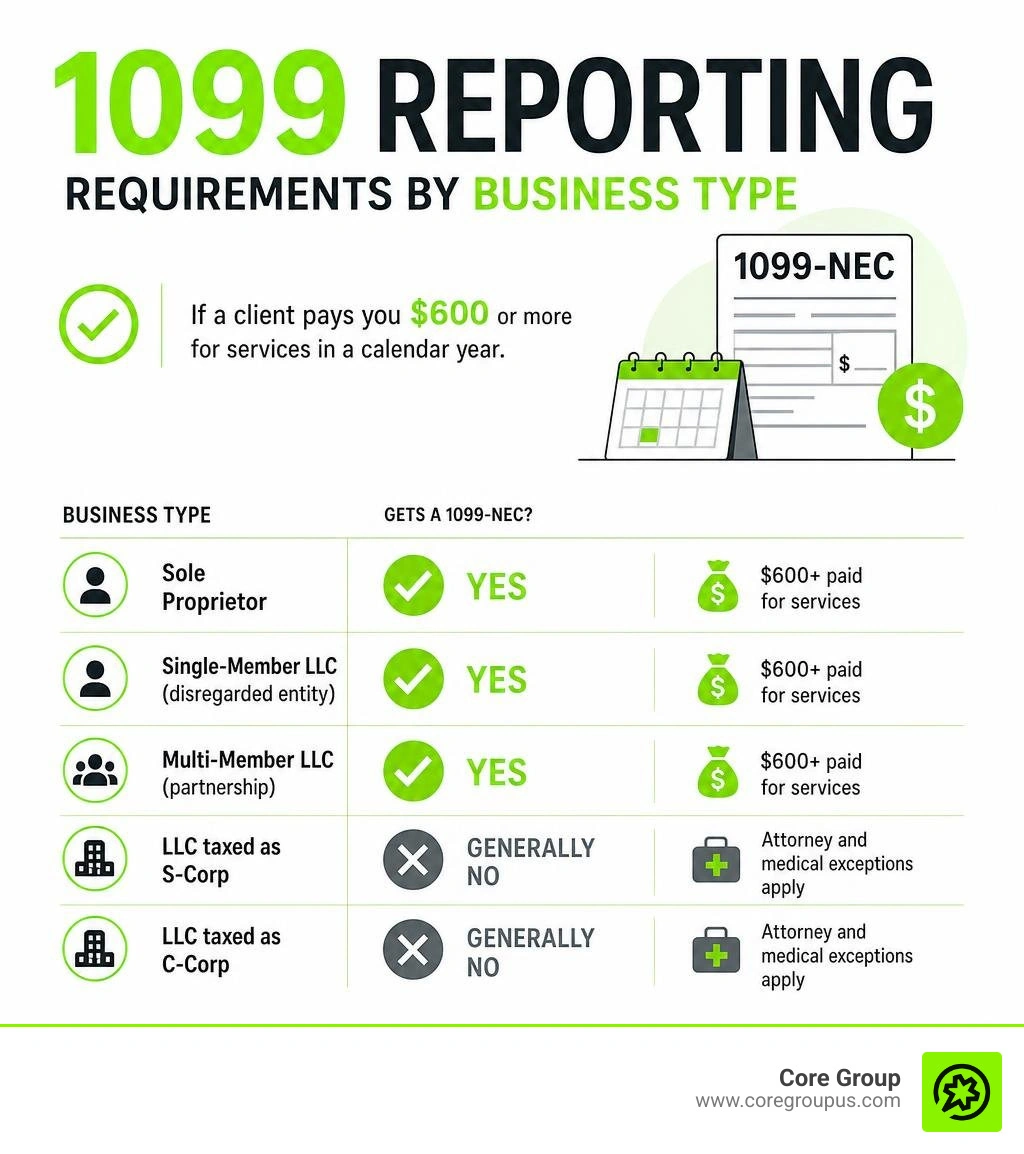
Yes, in most cases you will receive a 1099-NEC if a client pays you $600 or more for services in a calendar year.
| Business Type | Gets a 1099-NEC? | Key Condition |
|---|---|---|
| Sole Proprietor | Yes | $600+ paid for services |
| Single-Member LLC (disregarded entity) | Yes | $600+ paid for services |
| Multi-Member LLC (partnership) | Yes | $600+ paid for services |
| LLC taxed as S-Corp | Generally No | Attorney and medical exceptions apply |
| LLC taxed as C-Corp | Generally No | Attorney and medical exceptions apply |
Tax season is already stressful if your brain runs on creative projects, not spreadsheets. And 1099 rules are one of the most misunderstood areas for freelancers, independent contractors, and small business owners.
Here is why it matters. The IRS estimates that 60% of small business audits involve discrepancies related to 1099 reporting and self-employment income. Over 27 million sole proprietorships filed Schedule C in 2021 alone. Getting this wrong is not rare, and it is not cheap.
Whether you are a filmmaker, a media consultant, or a solo creative running your business through an LLC, understanding your 1099 obligations protects you from penalties, surprises at tax time, and unnecessary stress.
This guide breaks it all down clearly, so you can get back to the work you actually love.
Individual sole proprietor or single member llc get 1099 terms at a glance
Does an Individual Sole Proprietor or Single Member LLC Get 1099 Forms
When you operate as an independent creator or run a solo business, the paperwork can quickly feel overwhelming. If you are wondering whether you should expect these forms from your clients, the simple answer is yes. Both sole proprietors and single-member LLCs are firmly in the category of entities that receive 1099 forms.

For tax purposes, the IRS treats a single-member LLC as a disregarded entity by default. This means that even though you went through the effort of registering your business with your state, the federal government looks right through the LLC structure and treats you exactly like a sole proprietor. When a client pays you for your expertise, they must track those payments and report them to the government.
The magic number to keep in mind is the LLC Get 1099 Minimum of six hundred dollars. If a single client pays you six hundred dollars or more for services during the calendar year, they are legally required to send you a 1099 form. This threshold is cumulative, which means it applies to the total amount paid across the entire year, not just to individual invoices. If a client pays you two hundred dollars in January, three hundred dollars in June, and one hundred and fifty dollars in October, the total of six hundred and fifty dollars triggers the requirement.
Because of this, keeping clean records is vital. The IRS uses information returns to cross-reference what you report on your tax return with what your clients say they paid you. Discrepancies between these numbers are a major trigger for IRS audits. To stay on top of your requirements and learn more about your rights, you can visit the official Self-employed individuals tax center | Internal Revenue Service page.
When an Individual Sole Proprietor or Single Member LLC Get 1099 Payments
You will receive a 1099 form when you perform services in the course of a client's trade or business. These payments are generally classified as service fees or professional fees. If you are hired to design a website, write marketing copy, direct a commercial, or consult on a project, those payments represent nonemployee compensation.
It is important to understand that personal payments do not trigger this requirement. If a homeowner hires you to paint their personal living room, they do not need to send you a 1099 because the work was not done for a business. However, if a local marketing agency hires you to paint a mural in their office, that is a business expense, and they must track it. You can read more about how these payments are classified in our guide on how 1099 NEC Explained works for business owners.
Your clients must track these transactions throughout the calendar year. They will total up all payments made to you from January first through December thirty-first and use that total to fill out the form.
Why an Individual Sole Proprietor or Single Member LLC Get 1099 Forms Instead of W2s
The difference between receiving a 1099 and a W-2 comes down to your employment classification. When you work as an independent contractor, you are your own boss. You control how, when, and where you do the work. Because you are not an employee, your clients do not withhold any taxes from your payments.
This means you are responsible for paying your own self-employment tax, which covers Social Security and Medicare. When you receive Nonemployee Compensation, you must calculate and pay these taxes yourself. This is typically done by filing Schedule SE along with your annual tax return.
While employees have their taxes withheld gradually with every paycheck, independent contractors must manage their own tax withholding. This often means making quarterly estimated tax payments to avoid penalties at the end of the year.
How LLC Tax Classification Affects 1099 Reporting
Your legal structure and your tax structure are not always the same. While you might register your business as an LLC with your state secretary of state, the IRS allows you to choose how you want to be taxed. This choice is called entity selection, and it determines whether your business will receive a 1099.
To change how your LLC is classified for federal tax purposes, you must file IRS Form 8832. If you do not file this form, the IRS will apply a default classification based on how many members your business has. For a complete guide on how the federal government views your business structure, you can read the official page on Single member limited liability companies | Internal Revenue Service rules.
Disregarded Entities and Partnerships
If your LLC has only one owner and you have not elected corporate tax status, you are classified as a disregarded entity. In this scenario, you enjoy pass-through taxation. All of your business profits and losses flow directly to your personal tax return. Your clients will treat you just like a sole proprietor and issue a 1099-NEC for any service payments over the six hundred dollar threshold. You can explore this further in our detailed breakdown of Single Member LLC Taxes and how they work.
If your LLC has multiple owners, the IRS defaults to treating it as a partnership. Interestingly, partnerships are also subject to 1099 reporting. If a business pays a partnership six hundred dollars or more for services, they must issue a 1099-NEC. At the end of the year, the partnership itself will distribute a Schedule K-1 to each partner to report their individual share of the profits. For a deeper look at how these rules change based on your entity setup, check out this guide on Do LLCs Get a 1099? Complete Answer by LLC Type (2026) .
S Corporations and C Corporations
If your LLC elects to be taxed as an S Corporation or a C Corporation, the rules change dramatically. The IRS provides a corporate exemption for 1099 reporting. This means that businesses generally do not have to issue a 1099-NEC to corporations, even if they paid them more than six hundred dollars for services.
Once you make an S Corp election, you are no longer treated as a disregarded entity. Your business is now a separate tax entity, and you will report your business income differently. You can read more about how this affects your federal filing obligations in our guide on Federal Income Tax LLC rules.
However, there are two important exceptions to the corporate exemption. You must always issue a 1099 for medical and healthcare payments, and you must always issue a 1099 for legal services. If you pay an attorney or a medical provider six hundred dollars or more, you must send them a 1099 even if their business is incorporated as an S-Corp or C-Corp.
Can You Issue a 1099 to Yourself
As a business owner, you might wonder if you can simplify your taxes by issuing a 1099 to yourself from your own LLC. This is a common question, but the answer is a clear and resounding no.

Attempting to self-1099 is a direct violation of tax classification rules. If your LLC is a disregarded entity, you and your business are considered the same legal entity for income tax purposes. You cannot hire yourself as an independent contractor because you cannot contract with yourself.
Attempting to do this creates massive compliance risks and increases your audit exposure. The IRS will quickly reject any attempt to treat your own owner payments as third-party contractor expenses. For a comprehensive look at why this practice is invalid and how to stay compliant, you can read this guide on Can You 1099 Yourself From Your LLC? A Clear Guide to Owner Payments, Taxes, and Compliance .
Correct Ways to Pay Yourself as an Owner
So, how should you actually get paid? The correct method depends entirely on your tax classification.
For sole proprietors and single-member LLCs, the standard method is taking owner's draws. You simply transfer money from your business bank account to your personal bank account. These draws are not considered payroll, and you do not withhold taxes from them. You are taxed on the net profit of the business, regardless of how much money you actually draw out.
If your LLC is taxed as a partnership, you will receive guaranteed payments or partner distributions. Guaranteed payments are treated as ordinary income and are reported on your Schedule K-1.
If your LLC has elected S-Corp or C-Corp tax status, you are treated as an employee of your own business if you actively work in it. In this case, you must pay yourself reasonable W-2 wages through a formal payroll system, complete with payroll tax withholdings. To help you navigate these options, we have put together a resource on Tax Planning for Freelancers to help you choose the best structure.
When You Must Issue 1099 Forms to Others
As your creative business grows, you might start hiring other talented professionals to help you bring your projects to life. When you hire independent contractors, the shoe is on the other foot. You are now the payer, and you must handle the reporting requirements.
If you pay any individual, sole proprietor, or partnership six hundred dollars or more for services in the course of your trade or business, you must issue them a 1099-NEC. This includes hiring web designers, editors, videographers, or virtual assistants.
To make this process smooth, you should always collect a W-9 form from every contractor before you send them their first payment. This form gives you their legal name, business structure, and taxpayer identification number. Keeping track of these payments throughout the year is much easier when you use a dedicated system for 1099 Contractor Expense Tracking.
Deadlines and Penalties for Late Filing
Failing to file your 1099 forms on time can result in steep penalties from the IRS. The deadline to send Form 1099-NEC to both the recipient and the IRS is January thirty-first. This deadline applies to both paper and electronic filings.
To learn more about these critical dates, you can read our guide on When Are 1099s Due to keep your business on track. Late filing penalties start at sixty dollars per form and can quickly climb to over three hundred dollars per form if the IRS determines you intentionally disregarded the rules.
If you file ten or more information returns in a year, you are required to file them electronically. The IRS provides a free electronic filing portal called the IRIS system to make this process easier for small businesses.
Common 1099 Mistakes and How to Avoid Them
Managing tax paperwork can lead to simple mistakes that cause major headaches later. By understanding the most common pitfalls, you can protect your business and keep your finances organized.
One major issue is duplicate reporting, which happens when a client reports your income on a 1099-NEC, but you also receive a 1099-K from a payment platform for the same transactions. To learn how to navigate these challenges, check out our guide on As a Freelancer How Do I Plan for Taxes.
Another common mistake is failing to update your W-9 form after making a tax election. If you change your LLC tax status to an S-Corp, you must send an updated W-9 to all of your active clients immediately so they know they no longer need to send you a 1099-NEC.
Mixing Personal and Business Accounts
Commingling your personal and business funds is one of the biggest mistakes you can make as a business owner. When you use your business account to pay for personal groceries, or use your personal credit card for business expenses without tracking it, you create a financial mess.
More importantly, mixing your accounts can lead to piercing the corporate veil. This is a legal term that means a court can strip away your limited liability protection because you did not treat your LLC as a separate entity.
To protect your personal assets, you must maintain a dedicated business bank account. Use this account exclusively for business income and expenses, and use clean expense tracking tools to keep your records spotless.
Failing to Collect W9 Forms Early
Waiting until January to ask your contractors for W-9 forms is a recipe for stress. Contractors can move, change their email addresses, or simply ignore your messages once the project is complete.
Make it a strict policy to collect a completed W-9 during your contractor onboarding process, before you issue any payments. This form allows you to verify their taxpayer identification number and determine if they are subject to backup withholding. Keeping these records organized and secure is a fundamental part of good business record keeping.
Frequently Asked Questions About 1099 Rules
Tax regulations can be confusing, but having clear answers to common questions can give you peace of mind.
What is the Difference Between 1099 NEC and 1099 MISC
The IRS uses different forms for different types of payments. Form 1099-NEC is used exclusively to report nonemployee compensation, which includes fees, commissions, and prizes paid to independent contractors for services.
Form 1099-MISC is used to report other types of miscellaneous income, such as rent, royalties, and prizes. For example, if you pay rent for a creative studio space, you would report those payments on Form 1099-MISC. For detailed, official instructions on how to use these forms, you can read the Instructions for Forms 1099-MISC and 1099-NEC (12/2026) | Internal Revenue Service document.
Another key difference is how attorney payments are reported. If you pay an attorney for legal fees, that is reported on Form 1099-NEC. However, if you pay an attorney gross proceeds as part of a legal settlement, that is reported on Form 1099-MISC.
Does a Single Member LLC Need an EIN to Receive a 1099
If you run a single-member LLC, you do not technically need an Employer Identification Number to receive a 1099. Because the IRS treats you as a disregarded entity, you can use your Social Security Number on your W-9 form.
However, many solo business owners prefer to obtain an EIN anyway. Using an EIN instead of your SSN on W-9 forms adds a layer of identity protection, preventing you from having to share your personal Social Security Number with every client you work with. Applying for an EIN is free and can be completed online in just a few minutes.
How Do Payment Platforms Like Stripe Affect 1099 Reporting
The rise of payment settlement entities like Stripe, PayPal, and Venmo has changed how independent contractors receive their money. If your clients pay you through these third-party networks, they are generally not required to issue you a 1099-NEC.
Instead, the payment platform itself is responsible for tracking your transactions and issuing a Form 1099-K if you meet the reporting thresholds. This rule exists to prevent duplicate reporting, ensuring that the same income is not reported to the IRS twice. Always review your records carefully to make sure your 1099-NEC and 1099-K forms match your actual bank deposits.
Conclusion
Managing your 1099 requirements does not have to be a source of stress. Whether you are trying to understand your own tax obligations or figuring out how to pay the talented contractors who support your business, having a clear plan makes all the difference.
At Core Group, we specialize in offering financial management, bookkeeping, and tax services designed specifically for creative entrepreneurs. We understand that your passion is creating amazing work, not wrestling with tax forms.
That is why we created our profit first playbook, a clear strategy designed to guarantee you peace of mind and save you valuable time. We are so confident in our ability to streamline your business finances that we back our services with a MacBook Pro guarantee.
Let us handle the numbers so you can focus on what you do best. To take the first step toward stress-free taxes, read our complete guide on Single Member LLC 1099 Reporting and discover how we can help your business thrive.