Keep Your Wealth Where It Belongs: Top Avoidance Strategies
Understanding the Difference Between Estate and Inheritance Taxes
Inheritance tax avoidance strategies are legal tools that help you pass more of your wealth to the people you love, and less to the government. Here is a quick overview of the most effective ones:
Top Inheritance Tax Avoidance Strategies
- Annual gifting - Give up to $19,000 per person per year tax-free (2026 limit)
- Irrevocable trusts - Remove assets from your taxable estate entirely
- Irrevocable Life Insurance Trusts (ILITs) - Keep life insurance payouts outside your estate
- 529 education accounts - Move money out of your estate while funding a child's future
- Charitable giving - Reduce your taxable estate through donations or charitable trusts
- Step-up in basis planning - Let heirs inherit appreciated assets with a reset cost basis
- Advanced trust structures - Use GRATs, dynasty trusts, or IDGTs for larger estates
Building wealth as a creative entrepreneur takes years of hard work. Losing a large chunk of it to taxes when you pass it on feels like the wrong ending to that story.
The good news is that most people never pay federal estate tax at all. Fewer than two in every 1,000 estates trigger it. But that doesn't mean planning doesn't matter. State-level taxes kick in at much lower thresholds, and without a clear strategy, your heirs could face unexpected bills at the worst possible time.
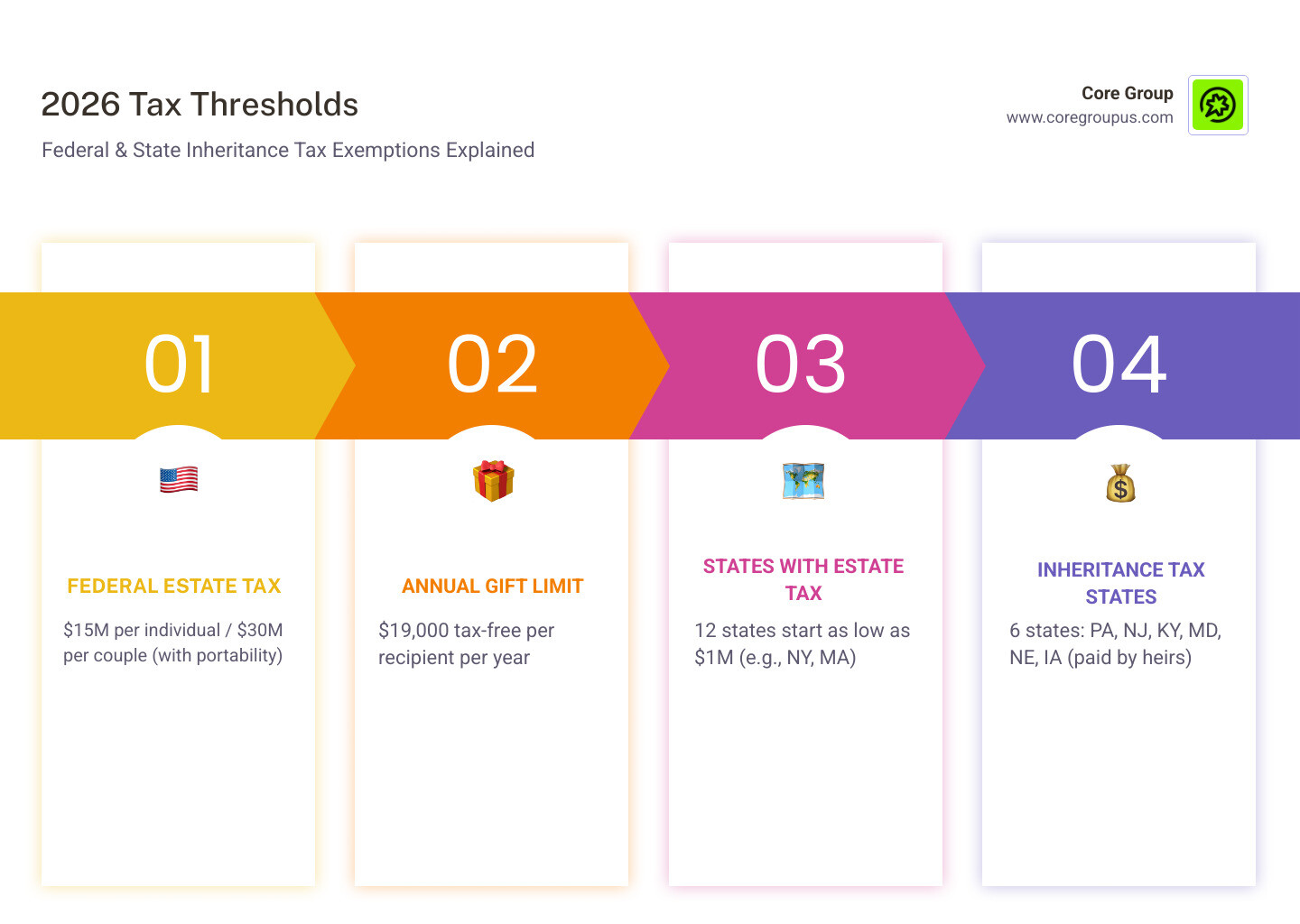
In 2026, the federal estate tax exemption sits at $15 million per individual and $30 million per couple. That sounds like a lot. But some states tax estates starting at just $1 million, and six states charge a separate inheritance tax paid directly by the person receiving your assets.
The rules are layered, and they change. This guide cuts through the noise.
Basic inheritance tax avoidance strategies vocab:
- corporate tax planning and strategy
- how firms integrate estate investment tax planning strategies
- should be considered in tax planning strategies
When we talk about death taxes, we are usually talking about three different things that often get confused. Understanding these is the first step in any inheritance tax avoidance strategies plan.
First, there is the federal estate tax. This is a tax on the right to transfer property at your death. It is paid by the estate itself before anything is handed out to your heirs. The rate can be as high as 40 percent. However, as of May 2026, the federal exemption is quite high at $15 million. This means if your total estate is worth less than that, you won't owe Uncle Sam a dime in estate tax.
Then, there is the inheritance tax. This is a state-level tax paid by the person who receives the money. Only six states currently have one. If you live in Pennsylvania or Maryland, for example, your children or siblings might have to pay a percentage of what they inherit back to the state.
Finally, we have the gift tax. This applies to money or property you give away while you are still alive. The IRS tracks these gifts to make sure people don't just give away their entire fortune the day before they die to avoid estate taxes.
| Tax Type | Who Pays? | Level | 2026 Status |
|---|---|---|---|
| Estate Tax | The Estate | Federal and some States | $15M Federal Exemption |
| Inheritance Tax | The Beneficiary | State Only (6 States) | Rates vary by relationship |
| Gift Tax | The Giver | Federal | $19,000 Annual Exclusion |
Maryland is a unique case because it is the only state that imposes both an estate tax and an inheritance tax. Pennsylvania is also notable because its inheritance tax applies to almost everyone, though the rates change based on how closely related you are to the deceased. You can learn more about these nuances in this guide on Strategies for How to Avoid Inheritance Taxes.
Effective Inheritance Tax Avoidance Strategies Through Lifetime Gifting
One of the simplest ways to reduce the size of your taxable estate is to simply give the money away while you are still around to see your loved ones enjoy it. This is a cornerstone of many inheritance tax avoidance strategies.
The IRS allows you an annual gift tax exclusion. For 2026, this limit is $19,000 per recipient. If you are married, you and your spouse can use gift splitting to give $38,000 to a single person every year without even having to file a gift tax return. If you have two children and four grandchildren, a couple could move $228,000 out of their estate every single year.
Over a decade, that is over $2 million removed from your taxable estate, potentially saving your heirs hundreds of thousands in future taxes. Plus, any appreciation on that money happens in their hands, not yours.
There are also two "super exclusions" that don't count toward your $19,000 limit or your lifetime exemption:
- Medical Expenses - If you pay a loved one's medical bills directly to the hospital or doctor, there is no limit on the amount.
- Tuition - If you pay someone's tuition directly to the educational institution, it is gift-tax-free.
For creative parents looking ahead, 529 plans are another brilliant tool. You can even "front-load" five years' worth of gifts into a 529 plan at once, moving up to $95,000 out of your estate in a single year for a child’s education. For more on how this fits into your broader plan, check out Help reduce estate taxes with lifetime gifting and our thoughts on what Should Be Considered In Tax Planning Strategies.
Using Trusts to Protect Your Assets and Minimize Liability
If you want to move assets out of your estate but aren't quite ready to hand a 21-year-old a massive check, trusts are your best friend. They offer control, protection, and significant tax benefits.
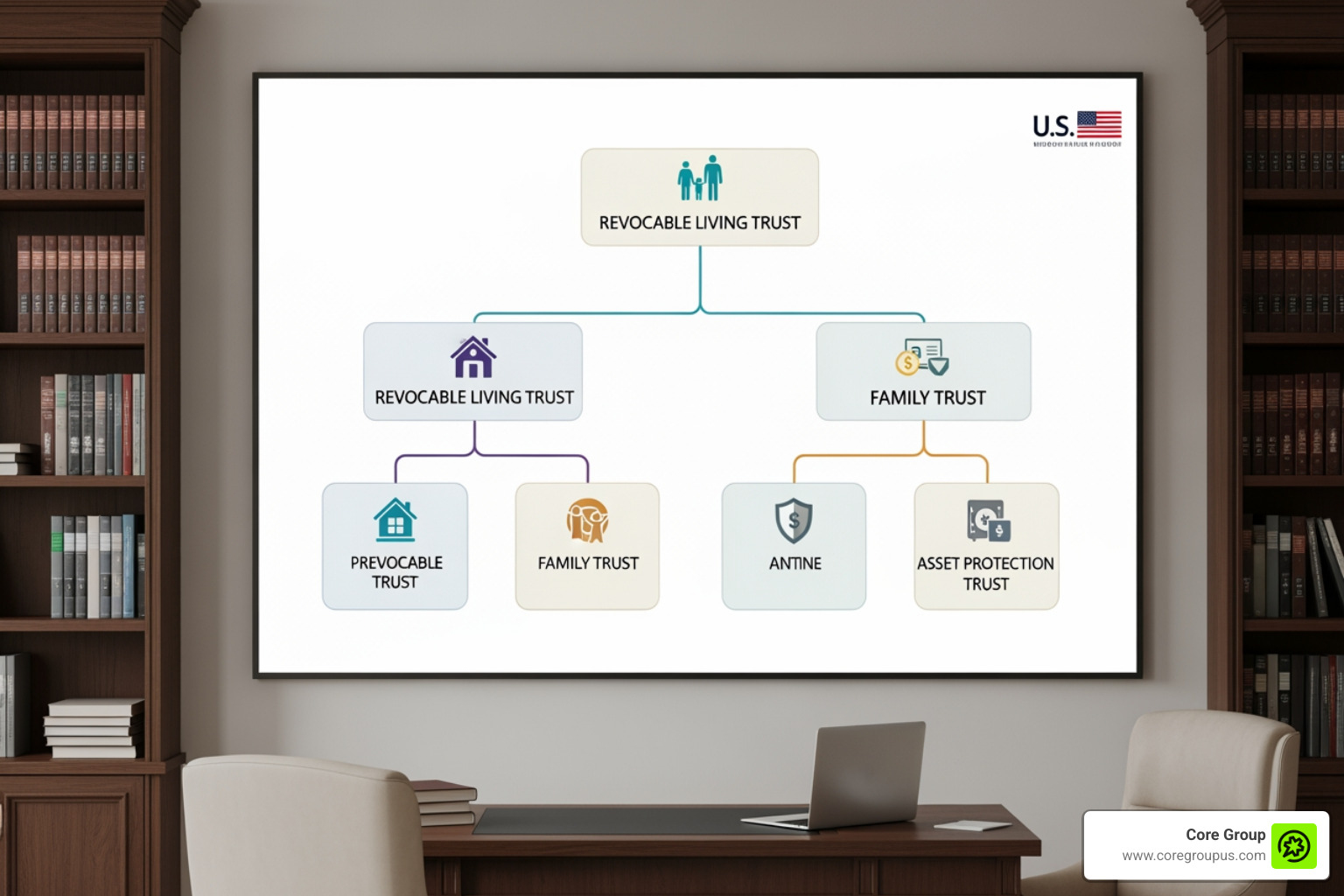
A Revocable Living Trust is the most common starting point. While it doesn't technically reduce your estate tax (because you still control the assets), it is a vital tool for avoiding probate. Probate is the public, often expensive court process of settling an estate. By keeping your assets in a trust, they pass to your heirs privately and much faster.
To actually lower your tax bill, you often need an Irrevocable Trust. Once you put assets into this kind of trust, you no longer legally own them. Because they aren't yours, they aren't part of your taxable estate when you pass away. This is a powerful way to "freeze" the value of assets like a growing business or real estate. You can find more details on this in How to Avoid Estate Tax and our guide on How Firms Integrate Estate Investment Tax Planning Strategies.
Advanced Inheritance Tax Avoidance Strategies for High Net Worth Individuals
For those with larger estates, basic gifting isn't enough. That is where the "alphabet soup" of advanced trusts comes in. These are all legal, battle-tested methods used by the wealthiest families to move millions of dollars tax-free.
- GRATs (Grantor Retained Annuity Trusts) - You put assets into a trust for a set number of years and receive an annuity back. If the assets grow faster than a small IRS-set interest rate, that extra growth passes to your heirs entirely tax-free. It is a "heads you win, tails you don't lose" strategy.
- IDGTs (Intentionally Defective Grantor Trusts) - These are "defective" for income tax purposes but effective for estate tax purposes. You pay the income tax on the trust's earnings, which further reduces your taxable estate while allowing the trust assets to grow unburdened by taxes.
- Dynasty Trusts - These are designed to last for generations. In states that have abolished the "Rule Against Perpetuities," these trusts can protect wealth from estate taxes for hundreds of years.
- Crummey Powers - This is a technical provision that allows gifts to a trust to qualify for the $19,000 annual exclusion by giving beneficiaries a short window to withdraw the money.
These strategies often involve valuation discounts. For example, if you own a family business, you might gift a "minority interest" to a trust. Because a minority owner can't control the business, the IRS allows you to discount the value of that gift by 30 percent or more, allowing you to move more of the business into the trust using less of your exemption. Explore these deeper in Generation-Skipping Transfer Tax Planning Opportunities.
Life Insurance and Irrevocable Life Insurance Trusts
Life insurance is a double-edged sword. The payout is usually income-tax-free for your heirs, but it is included in your gross estate for estate tax purposes. If you have a $5 million policy, that could suddenly push a medium-sized estate into the 40 percent tax bracket.
The solution is an Irrevocable Life Insurance Trust (ILIT). By having the trust own the policy, the death benefit remains entirely outside your taxable estate. This provides your heirs with immediate liquidity to pay any remaining taxes, debts, or administrative costs without having to sell off the family home or the business. It is one of the Five Top Strategies to AVOID Death Taxes.
Maximizing the Step Up in Basis and Retirement Account Planning
Taxes aren't just about what happens the moment you die; they are also about what happens when your heirs eventually sell what you left them. This is where the "step-up in basis" rule becomes your most powerful ally.
Normally, if you buy a stock for $10 and sell it for $100, you owe capital gains tax on the $90 profit. But if you die and leave that stock to your daughter, her "basis" is stepped up to the value on the day you died ($100). If she sells it the next day, she owes zero capital gains tax.
This is why gifting isn't always the best move for highly appreciated assets. If you gift that stock while you are alive, she keeps your $10 basis and will owe a huge tax bill later. Sometimes, the best inheritance tax avoidance strategies involve holding onto assets until death to wipe out the capital gains.
Retirement accounts like IRAs and 401(k)s are different. They don't get a step-up in basis. In fact, most non-spouse heirs must now empty inherited IRAs within 10 years, which can trigger a massive income tax bill. Strategies like Roth conversions while you are alive can help mitigate this by paying the tax now at a lower rate so your heirs inherit a tax-free pot of money. We cover more of this in our Tax Planning For Freelancers and this Investopedia guide.
Common Mistakes in Inheritance Tax Avoidance Strategies
Even the best-laid plans can go off the rails. Here are the most common traps we see:
- Joint Ownership - Many parents add a child to their home’s deed to "make things easier." This often ruins the step-up in basis and can expose the home to the child’s creditors or a divorce settlement.
- Outdated Beneficiaries - A will does not override a beneficiary designation on an IRA or life insurance policy. If your ex-spouse is still listed on your 401(k), they are getting the money, regardless of what your will says.
- DIY Planning - Using a generic online form for a complex estate is like performing surgery on yourself. It might look okay on the surface, but the internal complications can be fatal for your wealth.
- Ignoring State Borders - If you move from Florida (no estate tax) to Oregon (estate tax starts at $1 million), your entire plan needs an overhaul.

Common Questions Regarding Wealth Preservation
Navigating inheritance tax avoidance strategies brings up a lot of questions. Here are the big ones we hear most often at Core Group.
Which states currently impose an inheritance tax
As of 2026, only six states impose an inheritance tax. This is a tax paid by the person receiving the assets, and the rate usually depends on how closely you are related to the deceased.
- Pennsylvania - Rates are 4.5 percent for adult children, 12 percent for siblings, and 15 percent for others. Spouses are exempt.
- New Jersey - Spouses and children are exempt, but siblings and other heirs pay rates up to 16 percent.
- Maryland - The only state with both an estate and inheritance tax. Close relatives are generally exempt from the inheritance tax.
- Kentucky - Similar to NJ, close family is exempt, but others pay up to 16 percent.
- Nebraska - Closest relatives pay 1 percent, while non-relatives can pay up to 15 percent.
- Iowa - Iowa has been phasing out its inheritance tax, but it is important to check the current year's specific thresholds.
What is the federal estate tax exemption for 2026
For 2026, the federal exemption is projected to be approximately $15 million per individual and $30 million per married couple. This high threshold is due to the Tax Cuts and Jobs Act (TCJA).
However, there is a catch. These levels are part of a "sunset" provision. Unless Congress acts, these exemptions could drop significantly in the future, possibly back to the $7 million range. This makes "portability" very important. Portability allows a surviving spouse to "lock in" and use any of the $15 million exemption that their deceased spouse didn't use. You must file a federal estate tax return (Form 706) after the first spouse dies to claim this, even if no tax is owed.
How do charitable donations reduce taxable estate value
Charity is one of the few ways to get an "unlimited" deduction. Every dollar you leave to a qualified 501(c)(3) organization is removed from your taxable estate.
For creative entrepreneurs with a specific vision, a Donor Advised Fund (DAF) allows you to take an immediate tax deduction while deciding which charities to support over time. If you have a very large estate, a Charitable Remainder Trust (CRT) can provide you with income for life, with the remaining assets going to charity tax-free, effectively bypassing estate taxes on those assets.
Conclusion
Estate planning isn't just for the billionaires you read about in the news. For creative entrepreneurs, it is the final piece of a "profit-first" business strategy. It ensures that the business you built and the wealth you created continue to support your family and your values long after you are gone.
At Core Group, we focus on the numbers so you can focus on the art. Whether it is navigating the 2026 tax sunset or setting up a gifting schedule that actually makes sense for your cash flow, we are here to provide the "no-fluff" guidance you need. Don't let a lifetime of creativity be diminished by a lack of planning.
Ready to protect your legacy? Check out our Resources for Tax Planning and let's make sure your wealth stays exactly where it belongs.