Don't Get Taxed Out by Ignoring These Planning Strategies
Why the Right Factors Should Be Considered in Tax Planning Strategies Before It Costs You
The factors that should be considered in tax planning strategies include timing of income, retirement contributions, investment decisions, charitable giving, business structure, and deductions vs. credits. Here is a quick breakdown:
Key factors to consider in tax planning
| Factor | What to Think About |
|---|---|
| Timing of income | Defer or accelerate income based on your expected tax bracket |
| Retirement accounts | Max out 401(k), IRA, and HSA to reduce taxable income |
| Investment choices | Use tax-loss harvesting and smart asset location |
| Deductions vs. credits | Credits cut your tax bill dollar-for-dollar; deductions reduce taxable income |
| Business structure | S-Corp or LLC elections can lower self-employment tax |
| Charitable giving | Donate appreciated assets or use a donor-advised fund |
| Legislative changes | OBBBA updates like the new $40,000 SALT cap affect 2026 planning |
Most creative professionals are brilliant at their craft. Taxes? That is a different story.
The U.S. uses a progressive tax system, meaning the more you earn, the higher your rate on each additional dollar. That single fact makes proactive planning essential, not optional.
Without a plan, you are almost certainly overpaying. And the gap between what you pay and what you need to pay can be significant. For example, a single filer earning $75,000 who contributes $7,000 to a traditional IRA and $23,000 to a 401(k) can reduce their adjusted gross income (AGI) down to $45,000, potentially dropping into a lower tax bracket entirely.
Tax planning is not about loopholes or schemes. It is the legal arrangement of your finances to keep more of what you earn, while staying fully compliant with IRS rules.
This guide breaks down the strategies that actually move the needle, especially for creative entrepreneurs managing irregular income, project-based work, and growing businesses.
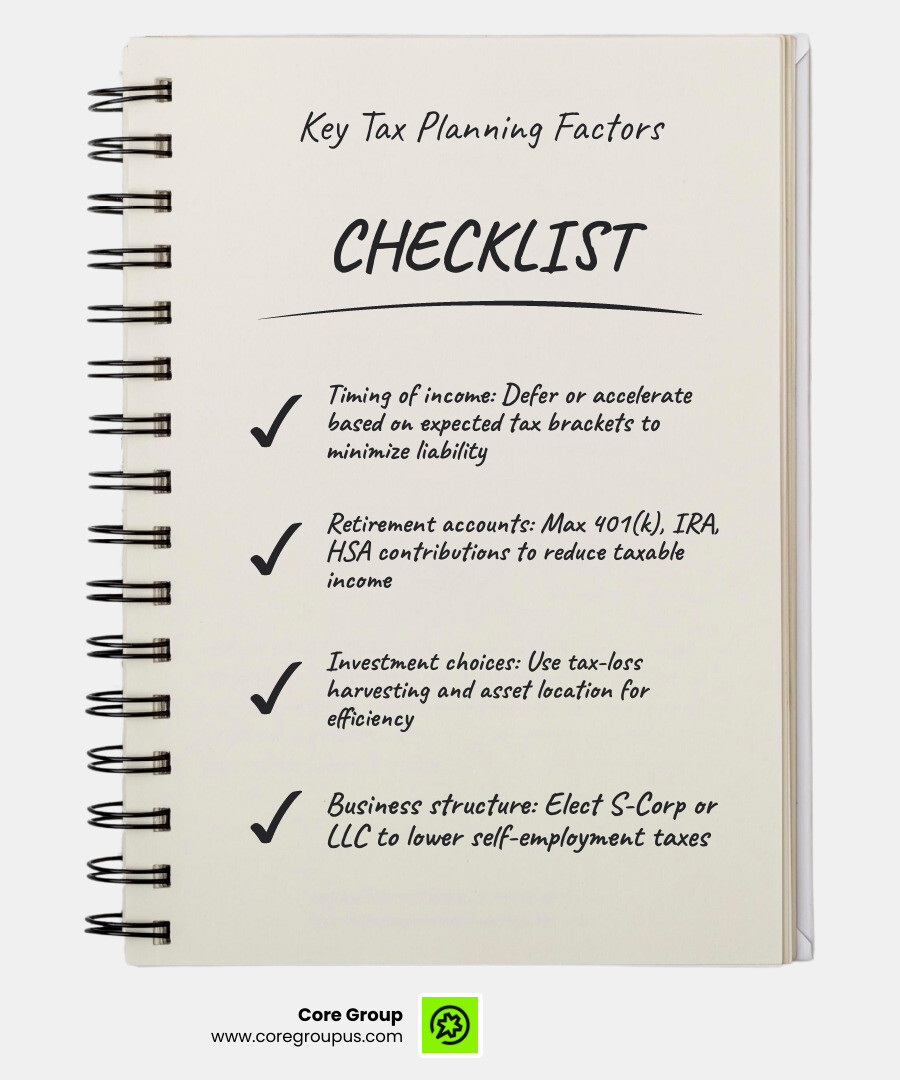
Easy should be considered in tax planning strategies glossary:
Essential Components That Should Be Considered in Tax Planning Strategies
As we navigate through May 2026, it is clear that the landscape of tax law has shifted. Effective tax planning is not a once a year event that happens in April. It is a year round process of making informed decisions. To keep your financial house in order, several fundamental components should be considered in tax planning strategies to ensure you are not leaving money on the table.
One of the most powerful tools at your disposal is the management of your Adjusted Gross Income (AGI). Your AGI is the gateway to many tax breaks, credits, and deductions. By lowering this number, you not only reduce your tax bill but often qualify for more benefits that are phased out at higher income levels. For 2026, the standard deduction amounts have been adjusted for inflation, sitting at $31,500 for married couples filing jointly and $15,750 for single filers. If your itemized expenses do not exceed these amounts, the standard deduction is your best friend.

Maximizing Retirement Contributions and HSA Benefits
Retirement accounts are the heavy hitters of tax efficiency. For 2026, the contribution limits reflect the need for robust savings. If you are under 50, you can tuck away $24,500 into a 401(k). For those aged 50 and older, catch up contributions allow for even more. A unique "enhanced" catch up also exists for individuals aged 60 to 63, allowing for a total contribution of up to $35,750.
Traditional IRAs also play a role, with a $7,500 limit for those under 50. These contributions are often deductible, providing an immediate tax break. If you are looking for more stability, a Safe Harbor 401k Complete Guide can help business owners understand how to maximize these benefits without the headache of complex compliance testing.
Do not overlook the Health Savings Account (HSA). We often call this the "triple tax advantage" account. Contributions are tax deductible, the growth is tax deferred, and withdrawals for qualified medical expenses are completely tax free. For 2026, family coverage limits have risen to $8,750. If you are 55 or older, you can add another $1,000 as a catch up. It is one of the few ways to get a deduction today and never pay taxes on that money again.
Strategic Timing of Income and Business Expenses
For creative entrepreneurs, income is rarely a steady stream. This volatility provides a unique opportunity for Business Tax Optimization. If you expect to be in a higher tax bracket next year, it might make sense to accelerate income into the current year. Conversely, if you had a bumper year in 2025 and expect 2026 to be slower, deferring income into 2026 can keep you in a lower marginal bracket.
The same logic applies to expenses. If you need new equipment for your studio, purchasing it before December 31 can provide a significant deduction through Section 179 expensing. In 2026, the maximum Section 179 deduction is $2.5 million, allowing you to write off the full cost of equipment immediately rather than depreciating it over many years. This "spiking" of deductions is a classic move that should be considered in tax planning strategies to offset a high income year.
Investment Tactics for Long Term Wealth Preservation
Investing is not just about what you make; it is about what you keep. Taxes can be a major headwind to building wealth, but smart tactics can help you navigate around them. By understanding how the IRS treats different types of investment income, you can structure your portfolio to be as lean and efficient as possible.

Why Asset Location Should Be Considered in Tax Planning Strategies
Asset allocation is about what you own, but asset location is about where you own it. This distinction should be considered in tax planning strategies to maximize after tax returns. Generally, you want to put tax inefficient investments, like bonds that pay ordinary interest or actively managed funds that trigger frequent capital gains, into tax advantaged accounts like an IRA or 401(k).
On the flip side, tax efficient investments like index funds, ETFs, or stocks held for the long term are better suited for taxable brokerage accounts. This allows you to take advantage of lower long term capital gains rates. Municipal bonds are also a great fit for taxable accounts because the interest is usually exempt from federal taxes. By placing the right assets in the right buckets, you can significantly reduce the "tax drag" on your portfolio growth. More insights on this can be found in our guide on How Firms Integrate Estate Investment Tax Planning Strategies.
Managing Capital Gains and Losses
One of the most effective ways to lower your tax bill is through tax loss harvesting. This involves selling investments that have decreased in value to "realize" a loss. These losses can offset any capital gains you have made during the year. If your losses exceed your gains, you can use up to $3,000 of the excess to offset your ordinary income, like your salary or business profits. Any remaining loss can be carried forward to future years indefinitely.
However, you must be careful of the "wash sale" rule. The IRS will disallow the loss if you buy a "substantially identical" security within 30 days before or after the sale. To stay invested, many people sell a losing stock and immediately buy a similar, but not identical, ETF to maintain their market position while still capturing the tax benefit.
Understanding the 2026 capital gains brackets is also vital.
| Tax Rate | Single Filers Income | Married Filing Jointly Income |
|---|---|---|
| 0% | Up to $47,025 | Up to $94,050 |
| 15% | $47,026 to $518,900 | $94,051 to $583,750 |
| 20% | Over $518,900 | Over $583,750 |
If you find yourself in a lower income year, you might even engage in "tax gain harvesting," where you sell appreciated assets to lock in the 0% rate before your income rises again. For more details on these nuances, check out the 2026 Tax Planning Guide What to Do After Filing Your 2025 Taxes.
Advanced Charitable Giving and Estate Planning Techniques
Giving back is a core value for many, but it can also be a sophisticated tax move. With the changes introduced by the One Big Beautiful Bill Act (OBBBA), charitable giving strategies have become even more important for those who itemize their deductions.
How Donor Advised Funds Should Be Considered in Tax Planning Strategies
A Donor Advised Fund (DAF) is like a personal charitable savings account. You contribute to the fund and receive an immediate tax deduction. The money can then be invested and grow tax free, and you can recommend grants to your favorite charities over time. This is particularly useful for the "bunching" strategy.
Since the standard deduction is so high, many people do not get any tax benefit from their annual donations. By "bunching" two or three years worth of donations into a single year and contributing them to a DAF, you can exceed the itemization threshold and get a large deduction in that year. In the "off" years, you simply take the standard deduction.
Donating appreciated assets, like stocks or real estate, to a DAF is even better. You get a deduction for the full market value and you never have to pay capital gains tax on the appreciation. This "double benefit" is why DAFs should be considered in tax planning strategies for anyone with a philanthropic heart and a high tax bill.
Estate Tax Minimization and Gifting
The OBBBA has made some significant changes to estate planning. For 2026, the federal estate tax exemption has been permanently increased to $15 million per individual. While this sounds like it only affects the ultra wealthy, many business owners find their estates growing faster than they realize.
The annual gift tax exclusion is another simple but effective tool. In 2026, you can give up to $19,000 per recipient ($38,000 for married couples) to as many people as you like without it counting against your lifetime exemption. This is a great way to shift wealth to the next generation while reducing the size of your taxable estate. For those in high tax states, looking into Top Estate Planning Tax Strategies for California Residents or similar local rules is essential, as state level estate taxes often have much lower thresholds.
Business Structure and Legislative Changes Under the OBBBA
The One Big Beautiful Bill Act (OBBBA) has reshaped the rules for business owners in 2026. One of the biggest wins is the increase in the State and Local Tax (SALT) deduction cap to $40,000. For years, business owners in high tax states were limited to a $10,000 deduction, which felt like a penalty for living in certain areas. This increase provides much needed relief.
Entity Selection and Self Employment Tax
Choosing the right business structure is one of the most important decisions a creative entrepreneur can make. Many start as a sole proprietorship or a simple LLC, but as income grows, an S-Corp election often becomes the smarter move.
In an S-Corp, you are treated as an employee of your own business. You pay yourself a "reasonable salary," on which you pay self employment taxes (Social Security and Medicare). Any profit above that salary can be taken as a distribution, which is not subject to self employment tax. This can save thousands of dollars every year.
If you are just starting out, our S-Corp Setup Process guide can walk you through the steps. Additionally, staying on top of LLC Tax Deductions Guide 2026 ensures you are capturing every possible write off, from your home office to your software subscriptions.
Accounting Methods and ASC 740 Compliance
For larger businesses or those looking to scale, the way you account for taxes matters for your financial statements. Under ASC 740, tax planning strategies must be "prudent and feasible" to be used to support the realization of deferred tax assets. This means management must have the ability and intent to carry out the strategy.
Common strategies include changing inventory methods, like moving away from LIFO (Last-In, First-Out) to trigger a taxable gain that can be offset by expiring losses. While this sounds technical, it is a vital part of Corporate Tax Planning and Strategy that ensures your business's value is accurately reflected to investors and lenders.
Frequently Asked Questions About Tax Planning
What is the difference between tax planning and tax evasion
Tax planning is the legal process of organizing your financial affairs to minimize your tax liability. It uses the incentives and deductions provided by the law to your advantage. Tax evasion, on the other hand, is the illegal non payment or underpayment of taxes through fraud, such as hiding income or claiming false deductions. Tax planning keeps you in the clear; evasion gets you in trouble with the IRS.
How does the SALT deduction cap work in 2026
Thanks to the OBBBA, the SALT deduction cap has been raised to $40,000 for tax years 2025 through 2029. This means you can deduct up to $40,000 of your state and local income taxes (or sales taxes) and property taxes on your federal return, provided you itemize. This is a significant jump from the old $10,000 limit and helps many homeowners and business owners in states with higher tax rates.
Can I contribute to both a 401k and an IRA
Yes, you can contribute to both an employer sponsored 401(k) and a personal IRA in the same year. However, your ability to deduct your traditional IRA contribution may be limited if you or your spouse are covered by a retirement plan at work and your income exceeds certain thresholds. Roth IRA contributions are also subject to income limits, but they offer tax free growth and withdrawals in retirement.
Conclusion
Tax planning is not just about numbers on a page; it is about the freedom to focus on what you love. For creative entrepreneurs, every dollar saved in taxes is a dollar that can be reinvested in a new project, a better studio, or your own retirement.
At Core Group, we believe in a "no-fluff, profit-first playbook" that takes the stress out of financial management. We handle the bookkeeping, the tax strategies, and the complex filings so you can stay in your creative flow. We are so confident in our ability to save you time and provide peace of mind that we even offer a MacBook Pro guarantee.
Do not wait until next April to wonder what you could have done differently. Start building a strategy today that protects your hard earned income. For more information, explore our tax planning services and see how we can help you thrive in 2026 and beyond.