The Ultimate Guide to Comparing International Payroll Services
How to Compare International Payroll Services
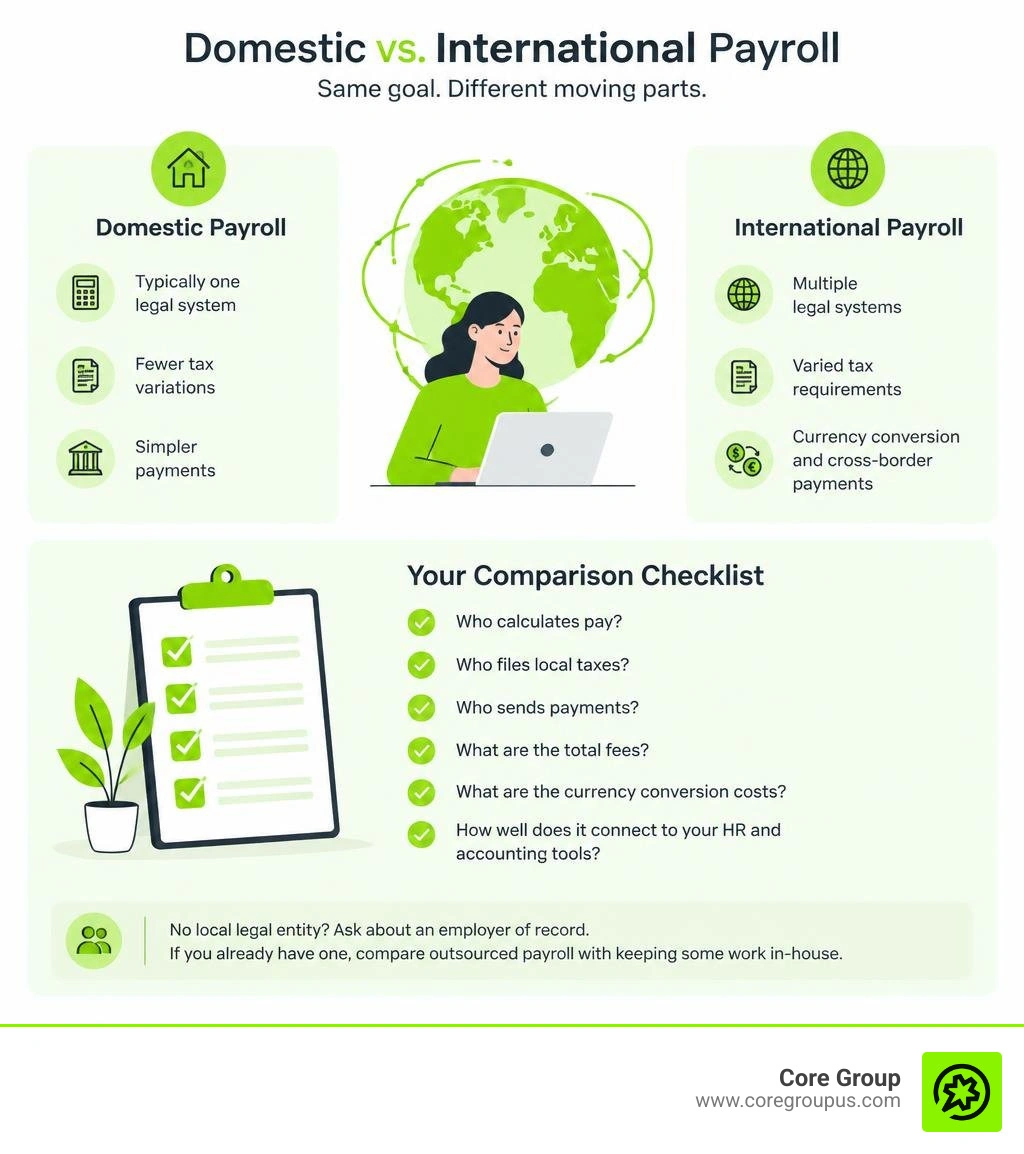
Compare international payroll services country by country. Check who calculates pay, files local taxes, and sends payments. Then compare total fees, currency conversion costs, and how well each service connects to your HR and accounting tools. If you do not have a local legal entity, ask whether you need an employer of record. If you do, compare outsourced payroll with keeping some work in-house.
For a growing creative team, the best fit is the one that can pay people on time without adding more work to your plate. I'm Christian Brim, and I'll help you sort through those choices.
International payroll services terms to learn include global payroll providers, payroll compliance for remote teams, and payroll management services. For broader context on how payroll systems operate across borders, the payroll entry on Wikipedia explains the core components of wage calculation, tax withholding, and record keeping.
Understanding International Payroll Services Global vs. Domestic Operations
When we manage payroll in our home country, we follow a single set of familiar rules. We calculate gross wages, deduct standard taxes, remit funds to local agencies, and transfer net pay into employee accounts. Expanding across international borders introduces an entirely different set of operational requirements.
International payroll involves managing onboarding, compensation, benefits, and tax filings across multiple countries. Each new market brings distinct corporate entity rules, worker protections, and statutory contribution mandates. Navigating these requirements effectively means understanding how global payroll diverges from domestic operations.
Key Structural Differences in International Payroll Services
The structural differences between domestic and global pay runs come down to regulatory variety. A domestic run relies on a unified framework. When you hire internationally, your business interacts with separate legal frameworks for every employee location.
These differences affect core administrative functions.
- Tax withholding frameworks. Domestic systems use standardized tax documentation. International systems require separate calculations for progressive income brackets, local municipal taxes, and unique national schemes.
- Mandatory contributions. Many international jurisdictions mandate employer payments toward national healthcare, retirement funds, disability protection, and unemployment systems.
- Statutory benefits. Standard benefits vary widely worldwide. Paid annual leave, 13th-month bonuses, mandatory sick pay, and parental leave follow statutory requirements rather than discretionary company policy.
- Worker classification definitions. Legal criteria separating contractors from permanent employees differ in every country. Misclassifying an international worker can lead to retroactive tax assessments and legal fines.
- Severance and termination mandates. Unlike at-will employment common in parts of the United States, most international jurisdictions require formal notice periods, statutory severance payouts, and government filings before terminating an employment contract.
Managing these moving parts demands strong internal oversight and continuous monitoring of payroll compliance for remote teams.
Critical Challenges in Cross-Border Payroll Management
Running international payroll introduces logistical and regulatory hurdles that can strain internal resources.
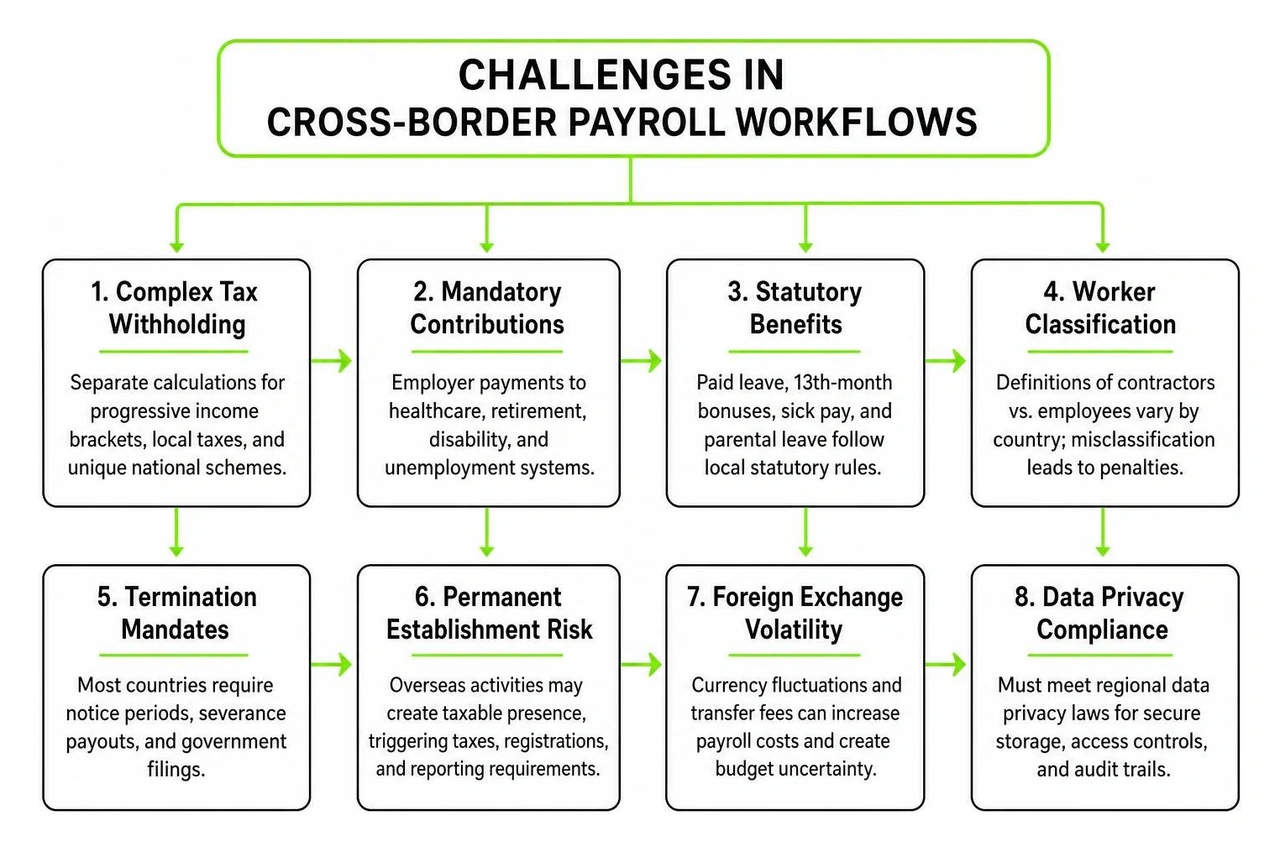
Permanent establishment risk is a major tax consideration. When an employee conducts revenue-generating activities abroad, local tax authorities may deem your business to have a permanent taxable presence. This triggers corporate income tax liabilities, local registration requirements, and separate financial reporting.
Foreign exchange volatility presents another recurring hurdle. Converting payroll funds into local currencies exposes your operating budget to exchange rate shifts and unpredictable bank transfer fees.
Data privacy standards also require strict technical controls. Handling international employee compensation means complying with complex regional regulations such as the General Data Protection Regulation in Europe and the California Consumer Privacy Act in the United States. Cross-border data transfers require secure storage, limited access permissions, and strict audit trails to prevent data leaks.
Maintaining payroll tax compliance across multiple state and national reporting systems requires reliable processes. When your business operates across different states and countries, coordinating filings without a unified process creates administrative bottlenecks.
How Global Payroll Works A Step-by-Step Operating Process
Processing global payroll follows a structured cycle that turns raw time and wage data into compliant, localized payments. While domestic payroll can take just hours, international processing runs typically require one to five business days depending on local banking schedules and currency clearing networks.
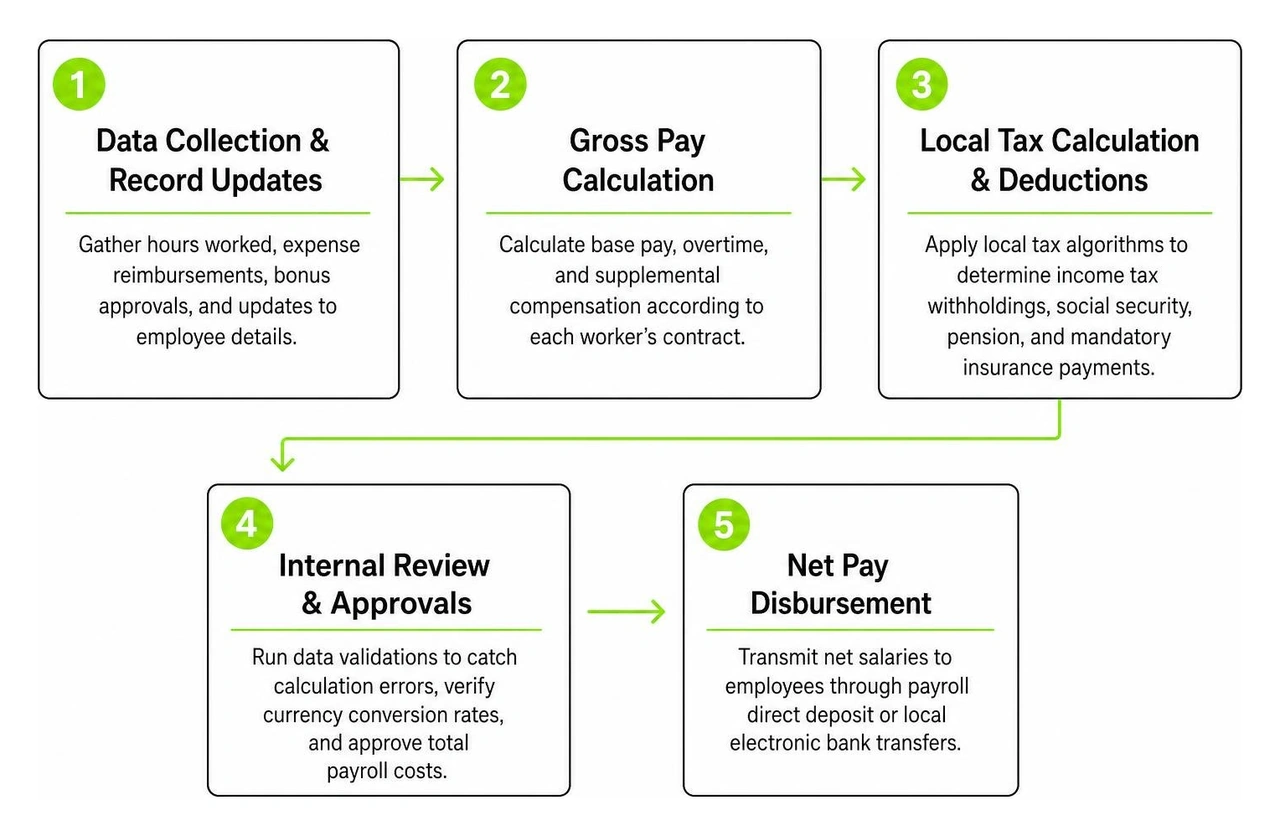
- Data collection and record updates. Gather hours worked, expense reimbursements, bonus approvals, and changes in employee details such as address or banking data.
- Gross pay calculation. Calculate base pay, overtime, and supplemental compensation according to each worker's employment contract.
- Local tax calculation and deductions. Apply local tax algorithms to determine income tax withholdings, social security contributions, pension deductions, and mandatory insurance payments.
- Internal review and approvals. Run data validations to catch calculation errors, verify currency conversion rates, and approve total payroll costs.
- Net pay disbursement. Transmit net salaries to employees through payroll direct deposit or local electronic bank transfers.
- Statutory remittances. Transfer withheld income taxes and employer contributions to national, regional, and municipal revenue agencies.
- Payslip delivery and record filing. Issue compliant, localized payslips to workers and archive digital payroll reports for annual accounting reconciliations.
Multi-Currency Handling and Foreign Exchange Workflows
Paying a global team requires sending funds across different banking networks and currencies. Handling multi-currency compensation involves more than simple conversions.
Modern systems use several strategies to control foreign exchange exposure.
- Real-time exchange rate integrations to reflect true conversion costs at the time of processing.
- Locked exchange rate arrangements to freeze conversion rates during the payroll review cycle, protecting gross payroll costs from sudden market movements.
- Centralized treasury funding, where you send a single lump-sum payment in your home currency, and the payroll engine disburses exact amounts in each worker's local currency.
- Local payment clearing rails to minimize intermediary banking wire fees and speed up delivery times.
Core Features of Modern International Payroll Services
Modern platforms rely on automation to handle the administrative load of global payroll operations.
Central calculation engines update automatically as tax laws, social contribution rates, and statutory benefits evolve in each jurisdiction. This setup protects businesses from relying on static spreadsheets that can quickly fall out of compliance.
Employee self-service portals let team members view their compensation history, download localized payslips, and adjust their personal data. Providing these portals in local languages improves clarity and reduces basic administrative inquiries.
Automated time-tracking integrations feed billable hours, overtime, and approved time-off directly into gross pay calculations. Pairing these workflows with integrated payroll and benefits tools ensures accurate calculations for health plans, retirement contributions, and paid leave.
Off-cycle payroll support provides the flexibility needed to issue one-off bonus payments, correct administrative errors, or settle final paychecks for departing employees without waiting for the next standard cycle.
Comparing Global Payroll Delivery Models In-House, Outsourced, Hybrid, and EOR
Choosing the right operating model depends on your corporate structure, head count in target markets, budget predictability, and internal compliance bandwidth.
| Payroll Model | Local Entity Required | Administrative Burden | Level of Direct Control | Best Suited For |
|---|---|---|---|---|
| In-House Payroll | Yes | High | Complete | Large teams with dedicated local HR and legal staff |
| Outsourced MCPO | Yes | Low to Moderate | Moderate | Businesses with local entities seeking managed execution |
| Hybrid Payroll | Yes in core markets | Moderate | High in key markets, low abroad | Companies with headquarters staff plus remote satellite hubs |
| Employer of Record | No | Low | Low to Moderate | Fast market entry without setting up foreign legal entities |
In-house payroll gives you direct control over your data and payment schedules. However, it requires your business to register a legal entity, open local corporate bank accounts, and maintain deep internal knowledge of local labor and tax laws. For creative firms expanding with small teams, the overhead of this approach can outweigh the benefits.
Multicountry payroll outsourcing, or MCPO, lets you keep your registered local entities while handing day-to-day calculation, tax filing, and payment execution to an external vendor. This option balances local compliance with reduced administrative strain.
Hybrid models combine both approaches. A company might run its domestic team in-house while outsourcing payroll operations for international satellite offices to specialized providers.
An Employer of Record, or EOR, acts as the legal employer for your international workers. The EOR handles employment contracts, tax withholdings, statutory benefits, and payroll execution on your behalf. This structure allows you to hire full-time international team members quickly without spending months establishing a foreign business entity.
Keeping Your Payroll Data Organized Across Systems
Managing a distributed workforce requires payroll data that stays organized and easy to reference. Isolating payroll data inside standalone spreadsheets creates reporting delays and increases data entry errors.
A well-organized payroll record keeps HR data, tax filings, and payment history aligned, so changes such as a salary increase, a tax withholding update, or an expense reimbursement are easy to trace.
Clean organization produces clear advantages.
- Fewer repetitive manual data entry tasks.
- Clearer labor costs, employer taxes, and benefit expenses that are easy to reference during financial reviews.
- Real-time labor cost visibility that helps you evaluate project profitability and manage department budgets effectively.
- Organized records of every change, approval, and transaction for annual financial reviews.
Keeping these payroll records well organized supports the kind of accurate bookkeeping that your broader financial picture depends on.
Scalability and Expansion into Emerging Markets
As your business grows, your payroll system should support that expansion without requiring a complete operational overhaul.
Expanding into new countries means adapting to local compliance requirements without disrupting current operations. A scalable setup lets you bring on new team members, manage contractor agreements, or convert independent contractors into full-time employees through standard workflows.
Centralizing your workforce data gives you an overview of total compensation, employer tax liabilities, and operational expenses worldwide. This visibility helps creative leaders make smart hiring decisions based on actual labor costs rather than guesswork.
Standardized review and approval processes maintain company-wide governance while letting local specialists handle country-specific calculations. This balance between global oversight and local flexibility keeps operations running smoothly as your team grows.
Best Practices for Selecting and Managing Global Payroll Providers
Selecting a partner for your global payroll operations requires looking beyond marketing claims. Payroll accuracy is a critical performance metric for distributed teams. Industry research indicates that only 33% of payroll professionals achieve an average accuracy rate of 90% or higher across all operating countries, down from 52% in earlier survey periods. Choosing a reliable provider is essential for protecting your bottom line and maintaining employee trust.
Use this evaluation framework when reviewing prospective partners.
- Assess actual country coverage. Confirm whether the provider owns local entities and processing engines in your target markets or relies entirely on unvetted third-party subcontractors.
- Verify local compliance expertise. Ensure the vendor maintains in-country legal and tax specialists who track regulatory updates and adjust system calculations automatically.
- Review data security standards. Look for strong data protection certifications, including SOC reports, end-to-end data encryption, and full compliance with GDPR and relevant regional privacy laws.
- Examine integration capabilities. Make sure the system connects directly with your existing time-tracking, accounting, and HR platforms via secure connections.
- Review service level agreements. Check guaranteed turnaround times for monthly pay runs, emergency off-cycle runs, and employee support inquiries.
- Evaluate pricing transparency. Look for clear pricing structures without unexpected fees for onboarding, off-boarding, currency conversions, or standard year-end tax reporting.
A structured evaluation process ensures you choose a partner that supports compliant payroll management across every market you enter.
Common Implementation Pitfalls and Compliance Risks to Avoid

Many businesses encounter preventable issues when launching international payroll systems. Identifying these risks early keeps your expansion plans on schedule.
Worker misclassification remains one of the most common and expensive errors. Treating an international worker as an independent contractor when their daily duties, working hours, and supervision match full-time employment can lead to back taxes, unpaid statutory benefits, and significant legal penalties.
Registration and setup delays can leave new hires waiting weeks for their first paycheck. Setting up local tax registrations, establishing corporate bank accounts, and verifying employee documentation often takes longer than expected. Planning these steps ahead of your hiring timelines prevents onboarding delays.
Relying on fragmented data silos creates blind spots across your business. When HR details, time cards, and payroll records live in separate spreadsheets, calculation mistakes and missed statutory filing deadlines become far more common.
Overlooking shadow payroll rules can create surprise liabilities. When domestic employees work abroad temporarily, they may become subject to host-country payroll taxes while remaining on their home-country payroll, creating reporting obligations in both locations.
Frequently Asked Questions About Global Payroll
How do global payroll systems manage multi-currency conversions and foreign exchange risk?
Modern global payroll platforms use real-time exchange rates, automated conversion tools, and locked foreign exchange windows. These features freeze conversion rates during payroll approvals, shielding your operating accounts from sudden market swings.
Many systems let you fund payroll through a single home-currency transaction, then distribute net pay locally through regional banking networks to reduce international wire fees and delays.
Can businesses pay international workers without opening a local legal entity?
Yes. Businesses can hire and pay international workers without establishing a foreign entity by partnering with an Employer of Record. The EOR acts as the worker's legal employer for tax filings, statutory benefits, and local payroll execution.
Meanwhile, your company manages their daily responsibilities, performance goals, and project assignments.
How long does international payroll implementation take when entering new countries?
Implementation timelines vary based on your chosen operating model and target markets. Using an Employer of Record can get international workers onboarded and on payroll within a few business days to two weeks.
In contrast, setting up a new foreign business entity, establishing local bank accounts, and registering with regional tax authorities typically takes anywhere from two to six months.
Conclusion
Managing a distributed workforce gives creative businesses access to exceptional talent worldwide, but cross-border compensation introduces real operational complexity. Between navigating foreign tax laws, maintaining accurate statutory deductions, and managing foreign exchange volatility, payroll demands disciplined systems and ongoing oversight.
At Core Group, we help creative entrepreneurs simplify their back-office operations and implement practical financial systems. Our profit-first playbook provides reliable financial management, accurate bookkeeping, and comprehensive tax guidance, giving you peace of mind so you can focus on building your business.
Every service we deliver is designed to protect your time and support long-term profitability, backed by our MacBook Pro guarantee. Explore our payroll services small business guide 2026 to see how straightforward, compliant payroll can support your team's ongoing growth.