A Comprehensive Guide to Comparing Payroll Service Providers
Compare Payroll Management Services Before Errors Cost You
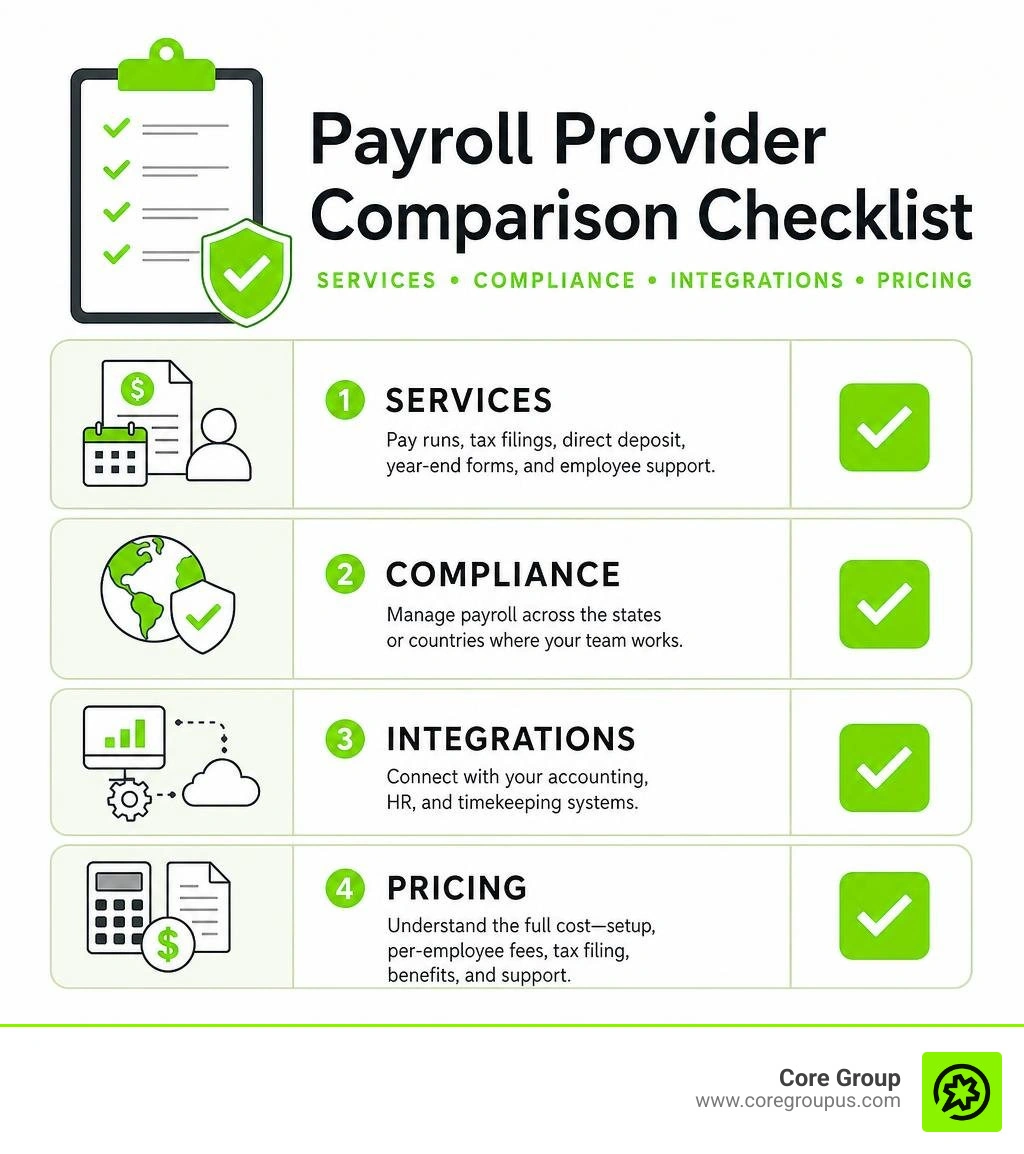
The right payroll management services should save time, file required payroll taxes, pay workers accurately, and connect with your time tracking and accounting tools. When comparing providers, focus on four things
- What they handle such as pay runs, tax filings, direct deposit, year-end forms, and employee support
- How they manage compliance across the states or countries where your team works
- Whether they integrate with your existing accounting, HR, and timekeeping systems
- The full cost including setup, per-employee fees, tax filing, benefits, and support
This matters because payroll mistakes are common. Industry research estimates that 1 in 5 payrolls contains an error. For a busy creative business, one missed overtime rule, incorrect tax withholding, or late filing can distract you from client work and put cash flow under pressure.
Outsourcing can reduce that burden, but providers use very different models. Some simply process payroll. Others add HR support, co-employment through a PEO, or international hiring through an employer of record. This guide will help you compare the tradeoffs and choose a fit for your team.
I am Christian Brim, and I help creative entrepreneurs build clearer financial systems so they can spend less time worrying about operations and more time doing their best work.
Related content about payroll management services
Key Benefits of Modern Payroll Management Services
Managing payroll manually might feel manageable when you only have a couple of contractors or one full-time employee. As your creative agency or studio grows, processing paychecks, tracking tax jurisdictions, and calculating deductions quickly turns into an operational bottleneck. Business owners often find that spending hours in spreadsheets takes them directly away from client delivery and revenue-generating projects.
Industry data shows that businesses achieve an average of 18% savings on administrative costs when they outsource their payroll functions. By shifting payroll operations to dedicated specialists, you eliminate manual calculation errors, ensure timely statutory tax submissions, and reclaim valuable executive hours.
Setting up small business direct deposit creates a predictable pay schedule that builds trust across your team. Modern platforms also provide specialized payroll for smb operations that automate wage calculations, withhold standard payroll taxes, and distribute electronic pay statements instantly.

Hidden Risks and Costs of In-House Processing
Running payroll in-house carries substantial hidden costs that extend far beyond the price of simple calculation software. When you process wages manually, a single miscalculated overtime rate, missed local tax filing deadline, or incorrect benefit deduction can trigger steep statutory penalties from state and federal revenue agencies.
Keeping your payroll aligned with current bookkeeping requirements demands constant attention. Following a comprehensive payroll bookkeeping complete guide 2026 helps prevent reconciliation errors between your wage reports and general ledger accounts. Using a reliable paycheck calculator with overtime ensures that non-exempt workers receive proper compensation under the Fair Labor Standards Act, helping you avoid wage disputes and administrative audits.
Strategic Value of Scalable Payroll Management Services
As creative businesses expand, their operational complexity compounds. You might start by hiring remote designers across multiple states, onboarding freelance copywriters, and introducing tiered healthcare benefits. A scalable payroll system adapts to these shifts without requiring additional administrative headcount.
Reviewing a detailed payroll services small business guide allows you to select solutions that offer self-service employee portals. These portals empower team members to download Form W-2s, update direct deposit accounts, and check leave balances independently. Aligning your internal systems with dedicated hr and payroll for small business frees leadership teams to focus on strategic growth and creative direction rather than answering repetitive administrative questions.
Comparing Payroll Delivery Models and Outsourcing Frameworks
Payroll service providers operate under distinct delivery models. Finding the best solution depends on whether you want standalone processing software, shared legal employer responsibilities, or international hiring capabilities.
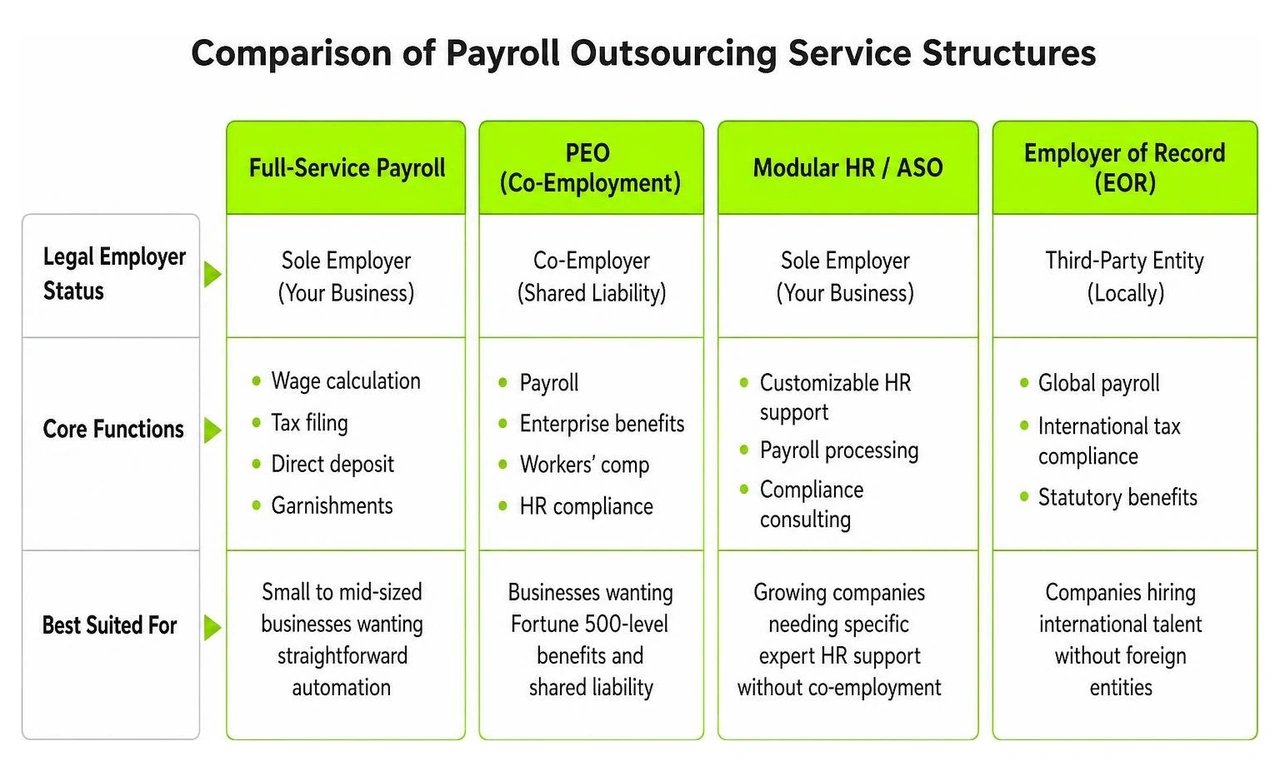
| Model Type | Legal Employer Status | Core Functions | Best Suited For |
|---|---|---|---|
| Full-Service Payroll | Sole Employer (Your Business) | Wage calculation, tax filing, direct deposit, garnishments | Small to mid-sized businesses wanting straightforward automation |
| PEO (Co-Employment) | Co-Employer (Shared Liability) | Payroll, enterprise benefits, workers' comp, HR compliance | Businesses wanting Fortune 500-level benefits and shared liability |
| Modular HR / ASO | Sole Employer (Your Business) | Customizable HR support, payroll processing, compliance consulting | Growing companies needing specific expert HR support without co-employment |
| Employer of Record (EOR) | Third-Party Entity (Locally) | Global payroll, international tax compliance, statutory benefits | Companies hiring international talent without foreign entities |
Full-Service Payroll and Administrative Service Options
Full-service payroll providers manage the entire transactional payroll cycle. They calculate gross wages, deduct appropriate statutory taxes, process direct deposits, manage wage garnishments, and submit quarterly tax returns on your behalf.
Utilizing dedicated employee payroll services ensures your business remains the sole employer of record while eliminating manual payment workflows. These systems represent practical sme payroll solutions for agencies that already have internal HR policies but need automated tax calculation and filing reliability.
Professional Employer Organizations and Modular HR Services
A Professional Employer Organization operates under a co-employment model where payroll taxes are filed under the PEO's Employer Identification Number. This shared relationship allows small creative agencies to access enterprise-grade group health insurance rates, 401k plans, and pay-as-you-go workers' compensation policies that are normally reserved for massive corporations. Studies show that partnering with an established PEO can save approximately 234K in HR time over three years.
Combining payroll and benefits into a single system simplifies deductions and carrier reconciliations. If you prefer to avoid co-employment, modular payroll hr services small business 17ba8 packages let you outsource payroll tax filing and compliance while retaining complete independence as the sole employer.
Employer of Record Solutions for Global Hiring
When hiring international creative talent, establishing a legal foreign business entity can take six to twelve months and cost thousands of dollars. An Employer of Record legally hires workers in foreign countries on your behalf, handling local statutory benefits, employment contracts, and tax withholding.
Selecting top-tier global payroll providers ensures that your distributed team members receive timely salary payments in their local currencies. Using secure payroll direct deposit networks across borders keeps cross-border compensation compliant without requiring separate local legal counsel in every country where you source talent.
Navigating Tax Compliance and State Level Employment Regulations
Payroll compliance involves navigating a web of federal income tax withholdings, FICA payments, Federal Unemployment Tax, state unemployment contributions, and local municipality taxes. Missing a single local tax registration can lead to automatic tax lien notices and frozen operational accounts.
Maintaining total payroll tax compliance requires staying informed about statutory updates. Many agencies consult official standards, such as state government payroll standards, to understand statutory timelines for pay distributions, tax remittance deadlines, and official recordkeeping mandates.
Multi-State Regulatory Shifts and Regional Compliance Mandates
As creative firms embrace flexible and remote work arrangements, managing payroll across state borders introduces significant compliance hurdles. Different states maintain distinct labor mandates that affect day-to-day wage calculations.
For instance, Maine requires employers with 10 or more workers to provide reporting time pay when non-exempt employees are sent home early due to canceled shifts. Maine also expanded its earned paid leave rules for businesses with 11 or more staff members, allowing employees to accrue leave hours on top of carried-over balances. Meanwhile, IRS standard mileage rates periodically adjust to reflect changing transportation costs, directly altering employee travel reimbursements.
Managing distributed workers requires comprehensive payroll compliance for remote teams to prevent tax nexus issues. If you operate in highly regulated states, reviewing a dedicated payroll services california guide helps you stay compliant with rigorous overtime structures, daily double-time rules, and mandatory paid sick leave requirements.
Managing Global Payroll Regulations and Multi-Currency Processing
Operating internationally introduces complex statutory benefit structures, mandatory thirteenth-month pay bonuses, and foreign exchange risks. Global managed payroll providers help cross-border organizations navigate local labor rules while executing accurate foreign currency disbursements.
Domestically, business entity structure also dictates how business owners pay themselves. Following established s-corp payroll rules ensures that agency owners take reasonable W-2 compensation before taking shareholder distributions, protecting the business from costly IRS payroll tax reclassification audits.
Essential Technology and Software Integrations in Payroll
Modern payroll platforms function as central hubs for workforce data. Instead of keeping time tracking, expense receipts, and payroll entries in separate software silos, modern platforms synchronize employee records across your entire administrative stack.
Connecting payroll directly to your human resources system ensures that new hires, salary adjustments, and benefit changes reflect immediately on pay runs. You can learn more about aligning administrative systems in our guide on payroll management in hr.
Automation and AI in Contemporary Payroll Management Services
Modern payroll technology utilizes artificial intelligence and automated anomaly detection to spot discrepancies before funds leave your company bank account. These automated checkpoints check for duplicate timesheet entries, unapproved overtime hours, missing tax withholding forms, and sudden wage calculation spikes.
Following an up-to-date online payroll guide small business 2026 will help you identify software providers that include automated gross-to-net calculations and digital tax filing verification directly in their base packages.
Accounting and Time Tracking Software Integrations
To keep your general ledger balanced, your payroll software must communicate seamlessly with your bookkeeping platform. Direct mapping between payroll line items and your chart of accounts ensures that wage expenses, employer tax liabilities, and benefit deductions sync accurately without manual journal entries.
Even if you are managing a small business payroll one employee setup, automated general ledger syncing prevents hours of manual bookkeeping reconciliation at month end. For specialized solo setups and micro-agencies, implementing structured micro business payroll workflows ensures that digital timecards, paid time off accruals, and client billable hours flow directly into every scheduled pay run.
How to Evaluate and Choose a Payroll Provider
Selecting the right payroll partner requires assessing your agency's specific size, growth projections, and operational complexity. Use the following criteria during your vendor evaluation process
- Pricing Transparency. Look for clear base monthly subscription fees paired with predictable Per Employee Per Month (PEPM) or Per Contractor Per Month (PCPM) rates. Watch out for hidden fees for year-end Form W-2 generation, multi-state tax registrations, or out-of-cycle payroll runs.
- Tax Filing Guarantee. Verify that the provider takes full responsibility for calculating, withholding, and remitting local, state, and federal taxes on time, backed by penalty protection.
- System Integrations. Ensure the platform integrates natively with your existing accounting tools, time-tracking software, and project management platforms.
- Support Responsiveness. Evaluate customer service availability. When a payroll calculation issue occurs on payday, you need immediate access to dedicated payroll specialists via live phone or chat.
- Implementation Timeline. Determine how quickly the provider can migrate historical employee wage records and tax data without interrupting scheduled pay cycles.
If you operate a non-commercial entity, exploring payroll for small nonprofit options can reveal specialized discounts and reporting features tailored for grant-funded organizations. Additionally, founders often ask does anyone offer free payroll services for very small businesses, but completely free platforms usually lack automated tax filing, leaving you fully exposed to compliance liabilities.
Frequently Asked Questions About Payroll Solutions
How do payroll service providers ensure multi-state tax compliance?
Payroll service providers maintain automated tax calculation engines that update whenever local, state, or federal tax laws change. When an employee moves to a new state or works remotely across state borders, the software applies the appropriate state withholding rates, tracks local municipality taxes, and submits statutory quarterly tax filings to the relevant state revenue agencies automatically.
What is the primary difference between full-service payroll and a PEO?
The primary difference lies in the legal employment relationship. With full-service payroll, your business remains the sole employer of record, and all payroll taxes are filed under your company's Employer Identification Number. Under a PEO arrangement, you enter a co-employment relationship where payroll taxes are reported under the PEO's identification number, giving your business access to large-group healthcare rates and shared HR liability.
When should a growing business switch from in-house processing to outsourced payroll?
A business should switch to outsourced payroll as soon as manual calculations begin consuming valuable leadership hours, when hiring workers in multiple tax jurisdictions, or when introducing complex employee benefits. Outsourcing is especially critical if you have experienced tax filing notices, calculation errors, or missed reporting deadlines.
Conclusion
Managing payroll shouldn't drain your creative energy or distract you from building a thriving business. When you partner with Core Group, we deliver financial management, bookkeeping, and tax advisory designed specifically for creative entrepreneurs. Our no-fluff, profit-first playbook provides total peace of mind and saves you administrative time, allowing you to focus on your clients and craft with absolute confidence. We stand firmly behind our commitment to your financial clarity, backed by our MacBook Pro guarantee.
To explore more strategies for streamlining your wage operations and building a sustainable business foundation, read our complete payroll services small business guide 2026 and take control of your company's financial future today.