The Mystery of IRS Code 806 Solved
What IRS Code 806 on Your Transcript Actually Tells You
If you have ever wondered what does code 806 mean on irs transcript pages, here is the short answer.
IRS Code 806 is a credit for federal income tax withheld from your wages during the year. It shows the total amount your employer (or payers) sent to the IRS on your behalf, as reported on your W-2 or 1099 forms. It is not a refund, and it does not mean your refund has been approved.
Quick answer at a glance
| What you see | What it means |
|---|---|
| Code 806 on your transcript | Federal tax withheld from your income and credited to your account |
| Negative amount next to Code 806 | A credit in your favor, reducing what you owe |
| Positive amount next to Code 806 | A reversal or adjustment to a prior withholding credit |
| Code 806 alone | Does not confirm a refund is coming |
Seeing a three-digit code on your transcript when you are expecting a refund update is frustrating, especially if you are a creative entrepreneur trying to stay focused on your work rather than IRS paperwork. Code 806 is one of the most common codes people encounter, and it is almost always routine. But understanding what it does and does not mean can save you a lot of unnecessary stress.
What Does Code 806 Mean on IRS Transcript
When you download your official account transcript from the IRS website, you are looking at a chronological log of everything that has happened to your tax account for a specific year. Every transaction, from the moment you file your return to the day a refund is sent, is marked by a specific three-digit code.
The official IRS title for transaction code 806 is Credit for Withheld Taxes and Excess FICA. This code simply records the total amount of money that was withheld from your paychecks, gig work, or other income sources throughout the tax year and sent to the federal government as prepayments.
For a deeper dive into how this fits into your overall tax planning, you can read our detailed breakdown on IRS Code 806 Meaning.
When you work as an employee, your employer takes a portion of your earnings every pay period and sends it to the IRS. This process is documented on your Form W-2. If you are a freelancer or creative business owner who receives certain payments, you might also have tax withheld on various Form 1099 documents. Additionally, if you worked multiple jobs and earned over the social security wage limit, you might have paid too much into social security. This excess is known as excess FICA, and it is also grouped under this exact same code.
Essentially, Code 806 tells you that the IRS has officially logged these withholdings and credited them to your tax account. It is their way of saying, we received the prepayments you made throughout the year.
Answering What Does Code 806 Mean on IRS Transcript
To understand this code on a practical level, think of it as a receipt for your wage withholding. Throughout the year, you do not actually pay your income taxes in one giant lump sum. Instead, you make continuous prepayments through paycheck withholdings.
When you file your annual tax return, the IRS calculates your actual tax liability. To find this number on your Form 1040, you can look at page 2, line 25d. This line shows the total federal income tax withheld from your forms W-2 and 1099.
Once the IRS processes your return, they match the withholding reported on your Form 1040 with the information sent to them by your employers. When those numbers align, Code 806 is posted to your transcript. The amount shown next to Code 806 represents this total credit balance. It acts as a massive deposit into your tax account that will be used to pay off the taxes you owe for the year.
Why What Does Code 806 Mean on IRS Transcript Matters for Your Refund
Many taxpayers get excited when they see a large number next to Code 806, thinking it represents their approved refund. However, this is a common misunderstanding.
Your actual refund calculation is a multi-step math problem. Code 806 is just one part of that equation. It represents the money you already paid, not the money you are getting back.
To determine whether you get a refund or owe a balance, the IRS subtracts your total tax liability from your total credits. Your credits include your paycheck withholdings (Code 806) plus any other refundable tax credits you might qualify for, such as the Child Tax Credit or Earned Income Credit.
If your total credits are greater than your tax liability, you have a credit posting in your favor, which results in a refund. If your credits are less than what you owe, you will have an outstanding account balance that must be paid.
Therefore, while Code 806 is a crucial step toward getting a refund, the code itself does not guarantee one. It is simply the record of your prepayments.
How Code 806 Interacts With Other Transcript Codes
Your IRS transcript is best read as a timeline. Instead of looking at Code 806 in isolation, you should look at how it interacts with the other three-digit codes around it.
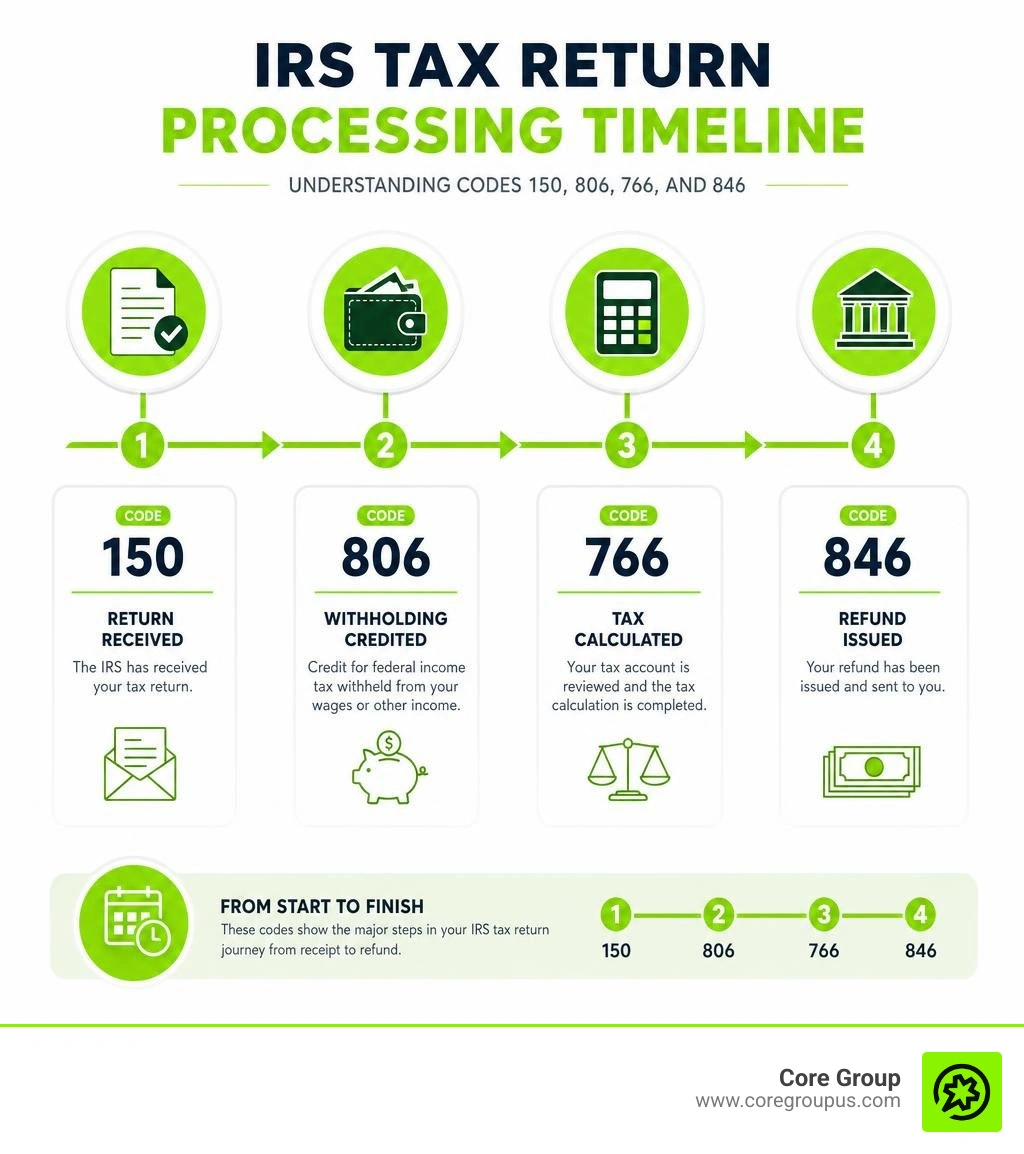
To help you make sense of this sequence, we have put together a table comparing the most common codes you will see during standard return processing.
| Transaction Code | What It Represents | Action Required |
|---|---|---|
| Code 150 | Tax Return Filed and Tax Assessed | None, indicates your return has been processed |
| Code 806 | Credit for Withheld Taxes and Excess FICA | None, confirms your paycheck withholdings are logged |
| Code 766 | Credit Allowed | None, represents refundable credits like the Child Tax Credit |
| Code 846 | Refund Issued | None, indicates your refund has been approved and sent |
| Code 570 | Additional Review or Temporary Hold | Wait for IRS letter or review, indicates a processing delay |
For a broader look at how other credits are applied to your account, check out our guide on IRS Code 766.
The Relationship Between Code 150 and Code 806
When the IRS processes your tax return, one of the very first codes to appear is Code 150. This code stands for Tax Return Filed and Tax Assessed. The dollar amount next to Code 150 is your actual tax liability for the year, which is the amount of money you owe the government before any withholdings or credits are factored in.
Immediately following or alongside Code 150, you will typically see Code 806. This creates a transaction sequence that determines your final account balance.
For example, if your Code 150 shows a tax liability of 3,000 dollars, and your Code 806 shows a withholding credit of 10,000 dollars, the IRS will apply that 10,000 dollars against your 3,000 dollars liability. This leaves you with a credit balance of 7,000 dollars in your favor.
Moving From Code 806 to Code 846 Refund Issued
Once your tax liability (Code 150) and your withholdings (Code 806) are matched and processed, the IRS will determine if you are owed a refund. If everything is correct and there are no holds on your account, the system will generate the highly anticipated Code 846.
Code 846 stands for Refund Issued. This is the official confirmation that your refund has been approved. The date listed next to Code 846 is the day the IRS plans to send your direct deposit or mail your paper check.
For more details on what to expect during this stage, you can read our guide on 846 Refund Issued.
Generally, you can expect to see Code 846 post to your transcript within one to three weeks after Code 806 appears, assuming your return goes through standard processing without any complications.

Understanding Negative and Positive Amounts Next to Code 806
One of the most confusing parts of reading an IRS transcript is the way the IRS uses positive and negative numbers. In standard accounting, a negative number usually means you owe money or are in the red. However, the IRS uses a different sign convention on tax transcripts.
On an IRS transcript, a negative number represents a credit in your favor. Because Code 806 is a credit for taxes you have already paid, the dollar amount next to it will almost always be displayed as a negative number. This negative balance reduces your overall tax liability.
For instance, if you see -5,000.00 next to Code 806, it means you have a 5,000 dollars credit sitting in your account.
On rare occasions, you might see a positive amount next to Code 806. This indicates a withholding reversal or an account adjustment. A positive number means the IRS has removed some of the withholding credit previously applied to your account.
This can happen if your employer submitted a corrected form to the IRS that lowered your reported withholding, or if the IRS found an error during processing. If the IRS assesses additional taxes or adjusts your account, you might also see other codes like Code 290. You can learn more about how these adjustments work in our article on 290 Additional Tax Assessed.
What to Do If Your Code 806 Amount Is Incorrect
If you review your transcript and notice that the amount next to Code 806 does not match the withholding listed on your W-2 or 1099 forms, you have a withholding mismatch. This is a common issue that can trigger a refund delay, often marked by a Code 570 hold on your transcript.
A mismatch usually happens because of an employer error, such as a typo in the employer identification number, a duplicate Social Security number entry, or a delay in submitting payroll data to the Social Security Administration.

If you find an error, here are the actionable steps you should take.
First, gather all of your W-2 and 1099 forms and manually sum the federal income tax withheld from Box 2 on each form. Compare this total to the amount shown next to Code 806.
Second, if the error is on your employer's end, contact them immediately and request a Form W-2c, which is a corrected wage and tax statement.
Third, if your employer is uncooperative or cannot issue the corrected form quickly, you can contact the IRS for assistance. You can also file Form 4852, which serves as a substitute for Form W-2, to report your correct withholding.
Fourth, if you have already filed your return with incorrect numbers, you may need to wait for the IRS to finish their review or file an amended return using Form 1040-X once the original return has fully processed.
Understanding the timing of these updates can be easier when you understand how the IRS schedules its processing cycles. To learn more, read our IRS Cycle Code Complete Guide.
Frequently Asked Questions About IRS Transcript Codes
Does Code 806 mean my refund is approved
No, Code 806 does not mean your refund is approved. It only confirms that the IRS has credited your account for the federal income taxes withheld from your wages during the year. Your return is still pending review during this stage. Your refund is not officially approved until you see Code 846 (Refund Issued) on your transcript.
Why does Code 806 show a future date
It is very common to see a future date listed next to Code 806, often April 15 of the current filing year. This is simply an IRS processing convention. The IRS treats all wage withholdings as if they were paid on the standard return due date, regardless of when your employer actually sent the money. If you filed for an extension, this date might reflect your extension date instead.
Can Code 806 appear multiple times on a transcript
Yes, Code 806 can appear multiple times on a single transcript. This usually happens if you had multiple employers throughout the year, if your employers submitted corrected forms at different times, or if the IRS had to make subsequent withholding adjustments to your account.
Conclusion
Understanding the details of your IRS transcript can feel like trying to solve a mystery, but codes like Code 806 are actually there to give you clarity. By showing you exactly how much withholding has been credited to your account, Code 806 helps you verify that your prepayments have been properly logged.
For a complete overview of this specific code, make sure to visit our comprehensive guide on IRS Code 806 Meaning.
At Core Group, we know that creative entrepreneurs would rather spend their time building their businesses than decoding IRS transaction sequences. That is why we offer a comprehensive, profit-first playbook designed to handle your bookkeeping, financial management, and tax services with absolute simplicity. We give you total peace of mind, backed by our MacBook Pro guarantee, so you can focus on what you do best.
If you are ready to stop stressing over tax transcripts and start scaling your creative business, let us handle the numbers for you.