The Ultimate Overtime Tax Planning Guide for Modern Consultants
What Marketing Consultants Need to Know About Overtime Tax Planning in 2026
Marketing consultant overtime tax planning got a lot more interesting in 2025, when the One Big Beautiful Bill Act (OBBBA) introduced a brand-new federal deduction for qualified overtime pay under IRC Section 225.
Here is a quick answer to what this means for you.
Key overtime tax deduction facts for 2026
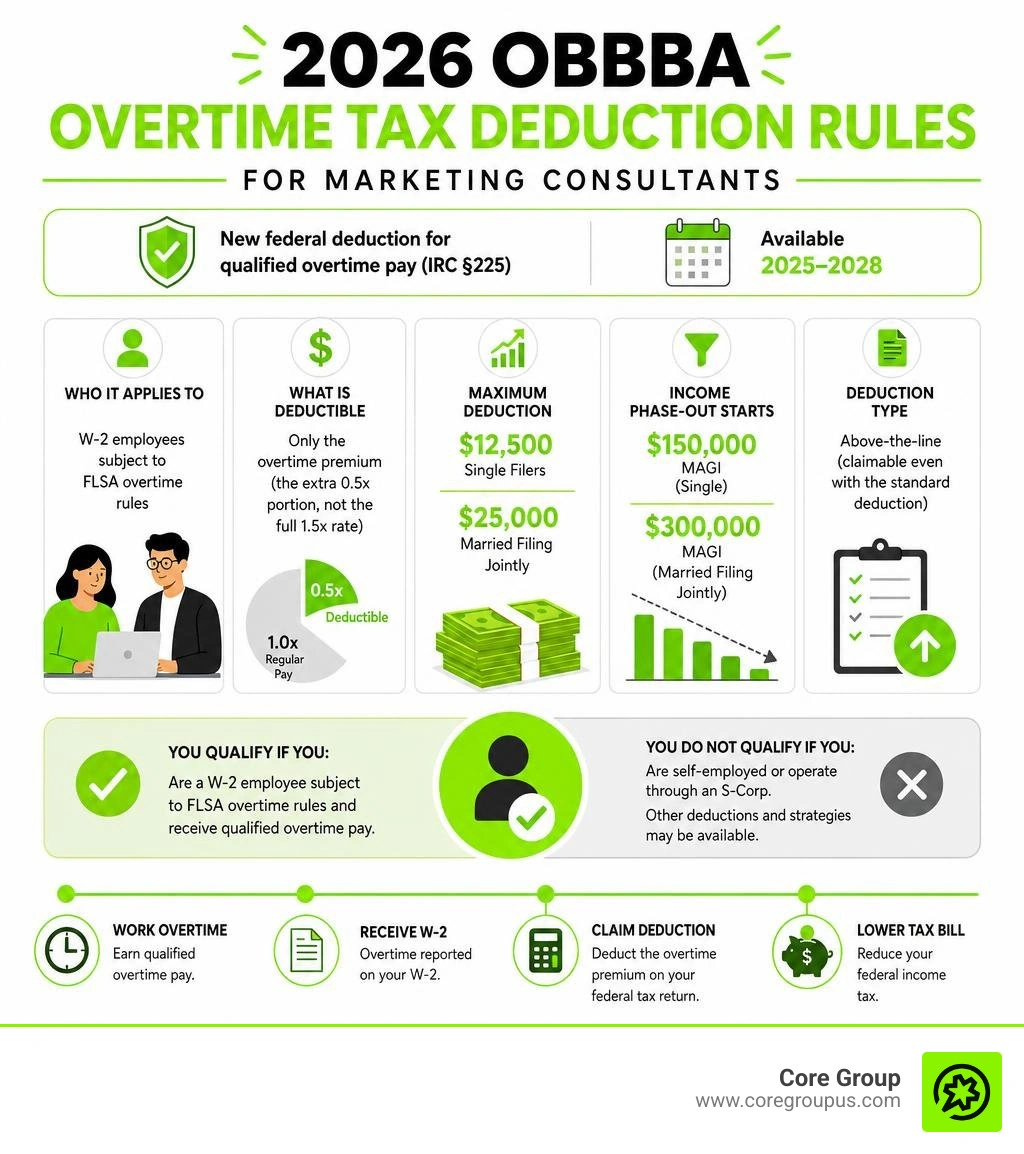
| Who it applies to | W-2 employees subject to FLSA overtime rules |
|---|---|
| What is deductible | Only the overtime premium (the extra 0.5x portion, not the full 1.5x rate) |
| Maximum deduction | $12,500 for single filers, $25,000 for married filing jointly |
| Income phase-out starts | $150,000 MAGI (single) or $300,000 MAGI (married filing jointly) |
| Deduction type | Above-the-line (claimable even with the standard deduction) |
| Available tax years | 2025 through 2028 |
| Self-employed consultants | Do not qualify, but have access to other powerful deductions |
If you are a marketing consultant working as a W-2 employee at a creative agency, this deduction can meaningfully reduce your federal tax bill. If you are self-employed or operating through an S-Corp, the rules are different but there are still strong strategies available to you.
The challenge is that most creative professionals are focused on their work, not their tax code. Payroll rules, MAGI thresholds, and IRS compliance requirements can feel overwhelming alongside a full client workload.
This guide breaks it all down in plain language, so you can take action with confidence.
Here is some helpful reading on marketing consultant overtime tax planning.
The Essentials of Marketing Consultant Overtime Tax Planning

Navigating the tax landscape as a creative professional requires a clear understanding of how new legislation affects your hard-earned income. The passage of the One Big Beautiful Bill Act introduced a unique way for W-2 professionals to keep more of their late-night earnings. However, the application of this law depends heavily on how your business is structured and how your hours are billed.
When we look at overtime tax rates, we find that many consultants mistakenly believe their extra hours are automatically taxed at a higher rate. In reality, your marginal tax bracket determines the tax rate on your overtime income. The new federal deduction under the OBBBA helps mitigate this tax hit by allowing you to deduct a portion of your overtime earnings directly from your federal taxable income.
To make the most of this opportunity, you must understand what qualifies as deductible overtime. The law does not exempt your entire overtime paycheck from taxes. Instead, it targets the specific premium portion of your compensation. For a deeper dive into these mechanics, you can review our comprehensive overtime tax deduction guide to see how these savings accumulate over the course of the year.
How Marketing Consultant Overtime Tax Planning Works for W2 Employees
For marketing consultants who operate as W-2 employees at creative agencies, the path to claiming this deduction is relatively straightforward. You must be classified as a non-exempt employee under the Fair Labor Standards Act. When you work more than 40 hours in a single workweek, your employer must pay you at least 1.5 times your regular hourly rate.
The OBBBA deduction specifically targets the premium portion of this pay. This means only the extra 0.5x portion of your time-and-a-half pay is eligible for the deduction. The base 1.0x hourly rate remains subject to standard federal income taxes.
To help visualize how this looks in practice, you can use the no tax on overtime calculator to estimate your potential savings. That while the federal income tax on this premium is deductible, you and your employer must still pay standard FICA taxes, including Social Security and Medicare, on the entire amount.
Why Self Employed Strategists Need Marketing Consultant Overtime Tax Planning
If you are an independent contractor or a sole proprietor filing Schedule C, the rules are very different. Because self-employed individuals do not have an employer-employee relationship under the FLSA, they cannot technically pay themselves overtime. This means the direct OBBBA overtime deduction is unavailable to self-employed strategists.
However, this does not mean you are out of luck. Self-employed consultants can utilize other powerful strategies to achieve similar tax-saving results. By focusing on smart consultant financial management, you can structure your business to minimize your overall tax liability. This includes exploring an S-Corporation election, which allows you to split your business income between W-2 salary and shareholder distributions, potentially lowering your self-employment tax burden.
To find other ways to reduce your taxable income, we recommend reviewing our consultant tax deductions guide. Additionally, you can consult the Schedule C guide to make sure you are capturing every quiet digital deduction available to modern strategists, such as software subscriptions and home office expenses.
Qualifying for the One Big Beautiful Bill Act Overtime Deduction
To qualify for the new overtime deduction, you must meet specific income limits and filing requirements. The federal government designed this deduction to support middle-income earners, meaning the benefits begin to disappear once your income reaches certain thresholds.
The table below outlines the maximum deduction limits and the income levels where the phase-out rules begin to apply.
| Filing Status | Maximum Annual Deduction | MAGI Phase-Out Threshold | Complete Phase-Out Limit |
|---|---|---|---|
| Single or Head of Household | $12,500 | $150,000 | $275,000 |
| Married Filing Jointly | $25,000 | $300,000 | $550,000 |
Please note that married couples filing separately are disqualified from claiming this deduction. To claim the deduction, you must file a joint return if you are married, and you must have a valid Social Security Number on file with the IRS.
Income Thresholds and Phase Out Calculations
The phase-out of the overtime deduction is calculated based on your Modified Adjusted Gross Income. For every $1,000 of MAGI you earn above the threshold, your allowable deduction is reduced by $100. This gradual reduction ensures that high-earning consultants do not receive the full benefit of the deduction if their total income exceeds the comfort zone set by Congress.
For example, if a single marketing consultant has a MAGI of $160,000, they are $10,000 over the phase-out threshold. Applying the phase-out rate of $100 for every $1,000 over the limit, their maximum deduction of $12,500 would be reduced by $1,000, leaving them with an eligible deduction of $11,500.
State tax laws also play a role in your overall planning. For instance, you should check how your specific state conformed to these federal changes. While the federal government offers this deduction, states like California or Delaware may still tax the overtime premium at their standard state rates. You can review resources like the Delaware business tax guide or check specific updates such as the Alabama tax updates and the Alaska overtime tax exemption to see how your state handles these rules.
Eligible Overtime Compensation vs Base Wages
It is critical to distinguish between your regular base wages and your qualified overtime premium. The OBBBA deduction applies only to the premium rate mandated by the FLSA for hours worked beyond 40 in a workweek.
If your regular hourly rate is $40 per hour, your overtime rate is $60 per hour. Under the new law, the $40 base rate is still taxed as regular income. Only the extra $20 premium portion is eligible for the deduction.

This distinction means you cannot simply classify your entire overtime paycheck as tax-free. You must keep precise track of the premium portion of your earnings to ensure your tax return is accurate and compliant.
Documentation and Compliance for Creative Agencies
For creative agencies employing marketing consultants, the new overtime rules bring a significant administrative burden. While the deduction benefits the employee, the responsibility for accurate tracking and reporting falls squarely on the employer.
Agencies must ensure their payroll systems are configured to separate regular wages from overtime premiums. Failure to do so can lead to reporting errors, penalties, and potential litigation. To navigate these complexities, many agencies partner with professionals for marketing agency accounting to keep their financial records clean and audit-ready.
Payroll System Configuration and W2 Box 12 Codes
To support the new deduction, the IRS released updated reporting guidelines for the W-2 form. Employers must now report qualified overtime compensation in Box 12 using the specific code OT. This allows the IRS to verify the deduction when the employee files their individual tax return.
Setting up your payroll software to track this is a multi-step process. You must isolate the 0.5x premium portion in your general ledger and map it directly to the Box 12 OT field. For a detailed look at how other industries handle this transition, you can read the contractor guide for payroll to understand the system updates required for compliance.
Transitional Reporting Rules for the 2025 Tax Year
Because the OBBBA was passed in the middle of 2025, the IRS provided transitional relief for the initial filing season. Many employers were unable to update their payroll systems in time to print the new codes on the 2025 W-2 forms.
To prevent widespread penalties under IRC Section 7434 for incorrect W-2 reporting, the IRS allowed employers to use alternative methods to share overtime records with employees. For the 2025 tax year, agencies were permitted to provide supplemental written statements or secure online portal summaries of qualified overtime earnings. Employees then had to reconstruct their overtime premium figures from these statements to file Schedule 1-A. However, for tax years 2026 through 2028, standard W-2 Box 12 reporting is mandatory.
Maximizing Write Offs and Combining Deductions

To get the most out of your tax strategy, you should not look at the overtime deduction in isolation. The real magic happens when you stack this new deduction with other available write-offs. By combining your overtime savings with ordinary business expenses, you can significantly lower your taxable income.
Our team focuses on business tax optimization to help creative entrepreneurs identify these overlapping opportunities. Whether you are a W-2 employee with a side hustle or a full-time independent consultant, there are several ways to maximize your annual savings.
Stacking the Overtime Deduction with Operating Expenses
If you operate a consulting business, you can deduct ordinary and necessary expenses incurred to run your operations. These expenses directly reduce your business net profit on Schedule C, which in turn lowers your self-employment tax and your Adjusted Gross Income.
Common deductible operating expenses include software subscriptions like project management tools, design suites, and communication platforms. You can also deduct travel costs to client sites, professional memberships, and 50% of business-related client meals. By lowering your overall MAGI through these deductions, you may also help preserve your eligibility for the overtime deduction if your income is close to the phase-out thresholds.
Continuing Education and the Lifetime Learning Credit
As a marketing consultant, staying ahead of industry trends is vital. The cost of professional development, including seminars, webinars, and industry conferences, is fully deductible as a business expense if it maintains or improves your current skills.
Additionally, if you take courses at an eligible educational institution, you may qualify for the Lifetime Learning Credit. This credit can directly reduce your federal tax liability by up to $2,000 per year for tuition and fee payments. Stacking this credit with your business write-offs and overtime deductions provides a powerful combination to keep your tax bill as low as possible.
Asset Depreciation Strategies for Modern Marketers
Investing in high-quality equipment is a major part of running a successful marketing consultancy. Whether you are purchasing new computers, cameras for content creation, or office furniture, the tax code provides several methods to write off these capital investments.
Understanding the differences between Section 179 expensing, bonus depreciation, and standard depreciation is essential for making smart purchasing decisions. We cover these methods extensively in our guide on tax planning strategies to help you choose the right approach for your business.
Section 179 Expensing Limits for 2026
Section 179 allows business owners to deduct the entire purchase price of qualifying equipment and software in the tax year it is placed in service. This is a massive advantage compared to standard depreciation, which forces you to write off the cost slowly over several years.
For the 2026 tax year, the Section 179 expensing limit is set at $2.56 million. This limit gives marketing consultants plenty of room to write off essential tools, from high-end laptops to office security systems, in a single tax year.
The Return of 100 Percent Bonus Depreciation
The One Big Beautiful Bill Act brought another major win for business owners by permanently restoring 100% bonus depreciation for qualified assets placed in service after January 19, 2025. This provision had been phasing down under previous tax laws, but it is now fully restored.
Bonus depreciation is similar to Section 179, but it does not have the same annual investment limits or business income restrictions. You can use bonus depreciation to write off qualified assets, including both new and used equipment, immediately. This provides a flexible and powerful tool for consultants looking to make significant capital investments before the end of the tax year.
Avoiding Compliance Pitfalls and Circular 230 Risks
With the excitement of new tax deductions comes the risk of aggressive tax planning schemes. Many non-licensed advisors promote strategies that promise to make your income entirely tax-free. However, falling for these schemes can lead to severe audits, penalties, and legal trouble.
To protect your business, it is critical to work with licensed professionals who provide legitimate business tax planning services. Proactive tax planning is a collaborative, year-round process, not a quick fix you buy online.
The Danger of Pre Packaged Tax Strategies
We often see business owners tempted by pre-packaged, advanced tax plans sold by unlicensed consultants. These plans frequently suggest aggressive structures, such as attempting to reclassify standard S-Corp distributions as tax-free overtime.
Under the FLSA, business owners and executives are generally exempt from overtime rules based on their job duties. Attempting to bypass these rules by simply changing your job title on paper is a major red flag for the IRS. If a strategy sounds too good to be true, it likely is.
Circular 230 and Professional Responsibility
Licensed CPAs and tax professionals are bound by strict ethical standards under IRS Circular 230. Section 10.2(a)(5) limits authorized IRS practice to licensed attorneys, CPAs, and enrolled agents. This means that if you buy a pre-packaged plan from an unlicensed advisor and ask your CPA to simply sign off on it, the CPA bears all the professional and legal risk.
A reputable CPA will not sign off on a strategy they did not design or verify. We take our professional responsibilities seriously and ensure that every tax position we take is fully supported by current tax law and clean documentation.
Frequently Asked Questions About Consultant Taxes
Do self employed marketing consultants qualify for the overtime deduction
No, the OBBBA overtime deduction is strictly reserved for W-2 employees who are subject to FLSA overtime rules. Independent contractors and sole proprietors filing Schedule C do not qualify. However, self-employed consultants can utilize other strategies, such as S-Corp entity optimization and SEP-IRAs, to reduce their taxable income.
What is the maximum overtime deduction allowed under the OBBBA
Under the One Big Beautiful Bill Act, the maximum annual deduction is $12,500 for single filers and $25,000 for married couples filing jointly. This deduction is currently scheduled to sunset on December 31, 2028, unless Congress decides to extend the legislation.
How does the overtime deduction affect state income taxes
The OBBBA overtime deduction is a federal income tax deduction. Most states do not automatically conform to federal changes of this nature, meaning you will likely still owe standard state income taxes on your overtime premium. It is important to check the specific tax conformity rules in your state to understand your local tax liability.
Conclusion
Navigating the complexities of marketing consultant overtime tax planning in 2026 requires a careful balance of tracking, compliance, and strategic write-offs. Whether you are a W-2 consultant aiming to maximize your federal overtime deduction or a business owner managing payroll for a creative team, staying compliant is key to protecting your hard-earned profits.
At Core Group, we offer a no-fluff, profit-first playbook designed specifically for creative entrepreneurs. We handle the heavy lifting of bookkeeping, payroll, and tax strategy so you can focus on delivering exceptional work for your clients. We are so confident in our services that we back our onboarding with a MacBook Pro guarantee.
If you are ready to secure true peace of mind and optimize your overtime tax rate planning, let our team of experts guide you. Reach out to us today to schedule a consultation and take control of your financial future.