Beyond the Basics: Advanced Tax Planning for New York City Businesses
Why Tax Optimization Matters for NYC Businesses
Business tax optimization is the strategic process of legally minimizing your tax liability while maximizing deductions, credits, and after-tax earnings. For New York City businesses, especially creative entrepreneurs in film and media, effective tax planning is the difference between struggling with cash flow and building real wealth.
Core strategies include choosing the right entity structure, maximizing R&D and equipment deductions, and leveraging innovation credits. Strategic timing of income and expenses, managing passive income, and planning for international growth are also essential for long-term success.
The tax landscape changed with recent reforms. Businesses can now fully deduct qualifying domestic R&D costs in the year incurred, and 100% bonus depreciation is available for assets placed in service after January 19, 2025. The qualified business income deduction for pass-through entities offers a 20% deduction on eligible income.
Tax planning is about opening up liquidity and supporting growth. For creative entrepreneurs managing complex projects and multiple revenue streams, a strategic approach means more cash for equipment and team members. New York City businesses face multiple layers of taxation—federal, state, and city—each with different rules and planning opportunities. This guide walks through advanced strategies that go beyond basic compliance to help you keep more of what you earn.
Laying the Groundwork for Business Tax Optimization

Foundational decisions impact your entire tax picture. For creative entrepreneurs, your business structure is a strategic tax decision that affects personal tax obligations and liability protection. We often see businesses miss opportunities because their entity structure isn't optimized for their goals.
Choosing the right entity for your business
The choice of entity—sole proprietorship, partnership, or corporation—is a crucial tax planning decision. Each has different rules regarding personal tax, liability, and profit treatment.
- Sole Proprietorship: Simple but offers no liability protection. All income is subject to self-employment taxes.
- Partnership: Profits flow through to partners, avoiding double taxation. Partners are typically subject to self-employment taxes.
- Limited Liability Company (LLC): Offers liability protection with tax flexibility. It can be taxed as a sole proprietorship, partnership, or corporation. Learn more about state-specific rules in our article on Maryland LLC Tax.
- S-Corporation (S-Corp): Passes income through to shareholders. Owners can be paid a reasonable salary, and remaining profits are generally not subject to self-employment taxes. See our guide on S-Corp Eligibility Requirements.
- C-Corporation (C-Corp): A separate legal entity taxed independently. It offers strong liability protection but faces double taxation on dividends. The 21% federal corporate rate can be lower than individual rates.
| Feature | Sole Proprietorship | C-Corporation |
|---|---|---|
| Legal Status | Not separate from owner | Separate legal entity |
| Liability | Unlimited personal liability | Limited liability for owners |
| Taxation | Taxed once on personal return | Taxed at corporate and dividend levels |
| Tax Rates | Individual rates | 21% federal corporate rate |
Local and regional tax factors for small business owners
NYC businesses steer federal, state, and city taxes. New York State and City have unique income and sales taxes. For example, the Metropolitan Commuter Transportation Mobility Tax (MCTMT) applies to many NYC businesses. You can find detailed filing requirements on the New York State Department of Taxation and Finance website.
Strategies like hiring family members or utilizing trusts can help with income splitting, but require careful planning. Community resources in New York City provide workshops on financial management, which are great starting points before seeking professional advice.
Making the Most of Deductions and Credits
Leveraging tax deductions and credits is a cornerstone of business tax optimization. For creative entrepreneurs, understanding write-offs can significantly boost the bottom line. Whether it is a Business Phone Deduction or specific Filmmaker Tax Deductions, every dollar saved is a dollar for reinvestment.
Optimizing deductions for business growth
Recent changes have created major opportunities to reduce taxable income:
- R&D Expensing: Businesses can now fully deduct qualifying domestic R&D costs in the year incurred. This is vital for tech-driven creative businesses developing new software or artistic methods.
- Bonus Depreciation: The 100% bonus depreciation allows businesses to deduct the entire cost of qualifying assets, like camera equipment or studio upgrades, in the year they are placed in service.
- Section 179 Expensing: This allows immediate expensing of certain depreciable property up to a statutory limit, which is ideal for smaller equipment purchases.
Optimizing taxes as your business grows
As you scale, advanced strategies become available:
- Qualified Business Income (QBI) Deduction: This permanent 20% deduction on qualified business income applies to eligible pass-through entities, significantly reducing the effective tax rate.
- Clean Energy Credits: Investing in renewable energy or energy-efficient equipment can open up substantial credits. New direct pay provisions make these credits easier to monetize.
- State Tax Optimization: We help adjust apportionment strategies and identify state-specific credits to minimize your overall state tax burden across multiple jurisdictions.
Tax considerations for building or buying artificial intelligence
The AI revolution has unique tax implications. Building proprietary AI models allows for immediate R&D deductions and 100% bonus depreciation on infrastructure like servers. Buying off-the-shelf AI solutions usually requires capitalization and amortization over several years. We help analyze the after-tax cost of building versus buying AI to guide your strategic investments.
Advanced Strategies for Corporations and Passive Income
For incorporated businesses with retained earnings, managing passive investment income is critical. Unmanaged passive income can lead to higher tax rates and reduce incorporation benefits. It is about how you invest and how that impacts your overall tax picture.
Managing investment income and liquidity in your corporation
Managing investment income within your corporation is important to avoid adverse tax consequences and ensure liquidity.
- Investment Mix: Interest income is taxed at ordinary corporate rates, while capital gains from equities can be more tax-efficient. We help adjust your portfolio for efficiency without compromising strategy.
- Tax-Advantaged Vehicles: Options like cash value life insurance owned by the corporation allow for tax-deferred growth, serving as a powerful tool for wealth accumulation.
- Retirement Planning: Integrating personal retirement with corporate strategy is key. Options like SEP IRAs or Solo 401(k)s allow for tax-deductible contributions, reducing corporate taxable income. You might also wonder Do 401k Contributions Reduce MAGI? for your personal planning.
- Accounting Method Changes: We explore formal requests to the IRS to change how income or expenses are recognized, allowing you to defer income or accelerate deductions to improve cash flow.
Structuring capital and financing for tax efficiency
Your capital structure—how you fund through debt and equity—has significant tax implications.
- Debt vs Equity Planning: Interest on debt is generally tax-deductible, while dividends are not. We optimize debt levels for maximum efficiency while staying within Section 163(j) limits.
- Qualified Small Business Stock (QSBS) Exclusion: This allows founders to exclude a significant portion of gains from federal tax when selling qualified stock. We help structure equity to maximize this benefit.
- Stock Repurchases: For C-Corps, buybacks now face a 1% excise tax. We model this exposure against other capital return strategies like dividends.
Expanding Globally and Minimizing International Taxes
Global expansion offers new markets but introduces tax complexity. Effective global tax minimization involves structuring cross-border operations to reduce worldwide liabilities while remaining compliant. Our guide on How To Plan for Global Tax Minimization offers deeper insights.
Strategic approaches to global tax efficiency
- Transfer Pricing: Transactions between a U.S. parent and foreign subsidiary must occur at "arm's-length." We help document policies that maximize profits in lower-tax jurisdictions while complying with regulations.
- International Tax Treaties: These treaties reduce double taxation by providing rules on which country taxes specific income. We ensure your structure qualifies for treaty benefits and reduced withholding rates.
- Local Country Tax Planning: Many countries offer incentives to attract business. We engage local advisors to uncover savings and ensure compliance with local laws.
Understanding international tax rules and compliance
The U.S. international tax system is complex. Key concepts include:
- Controlled Foreign Corporations (CFCs): Passive income earned by a CFC may be immediately taxable to U.S. shareholders under Subpart F rules.
- Global Intangible Low-Taxed Income (GILTI): This regime taxes certain CFC income at rates as low as 10.5% through 2025. We manage structures to minimize this exposure.
- Foreign-Derived Intangible Income (FDII): This deduction can lower the tax rate on qualifying export income to 13.125%.
- U.S. Blocker Corporations: These can be used to tax income at the 21% corporate rate instead of higher individual rates, while allowing for foreign tax credits.
- BEPS and Pillar Two: Global initiatives aim for a minimum effective tax rate. Understanding these shifting policies is crucial for any globally expanding business.
Planning Throughout the Year and Managing Risk
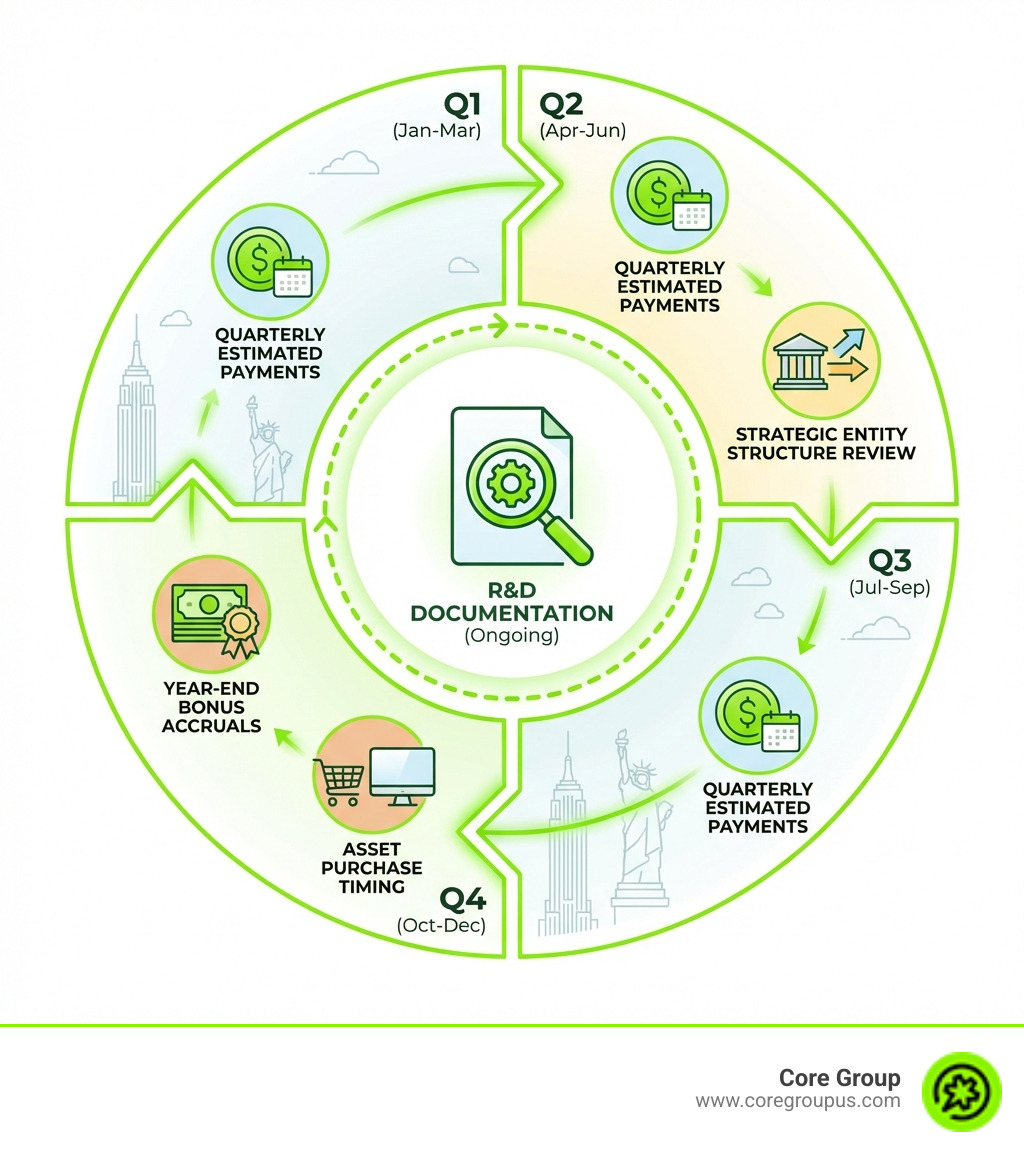
Tax planning is a year-round process. Proactive management helps you avoid surprises and capitalize on opportunities. Our approach ensures your business is always in the best position. Explore more about our Tax Planning services.
Strategic year end planning for incorporated businesses
As your fiscal year-end approaches, a financial review can yield savings:
- Bonus Accruals: Declaring bonuses before year-end can make them deductible in the current year, even if paid shortly after. Paying reasonable salaries to family members is also a legitimate strategy.
- Shareholder Loans: Ensure loans are repaid before the end of the following tax year to avoid income inclusion.
- Asset Purchases: Timing purchases is key. Under 100% bonus depreciation, you can deduct the cost of qualifying assets placed in service after January 19, 2025. We use cost segregation to accelerate deductions.
- Tax Loss Selling: Selling investments with unrealized losses can offset capital gains. Be mindful of wash sale rules that prevent repurchasing identical securities within 30 days.
What to consider when acquiring a business
Deal structure has massive tax implications for buyers and sellers:
- Share Purchase: You acquire the entity and its tax attributes, but a change in control can limit loss carryforwards.
- Asset Purchase: You buy specific assets, allowing for a "step-up" in tax basis to fair market value. This leads to higher future depreciation. Purchase price allocation is a critical negotiation point.
Staying compliant and avoiding common mistakes
Compliance builds a robust financial foundation. The IRS is increasing enforcement in high-risk areas like large partnerships and tax credits. Being audit-ready requires meticulous documentation for R&D and Employee Retention Credit (ERC) claims. Leverage accounting software to streamline record-keeping and reduce errors. For businesses in multiple states, monitoring nexus thresholds and sales tax obligations is paramount to avoid penalties.
Frequently Asked Questions about Business Tax Optimization
How does the timing of income recognition affect corporate tax liabilities?
By strategically deferring income and accelerating deductions, you can reduce current year taxable income. This lowers short-term tax payments, allowing you to retain more cash for reinvestment. We implement accounting method changes to optimize this timing.
What are the primary tax benefits of the Qualified Business Income deduction?
The QBI deduction offers a 20% deduction on qualified business income for eligible pass-through entities. This effectively lowers the federal income tax rate on earnings, allowing creative entrepreneurs to keep more profit for growth. This deduction is now a permanent part of the tax code.
When should a business owner transition from a sole proprietorship to a corporation?
Transitioning depends on growth, liability, and tax goals. Corporations offer lower rates on retained earnings and potential self-employment tax savings for S-Corps. If you expect initial losses, a sole proprietorship might be better as losses offset personal income. We analyze your situation to determine the optimal timing.
Conclusion
Building a strong financial foundation for your NYC business requires a proactive approach to business tax optimization. From entity structure to international rules, every decision has tax implications. At Core Group, we offer a no-fluff, profit-first playbook to simplify these complexities. We provide peace of mind and save you time, allowing you to focus on your creative work, backed by our MacBook Pro guarantee. Don't let taxes be an afterthought; leverage every opportunity to improve your after-tax earnings.