The Ultimate Guide to Understanding the No Tax on Overtime Phase Out Chart
How the No Tax on Overtime Phase Out Chart Works
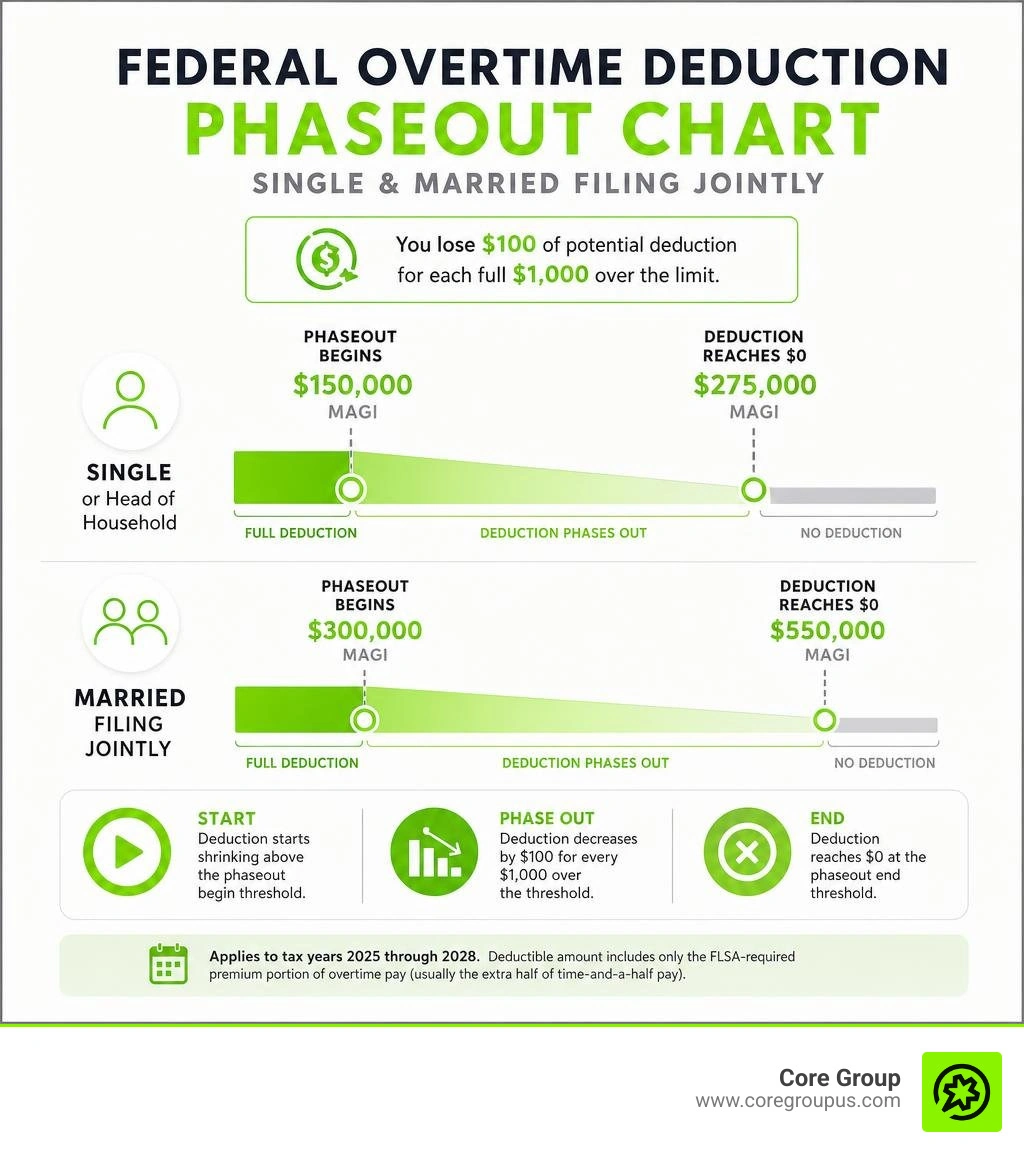
The no tax on overtime phase out chart shows how much of the federal overtime deduction remains as your modified adjusted gross income, or MAGI, rises. The deduction starts shrinking above $150,000 for single and head of household filers, and above $300,000 for married couples filing jointly. You lose $100 of potential deduction for each full $1,000 over the limit.
| Filing status | Phaseout begins | Deduction reaches $0 |
|---|---|---|
| Single or head of household | $150,000 MAGI | $275,000 MAGI |
| Married filing jointly | $300,000 MAGI | $550,000 MAGI |
This is not a tax-free pass for all overtime wages. For tax years 2025 through 2028, eligible workers may deduct only the FLSA-required premium portion of overtime pay, usually the extra half of time-and-a-half pay. The deduction is taken below the line, so it can work alongside either the standard deduction or itemized deductions.
I am Christian Brim, and this guide will help you turn these limits into a clear estimate of what your overtime could mean for your federal tax return.
Handy no tax on overtime phase out chart resources
Fundamentals of the Federal Overtime Tax Exemption

The federal overtime tax deduction was introduced under Section 225 of the Internal Revenue Code to provide targeted relief to non-exempt workers putting in extra hours. More than 15.5 million tax returns claimed this benefit in early March 2026 alone. However, claiming this deduction requires understanding the mechanics of qualified overtime compensation under the Fair Labor Standards Act, known as the FLSA.
The deduction does not make your entire hourly paycheck tax-free when you work late. Instead, it applies exclusively to the FLSA-mandated overtime premium. For standard time-and-a-half pay, your earnings consist of your regular base rate plus an extra half-rate premium. Only that extra half portion qualifies for the federal income tax deduction.
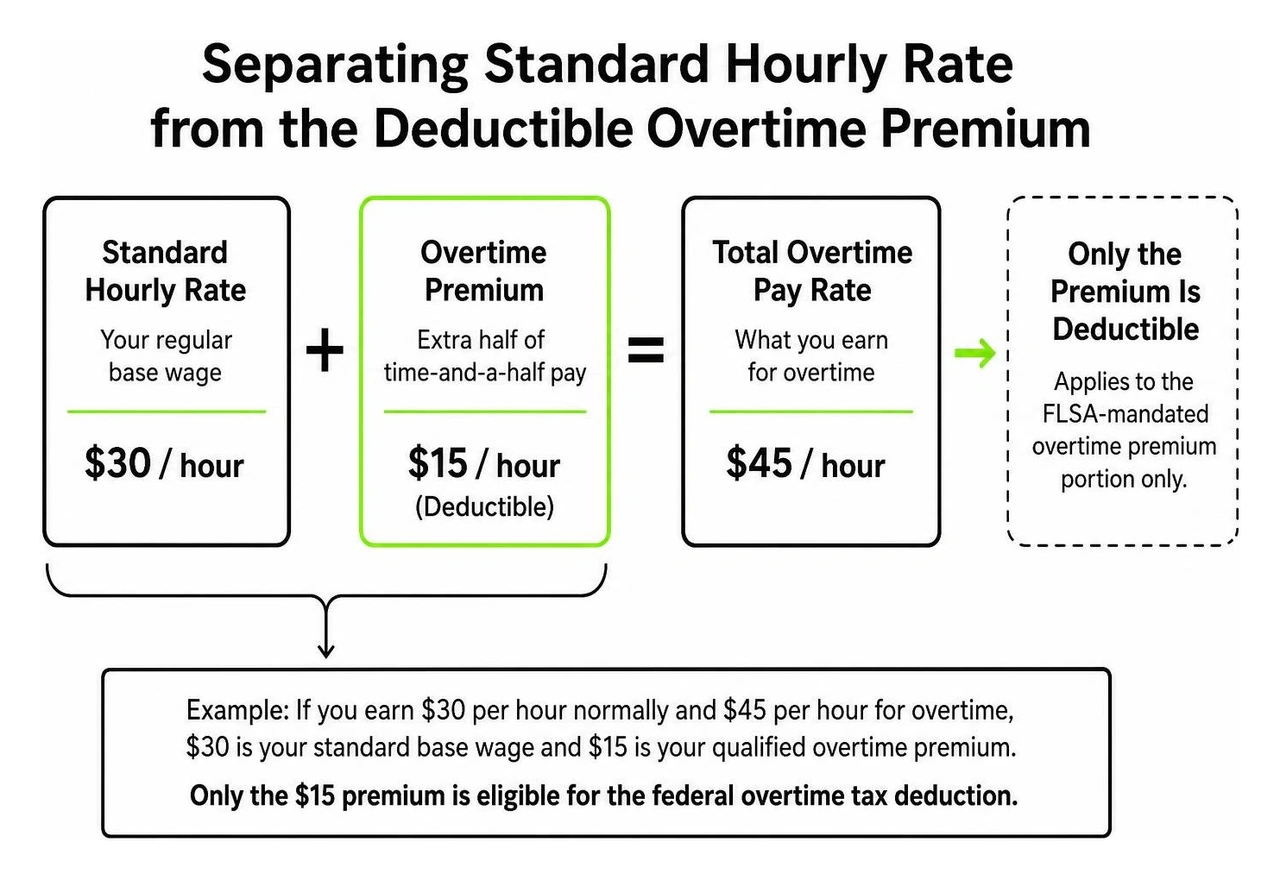
If you earn $30 per hour normally and receive $45 per hour for overtime, the $30 represents your standard base wage and the additional $15 is your qualified premium. You can review our detailed No Tax Overtime Guide 2026 for deeper background on these rules. When calculating your deduction, understanding how to calculate qualified overtime ensures you do not inadvertently deduct base hourly wages.
Maximum Deduction Caps by Filing Status
The statutory deduction limits establish an annual ceiling on how much qualified premium pay you can deduct in a single tax year. For single filers, head of household filers, and qualifying surviving spouses, the maximum annual deduction cap is $12,500.
For married couples filing jointly, the annual deduction cap doubles to $25,000 per return. This joint cap applies to the household total, regardless of whether one spouse or both spouses earned overtime. If you wonder When Does the No Tax on Overtime Start, the law went into effect for tax years beginning January 1, 2025, and runs through December 31, 2028.
Married individuals filing separately cannot claim the overtime deduction. The statute explicitly bars married filing separately returns from using this tax relief.
Taxes That Still Apply to Overtime Wages
A common point of confusion is assuming that no tax on overtime means zero taxes whatsoever. The deduction applies solely to federal income taxes. All overtime compensation remains 100 percent subject to standard payroll taxes under the Federal Insurance Contributions Act, or FICA.
- Social Security tax of 6.2 percent applies up to the annual statutory wage base.
- Medicare tax of 1.45 percent applies to all overtime earnings without an income cap.
- Additional Medicare tax of 0.9 percent applies to single earners making over $200,000 or married joint filers making over $250,000.
State and local income taxes also treat overtime differently depending on where you live. Most states decouple from federal rules, meaning your overtime premium remains subject to state income tax. To understand your true take-home pay, review the rules governing overtime pay taxes across various jurisdictions.
Visualizing the 2026 No Tax on Overtime Phase Out Chart
The phaseout mechanism gradually reduces your deduction cap once your Modified Adjusted Gross Income, or MAGI, passes specific thresholds. For most employees, MAGI equals the Adjusted Gross Income reported on Form 1040, which includes base wages, overtime pay, bonuses, and investment income.
To see how your cap adjusts as your earnings grow, reference this comprehensive breakdown comparing single and married joint filing statuses.
| Modified Adjusted Gross Income (MAGI) | Single / Head of Household Deduction Cap | Married Filing Jointly Deduction Cap |
|---|---|---|
| $150,000 or less | $12,500 | $25,000 |
| $175,000 | $10,000 | $25,000 |
| $200,000 | $7,500 | $25,000 |
| $225,000 | $5,000 | $25,000 |
| $250,000 | $2,500 | $25,000 |
| $275,000 | $0 | $25,000 |
| $300,000 | $0 | $25,000 |
| $350,000 | $0 | $20,000 |
| $400,000 | $0 | $15,000 |
| $450,000 | $0 | $10,000 |
| $500,000 | $0 | $5,000 |
| $550,000 or more | $0 | $0 |
Consulting statutory MAGI phaseout thresholds helps confirm your income tier before filing. You can also estimate your potential savings using our qualified overtime calculator.
Single and Head of Household Filers in the No Tax on Overtime Phase Out Chart
For individual filers, the phaseout begins immediately after your MAGI exceeds $150,000. For every full $1,000 of MAGI above that mark, your maximum allowable deduction shrinks by $100.
A single taxpayer earning $190,000 has $40,000 of excess MAGI. Dividing $40,000 by $1,000 yields 40 step reductions. Multiplying 40 steps by $100 produces a $4,000 reduction. Subtracting $4,000 from the statutory $12,500 cap leaves an adjusted deduction cap of $8,500. Once income reaches $275,000, exactly 125 steps of $100 eliminate the entire $12,500 benefit. Knowing how to calculate overtime tax rate prevents unexpected tax bills when working heavy overtime in higher tax brackets.
Married Couples Filing Jointly in the No Tax on Overtime Phase Out Chart
For married couples filing a joint return, the phaseout threshold starts at $300,000 of combined MAGI. The math follows the exact same $100 reduction per $1,000 of excess income.
Because the maximum joint deduction cap is $25,000, it requires 250 reduction steps of $1,000 to fully phase out the deduction. As a result, the deduction reaches exactly $0 when married joint MAGI hits $550,000. Dual-income households can explore creative overtime tax savings strategies to manage their adjusted gross income and protect their deduction limits.
Step by Step Phaseout Calculation Formula and Scenarios

Calculating your specific deduction involves a sequential formula based on statutory rules under Public Law 119-21. You do not calculate phaseouts based on fractional dollars. The IRS applies a floor division rule, meaning you only count complete, whole $1,000 increments over the threshold.

- Determine your qualifying overtime premium, which equals your regular hourly rate multiplied by 0.5 multiplied by your FLSA overtime hours.
- Determine your statutory maximum cap ($12,500 for single or $25,000 for married joint).
- Calculate your excess MAGI by subtracting your threshold ($150,000 or $300,000) from your total MAGI. If this number is zero or negative, your phaseout reduction is zero.
- Calculate reduction steps by dividing excess MAGI by 1,000 and rounding down to the nearest whole integer.
- Multiply the whole reduction steps by $100 to determine your total phaseout reduction.
- Subtract the phaseout reduction from your statutory cap to find your adjusted deduction limit.
- Your actual deduction is the lesser of your qualifying overtime premium and your adjusted deduction limit.
To double check legal provisions, review the statutory No Tax on Overtime Rules, Caps and Limits alongside our guide on tax on overtime pay.
Full Deduction Below the Threshold
Consider Jordan, an hourly production specialist who is single. Jordan earns a base hourly rate of $32 and works 300 overtime hours during the year.
- Regular hourly rate is $32.
- Overtime premium rate is $16 per hour ($32 multiplied by 0.5).
- Total qualifying overtime premium is $4,800 ($16 multiplied by 300 hours).
- Jordan's total MAGI for the year is $88,000.
Because Jordan's MAGI of $88,000 is well below the $150,000 threshold, the phaseout reduction is $0. Jordan's statutory cap remains $12,500. Jordan claims the entire $4,800 overtime premium as a deduction on Schedule 1-A, resulting in direct federal income tax savings.
Partial Phaseout and Marginal Tax Reductions
Consider Marcus and Elena, a married couple filing jointly. Marcus is a non-exempt systems technician who earned $18,000 in qualifying overtime premiums. Together, their combined household MAGI is $360,400.
- Baseline joint statutory cap is $25,000.
- Joint threshold is $300,000.
- Excess MAGI is $60,400 ($360,400 minus $300,000).
- Applying floor division, $60,400 divided by 1,000 equals 60 full steps. The remaining $400 is ignored.
- Phaseout reduction is $6,000 (60 steps multiplied by $100).
- Adjusted joint deduction cap is $19,000 ($25,000 minus $6,000).
Because Marcus earned $18,000 in qualifying overtime premiums, which is less than their adjusted cap of $19,000, Marcus and Elena deduct the full $18,000 on their joint tax return.
Full Phaseout Above Upper Income Limits
Now look at a single specialist whose total MAGI reaches $285,000 after substantial project work, including $10,000 in qualifying overtime premiums.
- Statutory single cap is $12,500.
- Single threshold is $150,000.
- Excess MAGI is $135,000 ($285,000 minus $150,000).
- Full reduction steps equal 135 ($135,000 divided by 1,000).
- Phaseout reduction is $13,500 (135 multiplied by $100).
- Adjusted deduction cap is $0 ($12,500 minus $13,500, floored at zero).
Even though the specialist worked hundreds of overtime hours, their federal overtime deduction is reduced to $0 because their MAGI exceeds the $275,000 full phaseout limit.
Reporting and Claiming the Overtime Deduction on Your Tax Return
Claiming the federal overtime deduction requires accurate tax reporting using official IRS schedules. The deduction is reported on Schedule 1-A and flows directly onto Form 1040, Line 13b.
Because this is a below the line deduction, you receive the tax savings regardless of whether you claim the standard deduction or itemize deductions on Schedule A. It does not reduce your Adjusted Gross Income, so it will not alter your eligibility for AGI-based items like traditional IRA deductibility or child tax credits.
For the 2025 tax year, employer reporting was optional, meaning many taxpayers had to manually isolate their overtime premiums using pay stubs or Form W-2 Box 14. Starting in tax year 2026, employers must report qualified overtime compensation directly in Box 12 of Form W-2 using Code TT. Creative professionals managing growing teams can check our advice on marketing consultant overtime tax planning to maintain compliant payroll systems.
Frequently Asked Questions About Overtime Tax Rules
What is the exact income level where the overtime deduction completely disappears
The overtime deduction phases out to exactly $0 at a Modified Adjusted Gross Income of $275,000 for single, head of household, and qualifying surviving spouse filers. For married couples filing jointly, the deduction is completely eliminated once household MAGI reaches $550,000.
Can married couples filing separately claim the overtime tax deduction
No. The federal statute explicitly prohibits taxpayers using the Married Filing Separately status from claiming the qualified overtime deduction. Married individuals must file a joint return to access the deduction.
Does claiming the overtime deduction reduce my AGI for other tax credits
No. The overtime exemption is structured as a below the line deduction on Form 1040, Line 13b. While it directly lowers your taxable income and reduces your federal tax bill, it does not lower your Adjusted Gross Income or Modified Adjusted Gross Income.
Conclusion
Understanding the rules behind overtime exemptions gives you the power to plan your income, withholdings, and deductions without costly surprises. Whether you are an employee working extra shifts or a business owner managing payroll, knowing how phaseout thresholds interact with statutory caps ensures you keep more of your hard-earned dollars.
At Core Group, we deliver financial management, bookkeeping, and proactive tax services tailored specifically for creative entrepreneurs. We run on a no-fluff, profit-first playbook designed to provide total peace of mind and save you valuable time. You can hand off complex tax calculations and focus on growing your business, backed by our MacBook Pro guarantee. Explore our resources on understanding your overtime tax rate to take full control of your financial future today.