No Tax on Overtime Rules: Deduction Caps and Eligibility Explained
How Does the No Tax on Overtime Work and What It Means for Your Paycheck
Understanding how does the no tax on overtime work matters if you are earning extra hours and want to keep more of that money. Here is the short answer.
The No Tax on Overtime deduction at a glance
- What it is - A federal income tax deduction on qualified overtime pay, created by the One Big Beautiful Bill Act (Section 70202)
- Who it covers - FLSA non-exempt employees (hourly workers and salaried workers earning under ~$43,888/year)
- What is deductible - Only the "half" portion of time-and-a-half pay, not your full overtime check
- Deduction caps - Up to $12,500 for single filers and $25,000 for married filing jointly
- When it applies - Tax years 2025 through 2028
- How you claim it - As a deduction on your federal tax return, not as a paycheck withholding change
- What still gets taxed - FICA payroll taxes (7.65%) and most state income taxes still apply to all overtime pay
This deduction does not make your entire overtime paycheck tax-free. It reduces your federal taxable income by the premium portion of your overtime earnings, up to the cap. Most workers save between $1,000 and $2,750 in federal income tax per year as a result.
I'm Christian Brim, and in this guide I'll walk you through exactly how the deduction works, who qualifies, and how to claim every dollar you're owed.

Similar topics to how does the no tax on overtime work
What Is the Overtime Tax Deduction and How Does the No Tax on Overtime Work
The "No Tax on Overtime" provision was signed into law under Section 70202 of the One Big Beautiful Bill Act. It introduced a temporary federal income tax deduction for qualified overtime compensation earned between January 1, 2025, and December 31, 2028. Many people mistakenly believed that starting in 2025, every dollar of overtime pay would be completely tax-exempt. However, the actual statutory language is far more nuanced.
To understand when does the no tax on overtime start and how it affects your tax liability, you need to look at the Fair Labor Standards Act (FLSA). The federal law grants a tax deduction exclusively to non-exempt employees who earn mandatory FLSA overtime. When a non-exempt employee works more than 40 hours in a workweek, federal law mandates that they receive pay at one and a half times their regular hourly rate.
The federal tax deduction applies only to the premium half-rate portion of that compensation. For example, if your base rate is $20 per hour, your time-and-a-half rate is $30 per hour. The regular $20 base component remains subject to standard federal income tax. The extra $10 premium component is what qualifies for the federal income tax deduction.
You can read the full official guidance in the No Tax on Overtime Deduction technical release.
Not everyone who works long hours is eligible for this tax relief. Certain groups are explicitly excluded by law.
- Independent Contractors (1099 Workers) - Because independent contractors are self-employed and not covered by FLSA wage standards, extra earnings or project overtime fees do not qualify.
- FLSA-Exempt Salaried Employees - Executive, administrative, and professional employees earning above the FLSA salary threshold (approximately $43,888 annually) who do not receive statutory FLSA overtime are excluded, even if their employer pays bonuses or spot incentives for extra work.
- Married Individuals Filing Separately - The tax law explicitly bars married taxpayers who file separate returns from claiming any portion of the deduction.
By early March 2026, more than 15.5 million tax returns had already claimed the overtime deduction out of roughly 63.5 million returns filed nationwide. This makes it one of the most widely used individual tax provisions enacted in recent years. However, because the law contains a 2028 sunset provision, the deduction will expire on December 31, 2028, unless Congress passes legislation to extend it.
Calculating Qualified Overtime Pay and Eligible Deductions

Calculating your eligible deduction requires separating your standard wage earnings from your statutory FLSA overtime premiums. Learning how to calculate qualified overtime prevents errors on your tax return and protects you from IRS adjustments.
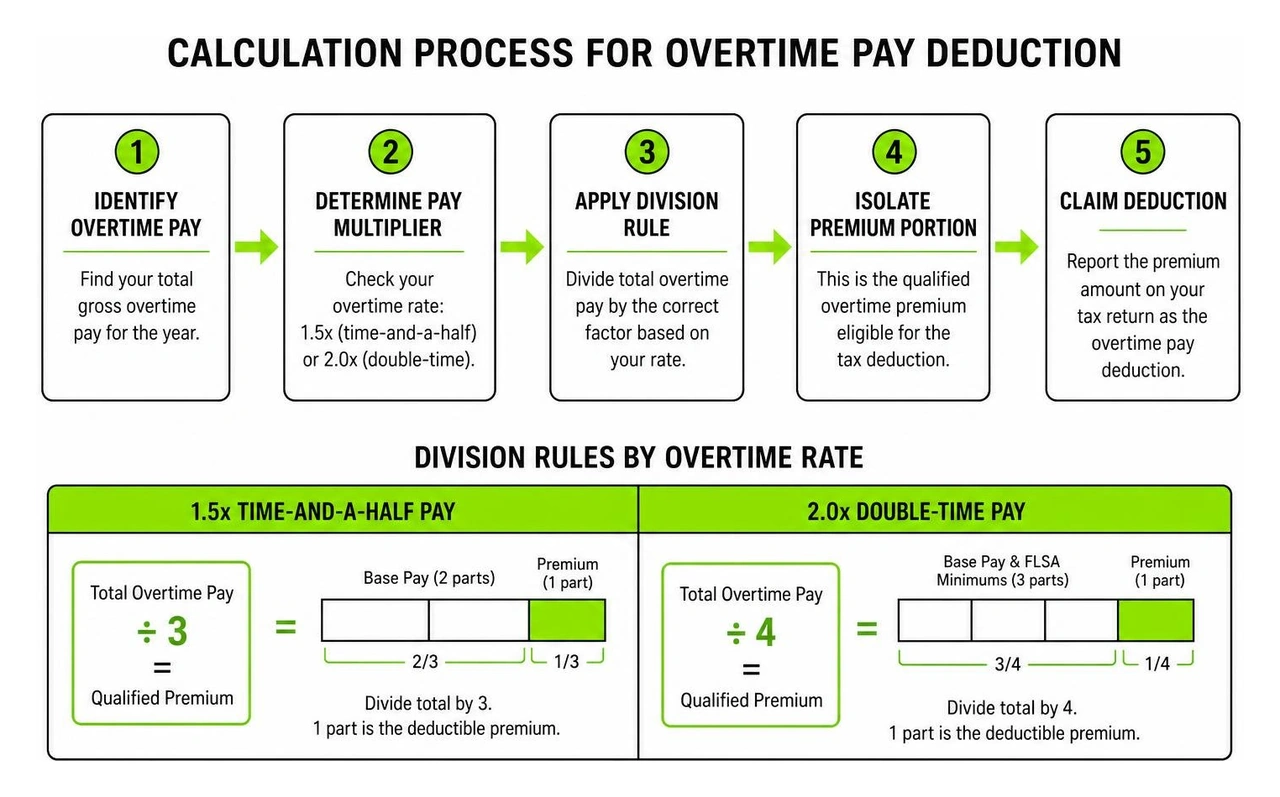
The most effective way to isolate your deductible FLSA premium is by using standard division rules based on your pay rate multiplier.
- The Divide-by-Three Rule (1.5x Time-and-a-Half Pay) - If your overtime pay is calculated at standard time-and-a-half, your total overtime check consists of two parts base pay and one part premium pay. To find your deductible premium, take your total gross overtime pay and divide it by 3.
- The Divide-by-Four Rule (2.0x Double-Time Pay) - If your employer pays double time for working holidays or seventh consecutive days, three parts represent base pay and FLSA minimums, while one part represents the deductible FLSA premium. Divide your total double-time pay by 4 to identify your eligible deduction.
An important requirement under FLSA regulations is the 40-hour actual worked threshold. Only actual hours worked count toward statutory FLSA overtime. Paid time off (PTO), sick leave, vacation days, and holiday pay do not count toward the 40-hour weekly baseline.
For instance, if you take 8 hours of vacation time on Monday and then work 36 actual hours from Tuesday through Saturday, your pay stub may show 44 total hours paid. However, because you only physically worked 36 hours, none of those hours meet the FLSA statutory definition of overtime for tax deduction purposes.
Similarly, employer policy overtime does not automatically qualify. If a collective bargaining agreement or company policy pays overtime rates for working weekends or night shifts regardless of weekly hour totals, those hours are treated as policy premiums rather than statutory FLSA overtime. Only premiums tied to statutory hours worked beyond FLSA limits qualify for the deduction.
| Pay Structure Type | Total Overtime Earned | Deductible FLSA Premium | Non-Deductible Base Portion |
|---|---|---|---|
| Standard Overtime (1.5x) | $3,000 | $1,000 (1/3) | $2,000 |
| Double Time Overtime (2.0x) | $4,000 | $1,000 (1/4) | $3,000 |
| Policy Overtime (Under 40 Worked Hrs) | $1,500 | $0 | $1,500 |
| Mixed Overtime with 8 hrs PTO | $2,400 | $400 (FLSA portion only) | $2,000 |
Understanding How Does the No Tax on Overtime Work for Hourly Pay
For standard hourly employees, calculating potential tax savings is straightforward once you know your hourly rate, weekly extra hours, and tax bracket.
Suppose you earn a regular hourly rate of $30.00 per hour. Your time-and-a-half rate is $45.00 per hour. If you work 10 hours of overtime per week for 48 weeks during the year, you log 480 overtime hours.
Your total overtime earnings equal $21,600 (480 hours multiplied by $45.00). To calculate your deductible FLSA premium under the divide-by-three rule, divide $21,600 by 3, which gives you $7,200 in qualified overtime compensation.
If your income places you in the 22 percent federal tax bracket, your annual tax savings equal $7,200 multiplied by 0.22, resulting in $1,584 in federal tax savings. For additional context on tax rates and paycheck impacts, read the full breakdown in How no tax on overtime works and when you'll still pay taxes.
How Does the No Tax on Overtime Work for Public Safety and Special Work Schedules
Public safety workers, including law enforcement officers, firefighters, and emergency medical personnel, often operate under non-standard work schedules established by Section 207(k) of the Fair Labor Standards Act.
Under FLSA 207(k), public safety employers are permitted to establish work periods ranging from 7 to 28 days rather than standard 7-day weekly cycles.
- Fire Protection Personnel - Firefighters operating on a 28-day cycle earn statutory FLSA overtime after working more than 212 hours during that 28-day period.
- Law Enforcement Personnel - Police officers operating on a 28-day cycle earn statutory FLSA overtime after working more than 171 hours during that period.
IRS Notice 2025-69 confirmed that public safety workers on 207(k) schedules qualify for the overtime tax deduction. The deductible portion remains the FLSA halftime premium earned above the statutory 207(k) threshold.
If a public safety officer receives a cash payout for accrued FLSA compensatory time ("comp time") off, one-third of that payout qualifies as a deductible overtime premium in the calendar year the payment is actually received and reported on Form W-2.
Income Limits Deduction Caps and Phase Out Rules

The No Tax on Overtime deduction is subject to annual statutory limits and income-based phase-out rules. The law places hard caps on the maximum allowable deduction per tax return each year.
- Single Filers and Heads of Household - Maximum allowable deduction of $12,500 per tax year.
- Married Couples Filing Jointly - Maximum allowable deduction of $25,000 per tax year.
These caps apply regardless of how much overtime you earn. If a single taxpayer earns $45,000 in total overtime pay, their raw halftime premium is $15,000. However, their federal tax deduction is capped at $12,500.
In addition to annual caps, the deduction phases out for higher earners based on Modified Adjusted Gross Income (MAGI).
- Single Filer Phase-Out Threshold - Phase-out begins at $150,000 MAGI and fully eliminates the deduction at $275,000 MAGI.
- Joint Filer Phase-Out Threshold - Phase-out begins at $300,000 MAGI and fully eliminates the deduction at $550,000 MAGI.
The phase-out calculation reduces your available deduction cap by $100 for every $1,000 (or fraction thereof) that your MAGI exceeds the initial threshold.
For example, imagine a single worker with a MAGI of $185,000 who earned $12,500 in qualified overtime premiums. Because their MAGI exceeds the $150,000 threshold by $35,000, we divide $35,000 by $1,000 to get 35 phase-out increments. Multiplying 35 by $100 results in a $3,500 reduction. Subtracting $3,500 from the $12,500 maximum cap leaves an allowable deduction of $9,000.
| Filing Status | MAGI Threshold for Phase-Out | MAGI Cutoff (Zero Deduction) | Maximum Annual Cap |
|---|---|---|---|
| Single / Head of Household | $150,000 | $275,000 | $12,500 |
| Married Filing Jointly | $300,000 | $550,000 | $25,000 |
| Married Filing Separately | Disqualified ($0) | Disqualified ($0) | $0 |
Married taxpayers filing separately are completely barred from claiming the deduction, regardless of income level or qualified overtime earned.
Payroll Withholding FICA Taxes and State Tax Impacts
A frequent point of confusion is whether the No Tax on Overtime law alters payroll tax withholdings or eliminates other employment taxes. Understanding what is the federal tax rate on overtime clarifies why your weekly paychecks may look different than expected.
The deduction applies only to federal individual income tax. It does not apply to Federal Insurance Contributions Act (FICA) taxes. All overtime earnings remain fully subject to FICA taxes, which consist of standard rates.
- Social Security Tax - 6.2 percent levied on all wages up to the wage base limit ($184,500 for tax year 2026).
- Medicare Tax - 1.45 percent levied on all wages, plus an additional 0.9 percent Additional Medicare Tax on earnings exceeding $200,000 for single filers ($250,000 for joint filers).
- Combined FICA Burden - Standard 7.65 percent payroll tax applies to every dollar of overtime earnings without exemption.
State and local income tax rules present another critical detail. The federal overtime tax deduction does not automatically apply at the state level. States determine whether to conform to federal tax changes through state legislative action.
States with high income tax rates, such as California, New York, and Oregon, do not automatically exempt overtime pay from state tax returns. Conversely, workers living in states with no personal income tax, such as Texas, Florida, Washington, Nevada, and Wyoming, receive the maximum relative benefit because no state income tax applies to wage earnings.
Furthermore, employers are not required to alter weekly federal income tax withholdings on regular paychecks throughout the year. Payroll systems continue withholding income taxes based on standard tax tables.
Because withholding levels usually remain unchanged during the pay period, workers realize their tax savings when they file their annual tax return, often resulting in larger end-of-year tax refunds.
Step by Step Guide to Claiming the Deduction on Your Tax Return
Claiming your deduction on your federal return is a straightforward process if you follow the official filing guidelines outlined in the Qualified Overtime Deduction Rules for 2025.
Here is the step-by-step procedure to follow when preparing your tax filings.
- Locate Overtime Data on Form W-2 - Check your official annual reporting forms. For tax year 2025 filings, employers report estimated qualified overtime premiums in Box 14 using the label "EstOvtPrm". Starting in tax year 2026, employers report official qualified overtime compensation in Box 12 using Code TT.
- Cross-Reference End-of-Year Pay Stubs - If your W-2 Box 14 figure is blank or estimated, gather your final pay stub for the year. Calculate your qualified FLSA premium using the divide-by-three rule for 1.5x pay or the divide-by-four rule for 2.0x pay.
- Complete Schedule 1-A (Form 1040) - Open Schedule 1-A, titled Additional Income Deductions. Enter your Modified Adjusted Gross Income in Part I to verify phase-out status. Proceed to Part III and input your calculated qualified overtime compensation. Apply the statutory caps ($12,500 single or $25,000 joint) and compute your net deduction.
- Transfer Net Deduction to Form 1040 - Carry the allowable deduction total from Schedule 1-A to Line 13b on Form 1040.
- Attach Documentation and File - Ensure Schedule 1-A is attached to your Form 1040 submission. Retain end-of-year pay stubs, W-2 forms, and Leave and Earnings Statements in your tax record archive.
Crucially, the overtime tax break is a "below-the-line" deduction that can be claimed regardless of whether you take the standard deduction or itemize deductions on Schedule A. It directly reduces federal taxable income without restricting standard deduction usage.
Frequently Asked Questions About Overtime Tax Rules
Is my entire overtime paycheck completely tax free
No. The law does not make your full overtime paycheck tax-free. Only the FLSA premium halftime rate portion (the extra 0.5 in 1.5x time-and-a-half) is exempt from federal income tax. The regular base pay portion remains subject to standard federal income tax. Furthermore, all overtime pay remains fully subject to 7.65 percent FICA payroll taxes (Social Security and Medicare) as well as state and local income taxes where applicable.
Why are taxes still taken out of my overtime on my weekly paycheck
Federal tax regulations do not mandate that employers adjust payroll withholding algorithms for overtime pay during weekly or biweekly pay cycles. Employers continue to withhold standard federal income tax, state income tax, and FICA taxes on all earnings. You claim the tax relief as an annual deduction on Schedule 1-A when filing your federal tax return, which converts overpaid paycheck withholdings into a larger tax refund.
What happens to the no tax on overtime deduction after 2028
The provision established under Section 70202 of the One Big Beautiful Bill Act includes a statutory sunset date of December 31, 2028. Unless Congress enacts new legislation extending or permanentizing the law, the overtime deduction will expire after tax year 2028. Starting January 1, 2029, overtime pay will revert to standard federal income tax treatment.
Conclusion
The "No Tax on Overtime" deduction offers valuable financial relief for hard-working non-exempt employees across the country. By understanding how the halftime premium is calculated, tracking year-end pay stubs, and staying mindful of income phase-outs, you can maximize your tax savings through 2028.
For creative entrepreneurs and business owners, managing payroll regulations, employee classifications, and complex tax compliance demands time and expertise. At Core Group, we provide financial management, bookkeeping, and tax services specifically tailored for creative businesses across the United States.
Our USP is a no-fluff, profit-first playbook that guarantees peace of mind and saves you time, allowing you to focus on growing your business. We back our commitments with our signature MacBook Pro guarantee, ensuring top-tier service delivery.
To learn more about optimizing your business tax strategy and understanding your overtime tax rate, contact Core Group today and let our team handle your financial growth with confidence.