The Ultimate Guide to Finding a Profit First Advisor
Why a Profit First Advisor Can Bring Calm to Your Cash Flow
A profit first advisor helps business owners turn revenue into clear, intentional buckets for profit, owner pay, taxes, and operating costs. Instead of waiting for financial reports to explain what already happened, they help you see what cash is actually available to use now.
For creative business owners, that can mean less stress around payroll, tax bills, and the uneasy feeling that a busy month should have produced more money.
A strong advisor does more than set up bank accounts. They guide the habits behind the system, help set realistic allocation percentages, and keep the plan useful as your business changes.
| What a Profit First Advisor helps with | Why it matters |
|---|---|
| Separating cash by purpose | Makes profit, taxes, and spending limits visible |
| Setting practical allocation targets | Creates a plan based on your current financial reality |
| Reviewing cash flow regularly | Helps catch problems before the bank balance becomes a crisis |
| Building better money habits | Reduces reactive spending and financial guesswork |
I am Christian Brim, and this guide will help you understand what to look for in a Profit First advisor and whether this approach fits your business.
Explore more about profit first advisor
Understanding the Profit First Methodology and Behavioral Psychology
Most entrepreneurs start their businesses with a desire for financial freedom, creative expression, and control over their time. However, cash flow management quickly becomes one of the most frustrating aspects of running a company. The Profit First framework tackles this challenge by working with human behavior rather than trying to change it.
At its core, the methodology reverses the standard accounting equation. Instead of subtracting expenses from sales to calculate profit, you subtract profit from sales first. What remains is the exact amount your company has available for operating expenses.
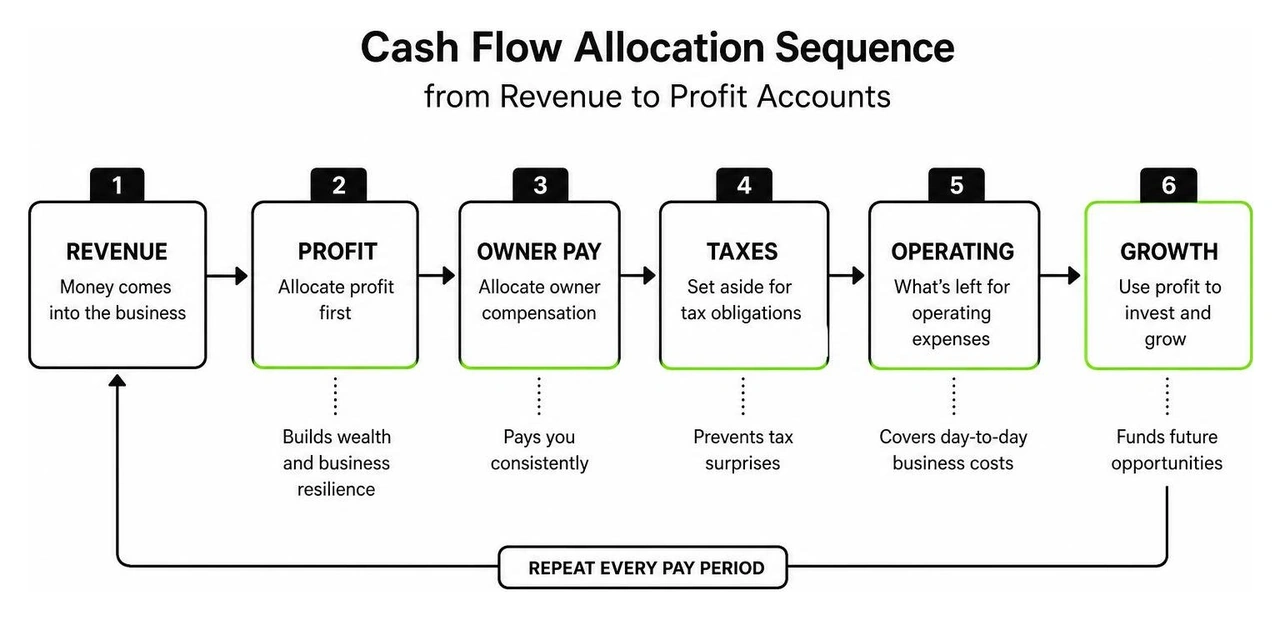
This simple shift relies on two key psychological principles that explain why traditional budgeting often fails creative business owners.
- Parkinson's Law dictates that demand for a resource expands to match the supply of it. When all cash sits in a single checking account, your brain perceives that full amount as available spending money. By immediately transferring profit, owner compensation, and tax reserves into dedicated accounts, you constrain the operational bank balance. This forces operational efficiency and smarter expense decisions.
- The Primacy Effect shows that humans prioritize whatever they see first. When a business owner logs into online banking, they check their primary account balance first to make spending decisions. Cash segregation ensures that the main balance reflects true operational availability after taking profit and taxes out of the equation.
By establishing behavioral boundaries through cash segregation, a profit first advisor helps business owners build lasting money management habits. If you want to dive deeper into the core principles, read our complete guide on the Profit First Method to see how these behavioral shifts work in practice.
How Traditional Accounting Differs From Cash Segregation
Generally Accepted Accounting Principles, known as GAAP, were created to provide standardized financial statements for external stakeholders like investors, lenders, and tax authorities. While accrual accounting is essential for tracking long term liabilities and measuring financial health, it is notoriously poor at helping entrepreneurs make day to day operational decisions.
Traditional bookkeeping produces backward looking reports such as income statements and balance sheets weeks after a month concludes. A business owner can review a profit and loss statement showing a healthy top line profit margin while simultaneously struggling to make payroll the following Friday. This disconnect happens because accounting profit does not equal cash in the bank.
Cash segregation solves this visibility issue by giving you real time clarity right inside your banking dashboard. Instead of trying to interpret complex accrual reports or calculate unearned revenue manually, you simply look at cash balances designated for specific operational purposes.
For a comprehensive comparison between backward financial reports and proactive cash management, explore our What is the Profit First Method Guide.
The Core Account Structure and Target Allocation Percentages
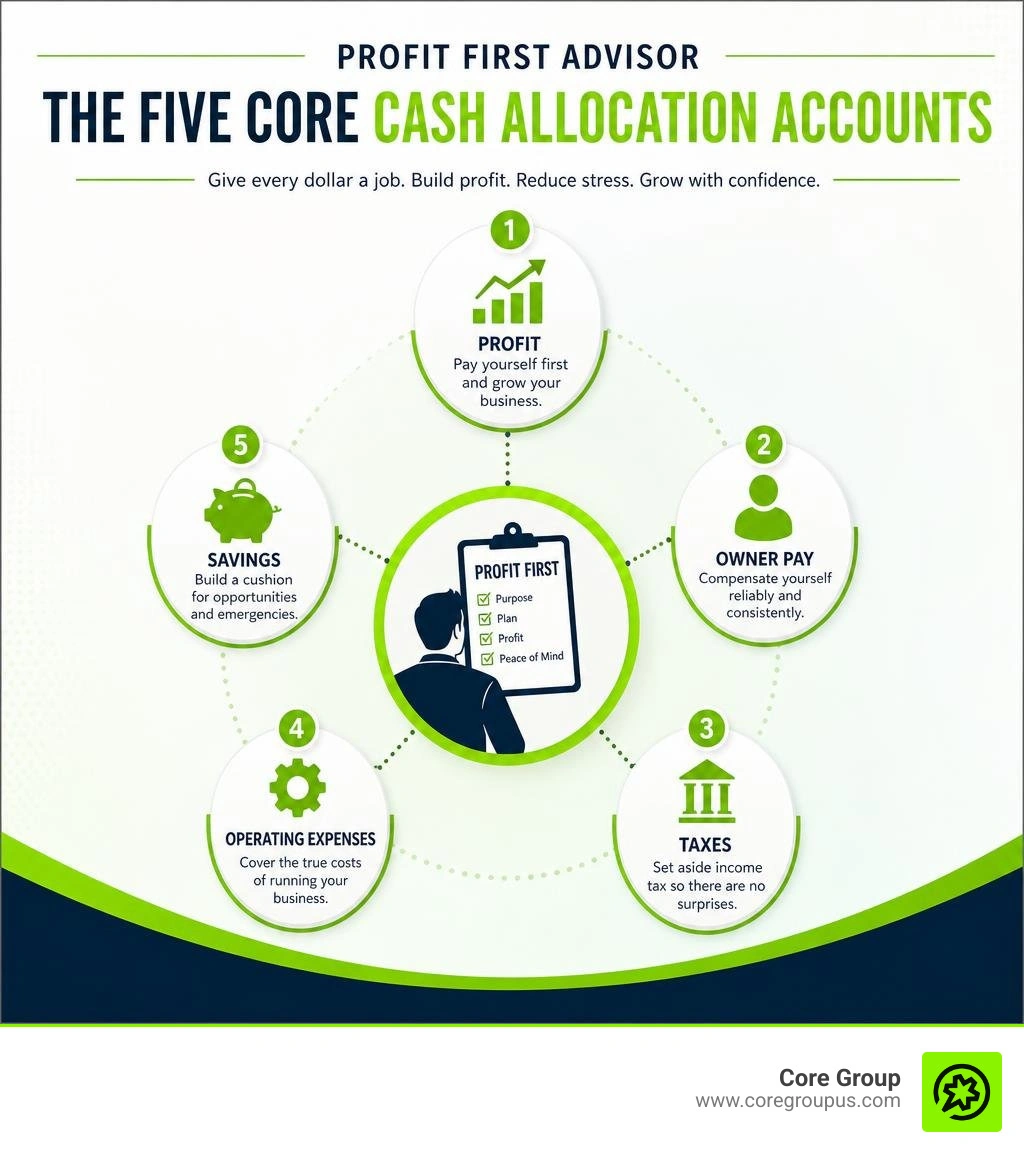
To execute this cash management strategy successfully, a business creates five core bank accounts.
- Income Account serves as the central receiving hub where all customer revenue is deposited before being allocated to other accounts.
- Profit Account accumulates quarterly distributions for business owners and serves as an emergency cash reserve.
- Owner Compensation Account holds funds specifically allocated to pay the business owner a standard salary or regular wage.
- Tax Account reserves cash continuously to ensure tax obligations are paid on time without scrambling.
- Operating Expenses Account holds the remaining funds available to cover day to day operational bills and overhead.
Setting target percentages depends heavily on your annual revenue size. Smaller businesses require higher relative owner compensation percentages, while larger scaled enterprises dedicate higher absolute percentages to operational costs and profit distributions.
| Annual Revenue Range | Profit Target | Owner Compensation Target | Tax Reserve Target | Operating Expense Target |
|---|---|---|---|---|
| Under $250,000 | 5% | 50% | 15% | 30% |
| $250,000 to $500,000 | 10% | 35% | 15% | 40% |
| $500,000 to $1,000,000 | 15% | 20% | 15% | 50% |
| Over $1,000,000 | 20% | 10% | 15% | 55% |
Understanding where your company fits across these ranges is essential for long term financial health. To review a full breakdown of target allocation models, check our guide on Profit First Percentages.
What to Look for in a Certified Profit First Advisor

Choosing the right financial partner is one of the most critical decisions a growing business owner can make. While many accountants call themselves financial guides, a certified profit first advisor possesses specific training in cash flow mechanics, behavioral coaching, and profit optimization.
When evaluating potential advisors, look beyond simple tax preparation experience. You need a proactive professional who understands how to analyze cash flows, adjust allocations without causing operational friction, and keep your company accountable to its targets.
How a Profit First Advisor Transforms Cash Flow
A qualified advisor moves your firm away from simple compliance work toward high value advisory services. Rather than telling you what happened last quarter, they work alongside you to protect future profit margins and control expenses proactively.
Their primary work includes evaluating your operational expenditure, designing custom allocation schedules, and providing steady guidance during low revenue seasons. This strategic oversight provides severe expense constraint, preventing unnecessary overhead growth while building strong business reserves.
Creative agency owners and entrepreneurs facing unique production cycles benefit greatly from structured cash planning. Learn how specialized advisory can transform creative operations in our article on Financial Consulting for Artists.
Strategic planning also involves structuring long term growth roadmaps that align cash allocations with business expansion. To see how structured planning supports long term stability, read our insight on Business Financial Planning.
Certification Prerequisites and Professional Standards
Not every bookkeeper or financial consultant who reads the book is qualified to guide client implementations. True certification requires significant practical experience, intensive coursework, and ongoing professional development.
Candidate advisors complete rigorous training requirements before earning official credentials.
- Candidates complete 12 to 15 hours of coursework monthly over two to six months covering cash management principles, advanced allocation logic, and client management.
- Professionals must operate an established accounting, bookkeeping, or coaching firm for a minimum of one year before applying.
- Applicants must complete a two day live masterclass workshop and successfully implement the methodology within their own operational practice first.
- Certified professionals maintain credentials through continuous educational updates and peer reviews across tiered mastery levels.
To learn more about executive level leadership and business advisory frameworks, review these executive insights at Chief Profit Officer® | Executive Business Advisor.
Working with an experienced Business Profit Coach ensures that your advisor has the deep experience needed to handle complex financial situations.
Technology Stack and Implementation Strategies

Implementing a multi account system requires modern financial tools. Attempting to manage five core bank accounts using legacy banking platforms often leads to high monthly service fees and administrative friction.
A successful implementation relies on pairing modern digital banking with cloud accounting software configured specifically for multi account general ledgers.
Modern Digital Banking and Multi Account Systems
Legacy brick and mortar banks frequently charge $10 to $25 per account every month in maintenance fees unless high minimum balances are kept. For a business maintaining five core accounts plus secondary tax or reserve sub accounts, bank fees can quickly total over $100 monthly.
Modern digital business banking platforms solve this issue by offering unlimited checking accounts with zero monthly fees, no minimum balance requirements, and automated transfer controls.
Using purpose built financial technology enables entrepreneurs to schedule bi weekly or monthly allocations automatically, eliminating manual transfer errors and saving valuable administrative time.
Accounting Software Setup in QBO and Xero
A common mistake business owners make when setting up their financial technology is creating sub accounts or virtual tags inside their bookkeeping platform instead of opening physical bank accounts. Official documentation for major platforms like QuickBooks Online and Xero strongly recommends configuring standalone checking accounts on the chart of accounts for each physical account.
Here is the proper general ledger configuration strategy for cloud accounting tools.
- Open five distinct, standalone checking accounts on your general ledger that correspond directly to your real world bank accounts.
- Avoid using virtual tags or sub accounts to track allocations, as these fail to trigger the behavioral spending constraints needed for cash management success.
- Record incoming customer receipts exclusively into the primary Income account balance.
- Process transfer journal entries or bank transfers between standalone accounts on scheduled allocation days.
- Reconcile each physical bank account independently during monthly reconciliation protocols.
Working with an expert Profit First Bookkeeper ensures your chart of accounts remains clean, organized, and fully compliant with standard reconciliation practices.
Overcoming Common Implementation Challenges and Friction
Transitioning to a structured cash management framework frequently uncovers hidden operational inefficiencies. Business owners may encounter cash flow friction, credit card liabilities, or resistance to expense constraints during initial implementation.
An experienced profit first advisor guides you through these obstacles, ensuring a smooth transition without threatening business operations or payroll stability.
Gradual Allocation Adjustments and Debt Management
One of the most dangerous mistakes an business owner can make is jumping directly from current cash spending habits straight to high target percentages overnight. Doing so creates immediate cash shortages that leave the company unable to cover existing vendor commitments.
Advisors use gradual quarterly adjustments to build business stamina safely over 6 to 12 months.
- Calculate your Current Allocation Percentages using historical financial data from the past 12 months.
- Compare your current metrics against ideal target percentages for your revenue bracket.
- Shift allocation percentages incrementally by 1% to 2% every quarter toward your target allocations.
- Establish a separate debt repayment strategy parallel to core allocations if existing credit card balances or loans are present.
Managing cash flow alongside credit card usage requires clear protocols. For example, if an owner makes a $3,000 operational purchase on a corporate credit card, that exact amount must be reserved from the Operating Expenses account immediately to prevent end of month settlement surprises.
To read more about managing cash flow schedules safely, explore our Profit First Guide 2026 as well as the Profit First Book Complete Guide 2026.
If you are looking for general strategies on operational planning and budgeting, read our practical resource on Budgeting for Entrepreneurs.
Questions to Ask Before Hiring a Profit First Advisor
Before committing to an advisory partnership, ask candidate advisors key questions to evaluate their qualifications and practical implementation experience.
- Have you implemented this cash management system inside your own business first?
- How many active client implementations have you successfully guided over the past year?
- What digital banking and accounting technology stack do you recommend for multi account setups?
- How do you handle credit card balance repayments within client allocation models?
- What is your ongoing advisory review schedule, and how do we monitor progress toward target percentages?
Frequently Asked Questions About Profit First
What are the five core bank accounts in the Profit First system?
The five core bank accounts are the Income Account, Owner Compensation Account, Profit Account, Tax Account, and Operating Expenses Account. All client revenue is received into the Income Account before being allocated to the other four accounts according to established target percentages.
How long does it take to fully implement Profit First in a business?
While opening accounts and setting up your technology stack can be completed in a few weeks, reaching your ideal target percentages usually takes between 6 and 18 months. Shifting allocations gradually by 1% to 2% each quarter ensures operational stability while permanently reducing unnecessary business expenses.
What is the difference between current and target allocation percentages?
Current Allocation Percentages reflect how your revenue is spent right now based on past financial performance. Target Allocation Percentages represent the ideal financial benchmark for your revenue tier. An advisor helps you bridge the gap between your current performance and target goals safely over time.
Conclusion and Next Steps
Implementing structured cash management gives creative entrepreneurs total control over their finances, clear visibility into operational costs, and guaranteed profit margins. Working alongside a certified profit first advisor eliminates guesswork, prevents cash surprises, and transforms top line revenue into bottom line wealth.
At Core Group, we offer financial management, bookkeeping, and tax services specifically tailored for creative business owners across the nation. Our no fluff profit playbook provides complete peace of mind, allowing you to focus on growing your business while we handle your financial clarity, backed by our MacBook Pro guarantee.
Ready to build a reliable, highly profitable creative business? Visit our Core Group Accounting Resources to schedule a consultation and transform your cash flow today.