Filing S-Corp Business Taxes: Tips to Reduce Your Tax Bill
Understanding S-Corp Business Taxes and How They Work
s-corp business taxes work differently from most other business structures, and understanding that difference can save you thousands of dollars every year.
Here is a quick answer to how S-corps are taxed.
- An S-corp does not pay federal income tax at the corporate level.
- Instead, profits and losses pass through to shareholders' personal tax returns.
- Shareholders pay tax at their individual income tax rates.
- Shareholder-employees must receive a reasonable W-2 salary, which is subject to payroll taxes.
- Distributions above that salary are generally not subject to self-employment tax.
- The S-corp files Form 1120-S and issues each shareholder a Schedule K-1.
This structure is why so many small business owners choose S-corp status. A sole proprietor pays 15.3% self-employment tax on every dollar of profit. An S-corp owner pays payroll taxes only on their salary, not on distributions. At $150,000 in net profit, that gap can mean roughly $9,000 or more back in your pocket each year.
But the savings only kick in if you set things up correctly. Missteps around reasonable compensation, filing deadlines, and state-level rules are the most common reasons S-corp owners end up with unexpected tax bills or IRS scrutiny.
This guide walks through everything you need to know to file accurately and keep more of what you earn.
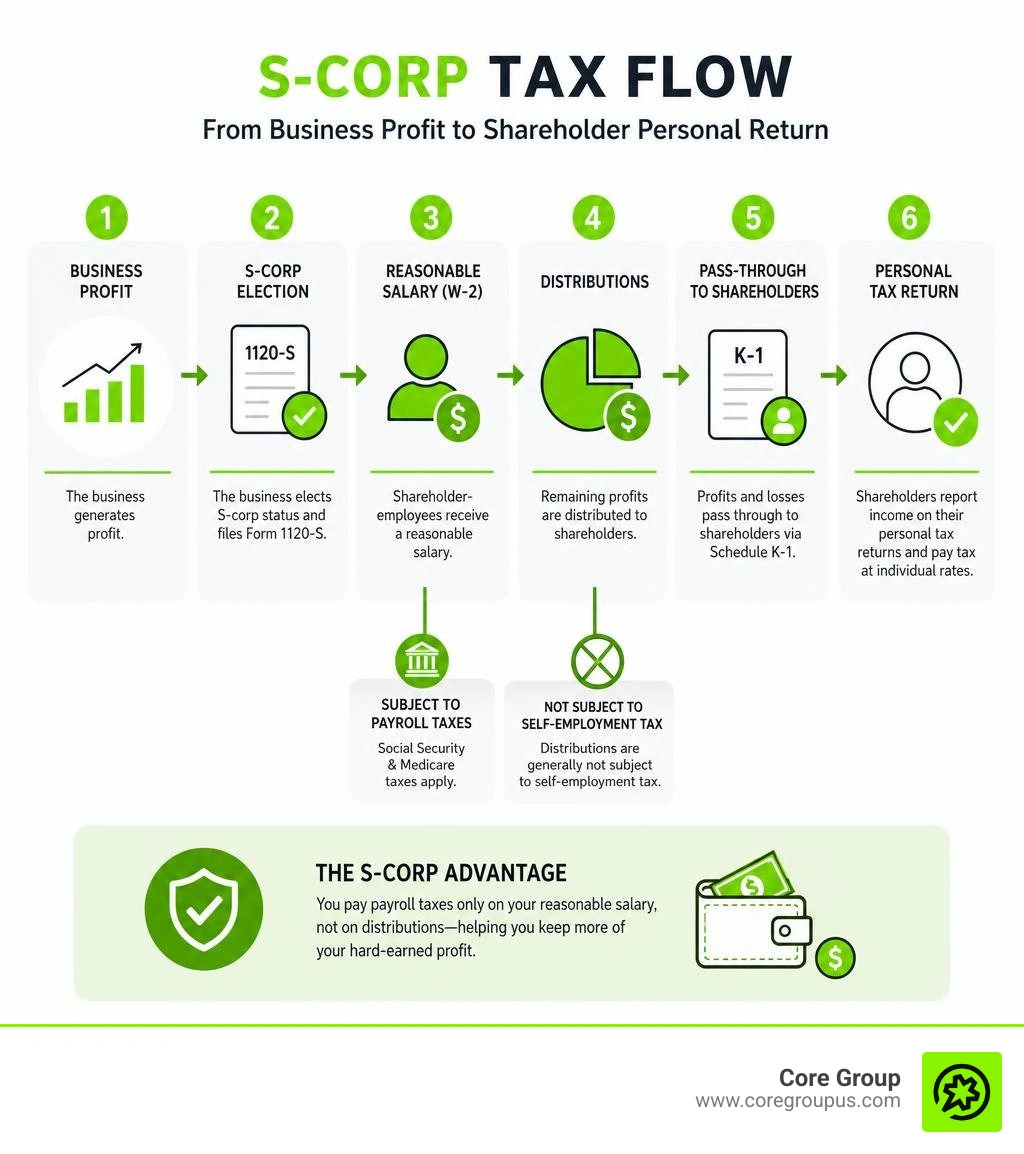

To understand how an S-corporation works, we first have to look at how the IRS views business entities. An S-corporation is not actually a separate legal entity type that you form with your state. Instead, it is a special tax status that a corporation or a limited liability company elects with the IRS.
When you operate as a default corporation, you are subject to what is known as double taxation. The corporation pays taxes on its profits at the corporate level, and then the shareholders pay taxes again on their personal returns when those profits are distributed as dividends. This double taxation can eat away at your hard-earned profits.
To help small businesses avoid this double taxation burden, Congress created Subchapter S of the Internal Revenue Code in 1958. This election allows profits and certain losses to flow directly through to the owners' personal tax returns. By choosing this status, you can effectively Avoid Double Taxation and ensure your business income is only taxed once at your individual tax rate.
Comparing LLCs C-Corps and S-Corporations
Choosing the right structure for your business is one of the most consequential decisions you will make. It affects your daily operations, your personal liability, and your overall tax burden.
A default limited liability company is a popular choice for new businesses because of its simplicity. If you are a single owner, the IRS treats you as a sole proprietorship by default. This means all business profits are subject to the standard Federal Income Tax LLC rules, which include paying a 15.3% self-employment tax on all net earnings.
A C-corporation offers strong liability protection and the ability to have unlimited shareholders, but it suffers from the double taxation we discussed earlier.
An S-corporation combines the best of both worlds. It provides the strong legal protection of a corporation or an LLC while allowing pass-through tax treatment. Below is a comparison of how these structures stack up against each other.
| Feature | Default LLC | C-Corporation | S-Corporation |
|---|---|---|---|
| Federal Income Tax | Pass-through to owner | Taxed at corporate level | Pass-through to owners |
| Self-Employment Tax | Paid on all net profits | Not applicable | Paid only on W-2 salary |
| Maximum Shareholders | Unlimited | Unlimited | Limited to 100 |
| Double Taxation | No | Yes | No |
| Ownership Restrictions | None | None | US citizens and residents only |
The Core Benefits of Pass-Through Taxation
The primary reason business owners transition to an S-corporation is the tax savings on self-employment taxes. In a standard LLC or sole proprietorship, you must pay the 15.3% self-employment tax on your entire net profit. This tax consists of 12.4% for Social Security up to the annual wage base limit and 2.9% for Medicare, which has no limit.
For the tax year 2026, the Social Security wage base is $176,100. If your business earns a high net profit, paying 15.3% on all of it can become incredibly expensive.
Under an S-corporation structure, you divide your income into two categories. The first category is your reasonable W-2 salary, which is subject to standard payroll taxes. The second category is business distributions, which are completely exempt from self-employment taxes.
For example, if your business makes $150,000 in net profit and you pay yourself a reasonable salary of $70,000, you only pay payroll taxes on that $70,000. The remaining $80,000 passes through to you as a distribution, saving you thousands of dollars in taxes.
Many creative business owners wonder, Should Creative Entrepreneurs Become an S-Corp? The answer usually depends on your net income. If your business consistently generates more than $60,000 to $80,000 in net profit, the tax savings will likely outweigh the additional administrative costs.
Eligibility Requirements and the S-Corp Election Process

While the tax benefits of an S-corporation are highly attractive, the IRS does not hand them out to everyone. To qualify for this tax status, your business must meet strict eligibility requirements.
First, your business must be a domestic entity. This means it must be organized as a corporation or an LLC within the United States. Second, you can only have one class of stock. This rule ensures that all profits and losses are distributed proportionally based on ownership percentage. You cannot give certain shareholders preferential distribution rights over others.
Maintaining these standards is critical to preserving your tax status. If you fail to meet any of these S-Corp Eligibility Requirements, the IRS can terminate your S-corp status immediately, forcing you back into standard corporate taxation.
Meeting the Strict IRS Shareholder Limits
The IRS also places strict limitations on who can own shares in an S-corporation. These rules are designed to keep the S-corporation status reserved for small to midsize businesses.
- Your S-corporation cannot have more than 100 shareholders.
- All shareholders must be individuals, certain estates, or specific types of trusts.
- Partnerships, other corporations, and non-resident aliens cannot be shareholders.
- All shareholders must be United States citizens or resident aliens.
If you plan to bring on venture capital or foreign investors in the future, an S-corporation may not be the right choice for your business because of these strict ownership limitations.
Filing Form 2553 for Your S-Corp Business Taxes
If your business meets all the requirements, the next step is to make the official election with the IRS. You do this by filing Form 2553, which is titled Election by a Small Business Corporation.
Timing is everything when it comes to this filing. To be effective for the current tax year, you must file Form 2553 no later than two months and 15 days after the beginning of the tax year. For calendar-year businesses, this deadline is March 15. If you miss this deadline, your S-corp status will not take effect until the following tax year.
Fortunately, the IRS does provide late election relief under Revenue Procedure 2013-30. If you missed the deadline but have reasonable cause for the delay, you can file Form 2553 late. You must state your reasonable cause on the form and file it within three years and 75 days of the original intended effective date.
Navigating the S-Corp Setup Process can be complicated, so working with a professional team can help ensure you do not miss these critical deadlines.
Managing Reasonable Compensation and Distributions
Once your S-corporation is active, you must change how you pay yourself. You can no longer simply transfer money from your business account to your personal account whenever you want and call it an owner's draw.
As an active owner-employee, the IRS requires you to run a formal payroll and receive W-2 wages. This is a non-negotiable step. These wages are subject to standard federal and state withholdings, including Social Security and Medicare taxes.
Running a formal payroll requires extra administrative work and payroll service fees, but it is the only way to legally access the self-employment tax savings. You can learn more about these operational steps by reading the S-Corp Payroll Rules.
Setting a Reasonable Salary to Avoid Audits
The most heavily scrutinized area of S-corporation taxation is reasonable compensation. Because distributions are free from self-employment taxes, some owners are tempted to pay themselves a tiny salary and take the rest of their income as distributions.
The IRS is fully aware of this tactic. In fact, roughly 73% of S-corporation audits focus specifically on reasonable compensation. If the IRS determines that your salary is too low, they can reclassify your distributions as wages, which triggers back payroll taxes, interest, and steep penalties.
To determine a reasonable salary, you should consider several factors.
- Your training, experience, and specific duties within the business.
- The amount of time and effort you devote to the business operations.
- What comparable businesses in your industry and geographic area pay for similar services.
- The local cost of living and general economic conditions.
As a general starting point, many tax professionals recommend setting your salary between 30% and 50% of your business's net profit, depending on your industry. However, you should always document your salary decision with real market data from sources like the Bureau of Labor Statistics to protect yourself in the event of an audit.
Tax Free Distributions and Shareholder Basis
Any business profit left over after paying your reasonable salary and business expenses can be distributed to you as a shareholder distribution. These distributions are generally tax-free because you already pay individual income tax on the business profits.
However, distributions are only tax-free up to your shareholder basis. Your basis represents your financial investment in the company. It increases when you contribute capital or when the business generates profit, and it decreases when you take distributions or when the business incurs losses.
If you take a distribution that exceeds your basis, that excess amount is treated as a taxable capital gain. To prevent this, you must track your basis annually. The IRS now requires shareholders to attach Form 7203 to their personal tax returns to report and track their shareholder basis.
Filing Requirements and Key Tax Forms
Operating an S-corporation comes with increased tax compliance and filing requirements. Unlike a sole proprietorship, which reports business activity directly on Schedule C of your personal Form 1040, an S-corporation must file its own separate tax return.
Additionally, the IRS has implemented strict e-filing mandates. S-corporations that are required to file 10 or more returns in a calendar year must e-file their corporate returns. This requirement makes using modern tax software or professional tax services essential for ongoing compliance.
Preparing Form 1120-S and Schedule K-1
The primary tax return for an S-corporation is Form 1120-S, which is an information return. This form reports the business's gross receipts, deductions, profits, and losses, but the corporation itself does not pay federal income tax.
Instead, the S-corporation generates a Schedule K-1 for each shareholder. The Schedule K-1 shows each owner's specific share of the business's income, deductions, and credits. Shareholders then use the information from their Schedule K-1 to report their business income on Schedule E of their personal Form 1040.
The deadline to file Form 1120-S and issue Schedule K-1s to shareholders is March 15 for calendar-year businesses. You can request a six-month extension to September 15 by filing Form 7004, but an extension to file is not an extension to pay any taxes you might personally owe.
State Level Rules and Multi-State Apportionment
While S-corporations enjoy pass-through status at the federal level, state-level tax rules vary significantly. Some states do not fully recognize the S-election, while others impose unique entity-level taxes and franchise fees.
For example, S-corporations must pay the $800 minimum franchise tax in California if they are incorporated, registered, or doing business in the state. This annual $800 minimum franchise tax applies regardless of whether your business makes a profit. You can find detailed filing guidelines on the S Corporations - California Tax Service Center website.
Other states have their own unique requirements. In Georgia, S-corporations are subject to an annual net worth tax in addition to income tax, which you can read about in the 2024 S Corporation Income Tax General Instructions.
If you operate in multiple states, you must also navigate multi-state apportionment. This process involves calculating what percentage of your business income was generated in each state based on sales, property, and payroll factors, and then paying taxes to those states accordingly.
Advanced Strategies to Reduce Your S-Corp Business Taxes
To get the most out of your S-corporation, you should look beyond basic bookkeeping and implement advanced tax planning strategies. Because your business income flows directly to your personal return, any deduction you claim at the corporate level directly reduces your personal tax bill.
How to Lower Your S-Corp Business Taxes with Deductions
One of the most powerful deductions available to S-corporation shareholders is the Section 199A Qualified Business Income deduction. This deduction allows eligible business owners to deduct up to 20% of their qualified business income directly from their personal taxes.
However, the QBI deduction has complex rules and limitations. For service-based businesses, the deduction begins to phase out once your taxable income exceeds certain thresholds. For 2026, these phase-outs begin at $241,950 for single filers and $483,900 for married couples filing jointly. To maximize this benefit, you must carefully balance your W-2 salary against your business distributions. You can read a complete breakdown of these rules in our guide, QBI Deduction Explained.
Another excellent way to reduce your tax bill is through Section 179 expensing. This rule allows you to deduct the full purchase price of qualifying equipment, software, and vehicles in the year you buy them, rather than depreciating them over several years.
Navigating Built-In Gains and Net Investment Income Tax
While S-corporations generally avoid corporate-level taxes, there are exceptions. If you convert an existing C-corporation to an S-corporation, you may be subject to the built-in gains tax. This tax applies if you sell appreciated assets that the business owned while it was still operating as a C-corporation. The built-in gains tax recognition period lasts for five years after your S-election takes effect.
Additionally, passive S-corporation shareholders may be subject to the 3.8% Net Investment Income Tax. If you do not materially participate in the daily operations of the business, your share of the S-corporation's profits is treated as passive income, which can trigger this additional tax if your personal income exceeds federal thresholds.
Frequently Asked Questions
This section answers some of the most common questions business owners have about managing their S-corporation taxes.
What is the deadline to file Form 2553
To elect S-corporation status for the current tax year, you must file Form 2553 within 75 days of your business's official start date or by March 15 of the tax year you want the election to begin. If you miss this window, the election will automatically apply to the following tax year unless you apply for late election relief.
Can a single member LLC elect S-Corp status
Yes, a single-member LLC can absolutely elect S-corporation tax status. This is a highly common strategy for solo business owners who want to maintain the legal simplicity of an LLC while enjoying the tax benefits of an S-corporation. You can learn more about how this transition works by reading about Single Member LLC Taxes.
How is health insurance handled for S-Corp owners
If you own more than 2% of your S-corporation, your health insurance premiums must be reported as additional W-2 wages in Box 1 of your W-2 form. However, these wages are not subject to Social Security or Medicare taxes. You can then claim a self-employed health insurance deduction on your personal Form 1040, which helps lower your overall tax bill.
Conclusion
Setting up and managing an S-corporation requires careful planning and strict compliance, but the annual tax savings can be life-changing for your business.
At Core Group, we specialize in helping creative entrepreneurs navigate the complexities of bookkeeping, payroll, and tax planning. We use a no-fluff, profit-first playbook designed to give you complete peace of mind and save you valuable time, allowing you to focus entirely on growing your business. We even back our services with a unique MacBook Pro guarantee.
If you are ready to take control of your business finances and reduce your tax bill, let our expert team guide you through the process. Explore our guide on How to Form S-Corp to get started today.