A Practical Guide to S Corp Setup Costs and Fees
Understanding the Real Cost to Set Up an S Corp
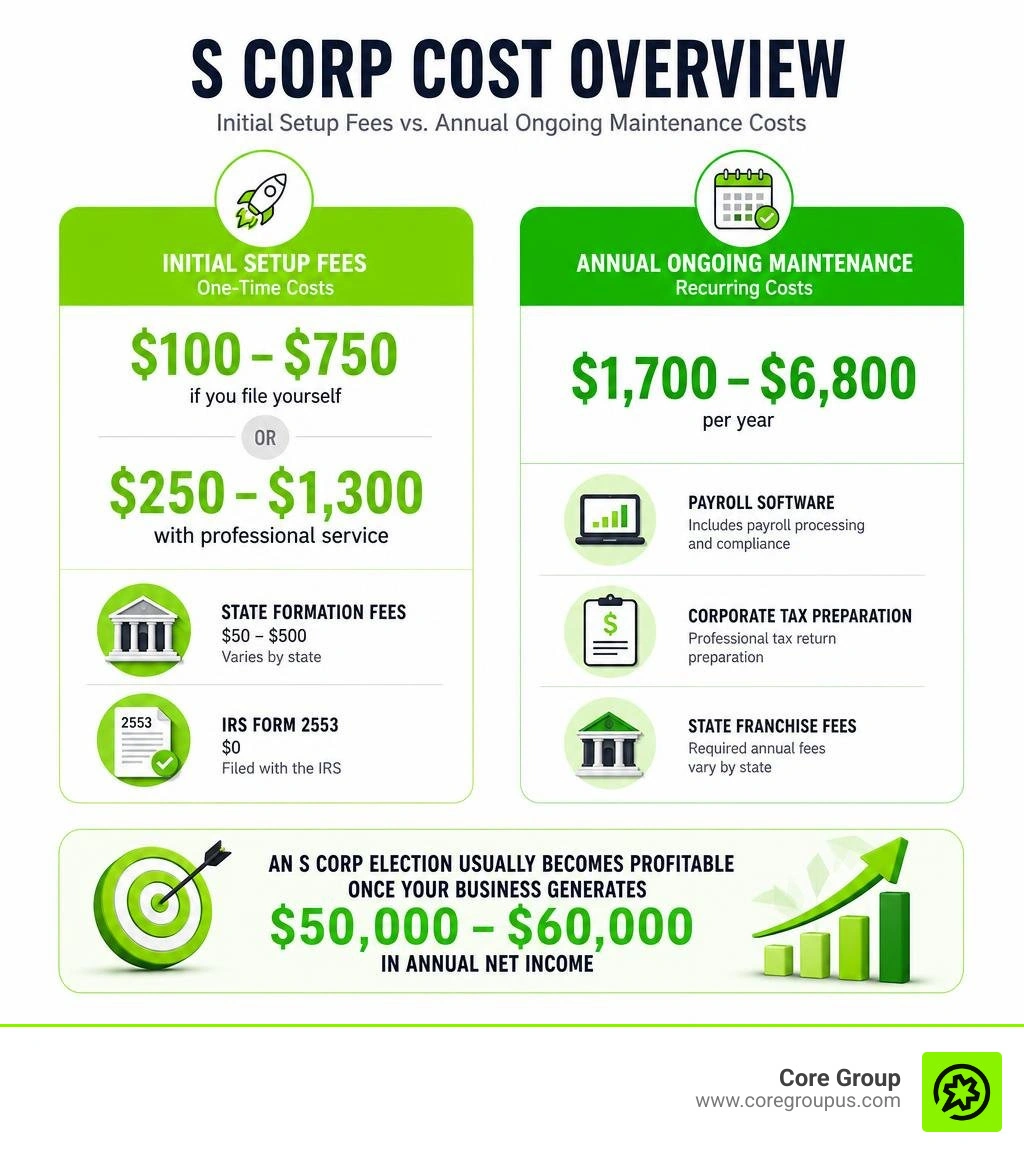
The total cost to set up an S Corp usually ranges from $100 to $750 if you handle the filings yourself, or $250 to $1,300 if you use a professional service.
Here is the quick financial breakdown.
- State formation fees run between $50 and $500 depending on where your business lives.
- IRS Form 2553 costs exactly $0 to submit to the federal government.
- Ongoing annual maintenance totals $1,700 to $6,800 per year for payroll software, corporate tax preparation, and state franchise fees.
Because of recurring compliance expenses, an S Corp election usually becomes profitable once your business generates at least $50,000 to $60,000 in annual net income.
Many creative entrepreneurs and studio founders feel overwhelmed by corporate taxes and legal jargon. The good news is that an S Corp is not an entirely new business entity. It is simply a federal tax status you add to your LLC or corporation to reduce self-employment taxes.
I am Christian Brim, and I help business owners navigate corporate tax strategies so they can build sustainable profits without financial stress.
Glossary for cost to set up an s corp
Initial Breakdown of the Cost to Set Up an S Corp

Starting an S Corporation requires understanding that an S Corp is not a standalone legal entity. You first create a base business entity, such as a limited liability company or a traditional corporation, and then file an election with the Internal Revenue Service.
Navigating the full S-Corp Setup Process involves two distinct phases. First, you register your base entity with your state Secretary of State. Second, you file Form 2553 with the IRS to establish your S Corp status for federal tax purposes.
The federal portion of the setup is completely free. The IRS does not charge a filing fee for processing Form 2553, nor does it charge for an Employer Identification Number. All your upfront creation costs come from state regulatory fees, document preparation, and optional professional support.
State Filing Fees and the Total DIY Cost to Set Up an S Corp
Every state sets its own statutory fees for creating a legal business structure. If you choose a do-it-yourself approach, you will pay only the mandatory state fees.
State filing fees for Articles of Organization for an LLC or Articles of Incorporation for a corporation vary widely across the country.
- Low-cost states like Montana charge $35, Kentucky charges $40, and states such as Arizona, Colorado, Hawaii, Iowa, Michigan, Mississippi, Missouri, and New Mexico charge around $50.
- Moderate-cost states include Delaware, where LLC filings are $110 and corporate filings start around $89, as detailed by the Delaware Division of Corporations. Florida charges $125 for an LLC and $70 for a corporation.
- Higher-cost states include Texas at $300 and Massachusetts at $500.
Some states also require optional or mandatory business name reservations prior to formation, which typically add $10 to $50. In total, a business owner handling their own paperwork can expect a bare minimum out-of-pocket setup fee between $100 and $750, depending on their state of residence.
How Professional Legal and Accounting Assistance Affects the Cost to Set Up an S Corp
While forming an entity on your own is possible, many entrepreneurs choose professional help to avoid costly organizational mistakes. You can explore whether to handle filing solo by reading Can I Set Up an S-Corp Myself.
Hiring a CPA or legal professional adds upfront costs but ensures complete compliance.
- Commercial business formation packages usually cost between $50 and $500, excluding state fees.
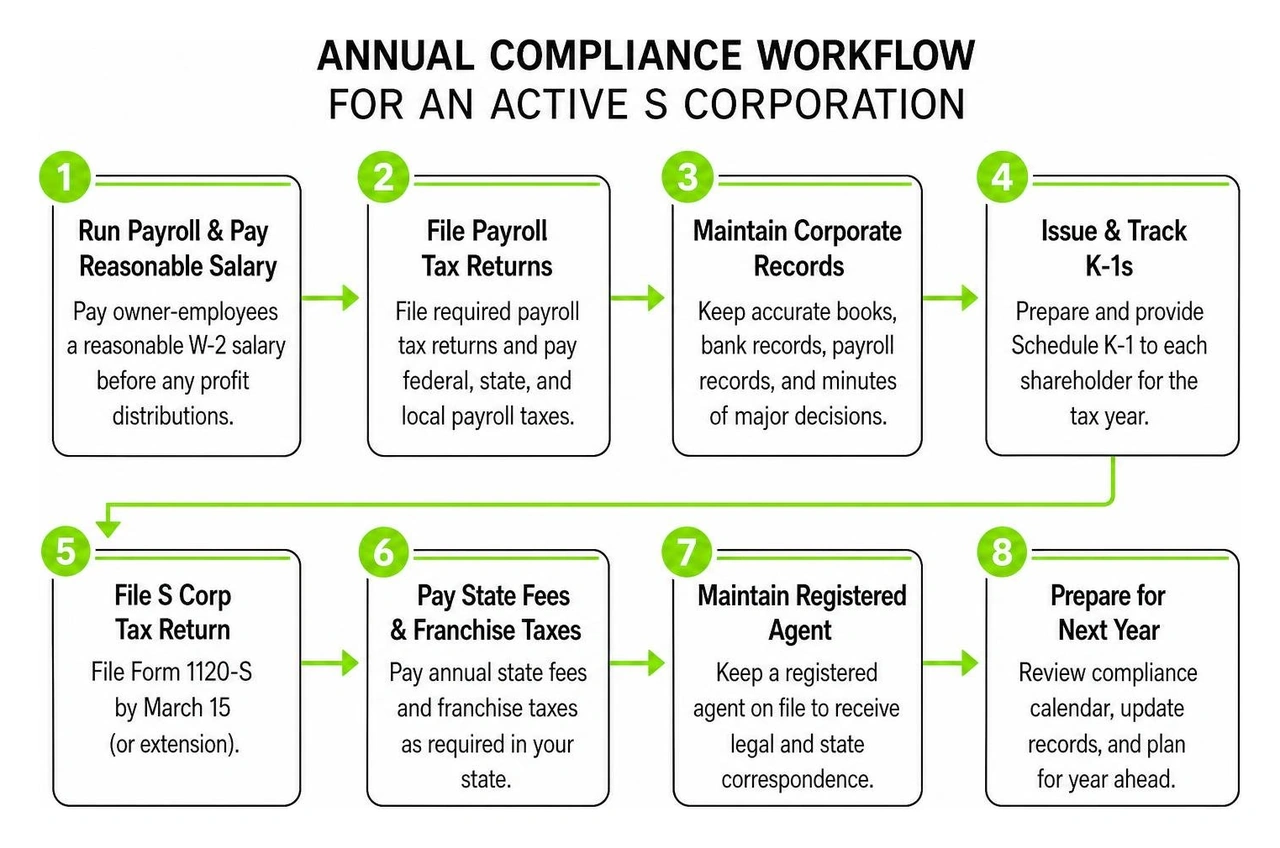
- Professional registered agent services cost between $50 and $300 annually. A registered agent is required in every state to receive official legal notices and state correspondence. You can serve as your own registered agent for $0 if you maintain a physical commercial address open during normal business hours in your formation state.
- CPA guidance for preparing corporate documents and submitting Form 2553 typically ranges from $200 to $800.
- Specialized attorney document drafting for customized corporate bylaws, shareholder agreements, or complex operating agreements ranges from $1,000 to $5,000.
Investing in professional guidance prevents common formation errors, such as accidentally establishing a second class of stock, which automatically invalidates S Corp status under federal tax rules.
Ongoing Operational and Compliance Expenses

The initial formation fee is only the entry ticket. The ongoing operational overhead of an S Corp represents the real investment you need to plan for every year.
Standard LLCs with single owners enjoy pass-through taxation reported directly on Schedule C of a personal tax return. In contrast, an S Corp functions as an independent tax entity requiring separate financial records, dedicated payroll filings, and corporate tax returns. Maintaining clean books is essential, which is why many owners seek S-Corp Bookkeeping Near Me to keep their financial transactions organized throughout the year.
The baseline annual overhead to operate an S Corp ranges from $1,700 to $6,800 per year, compared to just $300 to $1,900 for a standard LLC without an S Corp election.
Mandatory Payroll Processing and Reasonable Compensation Requirements
The defining operational requirement of an S Corp is running formal payroll for owner-employees. If you actively provide services for your business, the IRS classifies you as an employee rather than a self-employed individual.
You must pay yourself a reasonable W-2 salary before taking any profit distributions. This requires following strict S-Corp Payroll Rules and filing mandatory payroll tax returns.
Running corporate payroll creates recurring costs.
- Third-party payroll software subscription fees range from $30 to $150 per month, totaling $360 to $1,800 annually.
- Federal tax compliance requires four quarterly IRS Form 941 filings, one annual federal unemployment Form 940 filing, and annual W-2 and W-3 filings.
- Employer-side payroll taxes include 6.2% for Social Security up to the wage base limit, 1.45% for Medicare, and federal and state unemployment taxes.
Attempting to bypass payroll by taking only owner distributions triggers severe IRS penalties and back-tax assessments. Establishing a reliable, automated payroll system is essential from your very first day operating as an S Corp.
Annual Tax Preparation and State Franchise Taxes
Tax preparation complexity increases significantly after making an S Corp election. Instead of reporting your business numbers on Schedule C of your personal Form 1040, your company must file IRS Form 1120-S, the dedicated federal income tax return for an S Corporation.
Professional preparation of Form 1120-S along with generating Schedule K-1 forms for shareholders costs between $500 and $2,500 annually.
State-level fees also impact ongoing costs. Several states charge mandatory annual report fees or franchise taxes simply for the privilege of doing business.
- California imposes a mandatory $800 annual minimum franchise tax on corporations and LLCs, alongside a 1.5% tax on S Corp net income, as outlined in the California Franchise Tax Board guidance.
- Delaware corporate franchise taxes start at $175 and scale higher based on authorized shares.
- New York, Texas, and other jurisdictions enforce varying minimum entity taxes, reporting fees, or gross margin taxes.
These recurring corporate obligations mean that the extra administrative overhead of an S Corp ranges from $1,400 to $4,900 each year compared to a basic LLC.
Financial Thresholds and Break-Even Profit Analysis
Because an S Corp adds $1,400 to $4,900 in extra annual overhead, electing this tax status only makes sense when your tax savings comfortably exceed those costs.
In a standard LLC or sole proprietorship, all net business profit is subject to the 15.3% federal self-employment tax, which consists of 12.4% for Social Security and 2.9% for Medicare. With an S Corp, you only pay employment taxes on your reasonable W-2 salary. The remaining business profits flow through to you as shareholder distributions, which are free from self-employment taxes.
The break-even point for an S Corp usually occurs around $50,000 to $60,000 in net annual profit. To evaluate your business numbers, refer to our S-Corp Tax Planning Guide 2026.
| Net Business Profit | Annual W-2 Salary | Owner Distributions | Est. Self-Employment Tax Savings | Est. S Corp Overhead Costs | Net Annual Benefit |
|---|---|---|---|---|---|
| $40,000 | $30,000 | $10,000 | $1,530 | $2,000 | -$470 |
| $60,000 | $36,000 | $24,000 | $3,672 | $2,000 | +$1,672 |
| $80,000 | $45,000 | $35,000 | $5,355 | $2,200 | +$3,155 |
| $100,000 | $60,000 | $40,000 | $6,120 | $2,200 | +$3,920 |
| $150,000 | $80,000 | $70,000 | $10,710 | $2,500 | +$8,210 |
Comparing LLC and S Corp Total Cost of Ownership
Choosing the right legal and tax framework requires weighing compliance complexity against tax reduction. Reviewing the fundamental S-Corp Business Structure helps clarify how legal protection and tax strategy work together.
A standard LLC features low administrative overhead, minimal paperwork, and basic tax filing requirements. However, as profits grow past $60,000, paying 15.3% self-employment tax on every dollar of net earnings becomes expensive.
An S Corp requires more work, including regular payroll runs, corporate minutes, separate tax returns, and franchise tax compliance. Yet, once your business produces healthy profits, the tax savings easily surpass the extra $2,000 to $3,000 in annual administrative costs.
Deductions and Tax Advantages That Offset Overhead Costs
Several corporate tax advantages help offset the operational costs of maintaining an S Corp. Exploring comprehensive S-Corp Business Deductions allows you to capture every eligible write-off.
- Health insurance premium deductions. S Corporations can deduct 100% of health insurance premiums paid for greater than 2% shareholder-employees when handled correctly through payroll.
- Section 199A Qualified Business Income deduction. S Corp owners may qualify for up to a 20% pass-through tax deduction on eligible non-wage business distributions.
- Accountable reimbursement plans. An accountable plan allows the corporation to reimburse employees tax-free for home office use, vehicle mileage, and personal cell phone expenses.
These deductions lower your taxable income and help ensure your S Corp delivers clear financial value above its operating costs.
Critical Deadlines and Potential Hidden Costs
Before forming your entity, verify that you satisfy all S-Corp Eligibility Requirements. S Corps can have no more than 100 shareholders, may issue only one class of stock, and must not include non-resident alien owners.
Once qualified, you must track strict statutory deadlines to ensure your election takes effect on time.
Form 2553 Filing Deadlines and Late Relief Procedures
To elect S Corp status for the current tax year, calendar-year businesses must submit Form 2553 no later than two months and 15 days after the beginning of the tax year. For existing businesses operating on a standard calendar year, that filing deadline is March 16 in 2026.
New businesses have exactly two months and 15 days from their official formation date with the state to submit their election.
If you miss the deadline, the IRS provides relief under Revenue Procedure 2013-30. If your business had reasonable cause for the late filing, intended to be taxed as an S Corp from the start, and operated consistently as an S Corp, you can request retroactive S Corp status up to three years and 75 days after the intended effective date.
Hidden Fees and State Specific Maintenance Traps
Unexpected administrative expenses can surprise new business owners if they do not plan ahead.
- Foreign qualification fees. Registering your entity in another state like Delaware or Wyoming while operating from your home state requires filing a foreign qualification. You end up paying dual annual report fees and franchise taxes in both states.
- Publication mandates. States such as New York and Arizona require newly formed entities to publish notices in local newspapers, adding $600 to over $2,000 in unexpected setup costs.
- Local business licenses. Cities and counties often require annual municipal operating licenses, zoning permits, or gross receipt filings that range from $50 to $1,000 or more.
Factoring in these regional rules ensures you build an accurate first-year budget.
Frequently Asked Questions About S Corp Formation Costs
What is the minimum profit needed to make an S Corp cost effective?
An S Corp election usually becomes cost-effective once your business reaches $50,000 to $60,000 in consistent annual net profit. Below this income level, the $1,400 to $4,900 in extra annual costs for payroll software, corporate tax preparation, and state franchise fees will consume most or all of your self-employment tax savings.
Does the IRS charge a fee to file Form 2553?
No. The Internal Revenue Service does not charge any fee to file Form 2553. Applying for your Employer Identification Number on the IRS website is also free. All monetary costs for establishing an S Corp come from state filing fees, registered agent services, and optional professional tax or legal assistance.
Can business owners handle S Corp payroll independently to cut costs?
While you can technically process your own payroll, doing so manually carries substantial compliance risks. S Corp owners must calculate accurate federal income tax withholding, Social Security, Medicare, and state unemployment taxes, while submitting timely deposits and filing quarterly Form 941s and annual W-2s. Missing a filing deadline or miscalculating withholdings can result in severe IRS penalties that quickly erase any software savings.
Conclusion
Structuring your business correctly creates a solid foundation for sustainable growth and long-term tax savings. While the initial setup requires an investment in state fees and compliance tools, the tax advantages of an S Corp can save you thousands of dollars each year once your profits pass the break-even mark.
At Core Group, we help creative entrepreneurs streamline their finances through our no-fluff, profit-first playbook. We handle your financial management, bookkeeping, and corporate tax strategies so you can focus on growing your business with complete peace of mind, backed by our MacBook Pro guarantee.
Ready to optimize your business structure and start saving on taxes? Learn exactly how to form an S Corp and take control of your financial future today.