A Stress-Free Guide to S-Corp Health Insurance Deductions
What S-Corp Health Insurance Actually Means for Your Deductions
S-corp health insurance works differently from health coverage at a regular job, and getting it wrong is surprisingly easy to do. Here is the quick answer most owners need
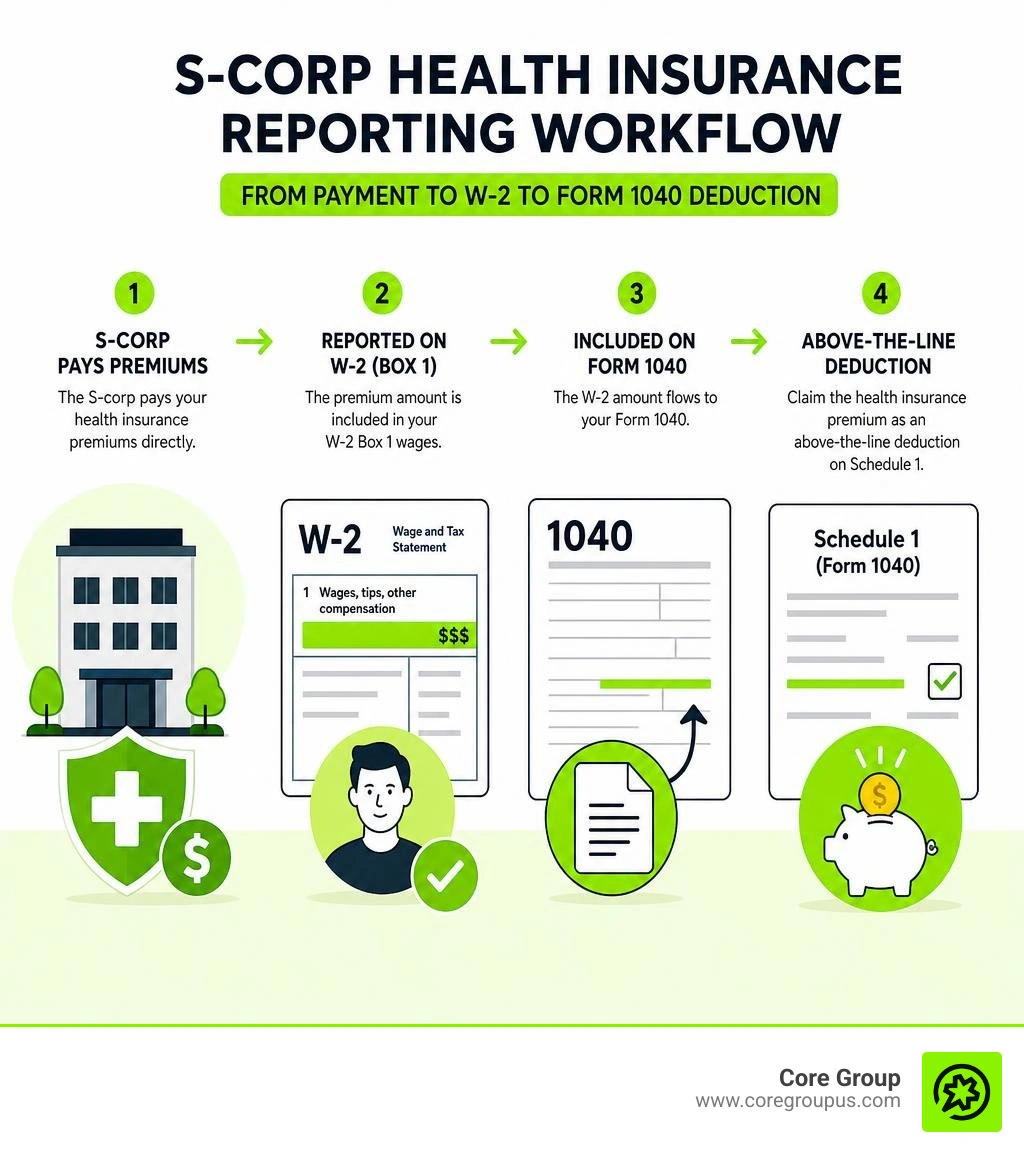
To deduct health insurance premiums as an S-corp owner, you must
- Own more than 2% of the S corporation's stock
- Have the S corp pay the premiums directly or formally reimburse you
- Include the premium amount in your W-2 Box 1 wages
- Claim the above-the-line deduction on Schedule 1 of your personal Form 1040
Those premiums are not subject to Social Security or Medicare taxes, which creates a real tax advantage. But the deduction only works if you follow the exact sequence above. Skip one step and the deduction disappears entirely.
Many creative business owners run into this the hard way. They pay premiums from a personal account all year, assume their accountant can sort it out at tax time, and then discover the deduction is disallowed because the reporting chain was never properly set up.
This guide walks you through every step clearly, so you can stop stressing about compliance and get back to the work you actually love. I'm Christian Brim, and I've helped many entrepreneurs in film and media get this right without the confusion.
Discover more about s-corp health insurance.
Understanding S-Corp Health Insurance Rules and 2 Percent Shareholders

When you run an S corporation, the IRS treats you as both an owner and an employee. That dual role is great for saving money on self-employment taxes, but it creates unique rules around fringe benefits like health insurance.
Standard W-2 employees at traditional companies receive company-paid health insurance completely tax-free. For an S corp shareholder who owns a significant chunk of the business, federal tax law handles those premiums differently. Instead of being an untaxed fringe benefit, the premium payments are counted as taxable wages for federal income tax purposes, but remain exempt from payroll taxes like Social Security and Medicare.
Understanding this balance is the key to unlocking valuable S-Corp Business Deductions while staying fully compliant with federal guidelines.
Defining the 2 Percent Shareholder Rule
The IRS sets a very specific threshold for who falls under these special medical insurance rules. Under Internal Revenue Code Section 1372, anyone who owns more than 2 percent of the S corporation's outstanding stock or voting stock on any single day during the tax year is classified as a 2 percent shareholder.
That classification applies even if you own 2.01 percent of the stock for just one afternoon in July.
It is also vital to understand constructive ownership under IRC Section 318. The IRS applies family attribution rules here. If your spouse, child, grandchild, or parent owns stock in the S corporation, you are constructively treated as owning that stock too. If your spouse owns 100 percent of the business and hires you as an employee, you are automatically treated as a 2 percent shareholder. You cannot bypass these rules by putting stock solely in one spouse's name.
Tax Implications for FICA and FUTA Exemptions
The tax treatment for 2 percent shareholders offers a fantastic tax benefit when handled properly.
When your S corporation pays for your health insurance premiums, that dollar amount must be added to your Box 1 gross wages on Form W-2. That means you pay federal income tax on the premium value through your normal wage reporting.
The big financial win comes from payroll tax exemptions. As long as the premiums are paid under a plan established by the business for its employees, those dollars are completely exempt from FICA taxes, which include Social Security and Medicare, as well as FUTA taxes, which cover federal unemployment.
By excluding health insurance premiums from Social Security and Medicare taxes, you instantly save the 15.3 percent tax hit that would otherwise apply. The IRS explicitly outlines these wage exclusion criteria in their guide on S corporation compensation and medical insurance issues.
How to Set Up and Report S-Corp Health Insurance
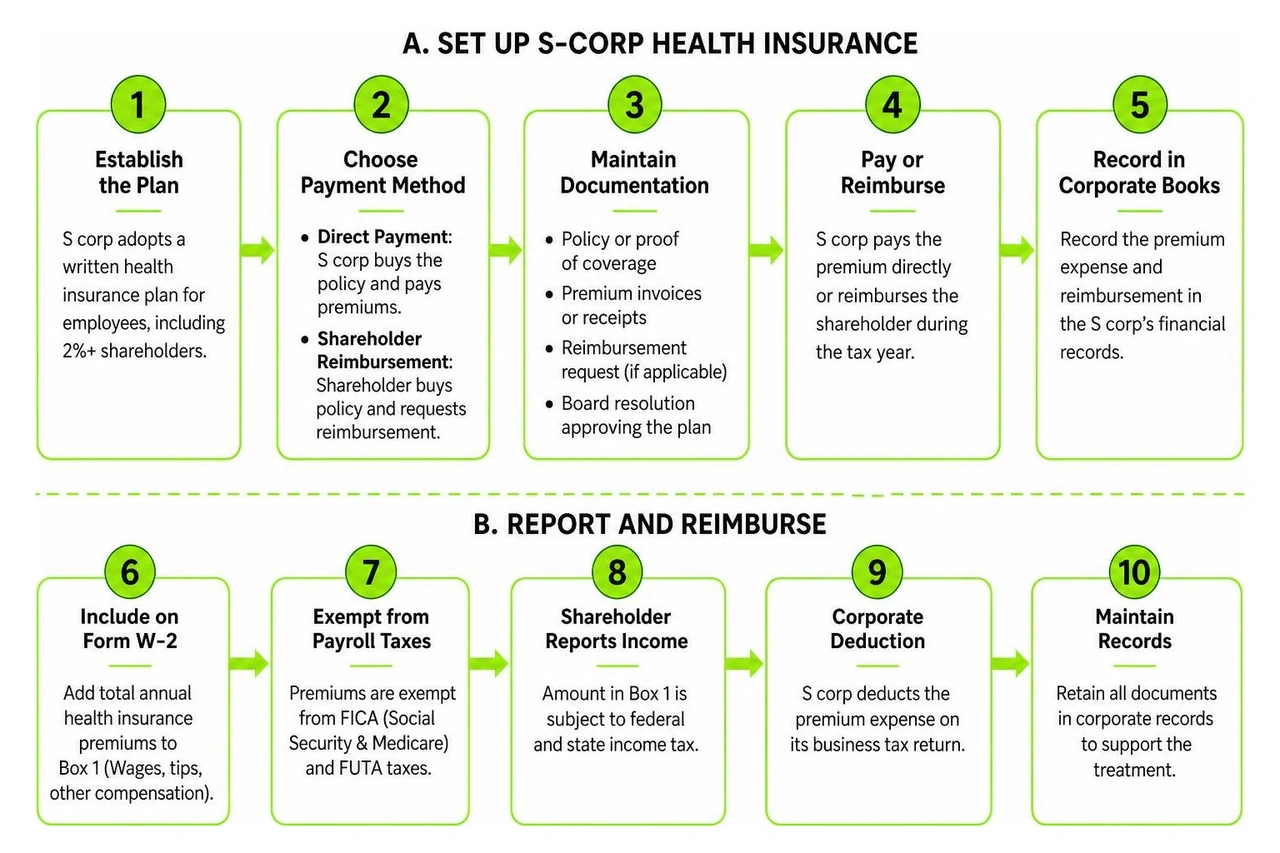
To take full advantage of this strategy, you must establish the health insurance policy through your S corporation under IRS Notice 2008-1 rules. The IRS gives us two approved ways to satisfy this policy establishment test
- Direct Business Payment. The S corporation purchases the insurance policy in the entity name and pays the monthly premiums directly from the business bank account to the insurance carrier.
- Shareholder Reimbursement. The shareholder-employee purchases an individual health insurance policy in their own name, pays the premium personally, and submits proof of payment to the S corporation. The business then reimburses the shareholder-employee during the tax year and documents the reimbursement in corporate records.
Whether the policy is in the business name or your personal name, the fundamental requirement is that the S corp must pay or reimburse the costs within the tax year and record it properly on your W-2. We regularly walk our clients through these essential S-Corp Payroll Rules to make sure no steps are missed.
How to Properly Report S-Corp Health Insurance on Form W-2
When tax season arrives, your payroll software or bookkeeper must populate Form W-2 with surgical precision. Here is the exact box-by-box breakdown for a 2 percent shareholder
- Box 1 Wages, tips, other compensation. Include the total annual health insurance premium amount here. This increases your federal taxable wages.
- Box 3 Social Security wages. Exclude the health insurance premium amount. Do not add it to your normal salary baseline here.
- Box 5 Medicare wages and tips. Exclude the health insurance premium amount.
- Box 14 Other. Enter the total premium amount with an informative label such as 2% SH HEALTH or SEHI. While Box 14 is technically informational, adding this notation helps your tax preparer verify the numbers instantly.
Proper reporting prevents double taxation and ensures your payroll system does not accidentally overwithhold FICA taxes. For a deeper breakdown on payroll settings, see our detailed guide on how S Corp Owners Are You Reporting 2% Shareholder Health Insurance Correctly on Form W-2?.
Claiming Self-Employed Health Deductions on Form 1040
Adding premiums to Box 1 of your W-2 increases your reported gross income, which might sound counterproductive at first glance. However, you offset that exact income addition when you file your personal tax return.
You claim the self-employed health insurance deduction on Schedule 1 of Form 1040 using Form 7206. This creates an above-the-line deduction, meaning it reduces your Adjusted Gross Income directly, even if you choose to take the standard deduction rather than itemizing.
Under IRC Section 162(l), two major limitations apply to this deduction
- Earned Income Cap. The health insurance deduction cannot exceed the wages reported in Box 1 of your Form W-2 from that specific S corporation. If your officer salary is $30,000 and your health insurance premiums are $12,000, your deduction is fully supported. But if your officer salary was set at $5,000, your health deduction would be capped at $5,000.
- Subsidized Group Plan Limitation. You cannot claim the self-employed health insurance deduction for any month in which you were eligible to participate in a subsidized health plan offered by another employer, including a plan offered through your spouse's job.
To make sure your overall financial structure matches these guidelines, review our S-Corp Tax Planning Guide 2026.
Health Reimbursement Arrangements and ACA Compliance Rules

Small business owners often wonder if they can use modern benefit structures like Health Reimbursement Arrangements to cover out-of-pocket medical expenses for themselves and their families. While these arrangements are wonderful for standard employees, the rules change dramatically for S corp owners.
Understanding how federal health policy intersects with tax law keeps your company safe from catastrophic compliance fines. Helpful guidance on general coverage rules can be found at the ALDOI - Health Insurance for Small Businesses resources page.
Alternative Reimbursement Plans and S-Corp Health Insurance Compliance
Account-based health plans like traditional HRAs, Qualified Small Employer Health Reimbursement Arrangements, and Individual Coverage HRAs rely on IRC Section 105(b) to reimburse medical expenses tax-free.
However, IRC Section 105(b) explicitly defines eligible employees by excluding self-employed individuals. Because 2 percent S corporation shareholders are treated as partners for fringe benefit purposes, they are legally prohibited from receiving tax-free reimbursements through an HRA, QSEHRA, or Flexible Spending Arrangement.
For 2026, the maximum allowable QSEHRA reimbursement limits for standard, non-owner employees are $6,450 for self-only coverage and $13,100 for family coverage. An S corporation can offer a QSEHRA or ICHRA to its non-owner W-2 staff members to reimburse health costs. But the 2 percent shareholder-employee cannot participate on a tax-free basis.
If you attempt to run an owner's personal medical reimbursements through a QSEHRA or standard HRA, the IRS will disallow the tax-free status of those payments. For more context on how Section 105 rules apply to other entity structures, read our comparison on Section 105 Plan for Sole Proprietors Filing Schedule C.
ACA Market Reforms and Potential IRC 4980D Penalties
Under the Affordable Care Act, employers cannot simply give employees untaxed money to purchase individual health insurance outside of an approved group plan. Reimbursement arrangements that fail market reform requirements are classified as non-compliant employer payment plans.
Failing to comply with ACA market reforms carries severe tax penalties under IRC Section 4980D. The penalty is an excise tax of $100 per day, per employee, per violation. That translates to $36,500 per year for a single employee.
Fortunately, small S corporations usually qualify for important statutory exemptions.
- The Fewer Than Two Participants Exemption. ACA market reform penalties under Section 4980D do not apply to group health plans that have fewer than two participants who are current employees on the first day of the plan year. If your S corp only covers a single shareholder-employee, you are exempt from these excise taxes.
- The 50 Employee ACA Threshold. S corporations with fewer than 50 full-time equivalent employees are exempt from the ACA employer mandate requiring businesses to offer minimum essential coverage.
Common Mistakes to Avoid with S-Corp Health Insurance
Even experienced business owners make simple administrative slip-ups when managing s-corp health insurance. To keep your tax filings stress-free, avoid these frequent errors.
| Issue or Action | Common Incorrect Handling | Correct Compliant Method | Tax Impact of Failure |
|---|---|---|---|
| Paying Premiums | Owner pays from personal account with zero business reimbursement | S corp pays carrier directly OR reimburses owner during the tax year | Disallows personal Schedule 1 tax deduction entirely |
| Payroll Reporting | Omitting health premiums from Form W-2 Box 1 | Add full premium total into W-2 Box 1 gross taxable wages | IRS disallows self-employed deduction upon audit |
| FICA Calculation | Including health premiums in W-2 Box 3 and Box 5 | Exclude health premiums from Box 3 and Box 5 | Overpays 15.3 percent in unnecessary FICA payroll taxes |
| Dual Eligibility | Claiming deduction while eligible for spouse's employer plan | Suspend Schedule 1 deduction for months spouse coverage is available | IRS back-taxes and penalties for unallowable deduction |
| HRA Participation | Enrolling 2 percent shareholder in a tax-free QSEHRA or ICHRA | Limit HRAs to non-owner employees; handle owner insurance via W-2 | Invalidates HRA tax exemption for the owner |
Paying premiums directly from a personal account without running a reimbursement through corporate payroll remains the single biggest reason owners lose their deductions. Another common pitfall is dual coverage disqualification. If your spouse has access to an employer-subsidized health plan, you cannot claim the self-employed health insurance deduction for those specific months, even if you chose not to enroll in your spouse's plan.
To review additional examples of common reporting tripwires, consult Self Employed Health Insurance S Corp A 2026 Guide and listen to our breakdown on The Essential Guide to S-Corporations.
Frequently Asked Questions About S-Corp Health Insurance Deductions
What happens if health insurance premiums are omitted from W-2 Box 1
If your S corporation pays for your health insurance but fails to include those premium amounts in Box 1 of your W-2 by the year-end payroll close, you lose the legal right to claim the self-employed health insurance deduction on Schedule 1 of Form 1040.
If this happens, your business must file an amended payroll return and issue a Form W-2c, Corrected Wage and Tax Statement. If the payroll chain is not corrected, the IRS can reclassify the corporate health insurance payments as non-deductible distributions or taxable personal expenses, triggering back taxes and interest.
Can family members of S-corp owners receive tax-free benefits
Family members who work for the business are bound by the IRC Section 318 attribution rules. Spouses, children, parents, and grandchildren of a 2 percent shareholder are automatically classified as 2 percent shareholders themselves.
That means their company-provided health coverage must follow the exact same path. Their premiums must be included in their W-2 Box 1 wages and excluded from FICA and FUTA taxes.
There is a helpful exception for young adults. Under federal tax rules, an S corporation owner can include coverage for their adult children under age 27 on their health policy and claim the Schedule 1 deduction workflow, even if the child is no longer claimed as a tax dependent on the owner's Form 1040.
Are state taxes treated differently for 2 percent shareholders
In most states, state income tax treatment mirrors federal rules. Premium inclusions in W-2 Box 1 carry over to state taxable wages, and the state personal return allows a corresponding deduction.
However, certain states handle shareholder fringe benefits differently. Pennsylvania is a notable example. Under Pennsylvania state tax rules, non-discriminatory health insurance premiums paid for 2 percent shareholder-employees are exempt from state income tax withholding, even though they are included in federal Box 1 wages.
Always verify local and state income tax guidelines with your CPA to ensure your payroll software is configured properly for your specific location.
Conclusion
Managing s-corp health insurance does not have to feel overwhelming. Once you understand the required sequence, corporate payment or reimbursement, W-2 Box 1 wage inclusion, FICA tax exclusion, and Schedule 1 Form 1040 reporting, the process becomes a smooth, routine part of your business strategy.
At Core Group, we take the stress out of tax planning and payroll management for creative entrepreneurs. Operating across the United States, our team provides financial management, bookkeeping, and tax services anchored in a clear, profit-first playbook. We make sure every administrative step is handled seamlessly so you never have to worry about missed deductions or unexpected tax notices.
Ready to build a stress-free financial foundation for your business? Take the next step today and learn How to Form an S-Corp for Business Growth with our experienced team by your side.