S-Corp Tax Planning 101: Smart Strategies for Business Owners
S-Corp Tax Planning Benefits and Business Structures
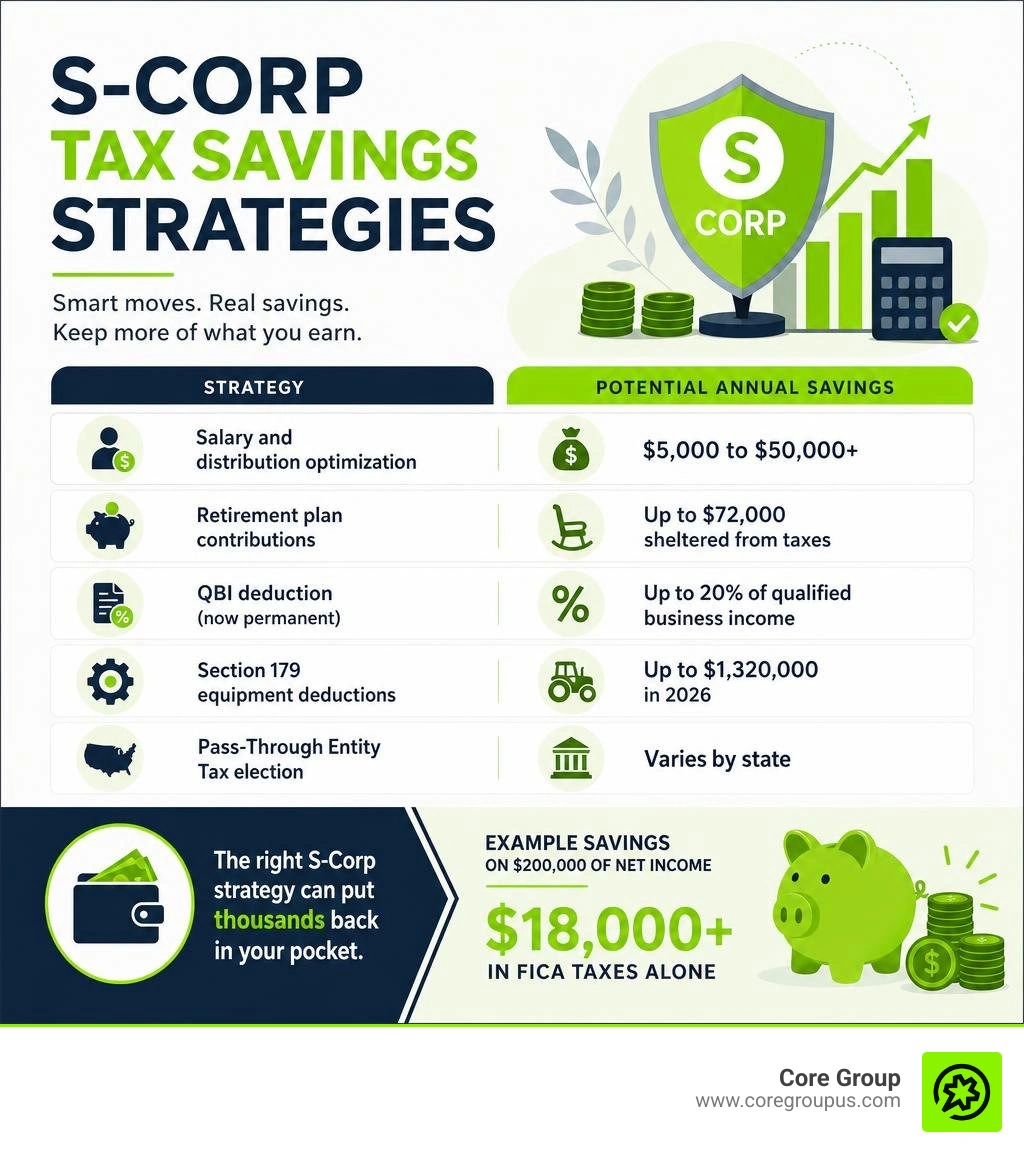
S-corp tax planning is one of the most powerful ways small business owners can legally cut their tax bill every year.
Here is a quick summary of what you need to know,
| Strategy | Potential Annual Savings |
|---|---|
| Salary and distribution optimization | $5,000 to $50,000+ |
| Retirement plan contributions | Up to $72,000 sheltered from taxes |
| QBI deduction (now permanent) | Up to 20% of qualified business income |
| Section 179 equipment deductions | Up to $1,320,000 in 2026 |
| Pass-Through Entity Tax election | Varies by state |
The core idea is simple. S-corporations are pass-through entities, meaning business profits flow directly to your personal tax return. You avoid the double taxation that C-corporations face. And unlike a sole proprietor or single-member LLC, you only pay payroll taxes on your W-2 salary, not on every dollar the business earns.
That difference is significant. On $200,000 of net income, the right salary and distribution split can save you over $18,000 in FICA taxes alone in a single year.
But the savings only materialize when the strategy is set up correctly. Pay yourself too little and the IRS comes knocking. Pay yourself too much and you hand money to the government that you did not have to. Miss a retirement deadline or skip tracking your shareholder basis and the whole plan unravels.
This guide covers everything you need to know, from reasonable compensation rules and QBI optimization to retirement planning and year-end moves that actually work in 2026.
Key terms for s-corp tax planning include,

When you start a business, you usually default to a sole proprietorship or a single-member LLC. While these setups are easy to manage, they subject all your hard-earned profits to self-employment taxes. As your business grows, this becomes an expensive tax trap.
By transitioning to an S-corporation, you change how the IRS views your business. An S-corporation is not a separate legal entity, but rather a special tax election made with the IRS. This election allows profits and losses to pass through directly to your personal tax return, which helps you Avoid Double Taxation that traditional corporations face.
For business owners in high-tax states, understanding state-specific rules is critical. For example, if you operate in California, you must navigate specific rules outlined by the S Corporations California Tax Service Center, which imposes a 1.5% franchise tax on S-corporation net income.
To see how the S-Corp Business Structure compares to a standard LLC, let us look at how they are taxed side by side,
| Tax Feature | Standard LLC | S-Corporation |
|---|---|---|
| Tax Classification | Pass-through entity | Pass-through entity |
| Self-Employment Tax (15.3%) | Applies to 100% of net profits | Applies only to W-2 salary |
| Owner Compensation | Owner draws (no payroll) | W-2 salary plus shareholder distributions |
| Corporate Income Tax | None at federal level | None at federal level |
| Special State Taxes | Varies by state | Varies, such as California franchise tax |
How S-Corp Tax Planning Reduces Self-Employment Taxes
The primary mechanism of s-corp tax planning is the reduction of FICA taxes. FICA consists of Social Security and Medicare taxes, which total 15.3% of your income.
As a sole proprietor or standard LLC owner, you pay this 15.3% tax on every single dollar of your net business profit up to the annual Social Security wage base, which is $184,500 for the 2026 tax year.
When you elect S-corporation status, you split your business income into two distinct categories,
- A reasonable W-2 salary, which is subject to FICA taxes.
- Shareholder distributions, which are completely exempt from FICA taxes.
This means you only pay the 15.3% tax on your salary portion. The rest of your business profit flows to you tax-free from a payroll perspective.
To make this strategy worthwhile, your net business income should generally exceed a threshold of $60,000 to $80,000. Below this amount, the administrative costs of running payroll, filing corporate tax returns, and paying annual state fees will likely eat up your tax savings. You can learn more about how standard structures compare by reading about Single Member LLC Taxes.
Maximizing the QBI Deduction with S-Corp Tax Planning
The Qualified Business Income (QBI) deduction, also known as Section 199A, allows eligible business owners to deduct up to 20% of their business income from their federal taxes.
For a long time, business owners worried that this deduction would disappear. However, the One Big Beautiful Bill Act, signed into law on July 4, 2025, made the QBI deduction permanent. This legislative change brings incredible stability to long-term tax planning. The law also introduced a new $400 minimum QBI deduction for qualifying businesses with at least $1,000 of active income, ensuring even smaller businesses benefit.
For S-corporation owners, maximizing this deduction requires active management of the W-2 wage limitation. For high-income earners above the 2026 phase-out thresholds, which start at $191,950 for single filers and $383,900 for married couples filing jointly, the QBI deduction is limited by the amount of W-2 wages the business pays.
This creates a balancing act. If you pay yourself too low of a salary, you save on payroll taxes but you might severely limit your QBI deduction. If you pay yourself too high of a salary, you increase your payroll tax burden but you might unlock a much larger QBI deduction. Working with a professional to model these scenarios is the best way to find your perfect financial balance. You can read a detailed breakdown in our guide on the QBI Deduction Explained.
Reasonable Compensation and IRS Compliance

Because S-corporations allow you to avoid payroll taxes on distributions, the IRS pays close attention to how much you pay yourself. If you pay yourself a salary of zero or set your compensation artificially low, the IRS can audit your business and reclassify your distributions as wages. This results in back taxes, interest, and expensive penalties.
To stay compliant, you must follow the S-Corp Payroll Rules and pay yourself what the IRS calls reasonable compensation. This is the amount that an unrelated employer would pay to hire someone to perform the exact same duties for your business.
Determining a Defensible Salary
There is no single percentage or rule of thumb that defines a reasonable salary. The mythical 60/40 rule, which suggests paying 60% salary and 40% distributions, has no actual basis in tax law.
Instead, the IRS looks at several concrete factors to evaluate your compensation,
- Your training, experience, and specific duties.
- The time and effort you dedicate to the business.
- What comparable businesses in your industry pay for similar services.
- The complexity of your business operations.
We recommend using specialized tools like RCReports to analyze local market data and establish a defensible salary range. Typically, reasonable compensation ends up falling between 30% and 50% of your business net income, but this must always be backed by real-world data. Once you determine your salary, you should formally document the decision in your corporate minutes to protect your business in case of an audit. You can find more payroll tips in our overview of Payroll for SMB.
Common Mistakes that Trigger IRS Audits
The IRS regularly targets S-corporation returns, and a large percentage of these audits focus on owner compensation.
Some of the most common mistakes that trigger IRS audits include,
- Paying yourself a zero salary while taking regular cash distributions.
- Misclassifying owner-employee wages as 1099 contractor payments.
- Adjusting your salary downward without a corresponding change in your actual business duties.
- Taking distributions that exceed your shareholder basis, which turns tax-free distributions into taxable capital gains.
Additionally, state tax agencies closely monitor S-corporations. If you operate in Alabama, you must comply with state-specific filing and compliance rules, which you can review on the FAQ Categories S-Corporations and Fiduciaries page. Failing to track your shareholder basis or ignoring state-specific payroll rules can quickly lead to audit notices and unexpected tax bills.
Advanced Strategies to Minimize Taxes
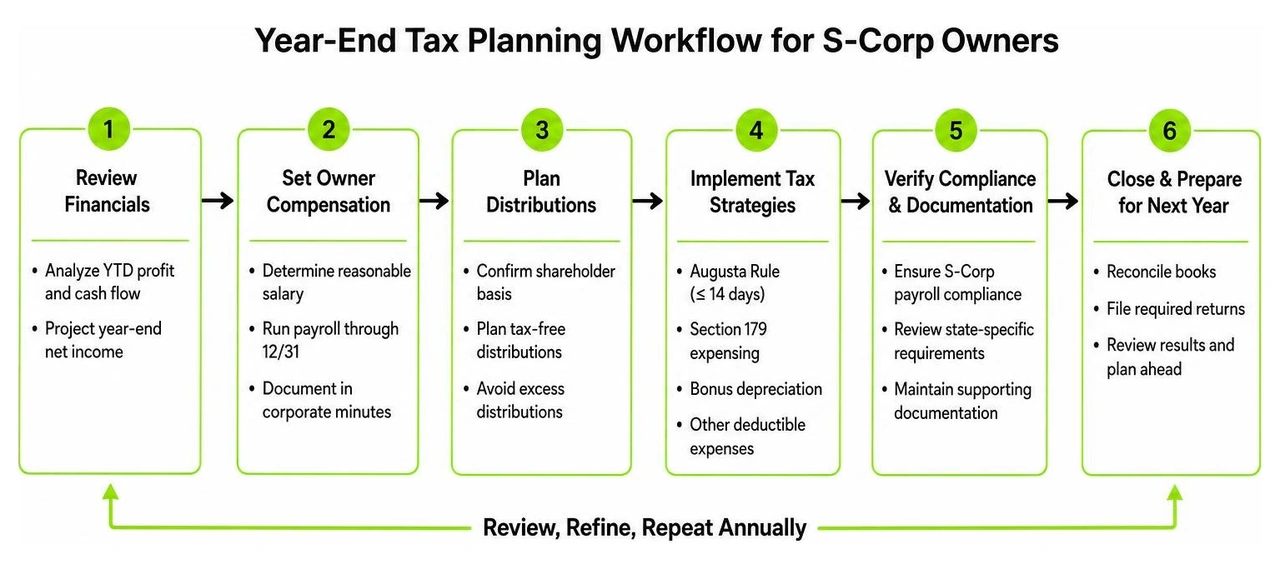
Once you have mastered the basics of salary and distribution planning, you can implement advanced Strategies to Minimize Taxes to further reduce your overall tax liability.
One highly effective strategy is the Augusta Rule, which comes from Section 280A of the tax code. This rule allows you to rent your personal residence to your S-corporation for up to 14 days per year for business meetings, planning sessions, or board meetings. The corporation gets a full tax deduction for the rent expense, and you receive the rental income completely tax-free on your personal return. To keep this strategy audit-proof, you must document the business purpose of each meeting, keep formal meeting minutes, and prove that the rental rate matches local market prices.
Another powerful tool is Section 179 expensing, which allows you to deduct the full purchase price of qualifying equipment, technology, and office furniture in the year you buy it and put it into service. For the 2026 tax year, the Section 179 deduction limit is $1,320,000, with a phase-out threshold of $3,290,000. Under the One Big Beautiful Bill Act, bonus depreciation is set at 60% for 2026, making the timing of asset purchases incredibly important for your tax planning.
Retirement Plans for S-Corporation Owners
If you are looking for the absolute best way to shelter large amounts of income, maximizing your retirement contributions is the way to go.
For solo business owners, a Solo 401k is often the most powerful option. In 2026, S-corporation owners can contribute up to $72,000 combined as both an employee and an employer.
- As an employee, you can make a salary deferral of up to $24,500.
- As the employer, your S-corporation can make a profit-sharing contribution of up to 25% of your W-2 salary.
If you prefer a simpler setup with less administrative paperwork, a SEP-IRA allows you to contribute up to 25% of your W-2 compensation, capped at $70,000 for 2026. For very high-income earners who want to contribute even more, establishing a Defined Benefit Plan can allow you to shelter multiple six-figure sums annually. You can read more about choosing the right retirement vehicle in our guide on How to Save on Taxes.
State Tax Strategies and PTET Elections
State taxes can significantly impact your overall tax burden, especially if you operate in multiple states. One of the most important developments in state tax planning is the Pass-Through Entity Tax election.
Currently, 36 states allow S-corporations to pay state income tax at the entity level rather than passing it through to the individual owners. This election acts as a workaround to the federal $10,000 limit on state and local tax deductions. By paying the tax at the corporate level, your S-corporation gets a full federal deduction, which directly lowers your federal taxable income.
Because we serve clients across the country, we help business owners navigate these rules in many different states,
- In Delaware, you can explore formation and state compliance through the Delaware Division of Corporations website.
- In Alaska, you can review state tax filing guidelines with the Alaska Department of Revenue portal.
- In Arizona, business owners can leverage local expertise to manage their state tax filings.
- In Arkansas, you can work with specialized professionals to handle your corporate tax returns.
- In Colorado, remote and local planning is available to help you stay compliant with state regulations.
- In Connecticut, you can find local filing support to manage your annual S-corporation requirements.
Understanding how these different states handle S-corporations is critical to avoiding double taxation and ensuring you do not pay more state tax than necessary.
Frequently Asked Questions about S-Corp Tax Planning
What is the best tax strategy for an S-Corp in 2026
The best tax strategy is a combination of salary optimization, maximized retirement contributions, and strategic year-end purchases. By keeping your W-2 salary at a reasonable minimum, you minimize your payroll tax exposure. You can then use a Solo 401k to shelter up to $72,000 of your income, and utilize Section 179 to write off new equipment purchases.
How much should I pay myself from my S-Corp
Your salary should reflect what it would cost to hire an outside professional to perform your daily duties. This should be based on real-world market benchmarks for your industry and geographic region. For most creative entrepreneurs, a defensible salary falls within the 30% to 50% range of net business profits, though it must always be supported by documented compensation data.
Is the QBI deduction permanent
Yes. The One Big Beautiful Bill Act, signed into law on July 4, 2025, made the Section 199A QBI deduction permanent. This means S-corporation owners can continue to enjoy up to a 20% deduction on their qualified business income without worrying about future sunset dates.
Conclusion
Proactive s-corp tax planning is the key to keeping more of your hard-earned money in your pocket. By optimizing your salary, taking advantage of the permanent QBI deduction, and leveraging strategies like the Augusta Rule and retirement plans, you can save thousands of dollars every single year.
At Core Group, we specialize in helping creative entrepreneurs build financial systems that work. Our no-fluff, profit-first playbook is designed to save you time and bring you complete peace of mind, allowing you to focus on what you do best. We even back our services with our signature MacBook Pro guarantee.
If you are ready to stop guessing and start saving, let us help you navigate the S-Corp Setup Process and build a custom tax strategy for your business. Reach out to us today to get started.