How to Never Worry About Schedule C Instructions Again
Understanding Who Must Follow Schedule C Instructions
Understanding schedule c instructions starts with knowing whether you are required to file this form. IRS rules state that you must file Schedule C with your Form 1040 if you operate an unincorporated trade or business as a sole proprietor, a single member LLC owner, a statutory employee, or as part of a qualified joint venture with your spouse.
A trade or business generally exists if you engage in an activity primarily for income or profit, and you pursue that activity with continuity and regularity. Sporadic activities or hobbies do not qualify as a business under IRS standards. If you set up a single-member LLC and do not elect to be taxed as a corporation, the IRS treats your business as a disregarded entity. That means your business profits flow through to your personal tax return using Schedule C. You can learn more about how this works in our guide on Single Member LLC Taxes.
When married couples operate an unincorporated business together, they can avoid the headache of filing a complex partnership return (Form 1065) by electing Qualified Joint Venture status. Under this rule, each spouse files a separate Schedule C to report their proportional share of income and expenses, ensuring both receive proper credit for Social Security and Medicare earnings.
Determining Sole Proprietor Status and Filing Rules
Determining whether you are a sole proprietor comes down to profit intent and business regularity. If you provide freelance services, run a design agency, or sell goods online with the intention of earning a profit, the IRS views you as self-employed.
To help clarify your business arrangement, review this decision flow.
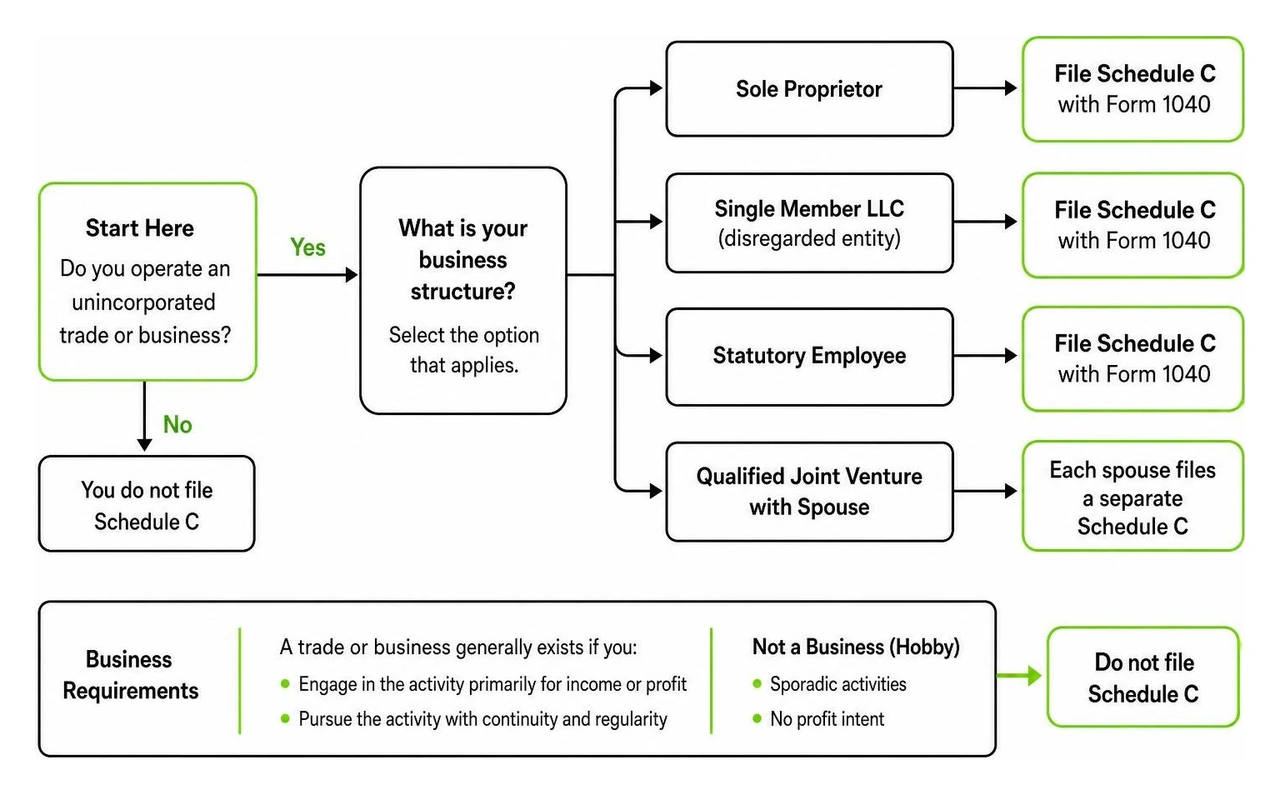
Distinguishing between a business and a hobby is vital because hobby expenses are no longer deductible against hobby income, whereas business expenses remain fully deductible on Schedule C. To support your business status, you should maintain clean books, keep separate bank accounts, and actively work to grow your income.
You must report all business income, even if you do not receive a Form 1099-NEC or Form 1099-K. If you hire contractors, you may also need to issue 1099s to them. Check our detailed Individual Sole Proprietor or Single Member LLC 1099 Guide for clear direction on handling these forms. Furthermore, while sole proprietors can often use their Social Security Number on tax forms, getting an Employer Identification Number (EIN) helps protect your identity and is required if you hire employees or establish qualified retirement plans.
Agricultural Income and Non Farm Schedule C Instructions
Farmers and agricultural producers face special filing rules when they earn non-farming income. Standard farm operations, such as selling crops or livestock, belong on Schedule F. However, if an agricultural business branches out into non-farm activities, those earnings must be reported using schedule c instructions.
Common examples of agricultural revenue that belong on Schedule C include
- Operating an agritourism venue, such as hosting farm weddings, corn mazes, or field tours.
- Processing raw farm products into value-added retail goods, such as artisanal cheeses, jams, or wines.
- Providing off-farm consulting, custom equipment work, or freelance services.
Studies show that over 90 percent of farm households earn off-farm income. Keeping a sharp dividing line between farm operations on Schedule F and non-farm activities on Schedule C prevents tax errors and keeps your deductions completely organized.
Key Changes and Updates to Schedule C Form Rules
Keeping up with annual tax adjustments ensures your return stays fully compliant while capturing every allowable savings opportunity. Tax rules for 2025 bring several key adjustments that impact how you report income and deduct business costs. You can review the complete technical release on the official Instructions for Schedule C (Form 1040) (2025) | Internal Revenue Service page.

Key updates for tax year 2025 include
- Standard mileage rate. The allowable rate for business driving increases to 70 cents per mile.
- Section 179 expensing. The maximum deduction cap rises to $2,500,000, with a phase-out threshold starting at $4,000,000.
- Bonus depreciation. Qualified property acquired after January 19, 2025, qualifies for 100 percent bonus depreciation.
- Information return e-filing. The threshold requiring electronic filing for 1099s remains at 10 aggregated forms.
- Reporting digital assets. You must report all digital asset transactions, including cryptocurrency or NFT payments accepted for goods and services, as gross business receipts.
A major shift in recent rules involves qualified tips and overtime pay. Under updated regulations, deductions for qualified tips (up to $25,000) and qualified overtime (up to $12,500 for single filers and $25,000 for married joint filers) are claimed on Schedule 1-A (Form 1040) rather than inside Schedule C.
Strategic Tax Changes and Deductions Explained
For creative entrepreneurs and freelancers, navigating deduction rules effectively reduces your total taxable income. Small business owners operating as sole proprietors may qualify for the Qualified Business Income (QBI) deduction, which allows eligible pass-through entities to deduct up to 20 percent of qualified business net income. Learn how to calculate this benefit in our article on QBI Deduction Explained.
Proactive tax strategies make filing far simpler when tax season arrives. Check out our guide on Tax Planning for Freelancers to organize your receipts and cash flow early.
Additional strategic tax updates for small businesses include
- Sound recording production deductions. You can deduct qualified sound recording production expenses up to $150,000 for production costs starting after July 4, 2025.
- Commercial clean vehicle credit. Businesses purchasing eligible clean commercial vehicles can lower tax liabilities under IRC Section 45W.
- Section 481(a) accounting adjustments. If you request a change in accounting methods by filing Form 3115, such as switching from accrual to cash, you must include a Section 481 adjustment to prevent omitting or duplicating income.
Line by Line Breakdown of Form 1040 Schedule C
Completing Schedule C involves moving through five detailed sections. Having a firm grasp on each line item helps you file accurately and avoid unnecessary delays.

Before filling in financial figures, you must supply basic identity information at the top of the form.
- Line A. Describe your primary business activity or product.
- Line B. Enter the correct six-digit Principal Business Activity (PBA) code that matches your primary trade.
- Line D. Enter your Employer Identification Number if you have one. Do not enter your personal Social Security Number on Line D.
- Line F. Select your accounting method, typically Cash or Accrual.
- Line G. Check whether you materially participated in the business by meeting one of the seven IRS participation tests, such as working 500 hours or more in the business during the tax year.
Reporting Income and Cost of Goods Sold
Part I of Schedule C captures your total gross income, while Part III measures the cost of producing or acquiring goods if your business maintains inventory.
Here is how income flows through Part I.
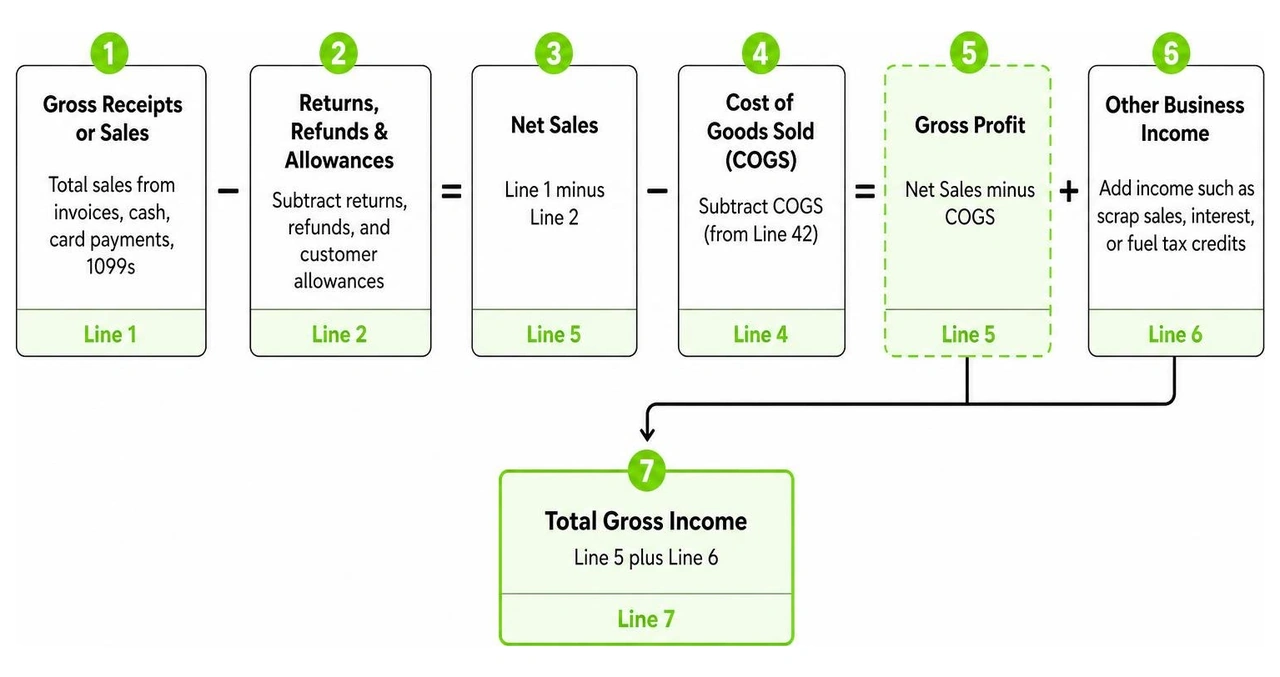
- Line 1. Report gross receipts or sales from invoices, cash, credit card payments, and 1099 statements.
- Line 2. Subtract returns, refunds, and customer allowances.
- Line 4. Calculate gross profit by subtracting Cost of Goods Sold (from Line 42) from net sales.
- Line 6. Enter other business income, such as scrap sales, interest, or fuel tax credits.
- Line 7. Combine Line 5 and Line 6 to determine total gross income.
If your business manufactures, buys, or resells physical goods, you must complete Part III (Cost of Goods Sold). You will report beginning inventory on Line 35, add purchases and labor costs on Lines 36 through 39, and subtract ending inventory on Line 41 to calculate Line 42.
Specific Line Expenses and Deductions Breakdown
Part II lists deductible business expenses that reduce your overall taxable profit. To qualify, an expense must be ordinary (common and accepted in your trade) and necessary (helpful and appropriate for your business).
Key expense lines in Part II include
- Line 8 (Advertising). Costs for website hosting, ad campaigns, design work, and promotional materials.
- Line 11 (Contract Labor). Payments to independent contractors. Remember to issue Form 1099-NEC for contractors paid $600 or more during the year.
- Line 19 (Pension and Profit-Sharing Plans). Contributions made for employee benefit accounts.
- Line 24b (Business Meals). Deduct 50 percent of allowable business meals with clients or during business travel.
- Line 27a and 27b (Other Expenses). Itemize extra costs in Part V, such as software subscriptions, professional dues, or specialized tools, and bring total sums to Line 27a and Line 27b.
To maximize medical tax deductions legally, sole proprietors can establish a Section 105 reimbursement plan. Read our detailed guide on Section 105 Plan for Sole Proprietors Filing Schedule C to discover how to turn medical costs into fully deductible business expenses.
Applying Vehicle and Home Office Schedule C Instructions
Vehicle expenses and home office deductions are two of the most valuable savings tools for small business owners, but they require strict compliance with schedule c instructions.
For business driving reported on Line 9, you can choose between two methods.
- Standard Mileage Rate. Multiply total business miles driven by 70 cents per mile. You must track your business driving using a timely log noting dates, mileage, destination, and purpose.
- Actual Expense Method. Track total vehicle operating costs, including gas, oil, repairs, insurance, and depreciation, multiplying total costs by the percentage of total driving done for business.
If you claim vehicle expenses without filing Form 4562, you must answer the detailed vehicle usage questions in Part IV of Schedule C.
For home office costs reported on Line 30, you can select one of two deduction paths.
| Option | Method | How it works |
|---|---|---|
| Simplified Method | Square footage calculation | Multiply qualified square footage (up to 300 sq ft) by $5 per square foot, up to a maximum $1,500 deduction. |
| Regular Method | Form 8829 | Calculate actual home costs including mortgage interest, utilities, insurance, and repairs allocated by the percentage of home area used exclusively for business. |
Form Interactions and Recordkeeping Best Practices
Schedule C does not stand alone; it interacts directly with several other federal tax forms. The net profit calculated on Line 31 carries over to Schedule 1 (Form 1040), Line 3. From there, it adds to your total personal income on Form 1040.
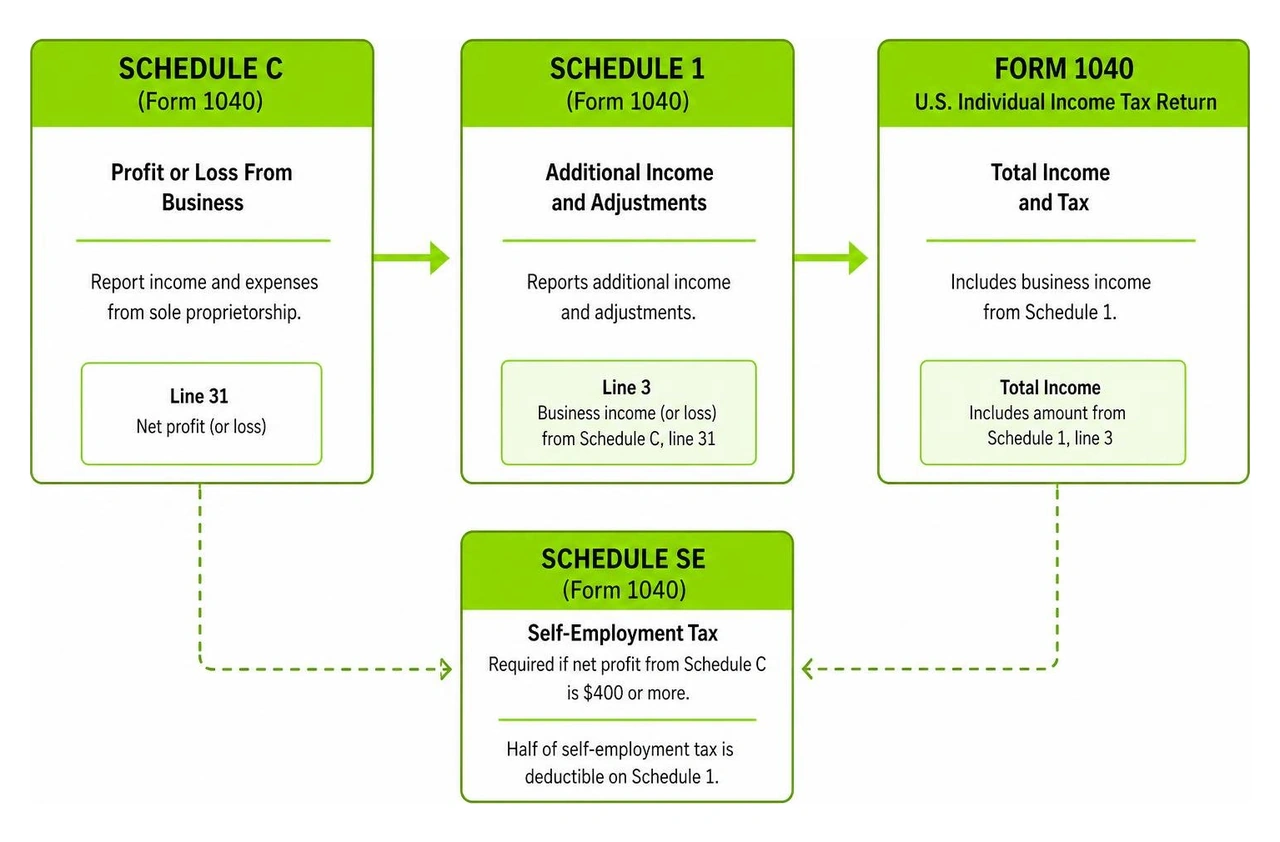
If your net business profit reaches $400 or more, you must also complete Schedule SE to calculate self-employment tax. This tax covers Social Security and Medicare obligations at a combined rate of 15.3 percent. Half of your calculated self-employment tax is deductible as an adjustment to income on Schedule 1.
Supporting your tax position requires meticulous recordkeeping. Keep all records, including
- Bank and credit card statements dedicated exclusively to business use.
- Electronic invoices, merchant processing statements, and point-of-sale summaries.
- Written receipts showing date, vendor, amount, and business purpose for every expense.
- Timely mileage tracking logs recording starting and ending odometer readings.
If you or your contractors use an Individual Taxpayer Identification Number (ITIN), note that ITINs not used on at least one tax return over the last three consecutive years expire on December 31. Keep tax documents for at least three to seven years to ensure complete audit protection. You can review additional official filing guidelines on the Federal Schedule C Instructions (Schedule C Instructions) - 2025 Federal TaxFormFinder database.
Avoiding Common Schedule C Mistakes and Audit Triggers
Filing errors delay tax refunds and increase audit risks. Avoiding frequent mistakes ensures smooth processing with tax authorities.
Common mistakes to avoid include
- Mixing personal and business expenses. Using business accounts for personal spending raises immediate red flags during an audit.
- Double-reporting income. Accidental duplicate entries of gross revenue from both merchant statements and 1099 forms inflate your taxable income.
- Unsubstantiated travel and meal costs. Deduction claims without matching receipts or recorded business details are frequently disallowed during tax reviews.
- Missing non-employee compensation. Failing to report gross income received from 1099-NEC or 1099-K forms causes matching discrepancies with IRS computer records.
- Incorrect EIN usage. Placing a personal Social Security Number on Line D instead of an official EIN, or using a corporate EIN for a sole proprietorship, causes document errors.
Frequently Asked Questions
What is the main purpose of Schedule C on Form 1040
The main purpose of Schedule C is to report annual income, deductible operating expenses, and net profit or loss from a business operated as a sole proprietor or single-member LLC. The resulting profit or loss transfers directly to Schedule 1 of Form 1040 to determine your overall personal income tax liability.
How does Schedule C connect with Schedule SE
Schedule C calculates the net business earnings used by Schedule SE to figure self-employment tax for Social Security and Medicare. If your Schedule C net profit is $400 or more, you must file Schedule SE alongside Form 1040 to determine your self-employment tax liability.
What records do I need to support my Schedule C deductions
To defend your business deductions, keep written receipts, canceled checks, paid bills, sales invoices, bank records, contract agreements, and detailed mileage logs. These records must verify the dollar amount, date, vendor, and business relationship for each expense claimed on your return.
Conclusion
Mastering schedule c instructions does not mean spending endless late nights wrestling with spreadsheets, tax line items, and changing mileage rules. With clean financial records, an understanding of key deductions, and awareness of annual updates, you can approach tax season with complete confidence.
At Core Group, we help creative entrepreneurs skip the stress of compliance using our no-fluff, profit-first playbook that guarantees peace of mind and saves valuable time. To make sure your business stays fully compliant while capturing every tax benefit you deserve, check out our comprehensive Single Member LLC 1099 Reporting Guide or reach out to our team today.