How to File Your Taxes with the Best Single Member LLC Tax Software
What You Need to Know About Single Member LLC Tax Software
The right single member LLC tax software can save you hundreds of dollars and hours of stress every tax season. Here is a quick answer based on your LLC's tax classification
| Your LLC Classification | Forms Required | Software Type Needed |
|---|---|---|
| Disregarded entity (default) | Schedule C on Form 1040 | Standard personal tax software |
| S Corp election | Form 1120S, Schedule K-1, W-2 | Business tax software |
| C Corp election | Form 1120 | Business tax software |
The short version Most single-member LLCs are treated as disregarded entities by the IRS. That means you report business income on Schedule C of your personal Form 1040. You do not need expensive business-tier software for that.
But here is where it gets tricky. A staggering 56% of small business owners admit to making mistakes during year-end tax prep. Those mistakes can mean IRS penalties, missed deductions, and a lot of unnecessary stress.
The complexity jumps when you factor in key variables
- State-level fees and separate filings (California alone requires an $800 annual franchise tax and Form 568)
- Self-employment tax, which runs roughly $14,130 on $100,000 in net profit
- Quarterly estimated payments and deductions like the Section 199A QBI deduction
- S Corp elections that change your entire filing structure
Getting your software choice wrong from the start costs you money. Getting it right saves you time, reduces audit risk, and lets you focus on the work you actually love doing.
I'm Christian Brim, and in this guide I'll walk you through exactly which software options fit your situation and how to avoid the most common filing mistakes.
Single member llc tax software glossary
- single member llc taxes
- is an llc a sole proprietorship or corporation
- 1099 contractor expense tracking
Choosing the Right Single Member LLC Tax Software for Your Business Structure
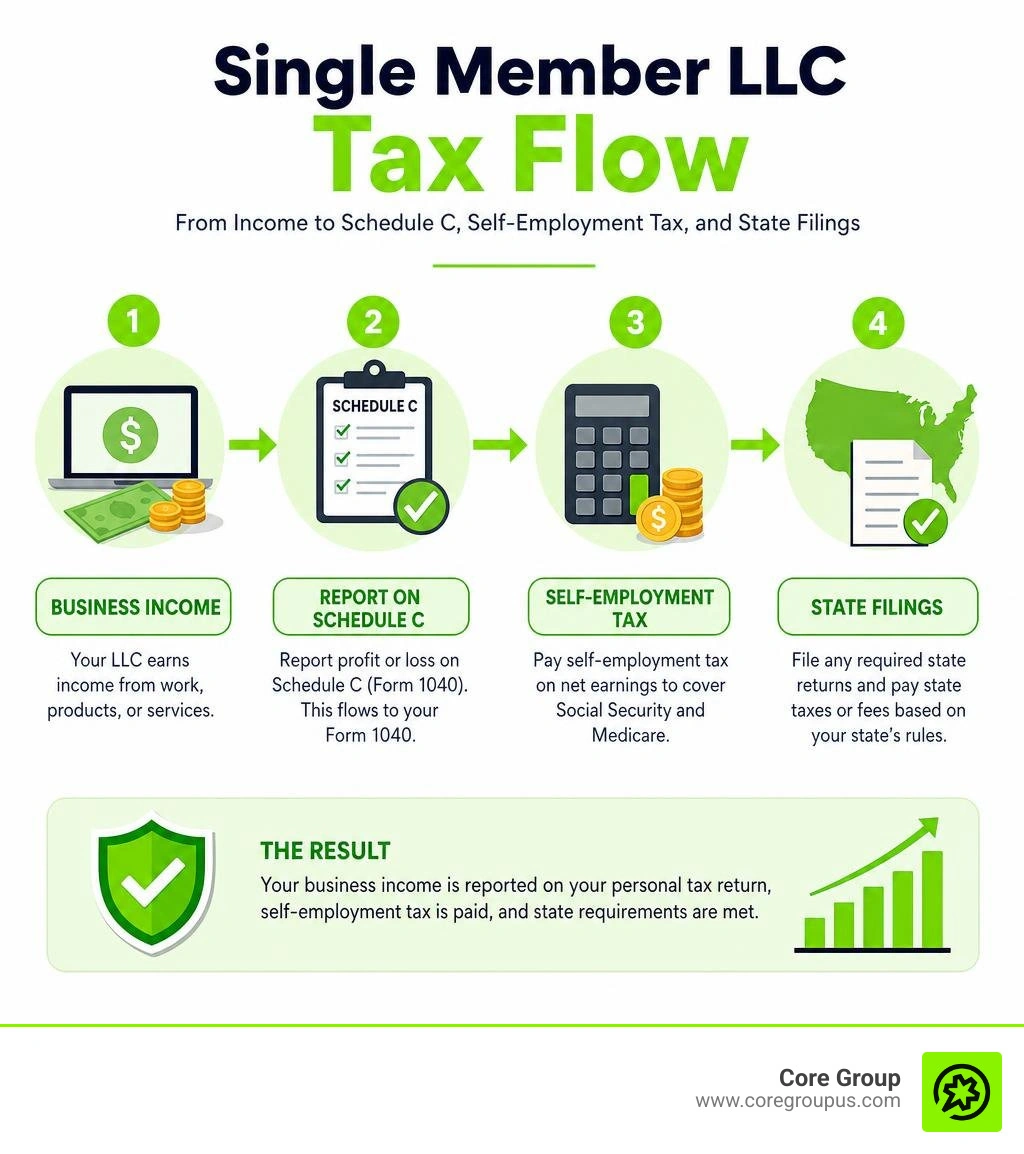
Selecting the ideal tax platform begins with understanding how the federal government views your business structure. A limited liability company is a state legal entity, but the IRS does not have a separate tax category specifically for LLCs. Instead, federal tax law assigns your business a default classification based on the number of owners.
By default, the IRS classifies a business owned by one individual as a disregarded entity. This means that for federal income tax purposes, the government ignores the separation between you and your business. All legal guidance from Single member limited liability companies IRS confirms that your business revenue and expenses pass directly through to your individual tax return using Form 1040.
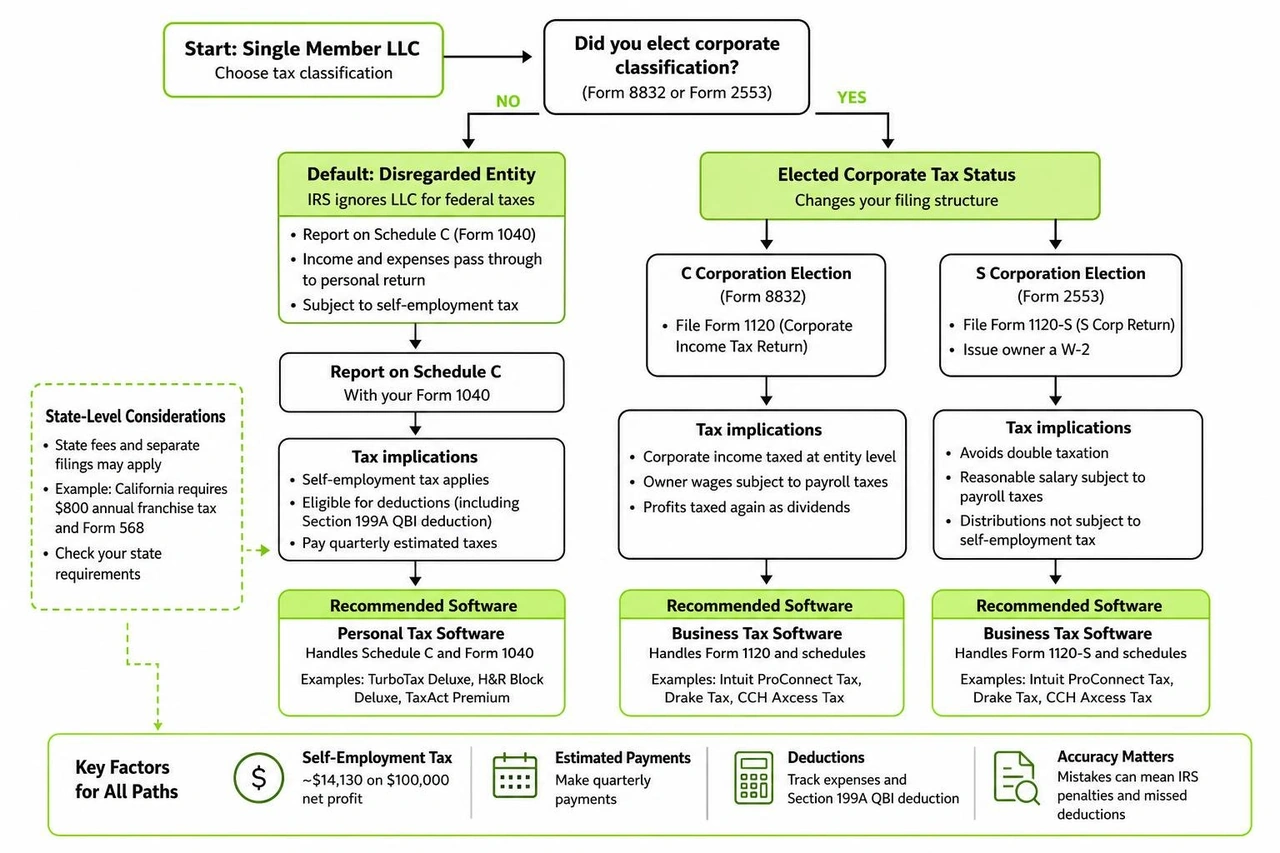
When business owners ask us if an LLC is a sole proprietorship or corporation, we remind them that while an LLC provides legal liability protection, its tax treatment mirrors a sole proprietorship unless you proactively elect corporate status. If you keep the default classification, standard consumer tax platforms that handle Schedule C will cover your needs completely. However, if you file Form 8832 or Form 2553 to change your tax classification, your software requirements change completely. You can learn more about these distinctions in our guide on is an llc a sole proprietorship or corporation.
Disregarded Entity Reporting on Schedule C
When operating as a disregarded entity, reporting your financial activity happens on Schedule C, Profit or Loss From Business, attached directly to your personal Form 1040. The tax platform you choose must capture your total gross revenue, cost of goods sold, and operating expenses.
Pass-through income flows from Schedule C into your overall personal taxable income calculation. A major component of this process involves calculating self-employment tax. Because you are technically both employee and employer, you pay 15.3% in self-employment taxes on 92.35% of your net business profit. This breakdown includes 12.4% for Social Security up to the annual wage limit and 2.9% for Medicare.
On $100,000 in net profit under default classification, you owe roughly $14,130 in self-employment tax alone before federal and state income taxes even enter the picture. To dive deeper into these calculations, explore our detailed breakdown on single member llc taxes and read about federal income tax llc guidelines.
Standard DIY tax platforms walk you through Schedule C using interview style questions. Many standard consumer tax software options offer federal filing for Schedule C at low costs, while other popular self-employed tiers automatically transfer your numbers to Schedule C.
S Corp Election Requirements and Corporate Software Needs
As your single member LLC grows in profitability, paying 15.3% self-employment tax on every dollar of net profit becomes a heavy burden. To reduce this tax liability, business owners often make an S Corporation tax election by filing IRS Form 2553.
Electing S Corp status changes your software requirements completely. You can no longer report your business operations on Schedule C inside standard personal tax software. Instead, your business must file a separate corporate return using IRS Form 1120S. The business software generates a Schedule K-1 for you as the owner, which reports your pass-through profit share to be entered on Schedule E of your personal Form 1040.
Under an S Corp election, you must pay yourself reasonable compensation via W-2 wages. You pay standard payroll taxes on that salary, but any remaining net profit can be distributed to you as shareholder distributions, which are free from self-employment taxes.
For example, on $100,000 in net profit, paying yourself a defensible reasonable salary of $60,000 means you only pay self-employment tax on that $60,000 wage base rather than the full $100,000. This structure saves roughly $1,793 per year in self-employment taxes. However, keep in mind that maintaining an S Corp requires running formal payroll and purchasing specialized business software or hiring professionals, which typically adds $2,000 to $4,000 in annual payroll, compliance, and corporate software costs.
If you elect S Corp taxation, standard basic consumer software platforms will not suffice for the business filing. You must purchase dedicated business software packages capable of generating Form 1120S and Schedule K-1 documents.
Essential Features to Evaluate in Single Member LLC Tax Tools
Choosing the right platform requires evaluating features beyond simple price tags. Modern tax platforms should streamline bookkeeping, protect you from calculation errors, and simplify complex deductions.
When reviewing tools for your single member LLC, look for automated import features, built-in tax calculation guarantees, and audit support options. Seamless integration with accounting systems reduces human error when entering end of year profit summaries.
Tracking Business Expenses Depreciation and Income
Maximizing legal write-offs is the single best way to lower your tax liability. The platform you select must handle standard Schedule C deductions effortlessly, including home office deductions, business mileage, professional software subscriptions, marketing expenses, and contractor payments.
For creative entrepreneurs managing contractor payouts, tracking Form 1099 details accurately is critical. You can learn more by checking out our guides on single member llc 1099 guide 2026 and single member llc 1099 reporting to make sure you remain fully compliant.
Depreciation calculations represent another critical area. When purchasing major assets such as computers, office furniture, or production equipment, your software must handle depreciation schedules accurately. High quality software guides you through Section 179 expense elections, allowing you to deduct the full purchase price of qualifying equipment in the year you buy it rather than spreading the deduction over several years.
To ensure you never miss eligible business write-offs, review our comprehensive llc tax deductions guide 2026 and check out our strategic advice on how to save on taxes.
Managing Estimated Payments and Section 199A QBI Deductions with Single Member LLC Tax Software
Because single member LLC profits pass directly to the business owner, the IRS requires you to pay income and self-employment taxes throughout the year. You must make estimated quarterly tax payments using Form 1040-ES if you expect to owe $1,000 or more when filing your annual return.
Top tier business tax platforms calculate quarterly voucher amounts based on your prior year income or current profit trends. Setting aside 25% to 40% of net profits in a dedicated tax account ensures you can make these quarterly payments comfortably through the Electronic Federal Tax Payment System or directly within supported tax software.
Another major feature to verify is proper handling of the Qualified Business Income deduction under Section 199A. The QBI deduction allows eligible pass-through business owners to deduct up to 20% of their qualified business income from their taxable income calculations.
Calculating the QBI deduction involves tracking income thresholds, taxable income limits, and specific business activity classifications. Good software handles these Section 199A rules automatically behind the scenes. For a complete look at how this tax saver works, read our breakdown on qbi deduction explained.
Navigating State Level Tax Forms and Electronic Filing Constraints
Federal tax rules receive most of the attention, but state level tax requirements create frequent headaches for single member LLC owners. Even when the IRS treats your LLC as a disregarded entity, state governments often impose independent filing obligations, annual franchise fees, and specialized tax forms.
Failing to file state specific LLC forms or missing annual registration fees can result in severe penalties or even the administrative dissolution of your legal entity.
State Franchise Taxes and Unique Annual LLC Reporting Forms
State laws regarding limited liability companies vary drastically across the country. Understanding your home state rules ensures your software choice supports every required form.
For example, California mandates that every single member LLC pays an annual $800 franchise tax fee, regardless of whether the business generated revenue or operated at a loss. Furthermore, California requires single member LLCs to file Form 568, Limited Liability Company Return of Income. Guidance from the Single member LLC Business type Franchise Tax Board CA gov outlines these mandatory filings for California business owners.
Other states impose unique reporting mechanisms as well
- New York requires single member LLCs with income from state sources to file Form IT-204-LL and pay an annual filing fee based on gross revenue.
- Texas imposes a state franchise tax requirement where LLCs must submit a Franchise Tax Report and Information Report annually, even if no tax is due.
- Arizona requires proper state tax registration and annual filing reviews as outlined in the Arizona LLC Filing Requirements Wolters Kluwer guide.
- Alabama details local single member filing rules on the state Is a single member LLC required to file a separate Alabama income tax return portal.
- Delaware charges a mandatory flat annual tax for maintaining an active LLC structure according to the Limited Liability Company FAQs Delaware Division of Revenue documentation.
E Filing Limitations and Paper Filing Requirements for State Taxes
While federal e-filing for Schedule C operates smoothly across virtually all consumer platforms, state level e-filing for single member LLC forms presents technical hurdles.
State modules inside consumer platforms sometimes fail to support electronic transmission for specialized entity forms like California Form 568. When preparing your return, software platforms may display conversion codes or error notifications stating that state LLC schedules cannot be transmitted electronically when linked to individual returns.
In professional software setups, technical workflows like Generating and e-filing a single-member LLC in professional tax software explain how dedicated software builds these state forms from Schedule C data. However, consumer tax tools might generate the required state forms for printing while requiring you to mail paper copies with physical signatures.

Always verify whether your software supports direct electronic transmission of your specific state LLC return or if you must print and mail paper forms to remain fully compliant.
Comparing DIY Software Costs with Professional CPA Guidance
Managing your taxes independently using software can be rewarding, but comparing software fees against professional services involves weighing direct costs against risk management and time savings.
Evaluating Direct Software Expenses Against Professional Services
DIY software applications typically range from free federal filers to $200 for advanced self-employed tiers, making them financially attractive for simple operations. Hiring professional tax services average roughly $600 for standard individual returns with business schedules, with fees increasing for complex corporate structures.
| Evaluation Metric | DIY Tax Software | Professional CPA Service |
|---|---|---|
| Average Cost | $50 to $200 | $600 to $1,500+ |
| Time Investment | High (5 to 15 hours) | Low (1 to 2 hours) |
| Filing Accuracy | Dependent on self-entry | Guaranteed by professionals |
| Audit Support | Basic automated prompts | Full representation and defense |
| Strategic Planning | Limited software suggestions | Customized year-round advice |
For sole operators with straight forward revenue and minimal physical assets, self-service software offers an efficient path. But as your business introduces complex contractor relationships, asset depreciation, or multi-state client operations, working with an experienced team provides peace of mind. To optimize your internal accounting before filing, explore our resources on bookkeeping for solopreneurs and tax planning for freelancers.
Avoiding Costly Errors When Using Single Member LLC Tax Software
Relying entirely on DIY software without accounting knowledge can lead to expensive errors. Statistics show that 56% of small business owners admitted making mistakes during year-end tax preparation.

Common mistakes made when using software for single member LLC filings include standard preparation errors.
- Filing Form 1065 partnership returns for a single owner entity, which raises immediate audit flags with the IRS
- Missing state specific mandatory filings like California Form 568 or annual registration fees
- Incorrectly entering 1099 income amounts or missing threshold limits covered in llc get 1099 mistakes
- Miscalculating self-employment taxes or missing deductions discussed in llc 1099 expenses guide 2026 and llc 1099 income guide 2026
When using DIY tools, always review your preliminary tax summary thoroughly before clicking submit.
Frequently Asked Questions About Single Member LLC Taxes
Do I Need Separate Tax Software for a Single Member LLC
If your single member LLC is classified as a disregarded entity, you do not need dedicated business tax software. Standard personal tax software that supports Schedule C will meet your requirements, allowing you to file your business income and expenses alongside your personal income tax filings on Form 1040.
Can I E File State Returns for My Disregarded Entity
In most cases, popular personal tax platforms allow you to e-file state income tax returns. However, specific state LLC returns, such as California Form 568 or Texas Franchise Tax reports, may require specialized state business software tiers or paper filing depending on the capabilities of the consumer tax application.
How Does S Corp Election Change My Annual Filing Requirements
Electing S Corp taxation changes your filing setup entirely. Your business can no longer report finances on Schedule C of your personal return. Instead, your business must file an independent corporate tax return using Form 1120S by March 15. The business generates a Schedule K-1 detailing your pass-through profit share, which you then report on Schedule E of your personal Form 1040. You must also operate a formal W-2 payroll system for owner compensation.
Conclusion
Finding the right single member llc tax software comes down to understanding your entity classification, state level requirements, and business complexity. For default disregarded entities, budget friendly platforms supporting Schedule C offer a fast, affordable way to maintain compliance. However, as your profits grow and state requirements multiply, keeping track of filings, quarterly estimates, and S Corp options demands careful strategy.
If managing tax software, calculating quarterly payments, and navigating state forms is pulling you away from growing your business, we can help. At Core Group, we provide tailored financial management, bookkeeping, and tax services designed specifically for creative entrepreneurs. Our no-fluff, profit-first playbook guarantees absolute peace of mind and frees up your valuable time, all backed by our MacBook Pro guarantee.
Visit our comprehensive resource on single member llc 1099 reporting to get started today, or reach out to our expert team to hand off your tax stress for good.