Tax Planning 101: Strategies to Minimize Taxes Like a Pro
Essential Strategies to Minimize Taxes for Every Taxpayer
Strategies to minimize taxes legally and effectively come down to a handful of core moves that any taxpayer can act on right now.
Quick answer, the most impactful tax minimizing strategies in 2026
- Max out tax-advantaged accounts by contributing the full $24,500 to your 401k, $4,400 or $8,750 to your HSA, and $7,500 to an IRA before deadlines.
- Claim every deduction you qualify for as the 2026 standard deduction is $16,100 single and $32,200 married; itemize only if your deductions exceed those amounts.
- Harvest investment losses to offset capital gains and up to $3,000 of ordinary income through tax-loss harvesting.
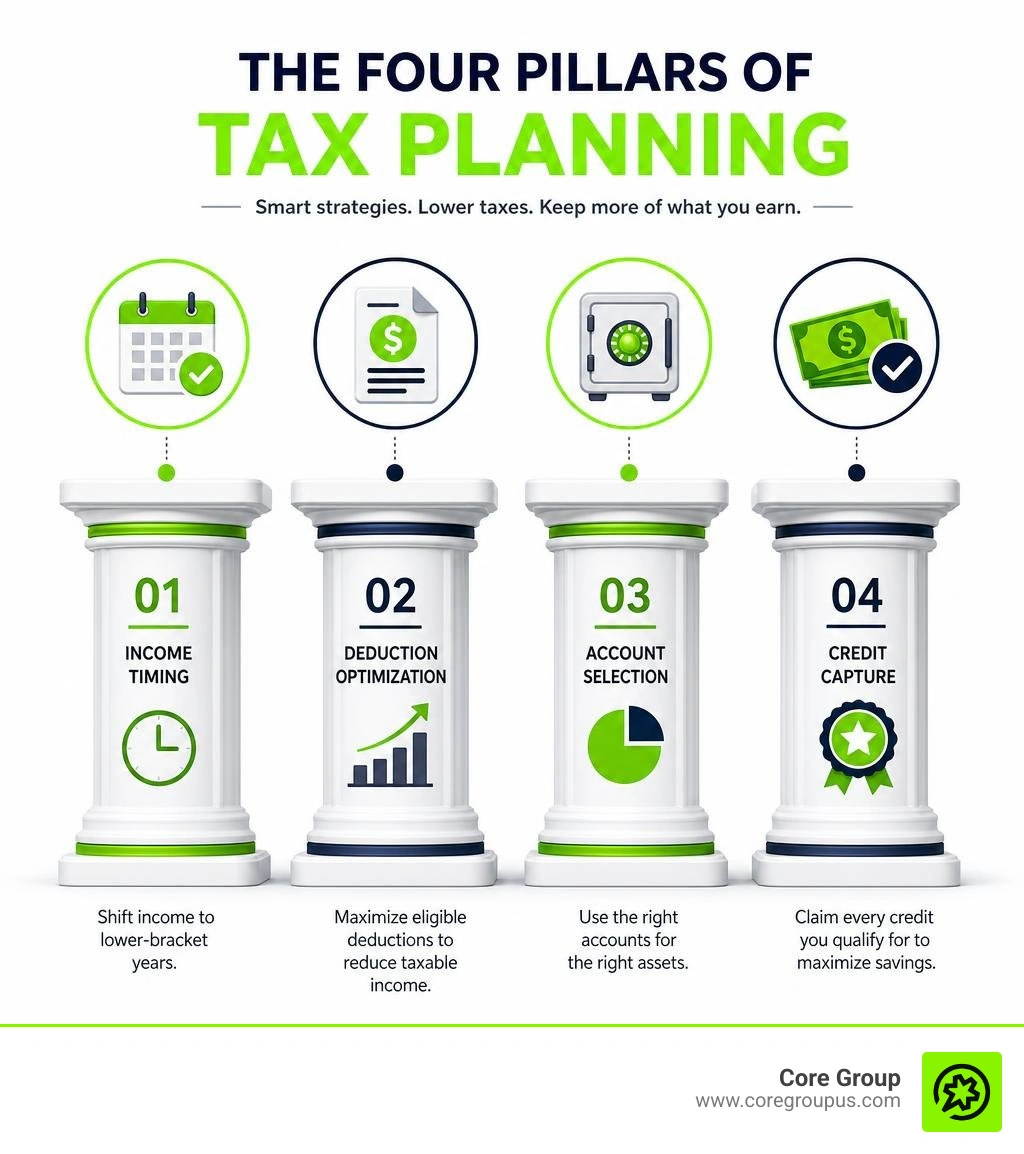
- Use the right account for the right asset by placing high-tax investments inside tax-advantaged accounts.
- Time your income and deductions to defer income to lower-bracket years and bunch charitable contributions to clear the itemization threshold.
- Leverage credits over deductions because a $1,000 tax credit saves more than a $1,000 deduction at almost every bracket.
- Plan year-round, not just in April because the biggest savings come from decisions made before year-end, not after.
Here is the reality most creative entrepreneurs discover too late, taxes are not a fixed cost. They are a variable you can actually influence.
If your income has grown over the past year, that is genuinely good news. But without a proactive plan, rising earnings can quietly push you into a higher tax bracket, a phenomenon sometimes called tax-bracket creep. Inflation-adjusted wage increases move you up the bracket ladder even when your real purchasing power barely budges.
The good news is that the tax code is full of legal tools designed to work in your favor, from retirement contribution limits that jumped again in 2026 to new deductions for seniors and a raised SALT cap. Knowing which levers to pull, and when to pull them, is what separates taxpayers who are surprised every April from those who barely flinch.
This guide walks through every major strategy, from the basics of deductions versus credits, to advanced moves like Roth conversions, asset location, and self-employment tax reduction. Whether you are a W-2 employee, a freelancer, or a small business owner in the creative space, there is a clear path to keeping more of what you earn.
Learn more about strategies to minimize taxes
To build a solid foundation, we must first understand the core mechanics of tax planning. Reducing your tax liability is not about finding hidden loopholes or taking risky shortcuts. Instead, it is about aligning your financial activities with the incentives built directly into the tax code. By taking a proactive approach, you can systematically lower your effective tax rate and improve your overall financial efficiency.
Tax Deductions Versus Tax Credits
One of the most common points of confusion for taxpayers is the difference between a tax deduction and a tax credit. While both help reduce your tax bill, they do so in fundamentally different ways.
A tax deduction reduces your taxable income. The actual value of a deduction depends entirely on your marginal tax bracket. For example, if you are in the 22% tax bracket, a $1,000 deduction reduces your taxable income by $1,000, which saves you $220 in actual taxes. If you are in a lower bracket, that same deduction is worth less; if you are in a higher bracket, it is worth more. To maximize your deductions, you can read our guide on How to Save on Taxes.
A tax credit, on the other hand, reduces your tax liability dollar-for-dollar. A $1,000 tax credit saves you exactly $1,000 on your tax bill, regardless of your income bracket. This makes tax credits incredibly valuable, especially for lower and middle-income households.
Several key credits to watch in 2026 include the following options.
- The Child Tax Credit provides up to $2,200 per qualifying child under age 17 for returns filed in 2026, with phase-outs starting at $200,000 for single filers and $400,000 for married couples filing jointly.
- The Saver's Credit provides up to $1,000 for single filers or $2,000 for married couples who make retirement contributions, provided their adjusted gross income is under $39,500 single or $79,000 married.
- The American Opportunity Tax Credit offers up to $2,500 annually per eligible student for the first four years of higher education.
Understanding the 2026 Federal Tax Brackets and Standard Deductions
To plan effectively, you must distinguish between your marginal tax rate and your effective tax rate. Your marginal rate is the tax bracket that applies to your last dollar of income. Your effective rate is the actual percentage of your total income that you pay in taxes. Because the federal income tax system is progressive, your effective rate will almost always be lower than your marginal rate.
For 2026, the standard deduction has been adjusted for inflation under IRS Revenue Procedure 2025-32. It stands at $16,100 for single filers and $32,200 for married couples filing jointly. There is also a temporary senior deduction available from 2025 through 2028, which provides an additional $6,000 deduction for taxpayers age 65 and older, phasing out for single filers earning above $75,000 and married couples earning above $150,000.
Here is a breakdown of the 2026 federal income tax brackets for single and married joint filers.
| Tax Rate | Single Filers Taxable Income | Married Filing Jointly Taxable Income |
|---|---|---|
| 10% | $0 to $12,400 | $0 to $24,800 |
| 12% | $12,401 to $50,400 | $24,801 to $100,800 |
| 22% | $50,401 to $105,700 | $100,801 to $211,400 |
| 24% | $105,701 to $201,350 | $211,401 to $402,700 |
| 32% | $201,351 to $255,900 | $402,701 to $511,800 |
| 35% | $255,901 to $639,750 | $511,801 to $767,700 |
| 37% | Over $639,750 | Over $767,700 |
Optimizing Your Accounts and Retirement Planning
One of the most reliable strategies to minimize taxes is to make full use of tax-advantaged accounts. These plans allow you to shield your money from immediate taxation, giving your investments more room to grow over time.
Account Funding Strategies to Minimize Taxes on Your Income
When it comes to funding your accounts, the order of operations matters. If you fund your accounts in a random order, you might miss out on matching funds or leave valuable tax breaks on the table.
We recommend following this priority list for your savings.
- Secure the employer 401k match because it is essentially free money and represents an immediate return on your investment.
- Maximize your Health Savings Account if you are enrolled in an HSA-eligible high-deductible health plan. For 2026, the contribution limits are $4,400 for self-only coverage and $8,750 for family coverage, with an additional $1,000 catch-up limit for those age 55 and older. The HSA is the only triple-tax-advantaged account in America, offering tax-deductible contributions, tax-free growth, and tax-free withdrawals for qualified medical expenses.
- Fund a Roth IRA or traditional IRA up to the 2026 limit of $7,500, plus an $1,100 catch-up if you are age 50 or older. If your income is too high to contribute directly to a Roth IRA, you can use the backdoor Roth IRA strategy by making a non-deductible contribution to a traditional IRA and then converting it.
- Max out your traditional 401k up to the 2026 employee contribution limit of $24,500. If you are age 50 or older, you can make an $8,000 catch-up contribution. If you are between ages 60 and 63, you can take advantage of a special super catch-up limit of $11,250. To see how these contributions lower your overall tax profile, check out our analysis on whether Do 401k Contributions Reduce MAGI.
- Explore the mega backdoor Roth if your employer 401k plan supports after-tax contributions and in-service distributions. This can allow you to shield up to an additional $46,000 in a tax-free Roth account.
- Invest in a taxable brokerage account using tax-efficient investments like broad-market index funds.
Deciding Between Roth and Traditional Contributions

The decision to choose traditional tax-deferred accounts or Roth accounts comes down to a simple comparison of your current tax bracket versus your expected tax bracket in retirement.
If your current marginal tax rate is higher than what you expect it to be when you retire, traditional contributions are usually the better choice. You get a tax break today when your rates are high, and you pay taxes later when your rates are lower. Conversely, if you are early in your career and expect your income to rise significantly in the future, Roth contributions make more sense. You pay taxes now at a low rate to secure tax-free withdrawals later.
For high earners, there is an important rule to keep in mind starting in 2026. If your wages exceeded $150,000 in the prior tax year, any catch-up contributions to your employer 401k plan must be made as Roth contributions. This means you can no longer use catch-up contributions to reduce your current year taxable income. For a detailed breakdown of these rules, check out The Complete W2 Tax Reduction Playbook for 2026.
Advanced Investment and Wealth Preservation Tactics
Once your basic accounts are funded, you can look for ways to optimize your investment portfolio. Managing the tax drag on your investments can significantly improve your long-term returns.
Investment Strategies to Minimize Taxes on Your Portfolio

Taxes can be a major drag on investment performance. To keep more of your returns, you should integrate several core portfolio strategies.
First, practice active tax-loss harvesting. This involves selling underperforming investments in your taxable accounts at a loss to offset any capital gains you realized during the year. If your losses exceed your gains, you can use up to $3,000 of the excess loss to offset your ordinary income, carrying any remaining losses forward to future years.
When harvesting losses, you must avoid violating the wash-sale rule. This rule prevents you from claiming a loss if you buy a substantially identical security within 30 days before or after the sale. To keep your portfolio balanced without triggering a violation, you can temporarily replace the sold asset with a similar fund that tracks a different index.
Second, optimize your asset location. This means placing your least tax-efficient assets, such as high-yield bonds, real estate investment trusts, and actively managed mutual funds, inside tax-advantaged accounts like traditional IRAs or 401ks. Meanwhile, keep your most tax-efficient assets, such as broad-market index ETFs and municipal bonds, in your taxable brokerage accounts. Learn more about this in How to Build a Tax-Efficient Investment Portfolio in 2026.
Third, be aware of the Net Investment Income Tax. This is a 3.8% surtax that applies to net investment income for single filers with a modified adjusted gross income above $200,000 and married couples filing jointly above $250,000. Keeping your taxable income below these thresholds through retirement contributions and deductions can help you avoid this extra tax.
Strategic Charitable Giving and Roth Conversions
Charitable giving is a powerful way to support causes you care about while reducing your tax liability. However, to get the maximum tax benefit, you must be strategic about how and when you give.
One effective strategy is bunching contributions. Because the standard deduction is so high, many taxpayers no longer get any tax benefit from their annual charitable donations. By bunching multiple years of donations into a single tax year, you can clear the standard deduction threshold and itemize your deductions. You can use a donor-advised fund to facilitate this, allowing you to take a large deduction in the current year and distribute the funds to charities over time.
For older taxpayers, Qualified Charitable Distributions are an excellent option. Starting at age 70.5, you can distribute up to $111,000 annually directly from your traditional IRA to a qualified charity. This distribution counts toward your Required Minimum Distributions but is excluded from your adjusted gross income, which can help keep your income below key thresholds for Medicare premiums and Social Security taxation.
If you are planning a Roth conversion, timing is everything. Converting traditional retirement assets to a Roth account is best done during low-income years, such as the gap years between retirement and the start of your RMDs at age 73. Making a large charitable donation in the same year as a Roth conversion can also help offset the income tax triggered by the conversion. Discover more details on these approaches at Tax Planning Strategies.
Retirement Withdrawal Sequencing
How you take money out of your accounts in retirement can have a massive impact on your tax bill. There are three primary sequencing strategies to consider.
- The Traditional Strategy involves withdrawing from taxable accounts first, allowing tax-deferred and Roth accounts to grow as long as possible. This is often the simplest approach and can help you utilize low capital gains tax brackets early in retirement.
- The Proportional Strategy involves taking withdrawals from taxable, tax-deferred, and Roth accounts simultaneously based on their relative size. This helps keep your taxable income stable year over year, preventing you from being pushed into higher marginal brackets later in life.
- The Combination Strategy allows you to dynamically adjust your withdrawals each year to fill up the lower tax brackets, using Roth conversions and taxable account withdrawals to manage your tax profile.
Specialized Planning for Business Owners and Homeowners
If you run your own business or own a home, you have access to some of the most powerful tax-saving tools in the tax code.
Tax Optimization for Freelancers and Small Businesses
As a self-employed individual or creative freelancer, you face unique tax challenges, including the 15.3% self-employment tax. Fortunately, you also have access to customized strategies to help reduce this burden.
One of the most effective moves for growing businesses is electing S-corporation status. By operating as an S-corp, you can split your business income into a reasonable salary paid via W-2 and shareholder distributions. While your salary is subject to self-employment taxes, your distributions are not, which can save you thousands of dollars annually.
You should also look to maximize the Qualified Business Income deduction, which allows eligible self-employed individuals to deduct up to 20% of their qualified business income. To understand how this works for your creative business, explore our QBI Deduction Explained guide.
Additionally, make sure you are claiming the home office deduction if you use a portion of your home regularly and exclusively for business. This allows you to deduct a portion of your rent, mortgage interest, utilities, and internet costs. For comprehensive guidance, see our dedicated resources on Tax Planning for Freelancers.
State Tax Considerations and Domicile Planning
For high-income taxpayers, state taxes can represent a significant portion of your total tax liability.
Under the One Big Beautiful Bill Act, the individual State and Local Tax deduction cap has been temporarily increased to $40,000 through 2029, phasing out for taxpayers with a modified adjusted gross income above $500,000. If you live in a high-tax state and own a business, you can often bypass this individual cap entirely by making a pass-through entity tax election at the business level, allowing your business to pay state taxes and claim a federal deduction.
If you are considering relocating to a state with lower taxes, domicile planning requires careful execution. States like California and New York aggressively audit taxpayers who claim to have moved. To establish a new domicile successfully, you must satisfy a multi-factor test, showing that you have truly moved your primary home, shifted your bank accounts, registered your vehicles, and spent more than 183 days in your new state. Read more on how high earners handle these challenges in 3 Ways High Earners in California Optimize Their State Taxes.
Frequently Asked Questions About Tax Planning
Tax planning can feel overwhelming, but clarity is the first step toward savings. Here are answers to some of the most common questions taxpayers ask.
What is the difference between tax planning and tax preparation
Tax planning is a proactive, forward-looking process that happens throughout the year. It involves making strategic financial decisions before December 31 to actively lower your tax liability. Tax preparation is a reactive, backward-looking process that happens after the year ends. It simply involves recording what already happened on your tax return.
How does tax-bracket creep affect my income
Tax-bracket creep occurs when inflation-driven wage increases push you into a higher marginal tax bracket. Even though your nominal income has gone up, your real purchasing power may remain the same or even decrease because a larger percentage of your earnings is now being taxed at a higher rate.
What are the most important tax deadlines to watch in 2026
The most important deadlines to keep on your radar include the following dates.
- April 15 is the deadline to file your federal tax return, pay any taxes owed, and make contributions to your traditional or Roth IRA and HSA for the prior tax year.
- Quarterly Estimated Payments are due on April 15, June 15, September 15, and January 15 for self-employed individuals and those with significant non-wage income.
- December 31 is the final day to execute tax-loss harvesting, complete Roth conversions, and make charitable donations for the current tax year.
Conclusion
At the end of the day, managing your taxes is about taking control of your financial future. For creative entrepreneurs, freelancers, and small business owners, trying to navigate the complexities of the tax code on your own can lead to missed opportunities and costly mistakes.
At Core Group, we specialize in providing financial management, bookkeeping, and tax services specifically tailored for creative entrepreneurs. Our no-fluff, profit-first playbook is designed to give you complete peace of mind and save you valuable time, allowing you to focus on what you do best, creating. We stand behind our work with our unique MacBook Pro guarantee.
Do not wait until April to think about your taxes. Proactive planning is the key to keeping more of your hard-earned revenue. Get started with professional tax planning today and let us help you build a highly tax-efficient financial strategy.