Tax Planning vs. Tax Management: A Guide to Keeping More of Your Money
What Tax Planning and Tax Management Actually Mean for Your Money
Tax planning and tax management are two distinct but deeply connected strategies that work together to help you keep more of what you earn.
Here is a quick breakdown before we dive deeper.
| Tax Planning | Tax Management | |
|---|---|---|
| What it is | A forward-looking strategy to reduce future tax bills | The ongoing process of handling tax obligations accurately and on time |
| When it happens | Throughout the year, before decisions are made | Continuously, including filing, compliance, and reporting |
| Goal | Minimize how much tax you owe | Ensure you meet obligations without overpaying or facing penalties |
| Examples | Roth conversions, loss harvesting, entity structuring | Record-keeping, estimated payments, audit support |
| Who benefits | Everyone, from freelancers to large businesses | Every individual and business with tax obligations |
Most people only think about taxes once a year, right before the filing deadline. But by then, the biggest opportunities to save have already passed. Nearly every meaningful tax move has to happen before December 31.
Albert Einstein reportedly called income taxes "the hardest thing in the world to understand." For creative entrepreneurs juggling client work, invoices, and creative projects, that frustration is very real. Tax complexity is not just stressful. It is expensive when left unmanaged.
The good news is that with the right approach, taxes shift from a dreaded surprise into a predictable, manageable part of your financial life.
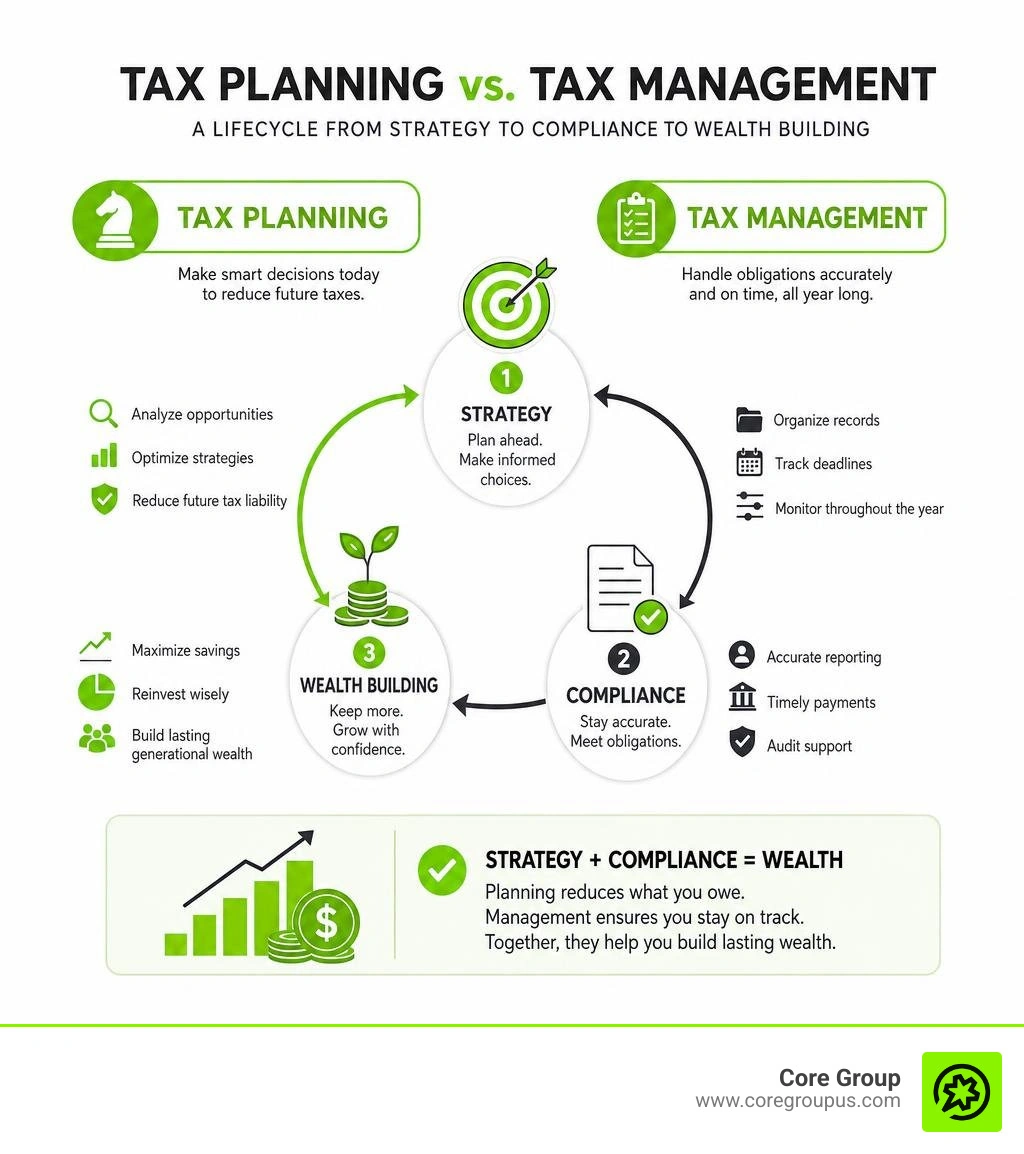
Tax planning and tax management terms you need include the following
The Core Differences Between Tax Planning and Tax Management
To truly understand how to protect your hard earned money, we must look at the distinct roles these two practices play. While they are often used interchangeably, they represent two entirely different phases of your financial journey.
Tax planning is a forward looking, proactive process. It is about looking at the road ahead and structuring your financial decisions to minimize what you will owe. When you engage in this strategy, you are making deliberate choices about income timing, account selection, and business structures before the tax year ends.
On the other hand, tax management is the ongoing execution and compliance side of the equation. It is reactive and administrative. It involves keeping clean records, paying quarterly estimates, and filing your returns accurately. Without strong management, even the best plans will fall apart during an audit.
We can look at how these two disciplines compare across key areas of your financial life.
| Feature | Tax Planning | Tax Management |
|---|---|---|
| Primary Focus | Forward looking strategy | Backward looking compliance |
| Timing | Year round proactive decisions | Scheduled filing deadlines |
| Main Objective | Reduce overall tax liability | Avoid penalties and ensure accuracy |
| Core Activities | Structural changes and investment timing | Bookkeeping and document organization |
By using Strategies to Minimize Taxes, you can turn your annual tax burden into an opportunity for growth.
How Tax Planning and Tax Management Work Together
These two practices must work in harmony to maximize your after tax returns. Think of tax planning as the blueprint and tax management as the construction crew. You cannot build a beautiful house without both.
When we coordinate these efforts, we improve your overall portfolio efficiency. For example, a great plan might identify that you should harvest investment losses. However, it requires careful day to day management to execute those trades without violating IRS rules. By combining strategic foresight with disciplined compliance, you can significantly boost your long term wealth. You can learn more about how we help with these integrated Tax Planning Services.
Strategic Tax Planning for High Net Worth Individuals

For families with significant wealth, the stakes are incredibly high. In 2026, the top marginal income tax rate of 37 percent applies to married individuals filing jointly once taxable income exceeds 768700 dollars. For nongrantor trusts, the situation is even more pressing because they reach that same top rate of 37 percent at just 16000 dollars of taxable income.
With these high thresholds, proactive planning becomes essential to protect your family wealth. High net worth families must look beyond basic deductions to find meaningful savings.
One of the most reliable starting points is maximizing your retirement contributions. Contributing to traditional tax deferred accounts immediately lowers your adjusted gross income. For business owners, setting up advanced plans like defined benefit plans or cash balance plans can allow you to shield hundreds of thousands of dollars from current year taxes.
Charitable giving is another powerful tool when structured correctly. Simply writing checks at the end of the year is rarely the most efficient path. Instead, wealthy families can use donor advised funds to bunch several years of donations into a single tax year. This strategy is especially useful in 2026 because the standard deduction is 32200 dollars for married couples and 16100 dollars for single filers. By bunching your donations, you can easily exceed these high standard deduction thresholds and claim a much larger write off.
Implementing advanced Tax Planning Strategies ensures that your philanthropic goals align perfectly with your wealth preservation plans.
Tax Loss Harvesting and Direct Indexing
For modern investors, tax management can add 1 percent to 2 percent in after tax excess returns annually. This is particularly true for those who use direct indexing strategies.
Direct indexing involves buying the individual underlying securities of an index rather than buying a single exchange traded fund or mutual fund. This structure gives you incredible flexibility because you own the actual shares.
With direct indexing, you can perform tax loss harvesting throughout the entire year, not just in December. When individual stocks within the index experience a temporary drop, you can sell those specific shares to realize a loss. You can then use those losses to offset capital gains from other investments or up to 3000 dollars of ordinary income.
To make this strategy work, you must carefully navigate the wash-sale rules established by the IRS. These regulations state that you cannot claim a loss if you buy a substantially identical security within 30 days before or after the sale. Continuous, automated tax management is required to monitor your portfolio and execute these trades safely throughout the year.
Business Tax Optimization and Structural Choices

For creative entrepreneurs and business owners, the way you structure your company has a massive impact on your bottom line. Many businesses start out as sole proprietorships, but as your revenue grows, this simple setup can become highly tax inefficient.
One of the most effective ways to lower your tax bill is by electing S corporation status. As a sole proprietor, you must pay a 15.3 percent self employment tax on all of your business net earnings. When you operate as an S corporation, you can split your income into two parts. You pay yourself a reasonable W 2 salary, which is subject to payroll taxes, and take the remaining profits as business distributions, which are free from self employment tax.
This simple shift can save business owners thousands of dollars every year. Additionally, S corporation owners must evaluate their eligibility for the Section 199A Qualified Business Income deduction. This deduction allows certain business owners to write off up to 20 percent of their qualified business income.
Because the rules surrounding S corporations and business write offs are complex, working on comprehensive Business Tax Optimization is the best way to protect your business profits.
Corporate Tax Planning and Strategy for Partnerships
For businesses with multiple owners, choosing the right entity structure is equally important. Partnerships and multi member limited liability companies offer incredible flexibility, but they also require careful planning.
Unlike corporations, partnerships are pass through entities. This means the business itself does not pay federal income tax. Instead, the profits and losses flow directly to the individual partners, who report them on their personal returns.
To maximize your deductions and preserve your cash flow, you must establish a clear corporate tax policy. This policy should outline how you track business expenses, manage partner distributions, and handle state tax obligations across different jurisdictions.
By utilizing structured Tax Planning Strategies for Partnerships and building a strong Corporate Tax Planning and Strategy, you can ensure your business remains compliant while keeping as much money as possible inside the company.
Estate Planning and Wealth Transfer under the One Big Beautiful Bill Act
The legislative landscape changed dramatically with the passage of the One Big Beautiful Bill Act, which was signed into law on July 4, 2025. This landmark legislation brought much needed certainty to families planning their long term legacy.
Under this act, the lifetime gift, estate, and generation skipping transfer tax exemption is permanently set at 15 million dollars per person, which continues to be indexed for inflation. This permanent high threshold allows families to plan with confidence, knowing the scheduled sunset of previous tax laws has been replaced with a stable framework.
To make the most of this 15 million dollar exemption, wealthy families use a variety of sophisticated estate planning vehicles. Gifting strategies are highly effective. You can make annual exclusion gifts to children and grandchildren, which immediately reduces the size of your taxable estate without touching your lifetime exemption.
For long term wealth preservation, trusts are incredibly useful. Irrevocable life insurance trusts and generation skipping trusts allow you to pass assets down through multiple generations without triggering massive estate tax bills at each transfer.
For a complete overview of these updated rules, you can consult our comprehensive 2026 Planning Guide.
Integrating Tax Planning and Tax Management into Wealth Building
True financial success requires looking at your wealth as a single, connected system. Your investment choices, business decisions, and estate plans cannot exist in isolation.
When you integrate tax planning with your long term wealth building goals, you ensure that every financial move supports your family legacy. This means aligning your asset location by placing high yield, taxable investments inside tax sheltered accounts while keeping tax efficient assets in your taxable portfolios.
By coordinating your daily tax management with your multi generational transfer goals, you create a seamless process that protects your wealth from unnecessary erosion. Learn more about How Firms Integrate Estate Investment Tax Planning Strategies to secure your family future.
International Tax Considerations and Cross Border Operations
For businesses and families with international connections, tax planning becomes significantly more complex. Operating across borders means you must navigate multiple tax jurisdictions, international treaties, and compliance standards.
One of the most critical aspects of international tax planning is transfer pricing. If your business has entities in different countries, the prices charged for transactions between those entities must align with market rates. Tax authorities monitor these transactions closely to ensure companies are not artificially shifting profits to low tax countries.
To prevent double taxation on the same income source, we must carefully analyze tax treaties between the United States and other nations. These treaties often provide tax credits or exclusions that protect you from being taxed twice.
Furthermore, international organizations are enforcing stricter standards, such as the Base Erosion and Profit Shifting framework developed by the Organisation for Economic Co-operation and Development. Compliance with these global rules requires total transparency and highly advanced IT systems to manage and report financial data accurately.
Year End Optimization and Compliance Best Practices
As the end of the year approaches, taking proactive steps can make a massive difference in your final tax bill. Implementing a few key strategies before December 31 can help you keep more of your profits.
One classic strategy is deferring income. If you expect to be in a lower tax bracket next year, or if you want to delay your tax liability, you can defer business invoicing or bonus payments until January.
Conversely, you can accelerate your deductions by paying for upcoming business expenses, making retirement contributions, or bunching your charitable donations. Bunching is especially effective if your total itemized deductions are close to the standard deduction of 32200 dollars for married couples. By grouping multiple years of donations or medical expenses into a single year, you can easily surpass that threshold and claim a larger deduction.
None of these strategies are possible without disciplined record keeping. You must maintain clean, organized financial records throughout the year. Utilizing cloud based digital asset management and modern accounting software ensures that your receipts, invoices, and documents are securely stored and easily accessible.
For a complete checklist of actions to take before the year closes, read our guide on Business Year-End Tax Planning.
Frequently Asked Questions About Tax Planning and Management
When should I consult a tax professional
You should consult a tax professional as soon as your financial situation becomes complex or when you experience major life changes. If you are starting a business, buying real estate, receiving equity compensation, or planning an estate, a professional can save you from costly mistakes.
When selecting an advisor, look for a Certified Public Accountant or an Enrolled Agent who specializes in proactive planning rather than just annual tax preparation. You want someone who will look at your financial life as a whole and offer tailored strategies. You can learn more about finding the right partner by exploring Tax Planning and Tax Credit Consulting.
What is the difference between tax planning and tax compliance
Tax compliance is a backward looking process focused on reporting what has already happened. It involves filling out forms, meeting filing deadlines, and ensuring you adhere to current laws.
Tax planning is a forward looking, strategic process. It happens while the tax year is still open, allowing you to make decisions that actively lower your tax liability. To build long term wealth, both compliance and planning Should Be Considered in Tax Planning Strategies.
How does the One Big Beautiful Bill Act affect my estate plan
The One Big Beautiful Bill Act permanently sets the lifetime gift and estate tax exemption at 15 million dollars per person, with annual adjustments for inflation. This permanent change eliminates the fear of a sudden drop in the exemption limit, allowing you to establish long term trust and gifting strategies with confidence.
Conclusion
Managing your taxes does not have to be a source of constant stress and confusion. By understanding the difference between tax planning and tax management, you can take control of your financial future and keep more of your hard earned money.
At Core Group, we specialize in helping creative entrepreneurs navigate the complexities of financial management, bookkeeping, and taxes. We believe you should spend your time doing what you love, not drowning in spreadsheets and IRS forms.
That is why we offer our no fluff, profit first playbook. We guarantee peace of mind and save you valuable time, allowing you to focus entirely on growing your creative business. We are so confident in our services that we back them with our unique MacBook Pro guarantee.
If you are ready to stop worrying about tax season and start building real wealth, Speak with an Advisor today.