Paying Taxes on Gambling Winnings in 2026 Just Got Harder
The New Ninety Percent Cap on Gambling Loss Deductions
Taxes on gambling winnings in 2026 are more complicated than ever before, and many bettors are going to be caught off guard this tax season.
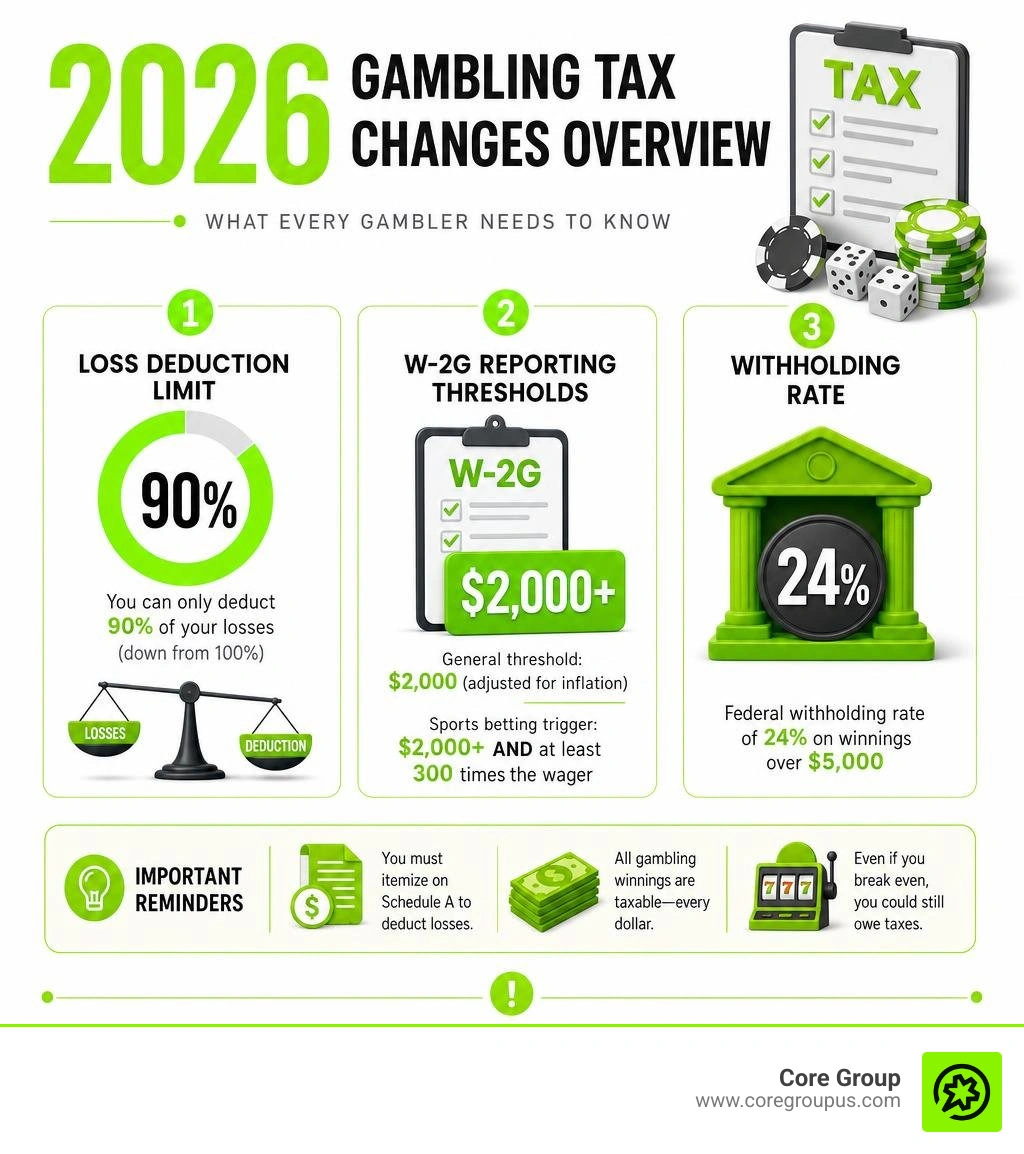
Here is a quick summary of the rules.
| Key Rule | 2026 Detail |
|---|---|
| Are all gambling winnings taxable | Yes, every dollar, no exceptions |
| New loss deduction limit | You can only deduct 90% of losses (down from 100%) |
| W-2G reporting threshold | $2,000 (adjusted for inflation, up from $1,200/$1,500) |
| Federal withholding rate | 24% on winnings over $5,000 |
| Sports betting W-2G trigger | Winnings of $2,000+ and at least 300 times the wager |
| Can you deduct losses without itemizing | No, you must itemize on Schedule A |
| Break-even still taxable | Yes, $50,000 won and $50,000 lost still creates $5,000 of taxable income |
Everything changed in 2018 when the Supreme Court struck down the nationwide ban on state-sanctioned sports betting. Since then, sports betting has exploded into a $17 billion industry, now legal in 39 states.
More bettors means more tax complexity. And in 2026, the complexity just jumped again.
The One Big Beautiful Bill Act, signed into law on July 4, 2025, introduced a hard new cap on how much of your gambling losses you can write off. For the first time, even gamblers who break even will owe taxes on a portion of their winnings.
If you are a creative entrepreneur who bets on the side, or someone with significant gambling activity this year, this change could create a surprise tax bill you never saw coming.
Read more about taxes on gambling winnings in 2026 below.

The most significant shift in the tax landscape this year comes from the One Big Beautiful Bill Act. For many years, the Internal Revenue Service permitted taxpayers to deduct 100% of their documented gambling losses up to the amount of their total winnings. If you won $10,000 and lost $10,000, your net taxable gambling income was zero, provided you itemized your deductions on Schedule A.
Under the new gambling tax law 2026, that safety net has been partially dismantled. Taxpayers can now only claim up to 90% of their gambling losses against their winnings. This 10% reduction might sound small, but it fundamentally changes the tax math for everyone who steps into a casino or opens a sports betting app.
To make matters more challenging, this deduction is still only available to those who itemize their deductions. For the 2026 tax year, the standard deduction has risen to $16,100 for single filers and $32,200 for married couples filing jointly. This means that if your total itemized deductions do not exceed these high thresholds, you cannot deduct any of your losses. You will be taxed on 100% of your gross winnings, while your losses provide zero tax benefit.
For those who do itemize, the new 2026 Gambling Loss Deduction and How To Claim The New 90% Limit guidelines require strict adherence to the new math. The table below outlines how the core rules have shifted between the previous tax year and the current 2026 rules.
| Tax Provision | 2025 Rules | 2026 Rules |
|---|---|---|
| Maximum Loss Deduction | 100% of losses up to winnings | 90% of losses up to winnings |
| Standard Deduction Single | $15,750 | $16,100 |
| Standard Deduction Married | $31,500 | $32,200 |
| Tax on Break-Even Activity | None if itemized | Taxed on 10% of gross winnings |
How the Ninety Percent Rule Affects Taxes on Gambling Winnings 2026
The introduction of the 90% cap has created a phenomenon known as phantom income. This is taxable income that exists on paper even though you did not actually make a profit in real life. Under this system, the Internal Revenue Service is effectively taxing your gross gambling activity rather than your true net economic results.
Consider a recreational gambler who wins $50,000 over the course of 2026 but also loses $50,000. Economically, this player broke even. However, when filing taxes, the player must report the full $50,000 of winnings as gross income. If they itemize, they can only deduct 90% of their losses, which amounts to $45,000. This leaves them with $5,000 of taxable phantom income, resulting in a real tax bill on a net zero financial return.
The situation becomes even more severe for high volume sports bettors who operate on thin margins. Imagine an active bettor who generates $200,000 in gross winnings but accumulates $195,000 in losses, leaving a modest real profit of $5,000. Under the 2026 rules, the maximum deduction is 90% of the $195,000 in losses, which equals $175,500. When you subtract that deduction from the $200,000 in winnings, the taxable income becomes $24,500. The bettor is now paying taxes on an amount nearly five times larger than their actual $5,000 profit. We advise our clients to carefully model their betting volume, as high turnover can quickly lead to a devastating tax liability under these updated taxes on gambling losses rules.
New Reporting Thresholds and Form W2G Rules

The administrative side of gambling taxes has also received an overhaul. The primary document used to report gambling winnings and tax withholdings to the government is Form W-2G. Casinos, sportsbooks, and race tracks use this form to notify the government of your successful wagers.
According to the updated Instructions for Forms W-2G and 5754, the minimum threshold for reporting certain payments on Form W-2G has been adjusted for inflation to $2,000 for the 2026 calendar year. This is a significant change designed to modernize reporting limits that had remained stagnant for decades.
Federal tax withholding rules remain strict. The regular withholding rate is a flat 24% on gambling winnings of $5,000 or more from sweepstakes, wagering pools, lotteries, and sports wagering. If you win a noncash prize, such as a car or a luxury vacation, the tax calculations get even more interesting. If you pay the 24% withholding tax yourself, the tax is based on the fair market value of the prize. However, if the sweepstakes organizer pays the withholding tax on your behalf, the federal government treats that tax payment as additional winnings. This bumps the withholding rate up to 31.58% of the fair market value of the prize.
Understanding the Two Thousand Dollar Threshold for Taxes on Gambling Winnings 2026
The new $2,000 reporting threshold applies uniformly to several popular gambling categories, including slot machines, keno, bingo, poker tournaments, and sports wagering. This means that casinos and betting platforms will issue a Form W-2G whenever a single payout hits or exceeds this amount.
For sports bettors, the issuance of a Form W-2G is tied to a specific ratio. A sportsbook must file a Form W-2G if your winnings are at least $2,000 and the payout is at least 300 times the amount of your original wager. For example, if you place a $5 sports bet and win $2,500, you will trigger a Form W-2G because the win exceeds $2,000 and represents a 500 to 1 payout. If you place a $100 bet and win $2,100, you will not trigger a Form W-2G because the payout is only 21 times your wager, though you are still legally required to self-report those winnings.
It is a common mistake to assume that no Form W-2G means no tax. The government requires you to report all gambling winnings as income, regardless of whether a form was generated. You can read more about these reporting duties in our guide on can you claim gambling losses on your taxes.
Additionally, if you fail to provide a correct Taxpayer Identification Number or Social Security Number to the gaming operator at the time of your win, they are required to apply backup withholding. This backup withholding is a flat 24% tax taken directly from your payout, which can complicate your tax filing later in the year.
Recreational Versus Professional Gamblers and Session Tracking Rules
The tax code treats recreational gamblers and professional gamblers very differently, and the distinction has never been more important than in 2026. Recreational gamblers must report their gross winnings on Schedule 1 of Form 1040, and they can only deduct their losses on Schedule A as an itemized deduction. This means recreational bettors cannot use their losses to reduce their adjusted gross income, which can impact their eligibility for other tax credits and deductions. You can explore this dynamic further in our article on are gambling losses itemized deductions.
Professional gamblers, on the other hand, file their taxes using Schedule C. They treat their gambling as a business, which allows them to deduct their losses and business expenses directly against their winnings. This means they do not have to itemize on Schedule A to get a tax benefit from their losses. However, qualifying for professional status is difficult. The government relies on the Supreme Court Groetzinger case, which established that you must pursue gambling full-time, with regularity and continuity, as your primary source of livelihood.
Furthermore, professional status comes with a major downside, the self-employment tax. Professionals must pay a 15.3% self-employment tax on their net business income. Under the 2026 rules, with the 90% cap on loss deductions also impacting business calculations, many professional gamblers are seeing their effective tax rates rise dramatically.
To protect yourself from audits, accurate recordkeeping is critical. The government requires taxpayers to track their gambling on a per-session basis rather than simply netting their wins and losses at the end of the year. You must keep a contemporaneous diary or log of your activities.
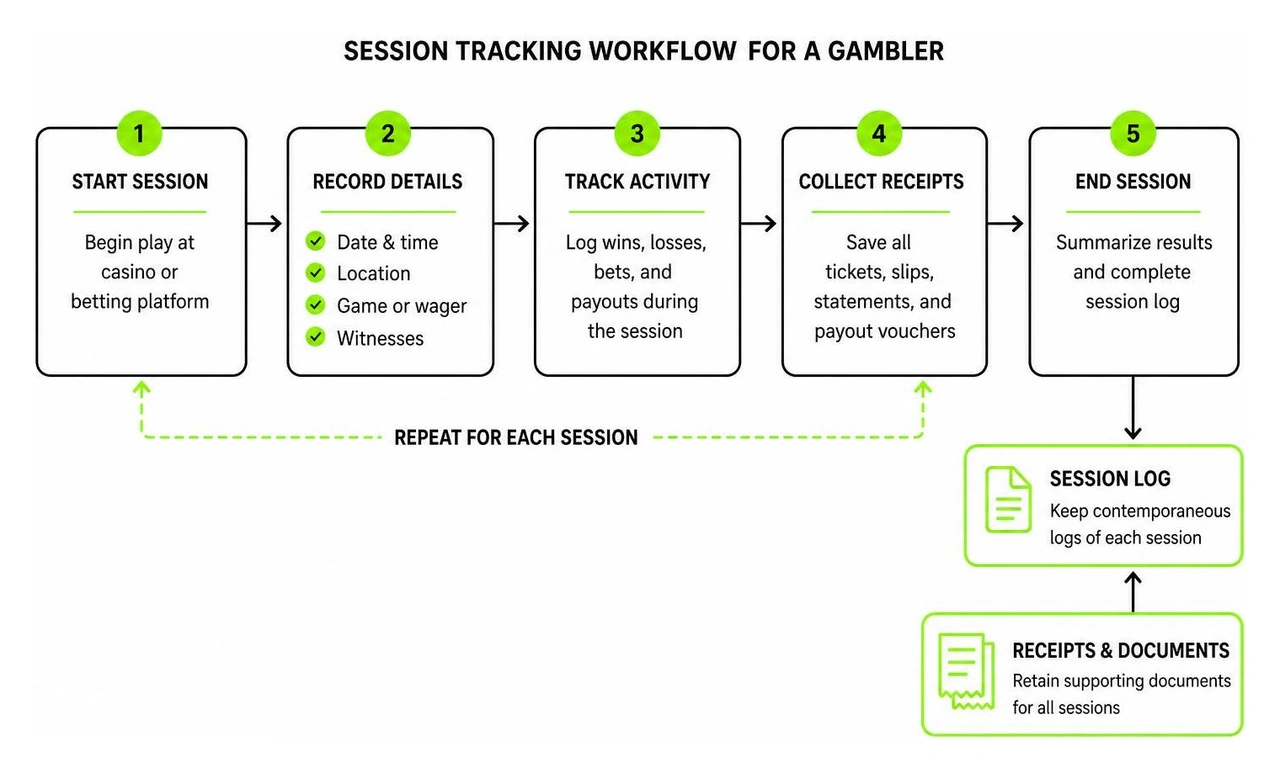
An acceptable log must include these details.
- The date and time of the specific session
- The name and location of the casino or betting platform
- The type of game or wager placed
- The names of any witnesses present during the session
- The exact amount won or lost during that specific session
You cannot simply point to a net loss on a sportsbook statement at the end of the year and assume the government will accept it. We explain this in detail in our resource on gambling losses should just offset my gambling winnings right.
State-level tax conformity adds another layer of complexity. Many states do not mirror federal tax rules. For example, states like Illinois and North Carolina do not allow any gambling loss deductions on state income taxes, meaning you will pay state tax on your gross winnings even if you lost more than you won. Other states have unique withholding thresholds. Massachusetts, Connecticut, and Ohio require state tax withholding on winnings as low as $600. If you win money in a state where you do not live, you may also have to file a non-resident state tax return to report those winnings, creating a significant administrative burden.
Frequently Asked Questions About Taxes on Gambling Winnings 2026
Can I deduct gambling losses if I take the standard deduction
No, you cannot deduct any gambling losses if you claim the standard deduction. The tax code only allows gambling losses to be claimed as an itemized deduction on Schedule A. If you choose the standard deduction, which is $16,100 for single taxpayers and $32,200 for married couples filing jointly in 2026, your gross gambling winnings will be fully taxable, and your losses will provide no tax relief. This makes it vital to calculate whether itemizing is financially beneficial for you.
What happens if I break even on my bets this year
If you break even on your bets in 2026, you will likely still owe federal income taxes on a portion of your winnings. Because of the new 90% cap on loss deductions, you can only write off up to 90% of your documented losses. If you won $50,000 and lost $50,000, you can only deduct $45,000. This leaves you with $5,000 of taxable phantom income, even though your net economic result for the year was zero.
How does cryptocurrency gambling affect my tax return
Cryptocurrency gambling introduces a double layer of taxation. First, when you deposit cryptocurrency into a gambling platform, the government treats the deposit as a sale of property. If the cryptocurrency appreciated in value between the time you acquired it and the time you deposited it, you will trigger a taxable capital gains event. Second, any winnings you receive must be reported as ordinary gambling income based on the fair market value of the cryptocurrency at the exact time you won it. Finally, when you eventually sell or withdraw that cryptocurrency, you may trigger another capital gains event.
Conclusion
The rules surrounding taxes on gambling winnings in 2026 have become incredibly complex, leaving many casual and active bettors vulnerable to unexpected tax bills and audit risks. The days of simply assuming your losses will cancel out your wins are officially over. Meticulous tracking and strategic planning are now required to navigate the new 90% loss deduction cap and the updated reporting thresholds.
At Core Group, we provide financial management, bookkeeping, and tax services specifically tailored for creative entrepreneurs. We understand that you want to focus on growing your business rather than drowning in tax forms and complex calculations. Our no-fluff, profit-first playbook is designed to give you peace of mind and save you valuable time, all backed by our unique MacBook Pro guarantee.
If you want to ensure your bookkeeping is bulletproof and your tax strategy is optimized for the new 2026 rules, we are here to help. You can learn more about managing your tax obligations in our comprehensive guide on irs gambling deductions. Let us handle the numbers so you can focus on your creative passion.