401(k) Employer Contribution Rules Demystified
How to follow 401(k) employer contribution rules
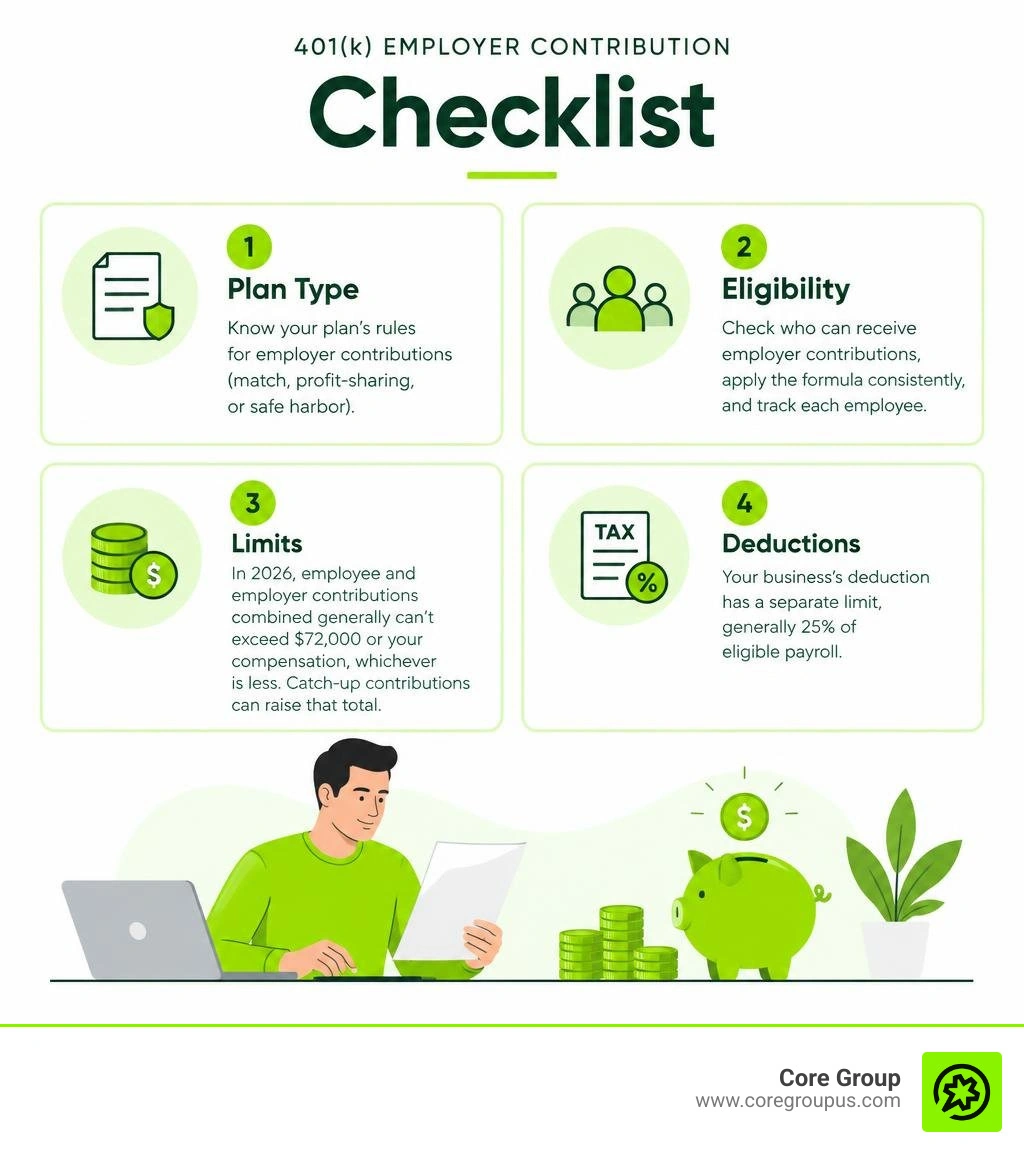
Start with your plan document. A traditional 401(k) generally does not require an employer contribution, but if you offer a match or profit-sharing contribution, you must follow the formula in your plan. A safe harbor 401(k) requires a qualifying employer contribution. In either case, check who is eligible, apply the formula consistently, and track each employee's annual limit.
For 2026, employee and employer contributions combined generally cannot exceed $72,000 or the employee's compensation, whichever is less. Eligible catch-up contributions can raise that total. Your business's deduction has a separate limit, generally 25% of eligible payroll.
I'm Christian Brim, and I'll help you sort these rules into steps you can use when planning contributions.
Must-know 401k employer contribution rules terms include the 401k company match limit, the 401k employer match calculator, and the safe harbor 401k.
Core 401k Employer Contribution Rules and Contribution Types
Operating a qualified workplace retirement plan involves following clear IRS guidelines while using plan design to attract top talent and lower taxable business revenue. When you establish a plan, your written document outlines participation standards, allocation formulas, and distribution timing.
Federal standards generally state that employees become eligible after reaching age 21 and completing one year of service, defined as 1,000 hours of work within a 12-month period. Under ongoing updates from the SECURE 2.0 legislation, long-term part-time employees who log at least 500 hours across two consecutive years also gain eligibility to participate in elective deferrals.
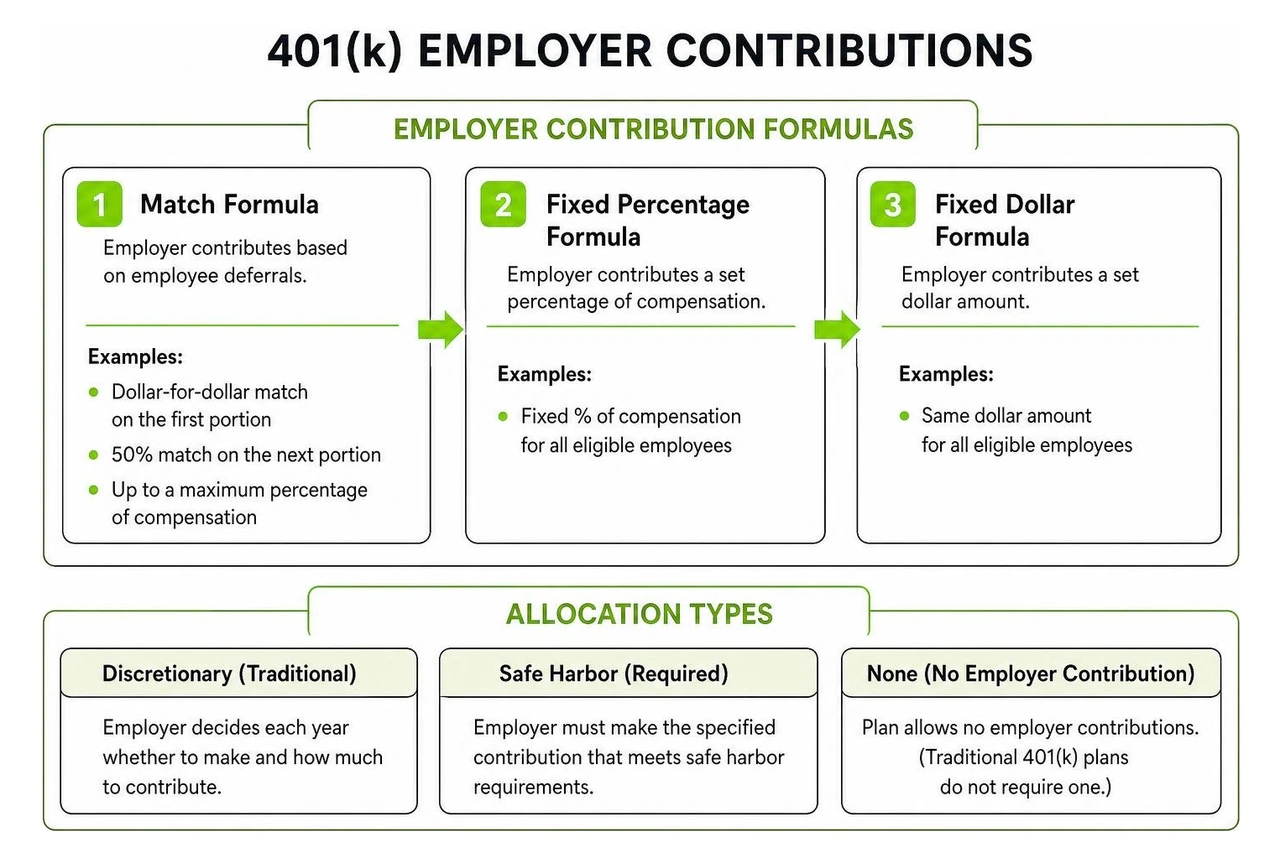
Employer contributions are tax-deductible business expenses that grow tax-deferred within the plan trust. You have several options for funding participant accounts, ranging from matching employee savings to making across-the-board company contributions.
Matching Contributions and Common Formulas
A matching contribution occurs when a business deposits funds into an employee account based on the salary deferrals that the worker chooses to contribute. Industry data reveals that 75% of retirement plans provide an employer match, and 42% of those matched plans use a dollar-for-dollar formula on the first 4% of deferred compensation.
You can structure your company match in several ways.
- Dollar-for-dollar match. The business matches 100% of the employee deferral up to a set percentage cap of total wages, such as matching all employee contributions up to 4% of pay.
- Partial match. The business matches a fraction of what the employee saves, such as 50 cents per dollar contributed up to 6% of compensation, giving the employee a maximum 3% company contribution.
- Tiered match. The formula changes across different savings thresholds, such as 100% on the first 3% of pay and 50% on the next 2% of pay.
Reviewing guidelines on 401(k) company match limits helps plan sponsors keep contributions within legal boundaries. For step-by-step setup details, our comprehensive 401(k) employer match guide for 2026 outlines practical formula structures.
Nonelective and Profit-Sharing Contributions
Nonelective contributions are company deposits made to eligible staff regardless of whether an individual employee chooses to defer salary into the plan. If an employee contributes 0% of their paycheck, they still receive the designated nonelective percentage.
Profit-sharing allocations function as discretionary employer deposits. Despite the name, your business does not need net accounting profits to declare a profit-sharing contribution. Plan sponsors can use different allocation methods.
- Pro-rata formula. Every eligible participant receives an identical percentage of their total annual compensation.
- Flat dollar formula. Every eligible participant receives the same fixed dollar amount.
- Cross-tested or new comparability formula. Participants are grouped by job tier or classification to allow varying contribution rates, provided the plan passes strict nondiscrimination tests.
Review the DOL guidance on profit sharing plans for small businesses to see how discretionary contributions help adapt retirement funding to fluctuating annual cash flow.
2026 Limits and Deductibility Guidelines
Federal tax law places limits on both individual participant accounts and the total tax deduction a company can claim each fiscal year.
Annual Contribution Caps Under 401k Employer Contribution Rules
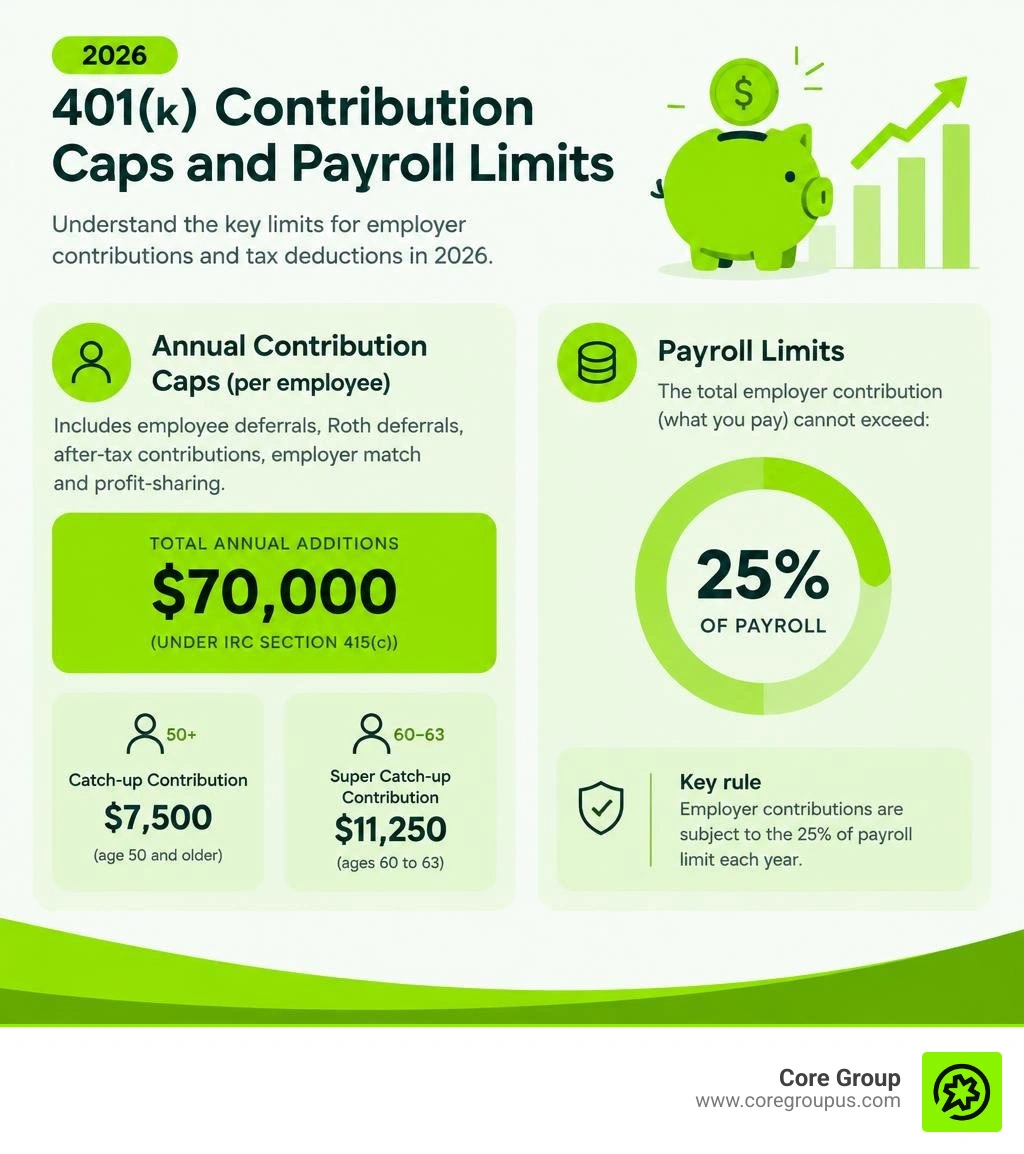
Under Internal Revenue Code Section 415(c), annual additions to any single employee account cannot exceed statutory caps. Annual additions include employee pre-tax deferrals, employee designated Roth deferrals, after-tax contributions, employer matching, and employer profit-sharing.
Consult the IRS contribution limits for 401(k) and profit-sharing plans alongside our review of 2026 maximum 401(k) contribution rules. Participants aged 50 and older can make standard catch-up contributions, while workers aged 60 through 63 can utilize super catch-up limits for participants ages 60 to 63.
Understanding combined employer and employee 2026 limits ensures you never overfund participant accounts.
| 2026 Contribution Parameter | Statutory Dollar Limit |
|---|---|
| Employee Base Salary Deferral Limit | $24,500 |
| Standard Catch-Up Limit (Ages 50-59 and 64+) | $8,000 |
| Super Catch-Up Limit (Ages 60-63) | $11,250 |
| Overall Section 415 Combined Limit (Employee + Employer) | $72,000 or 100% of pay |
| Total Maximum with Standard Catch-Up (Age 50+) | $80,000 |
| Total Maximum with Super Catch-Up (Ages 60-63) | $83,250 |
Deductibility Limits and Tax Return Deadlines
The maximum corporate tax deduction for employer contributions is 25% of total eligible compensation paid to all qualifying employees during the tax year. Employee salary deferrals do not count toward this 25% aggregate payroll ceiling.
The 25% deduction limit applies across total aggregate payroll rather than on an individual basis. That distinction allows a business owner to receive an employer contribution exceeding 25% of their personal wage, provided the total company contribution remains below 25% of the total eligible payroll for all staff combined.
To claim a deduction for a given tax year, you must deposit your company contribution by the corporate tax filing deadline, including formal tax extensions. For instance, an S-corporation operating on a calendar year can fund its prior-year employer contribution as late as September 15 if it filed a timely extension. Under SECURE 2.0, you can also adopt a brand-new plan after the calendar year closes and fund deductible contributions right up to that extended tax deadline.
Traditional vs Safe Harbor 401(k) Frameworks
Plan structure dictates how strictly the IRS monitors your employee participation rates and business owner allocations.
| Feature | Traditional 401(k) | Safe Harbor 401(k) | SIMPLE 401(k) |
|---|---|---|---|
| Employer Contribution | Completely voluntary | Mandatory (match or nonelective) | Mandatory (3% match or 2% nonelective) |
| Vesting on Employer Money | Graded or cliff schedules | Immediate 100% ownership | Immediate 100% ownership |
| Annual Testing (ADP/ACP) | Required each year | Exempt from testing | Exempt from testing |
| 2026 Employee Limit | $24,500 | $24,500 | $17,000 |
| Overall Section 415 Limit | $72,000 | $72,000 | Limited to salary + mandatory contribution |
Traditional plans must undergo annual nondiscrimination testing, specifically the Actual Deferral Percentage (ADP) test and Actual Contribution Percentage (ACP) test. These checks confirm that highly compensated employees and company owners do not save at rates that disproportionately outpace rank-and-file workers. If lower-paid staff participate at low rates, owners may face forced contribution refunds and surprise tax bills.
Safe Harbor Compliance Under 401k Employer Contribution Rules
A safe harbor plan eliminates annual ADP, ACP, and top-heavy testing obligations by requiring mandatory, fully vested employer contributions.
A standard safe harbor formula requires one of two approaches.
- Basic matching. Match 100% on the first 3% of deferred pay, plus 50% on the next 2% of pay, yielding a 4% total match for employees saving at least 5% of salary.
- Nonelective contribution. Deposit at least 3% of salary for every eligible employee, regardless of personal savings choices.
Explore our complete guide to safe harbor 401(k) plans to evaluate whether avoiding annual compliance testing balances out the cost of mandatory company contributions.
Vesting Schedules and Discretionary Adjustments
Vesting defines how much ownership an employee holds over employer-funded contributions if they depart the business. Employee salary deferrals are always 100% immediately vested.

For traditional matching and profit-sharing contributions, employers can select between two statutory schedules.
- 3-Year cliff vesting. Employees own 0% of company contributions for their first two years of service and become 100% vested upon completing three years.
- 6-Year graded vesting. Ownership vests in annual increments of 20% starting at year two, reaching 40% at year three, 60% at year four, 80% at year five, and 100% at year six.
Non-vested funds left behind by departing workers flow into a plan forfeiture account. The employer can use these forfeitures to pay reasonable plan administration fees or offset future company contributions.
Leveraging SECURE 2.0 Tax Credits for Employer Contributions
Small businesses establishing retirement benefits can take advantage of federal tax credits created by the SECURE 2.0 Act. These credits directly offset your end-of-year corporate tax bill rather than just reducing taxable income.
Employers with up to 50 employees can claim a tax credit covering up to 100% of employer matching or nonelective contributions made on behalf of non-highly compensated employees earning under statutory thresholds. The credit is capped at $1,000 per qualifying worker per year and phases out over a five-year window.
- Year 1. 100% of eligible contributions
- Year 2. 100% of eligible contributions
- Year 3. 75% of eligible contributions
- Year 4. 50% of eligible contributions
- Year 5. 25% of eligible contributions
For businesses with 51 to 100 workers, the credit percentage phases down proportionally.
That you cannot double-dip on tax perks. The portion of an employer contribution reimbursed through a SECURE 2.0 tax credit cannot also be deducted as an ordinary business expense on your corporate tax return. Catch up on our breakdown of key 401(k) legislative updates for 2026 to maximize these incentives.
Frequently Asked Questions About Employer 401(k) Rules
Are employers legally required to contribute to an employee's 401(k)?
Federal law does not require private employers to provide a retirement plan or contribute to a traditional 401(k). However, if you choose a safe harbor 401(k) or a SIMPLE 401(k), mandatory company contributions are required by the plan structure. Additionally, several states require businesses of certain sizes to offer either a qualified private retirement plan or participate in a state-sponsored payroll-deduction IRA program.
Can an employer change or stop matching contributions mid-year?
For a traditional 401(k) with discretionary contributions, an employer can adjust or suspend matching formulas at any point by executing a formal plan amendment and notifying staff. Safe harbor plans face stricter rules. Mid-year reductions to safe harbor contributions are only allowed if the company is operating at an economic loss or if the business issued an advance notice prior to the start of the plan year reserving the right to reduce funding. In both scenarios, staff must receive a 30-day notice and an opportunity to modify their deferrals.
When is the absolute deadline for depositing deductible employer contributions?
Employer matching and profit-sharing contributions must be deposited into the plan trust by the due date of your business federal income tax return, including any formal extensions. For example, if your company files Form 1120-S on an extended September 15 deadline, deposits made up to that date qualify as deductible expenses for the prior tax year. By contrast, employee salary deferrals must be transferred into the plan trust as soon as administratively feasible following payroll, generally within seven business days for small businesses.
Conclusion
Managing employer contribution rules does not have to pull your attention away from scaling your business. At Core Group, we provide comprehensive financial management, bookkeeping, and tax services designed specifically for creative entrepreneurs. Our no-fluff, profit-first playbook guarantees peace of mind and saves you time, all backed by our MacBook Pro guarantee.
Whether you want to optimize company profit-sharing or clarify understanding how 401(k) contributions impact MAGI and tax strategy, our team is here to help you build a compliant, wealth-generating retirement framework.