Beginner's Guide to 401(k) Catch-Up Contributions for Over 50
401(k) Catch-Up Contributions Can Add More Room to Save
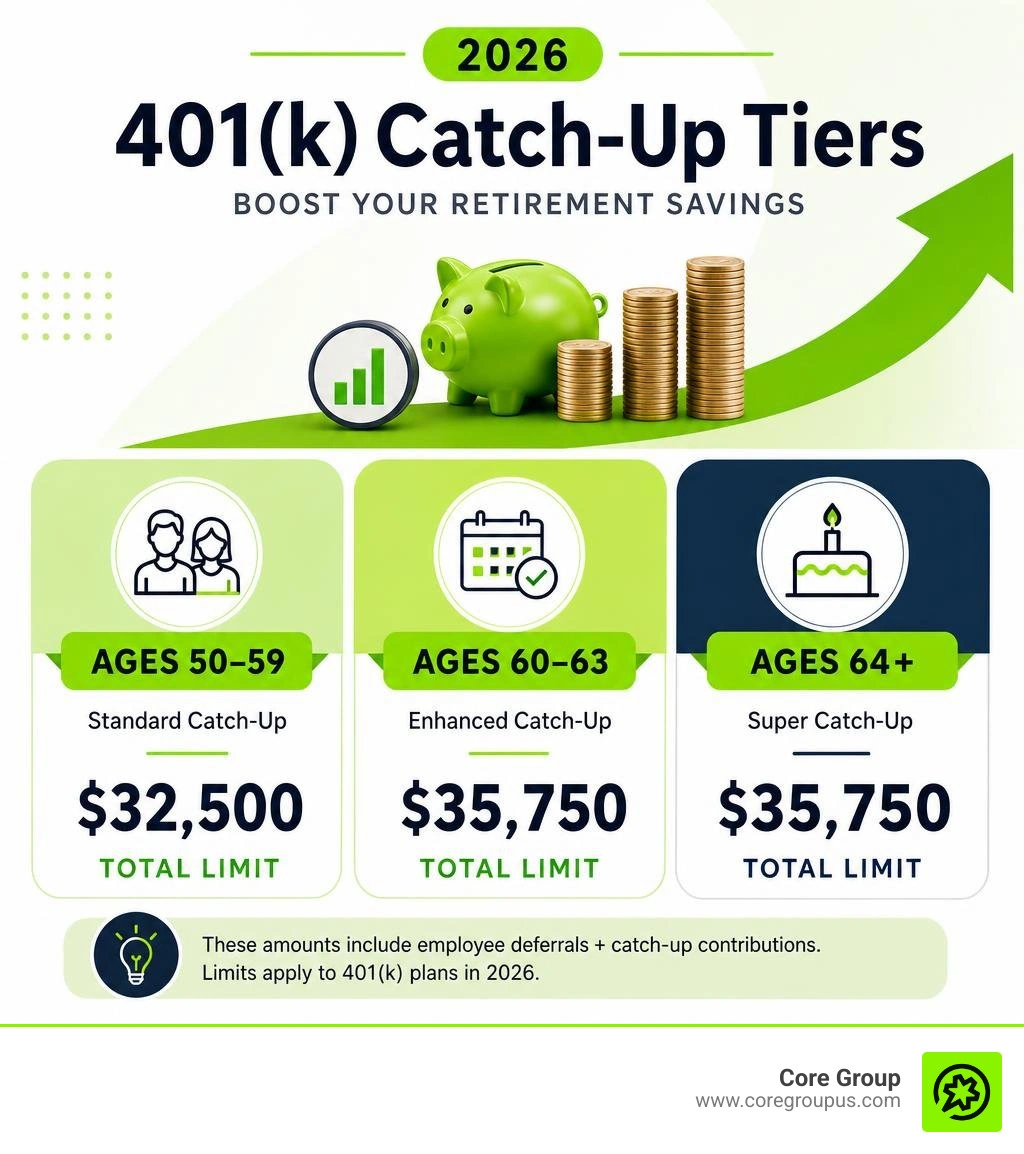
In 2026, a 401(k) over 50 catch up can raise your employee contribution limit from $24,500 to $32,500. If you turn 60, 61, 62, or 63 this year, you may qualify for the higher $35,750 limit instead.
The key steps are simple.
- Confirm your plan allows catch-up contributions.
- Increase payroll deferrals toward your age-based limit.
- Check whether your 2025 wages from this employer exceeded $150,000. If so, your catch-up dollars generally must go into a Roth 401(k) in 2026.
These extra contributions can matter most in your peak earning years, when you may have more income but less time before retirement. That is especially true for creative business owners and professionals whose income and cash flow can change from project to project.
The gap between the average and median 401(k) balance also tells an important story. The median balance is $44,115, far below the $167,970 average, so comparing yourself with averages can give a misleading picture of retirement readiness. Catch-up contributions are one practical lever you can control now.
I am Christian Brim, and the rest of this guide will help you use these rules without creating avoidable tax or payroll mistakes.
Explore more about 401k over 50 catch up
Understanding 401k Over 50 Catch Up Contribution Limits for 2026

Navigating workplace retirement plans as you approach your 50s and 60s requires a firm grasp of annual IRS caps. Every year, federal regulators establish baseline thresholds under Internal Revenue Code Section 402(g) for employee salary deferrals, while Section 414(v) governs the additional amounts eligible workers can stash away. Understanding your total allowable 2026 maximum 401k contribution over 50 lets you structure your cash flow and reduce current or future income taxes strategically.
Under standard regulatory guidelines detailed on the IRS retirement topics on catch-up contributions portal, catch-up contributions are extra elective deferrals that exceed statutory caps, employer plan limits, or non-discrimination testing limits. Let us walk through how these tiers break down across different age brackets in 2026.
Standard 401k Over 50 Catch Up Rules for Ages 50 to 59
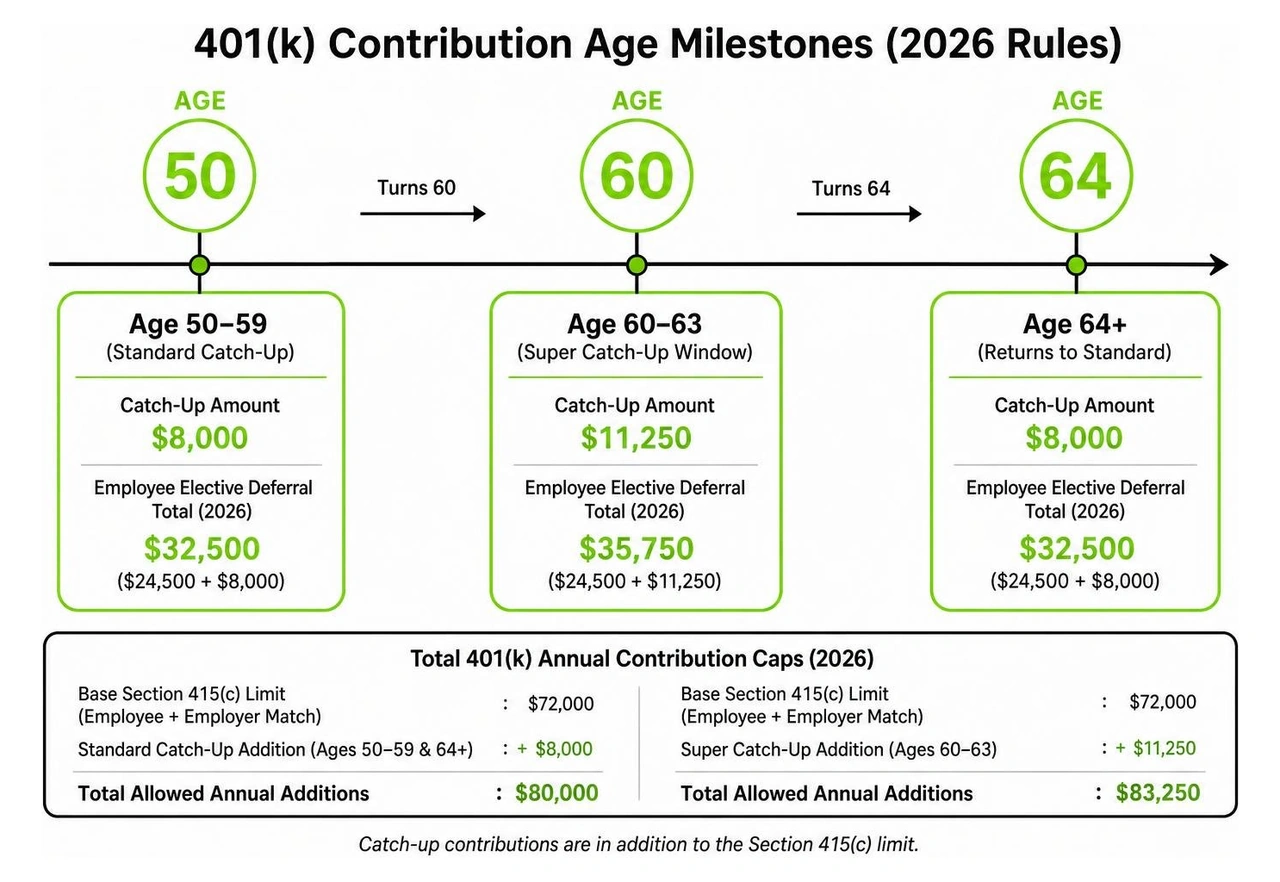
For the 2026 tax year, the baseline employee elective deferral limit stands at $24,500. If you reach age 50 at any point during the calendar year, you gain the statutory right to defer an extra $8,000 into your account, creating a personal employee deferral cap of $32,500.
A frequent area of confusion involves the calendar year qualification rule. Under IRS regulations, you are deemed to reach your age benchmark on January 1 of the calendar year in which your birthday falls. If your 50th birthday is on December 31, 2026, you can begin funding your catch-up amount starting on your very first paycheck in January 2026.
Reviewing a comprehensive 401k 2026 contribution limit guide helps ensure that you do not leave valuable tax-advantaged room unused.
| Age Bracket in 2026 | Base Elective Deferral | Catch-Up Allowance | Total Maximum Employee Deferral |
|---|---|---|---|
| Under Age 50 | $24,500 | $0 | $24,500 |
| Ages 50 to 59 | $24,500 | $8,000 | $32,500 |
| Ages 60 to 63 (Super Catch-Up) | $24,500 | $11,250 | $35,750 |
| Ages 64 and Older | $24,500 | $8,000 | $32,500 |
SECURE 2 0 Super Catch Up Limits for Ages 60 to 63
The SECURE 2.0 Act introduced Section 109, which creates a special four-year window known as the super catch-up. For 2026, workers who turn 60, 61, 62, or 63 can contribute a higher catch-up amount of $11,250 instead of the standard $8,000. Combined with the $24,500 base limit, this allows an impressive annual employee elective deferral total of $35,750.
This rule provides a meaningful boost right when many professionals are experiencing peak earnings and want to accelerate their portfolio growth. However, employer plans are not legally mandated to offer this provision. Because plan adoption is discretionary, you must verify that your plan administrator has amended their documents to permit the higher tier.
Once you celebrate your 64th birthday during a calendar year, your catch-up ceiling reverts to the standard $8,000 amount. You can read more about legislative rollout nuances in our breakdown of 401k changes 2026.
Total Defined Contribution Caps and Employer Match Interactions
Employee elective deferrals represent only one side of the equation. Employers can also contribute to your retirement account through matching formulas, non-elective contributions, or profit-sharing allocations.
Under IRC Section 415(c), the overall annual addition limit for defined contribution plans rises to $72,000 in 2026. Catch-up contributions sit entirely outside this basic $72,000 ceiling. When you add the age-50 catch-up allowance of $8,000, your combined employee and employer total cap reaches $80,000. For participants utilizing the super catch-up between ages 60 and 63, the total combined cap rises to $83,250.
Federal tax law also establishes an annual compensation cap under IRC Section 401(a)(17), which is $360,000 for 2026. This means employer matching formulas cannot factor in compensation earned above that amount.
To model your specific matching structure, use our 401k employer match calculator. For additional technical specifics on plan classifications, consult the IRS catch-up contribution eligibility guidance.
SECURE 2 0 Mandatory Roth Rules for High Earners

One of the most consequential changes taking effect in 2026 under SECURE 2.0 Section 603 is the mandatory Roth catch-up rule for higher-income earners. In the past, workers had complete freedom to decide whether their catch-up contributions went into pre-tax traditional balances or after-tax Roth buckets.
Starting in 2026, certain high-wage employees can no longer deduct their catch-up contributions from their current-year taxable income. These catch-up dollars must be directed into a designated Roth account, meaning taxes are paid upfront in exchange for tax-free growth and qualified tax-free distributions in retirement.
Prior Year FICA Wage Thresholds and Lookback Rules
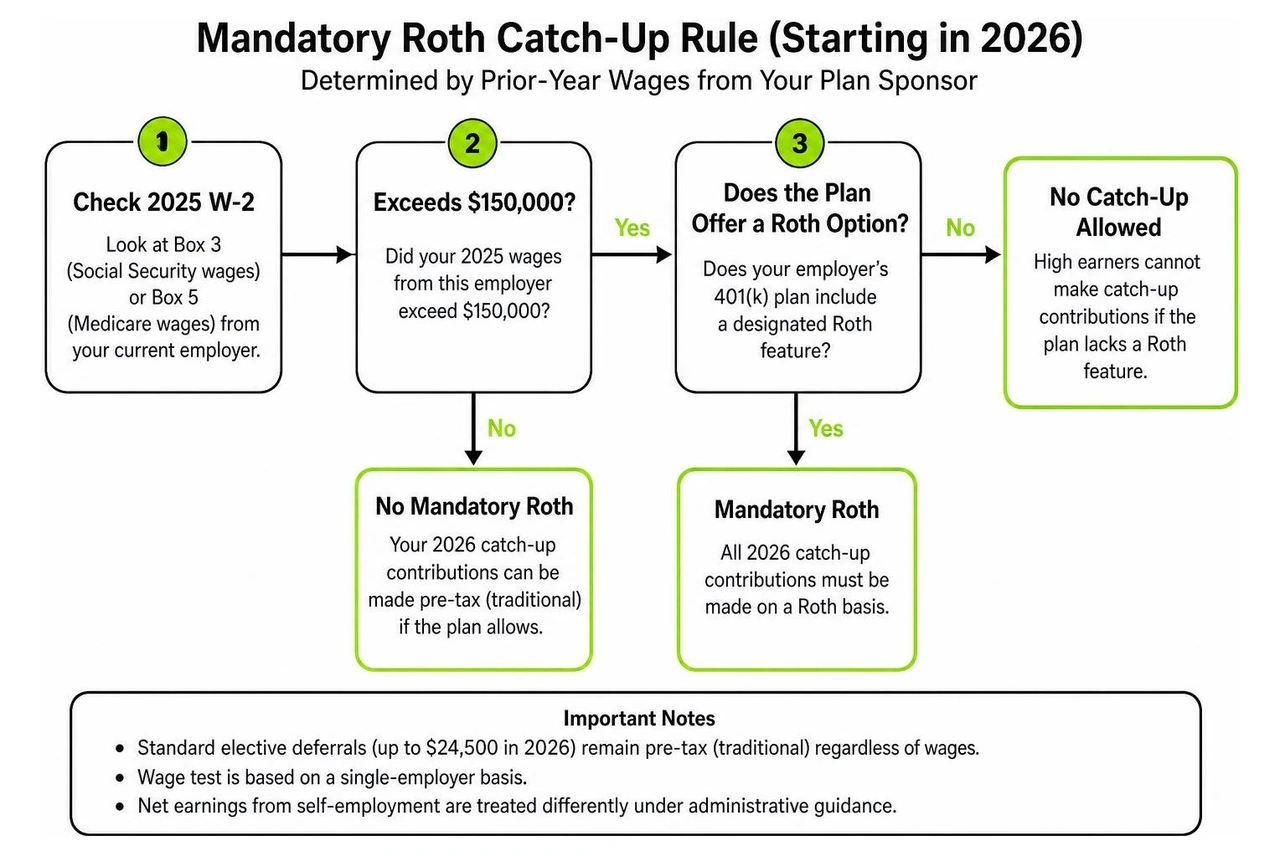
The mandatory Roth requirement hinges on an indexed compensation threshold of $150,000 in prior-year wages from the plan sponsor.
To determine whether this rule applies to you in 2026, look at Box 3 (Social Security wages) or Box 5 (Medicare wages) on your 2025 Form W-2 issued by your current employer. If that figure exceeded $150,000, all 2026 catch-up contributions must be made on a Roth basis.
Key details to keep in mind regarding this rule include the following points.
- The wage evaluation applies strictly on a single-employer basis. If you changed jobs mid-year in 2025 and earned $100,000 from one employer and $100,000 from another, neither employer recorded more than $150,000, exempting you from the mandatory Roth rule at your current employer for 2026.
- Your standard elective deferral of up to $24,500 remains fully eligible for traditional pre-tax treatment regardless of your earnings level. Only the excess catch-up layer ($8,000 or $11,250) is forced into Roth status.
- Net earnings from self-employment for sole proprietors and partners are treated differently under administrative guidance, making precise payroll structuring critical for business owners.
What Happens if Your Employer Plan Lacks a Roth Option
The mandatory Roth rule creates a potential trap for high earners whose workplace plans do not offer a Roth feature.
Federal law states that if a plan allows catch-up contributions, it cannot offer pre-tax catch-ups to high earners who exceed the wage threshold. If the employer's plan document does not contain a designated Roth feature, high earners earning over $150,000 are barred from making any catch-up contributions whatsoever.
For business owners managing company benefits, reviewing our safe harbor 401k complete guide provides a clear blueprint for adding Roth provisions and avoiding non-discrimination testing headaches.
Strategic Ways to Maximize Retirement Savings Beyond the 401k
While the 401(k) serves as the cornerstone of retirement planning, relying on a single vehicle can limit your options. By combining your workplace plan with individual retirement accounts, health savings accounts, and after-tax structures, you can build a diversified retirement portfolio.
Taking advantage of multiple savings options allows your money to compound faster and gives you greater control over your future tax brackets. For specialized savings techniques, explore how a 401k after tax contribution can unlock additional annual additions toward the $72,000 or $80,000 defined contribution limits.
Coordinating Traditional and Roth IRA Catch Up Limits
Outside of employer plans, you can fund an Individual Retirement Account (IRA) to capture additional catch-up savings. For 2026, the baseline IRA contribution limit is $7,500, with an indexed catch-up contribution of $1,100 for individuals age 50 and older, bringing the total limit to $8,600.
Unlike workplace 401(k) contributions that must be completed through payroll by December 31, IRA contributions can be made up until your federal tax filing deadline in mid-April 2027.
That high earners may face Modified Adjusted Gross Income (MAGI) phaseouts that limit deductions for traditional IRAs or restrict direct contributions to Roth IRAs. In 2026, the Roth IRA income phaseout range spans $153,000 to $168,000 for single filers and $242,000 to $252,000 for married couples filing jointly. If your income exceeds these levels, you can still utilize a backdoor Roth IRA strategy by making a non-deductible traditional IRA contribution and converting it to a Roth account.
Leveraging Health Savings Accounts and Spousal Options
A Health Savings Account (HSA) paired with a qualifying High Deductible Health Plan offers an exceptional triple tax advantage where contributions are tax-deductible, investments grow tax-free, and withdrawals for qualified medical expenses are completely tax-free.
For 2026, HSA contribution caps are $4,400 for self-only coverage and $8,750 for family coverage. Once you turn 55, you can contribute an extra $1,000 catch-up amount. If both spouses are 55 or older and covered under a family plan, each spouse can contribute a $1,000 catch-up into their own separate HSA account.
A smart long-term strategy involves paying current out-of-pocket medical bills with personal cash while saving the receipts. This lets your HSA balance remain invested in index funds to compound for decades. Because the tax code does not impose a deadline on reimbursing yourself, you can pull those funds out tax-free years later during retirement. Once you reach age 65, non-medical HSA withdrawals can also be made penalty-free, taxed simply as ordinary income just like a traditional IRA.
If your spouse does not earn wage income, you can also fund a spousal IRA. As long as the working spouse has sufficient earned income to cover both contributions, you can contribute up to $8,600 into the non-working spouse's IRA if they are 50 or older.
Tax Bracket Management IRMAA Surcharges and RMD Reductions
Coordinating pre-tax and Roth contributions helps you manage taxes both now and in retirement.
When you maximize pre-tax 401(k) deferrals during your 50s, you lower your current MAGI. This is especially helpful if your earnings sit near thresholds that trigger the Income-Related Monthly Adjustment Amount (IRMAA). IRMAA imposes substantial monthly surcharges on Medicare Part B and Part D premiums based on income from two years prior. By lowering your taxable income during high-earning years, you can protect yourself against these surcharges later on.
Furthermore, Roth 401(k) accounts are no longer subject to Required Minimum Distributions (RMDs) during the account owner's lifetime, aligning their rules with Roth IRAs. Maxing out Roth catch-up contributions creates a pool of tax-free money that you can draw down at your own pace without driving yourself into higher retirement tax brackets.
Action Plan and Common Mistakes to Avoid
Executing a catch-up savings strategy requires careful attention to payroll timing and plan rules. Simple administrative missteps can cost you valuable matching dollars or lead to tax penalties.
Use this audit checklist to keep your contributions on track throughout the year.
- Confirm your plan permits catch-up contributions and offers the age 60 to 63 super catch-up tier if you qualify.
- Check Box 3 of your prior-year W-2 to see whether the mandatory Roth catch-up rule applies to your contributions.
- Calculate your per-paycheck contribution percentage to hit your target limit smoothly without front-loading too early.
- Verify whether your employer plan offers a true-up provision for its matching formula.
- Review your year-to-date paystubs each autumn to adjust withholding percentages if your compensation changed.
How to Automate Payroll for Your 401k Over 50 Catch Up
Most employer portals allow you to choose between a flat dollar amount or a percentage of your salary for your deferrals. To capture the full $32,500 limit across a bi-weekly pay schedule (26 pay periods), you need to defer approximately $1,250 per paycheck. If you qualify for the $35,750 super catch-up, the target comes to roughly $1,375 per paycheck.
If your payroll portal separates base contributions from catch-up elections, make sure you configure both fields properly. If your salary changes mid-year due to a raise or bonus, revisit your portal to recalculate your withholdings so you do not stop contributing early.
Timing Traps True Up Provisions and Overcontribution Penalties
A common mistake made by high-earning professionals is maxing out their elective deferrals too early in the calendar year.
If your employer matches your contributions on a per-paycheck basis and your plan lacks a true-up provision, front-loading your contributions by August means you will contribute 0% during the final four months of the year. As a result, you forfeit the employer match for those remaining pay periods. A true-up provision fixes this by recalculating your match at year-end, but you should verify this feature with your benefits department beforehand.
If you change employers mid-year and accidentally overcontribute across multiple plans beyond the statutory cap, notify your plan administrator right away. You must remove the excess deferrals along with any associated investment earnings by April 15 of the following year. Failing to correct an excess deferral leads to double taxation because the excess is taxed in the year contributed and taxed a second time upon eventual withdrawal.
Always double-check Box 12 of your Form W-2 at tax time, ensuring pre-tax amounts are marked under Code D and designated Roth contributions appear under Code AA.
Frequently Asked Questions About Catch Up Contributions
What happens if I turn 50 late in December 2026?
Under IRS regulations, you are considered eligible for the full $8,000 catch-up contribution for the entire calendar year in which you turn 50. Even if your 50th birthday falls on December 31, 2026, you can begin making catch-up contributions starting with your very first paycheck in January 2026.
Can high earners still make traditional pre tax catch up contributions?
No. If your prior-year FICA wages from your current employer exceeded $150,000, SECURE 2.0 rules mandate that your catch-up contributions must be directed to a Roth 401(k). However, you can still make your standard baseline contribution of up to $24,500 on a pre-tax traditional basis.
How does the super catch up work if I turn 64 this year?
The enhanced $11,250 super catch-up limit applies only during the calendar years you turn 60, 61, 62, and 63. During the calendar year you reach age 64, your catch-up ceiling reverts to the standard $8,000 amount, setting your maximum employee deferral limit at $32,500 for 2026.
Conclusion
Accelerating your retirement savings during your 50s and 60s is one of the most effective steps you can take to secure your financial future. Maxing out your catch-up contributions from age 50 to 65 can add hundreds of thousands of dollars to your retirement portfolio through the power of compounding growth.
For creative entrepreneurs, agency founders, and busy professionals, managing variable income while staying on top of changing tax rules can feel overwhelming. At Core Group, our no-fluff, profit-first playbook provides financial management, bookkeeping, and tax services that give you peace of mind and free up your time to focus on your craft. To learn more about optimizing your retirement strategy and keeping your taxes low, read our guide on 401k and MAGI or reach out to our team today.