The Essential Guide to Bookkeeping for Small Business Success
Understanding the Basics of Bookkeeping for Small Business
Bookkeeping for small business is the process of recording, organizing, and tracking every financial transaction your business makes, from income and expenses to invoices and receipts. Done consistently, it gives you a clear picture of your cash flow, keeps you tax-ready year-round, and helps you make smarter decisions about your business.
Here's what small business bookkeeping covers at a glance:
- Recording transactions - logging every sale, expense, and payment
- Categorizing income and expenses - organizing money into clear groups
- Reconciling accounts - matching your records to your bank statements
- Generating financial reports - producing profit and loss statements, balance sheets, and cash flow summaries
- Staying tax compliant - keeping records accurate for filing deadlines
If you run a small business, especially a creative one, chances are you didn't launch it to spend hours managing spreadsheets. You started it to do the work you love. But here's the uncomfortable truth: nearly 42% of small business owners admit they had limited or no financial literacy before starting their venture.
That gap between passion and financial know-how is exactly where things go wrong. Cash flow dries up. Tax season becomes a nightmare. Growth stalls because you can't see where your money is actually going.
The good news is that bookkeeping doesn't have to be complicated. With the right foundation, it becomes a rhythm, not a burden.
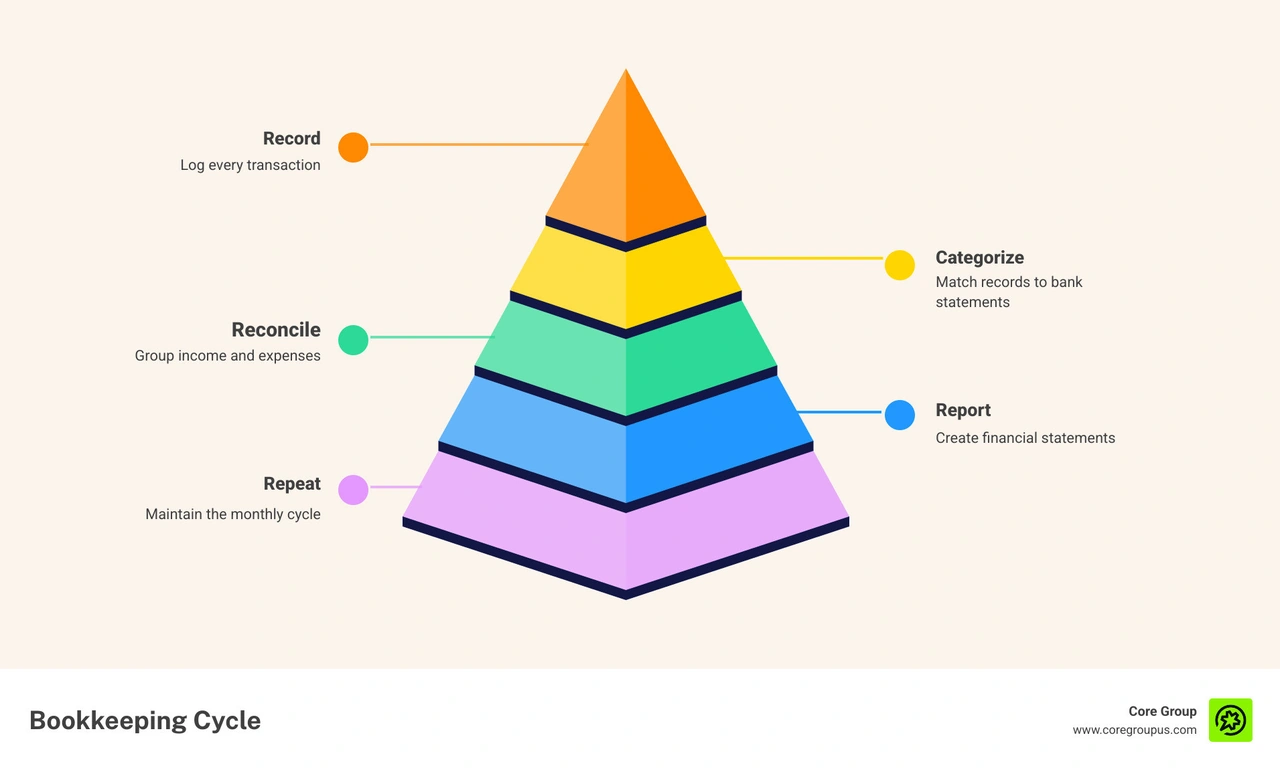
Bookkeeping for small business terms at a glance:
When we talk about bookkeeping for small business, we are talking about the bedrock of your company. It is the administrative system of recording every single dollar that moves through your hands. Think of it as the "what" and the "where" of your money. It tells you that you spent fifty dollars on printer ink or received five hundred dollars from a client.
Many people use the terms bookkeeping and accounting interchangeably, but they serve different purposes. Bookkeeping is the day to day tracking of transactions and keeping the records tidy. Accounting is the next step where those records are turned into reports, insights, and strategic plans. You can think of a bookkeeper as the person who builds the foundation and the accountant as the architect who uses that foundation to build a house.
For a deeper dive into these fundamentals, you might find our Bookkeeping for Small Business guide helpful. Understanding these bookkeeping 101 basics is essential because it allows you to maintain a clear reporting structure. Without this clarity, you are essentially flying blind, which is a dangerous way to run a business in May 2026.

Key Terms and the Accounting Equation
To master bookkeeping for small business, you need to speak the language. There are five main categories of accounts you will encounter, and they all fit into a simple formula known as the accounting equation.
- Assets are things your business owns. This includes cash in the bank, equipment, and inventory.
- Liabilities are things your business owes. This includes loans, credit card balances, and unpaid bills.
- Equity is what is left over for the owners after all liabilities are subtracted from assets.
- Revenue is the money coming in from sales.
- Expenses are the costs of doing business, like rent or software.
The accounting equation is the foundation of the balance sheet: Equity = Total Assets - Total Liabilities. This equation must always stay in balance. If it does not, you know there is a mistake in your records. For a more exhaustive list of these concepts, check out our Bookkeeping Services Complete Guide.
We also need to mention Accounts Payable and Accounts Receivable. Accounts payable represents money you owe to creditors for goods or services you have already received. Accounts receivable represents money that customers owe you for products or services you have already delivered but have not yet been paid for. Keeping a close eye on these ensures your cash flow stays healthy.
The Three Golden Rules of Bookkeeping for Small Business
If you ever feel lost while recording a transaction, you can always fall back on the three golden rules. These rules come from the traditional world of bookkeeping made easy and help ensure that your debits and credits are handled correctly.
- Debit what comes in, credit what goes out. If you receive cash, you debit your cash account. If you pay for a new laptop, you credit your cash account.
- Debit the receiver, credit the giver. This applies to personal accounts. If you give money to a vendor, you debit the vendor account and credit your own.
- Debit expenses and losses, credit income and gains. This is the rule for tracking how your business is performing. Every time you pay for a subscription, that expense is a debit. Every time you make a sale, that income is a credit.
By following these rules, you keep your books balanced and ensure that every transaction is accounted for in two places, which is the hallmark of professional bookkeeping.
Choosing the Right Bookkeeping Methods and Systems
Choosing how to track your money is one of the first big decisions you will make. There are two main forks in the road: single entry versus double entry, and cash versus accrual.
Single Entry vs. Double EntrySingle entry bookkeeping is like a checkbook register. You record each transaction once as either an income or an expense. It is simple and works for very small freelancers with few transactions. However, most growing businesses use double entry bookkeeping. In this system, every transaction affects at least two accounts (a debit and a credit). This provides a built in check and balance system that prevents errors.
Cash vs. Accrual AccountingThis is a choice about when you record a transaction.
| Feature | Cash Accounting | Accrual Accounting |
|---|---|---|
| Timing | Records when cash actually changes hands | Records when the transaction occurs |
| Pros | Easy to see actual cash in the bank | Better for long term planning and accuracy |
| Cons | Can hide upcoming bills or income | Harder to track actual cash flow |
| Best For | Very small businesses and solopreneurs | Growing businesses with inventory or employees |
Choosing the right bookkeeping software can make these choices much easier, as most modern tools default to double entry and allow you to toggle between cash and accrual views.
Setting Up Your Bookkeeping for Small Business Infrastructure
Once you have picked your method, it is time to build the pipes. The first and most important rule of bookkeeping for small business is to separate your personal and business finances. We cannot stress this enough. Open a dedicated business bank account and get a business credit card. Mixing these two worlds is the fastest way to trigger an audit and create a massive headache for yourself.
Next, you need to create your Chart of Accounts. This is just a fancy name for a list of categories where you will put your transactions. Common categories include:
- Advertising and Marketing
- Office Supplies
- Rent or Lease
- Travel and Meals
- Software and Subscriptions
When you set this up in your software, try to align your categories with the IRS tax forms you will file at the end of the year. This makes tax preparation a breeze. If this feels overwhelming, professional bookkeepers can help you set this up correctly from day one so you don't have to fix it later.
Best Practices for Accurate Financial Records
Accuracy is the name of the game. If your data is wrong, your reports are wrong, and your decisions will be wrong too. The best way to maintain accuracy is to stay current. We recommend a "Fiscal Friday" routine where you spend thirty minutes at the end of every week categorizing your transactions.

One of the most important best practices is monthly reconciliation. This is the process of comparing your bookkeeping records against your bank statements. If your software says you have ten thousand dollars but your bank statement says you have nine thousand, you have a problem. Reconciliation helps you catch bank errors, fraudulent charges, and missing entries.
You should also digitize everything. Use a scanning app to capture receipts the moment you get them. Physical receipts fade and get lost, but a digital copy in the cloud is forever. This is a core part of expert bookkeeping services and something every small business owner should adopt.
Common Bookkeeping Mistakes to Avoid
Even the most diligent owners can trip up. Here are the most common pitfalls we see in bookkeeping for small business:
- Mixing personal and business expenses. This is the "cardinal sin" of bookkeeping. It makes it nearly impossible to see your true profit and puts your liability protection at risk.
- Falling behind. Waiting until tax season to enter a year's worth of data is a recipe for disaster. Our brains are much better at remembering what a mystery forty dollar charge was last week than they are six months later.
- Transposing digits. This is a simple human error where you write $54 instead of $45. A fun tip from the pros: if your books are off by an amount that is divisible by nine, you probably transposed two digits!
- Relying solely on software. Automation is great, but it is not perfect. Software can miscategorize a "Staples" purchase as "Office Supplies" when you actually bought a new desk that should be a "Fixed Asset." You still need a human eye to review the work.
Working with virtual bookkeeping companies can help you avoid these mistakes by providing a second set of professional eyes on your data.
Essential Bookkeeping Routines and Financial Tasks
Bookkeeping is not a one time event. It is a rhythm of daily, weekly, and monthly tasks. By breaking it down, it feels much less intimidating.
Weekly Tasks:
- Record and categorize all transactions.
- File away digital receipts.
- Send out invoices to clients.
- Pay bills to vendors.
Monthly Tasks:
- Reconcile all bank and credit card accounts.
- Review your Profit and Loss (P&L) statement.
- Check your Accounts Receivable to see who owes you money.
- Review your Balance Sheet to see your overall health.
For those in the creative space, our Bookkeeping for Creatives Complete Guide offers specific routines tailored to the way you work.
Quarterly and Annual Bookkeeping Requirements
As the year progresses, larger tasks will pop up on your radar. These are usually related to compliance and tax filing.
Quarterly Requirements:
- Estimated Tax Payments. Most small business owners need to pay taxes to the IRS and their state four times a year (April, June, September, and January).
- Sales Tax. If you sell physical products or certain services, you may need to file sales tax returns.
- Inventory Review. If you hold stock, do a physical count to ensure your records match what is on the shelf.
Annual Requirements:
- 1099 Reporting. You must send 1099-NEC forms to any contractor you paid more than $600 during the year. The deadline for this is usually January 31.
- Year End Financial Review. This is the time to look at your full year performance and set goals for the next one.
- Tax Preparation. Gather all your reconciled reports and send them to your tax professional.
If you are located in a high regulation area, such as the Northeast, you might want to look at Bookkeeping and Tax Services New York for specific local requirements.
Frequently Asked Questions about Small Business Finances
We hear a lot of the same questions from business owners as they navigate their financial journey. Most of them boil down to one thing: how can I use these numbers to grow?
Good bookkeeping for small business isn't just about staying out of trouble with the IRS. It is about profitability analysis. When your books are clean, you can see which of your services are actually making money and which ones are "bleeding" cash. You can see if your expenses are growing faster than your revenue. This allows for better financial decision making and more confident growth planning.
For those running a one person show, our guide on Bookkeeping for Solopreneurs answers many of these questions from a single owner perspective.
When should I hire a professional bookkeeper
There comes a point in every successful business where the owner's time is worth more than the cost of a bookkeeper. You should consider hiring help if:
- You are spending more than five hours a month on bookkeeping.
- You are consistently behind on your reconciliations.
- You feel anxious or confused every time you look at your software.
- Your business is growing and your transactions are becoming more complex.
Hiring a pro doesn't just save you time. It often pays for itself by catching missed deductions and preventing costly late fees. For larger teams, our Bookkeeping for Agencies Ultimate Guide explains how to scale your financial department.
Is bookkeeping hard for beginners
Bookkeeping is a skill, and like any skill, it has a learning curve. It is not necessarily "hard," but it does require consistency and attention to detail. Many beginners find that modern automated tools take a lot of the heavy lifting out of the process.
The key is to start simple. Don't try to master complex depreciation schedules on day one. Focus on accurately recording your money in and money out. As you get comfortable with the rhythm, your financial literacy will naturally improve. Nearly half of your peers started with no financial training either!
What are the best free bookkeeping tools
If you are just starting out and need to keep costs low, there are several options available:
- Spreadsheets. Tools like Google Sheets or Excel are free (or very cheap) and highly customizable. However, they are manual and prone to human error.
- Open Source Software. Tools like GnuCash or Akaunting offer powerful features without the monthly subscription fee, though they may require more technical setup.
- Free Tiers of Cloud Software. Some platforms offer free versions for businesses with low revenue or a small number of users.
While free tools are great for starting, keep in mind that they often have revenue limits. As you grow, you will likely find that the time you save with a paid, automated platform is well worth the investment.
Conclusion
At Core Group, we understand that you didn't become a creative entrepreneur to spend your life staring at a ledger. Our mission is to take that weight off your shoulders. We provide financial management, bookkeeping, and tax services specifically designed for people like you.
Our "no-fluff, profit-first playbook" is built to give you total peace of mind. We don't just "do the books." We help you keep more of what you earn and provide the clarity you need to scale your business. We are so confident in our ability to streamline your life that we even offer a MacBook Pro guarantee.
Whether you are in Alabama, California, New York, or any of our other service locations across the United States, we are here to help you master your finances. Don't let another month go by wondering where your cash went.
Start your tax planning journey with us today and get back to the work you were meant to do.