The Ultimate Business Year End Tax Planning Checklist
Why Business Year End Tax Planning Can Save You Thousands
Business year end tax planning is one of the highest-leverage things you can do to lower your tax bill before December 31. Businesses that plan proactively can reduce their tax liability by 10 to 20% on average. Yet most creative entrepreneurs only think about taxes when filing season hits, which is already too late for most of the best strategies.
Consider these highly impactful year-end tax moves to make before December 31
- Review your year-to-date financials and project your full-year income
- Maximize deductions by purchasing equipment, paying bonuses, and prepaying expenses
- Leverage 100% bonus depreciation under the One Big Beautiful Bill Act (OBBBA) for qualifying assets placed in service by year-end
- Maximize retirement contributions to a SEP IRA, SIMPLE IRA, or Solo 401(k)
- Defer income or accelerate expenses depending on your accounting method and expected tax bracket
- Review your entity structure to confirm you are in the most tax-efficient setup
- Make charitable contributions before December 31 under current rules, which change in 2026
- Confirm your estimated tax payments are on track to avoid underpayment penalties
If you run a film production, media company, or creative business, the financial side can feel overwhelming. Tax strategy probably is not the reason you started your business. But skipping year-end planning is one of the most expensive mistakes small business owners make.
The good news is that a handful of focused moves before December 31 can make a real difference, without requiring you to become a tax expert.
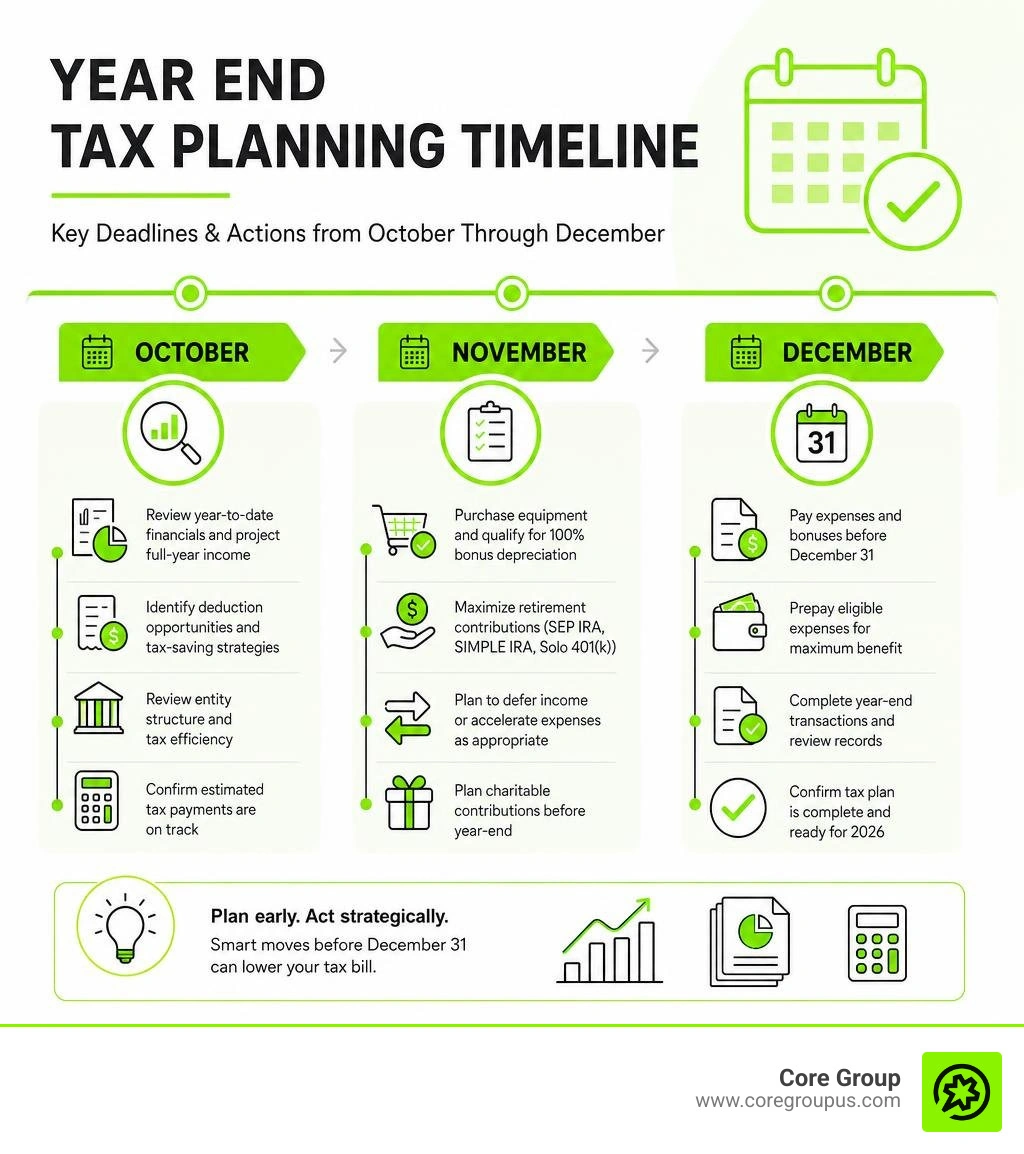
Business year end tax planning terms simplified
Essential Steps for Business Year End Tax Planning

Taking control of your taxes requires moving away from reactive bookkeeping and moving toward proactive financial strategy. When we look at successful creative firms, they do not wait until spring to see how the financial cards fell. They start implementing structured Tax Planning Strategies months before the calendar flips.
Getting your financial house in order is the first step in this process. Proactive planning helps you identify deductions you might otherwise miss. It also prevents the unpleasant surprise of an unexpected tax bill when you least expect it. By establishing a clear timeline and reviewing your numbers early, you put yourself in the driver's seat.
Reviewing Year to Date Financials and Projecting Income
To make smart decisions before December 31, you must know exactly where your business stands today. This begins with pulling a clean, accurate profit and loss statement. If your books are a few months behind, now is the time to catch up. Accurate bookkeeping is the absolute foundation of any successful tax plan. You cannot plan for what you cannot see.
Once your year-to-date numbers are accurate, the next step is projecting your income for the rest of the year. Look at your active client contracts, pending invoices, and expected expenses through December 31. This projection helps you estimate your final taxable income. Knowing this number is critical because it tells us which tax bracket you will fall into and whether you need to take immediate action to lower your liability. For a complete guide on keeping your books organized throughout the year, check out our Bookkeeping Small Business Guide 2026 to set yourself up for success.
Managing Estimated Tax Payments and Cash Flow
Underpaying your quarterly estimated taxes can lead to annoying penalties and interest charges from the IRS. To avoid this, we recommend utilizing the safe harbor rules. Generally, you can avoid underpayment penalties if you pay at least 90% of your current year tax liability or 100% of your prior year tax liability through quarterly payments. If your adjusted gross income exceeds a certain threshold, that prior year safe harbor requirement may rise to 110%.
Managing these payments is a delicate balance of cash flow. You want to keep enough cash in your business to fund operations and growth, but you also want to avoid a massive cash drain when tax day arrives. By projecting your income in real time, you can adjust your remaining estimated payments to match your actual earnings. This keeps your cash flow predictable and ensures you do not overpay the government throughout the year. For more tactical advice on managing your cash flow while keeping the IRS happy, read our guide on How to Save on Taxes.
Maximizing Deductions and Depreciation Under the OBBBA

The legislative landscape changed dramatically with the passage of the One Big Beautiful Bill Act, commonly known as the OBBBA. This major legislation has completely reshaped how businesses handle capital investments, depreciation, and research expenses. For business owners looking to minimize their tax burden, understanding the OBBBA is one of the most profitable things you can do this year.
One of the biggest areas of impact is Section 179. For the 2026 tax year, the Section 179 expensing limit has been raised to a generous 2.56 million dollars. The phase-out threshold has also increased to 3.05 million dollars. This means small and mid-sized businesses can write off the entire cost of qualifying equipment and software immediately, up to those historic limits, before even touching other depreciation methods.
Leveraging Permanent One Hundred Percent Bonus Depreciation
In addition to expanding Section 179, the OBBBA permanently reinstated 100% bonus depreciation for qualifying property placed in service after January 19, 2025. This is a massive win for businesses that need to make significant capital investments. In previous years, bonus depreciation was on a scheduled decline, but it is now back at full strength.
This permanent incentive applies to both new and used qualifying equipment, vehicles, and software. However, you must remember the placed in service rule. Simply ordering or paying for a piece of equipment before December 31 is not enough to claim the deduction. The asset must be fully delivered, installed, and ready for use in your business before midnight on December 31. If you are curious about how these depreciation rules apply specifically to your business structure, take a look at our LLC Tax Deductions Guide 2026.
Capitalizing on Research and Development Expensing
For creative agencies, tech startups, and product developers, research and development costs represent a major annual expense. Under previous rules, businesses were forced to capitalize and amortize domestic R&D costs over a five-year period, which created massive tax challenges for growing companies.
Fortunately, the OBBBA restored immediate expensing for domestic research and development costs under Section 174, retroactive to 2025. This means you can once again deduct the full amount of your domestic R&D expenses in the year they are incurred. However, you must watch out for state tax conformity issues. Some states have decoupled from federal rules, meaning you might still have to amortize these expenses on your state tax return even if you deduct them fully on your federal return.
Timing Income and Expenses to Optimize Cash Flow
Timing is everything in tax planning. Depending on your business model, you may have the flexibility to shift the timing of your income and expenses to minimize your current year tax liability. The goal is to level out your income so you stay in the lowest possible tax bracket over a multi-year period.
The effectiveness of timing strategies depends heavily on your accounting method. Cash basis and accrual basis businesses must follow very different sets of rules.
| Strategy | Cash Basis Taxpayers | Accrual Basis Taxpayers |
|---|---|---|
| Income Deferral | Delay sending invoices until late December so payments arrive in January. | Delay shipping products or completing services until the new year. |
| Expense Acceleration | Prepay eligible expenses like rent, insurance, or utilities before December 31. | Accrue liabilities and ensure all events fixing the obligation occur by year-end. |
| Inventory Write-downs | Write off obsolete inventory and scrap it before year-end. | Write down subnormal goods to their actual offering price within 30 days of year-end. |
How Cash Basis Accounting Impacts Business Year End Tax Planning
Most small businesses and creative entrepreneurs use the cash method of accounting. Under this method, you record income when you physically receive cash, and you record expenses when you actually pay them. This simplicity gives you a powerful tool for business year end tax planning.
If you expect to be in a lower tax bracket next year, you can defer income by delaying your customer invoicing until late December. This ensures the payments will not hit your bank account until January, pushing that taxable income into the next tax year. On the flip side, you can accelerate expenses by prepaying eligible bills before December 31. Under the IRS twelve month rule, you can deduct prepaid expenses in the current year as long as the benefit does not extend beyond twelve months or the end of the taxable year following payment. To learn more about aligning these cash-flow strategies with your long-term goals, check out our insights on Business Tax Optimization.
Writing Down Inventory and Paying Year End Bonuses
If your business carries inventory, year-end is the perfect time to clean up your warehouse and your balance sheet. Obsolete, damaged, or slow-moving inventory can be written down to its net realizable value, which creates an immediate tax deduction. To claim this write-down, you must value these subnormal goods at their actual offering price within 30 days of your year-end inventory count.
For businesses looking to reward their team while lowering their tax bill, year-end bonuses are an excellent strategy. If you use the accrual method, you can deduct employee bonuses in the current tax year even if you do not pay them immediately, provided you meet the all-events test. This requires the bonus pool to be fixed and established before December 31, and the actual payments must be distributed to employees within two and a half months after the close of the tax year.
Choosing the Right Entity Structure and Retirement Plans
As your business grows, the legal structure you chose when you started may no longer be the most tax-efficient option. Year-end is the ideal time to evaluate whether you should operate as a sole proprietorship, S corporation, partnership, or C corporation. Making a change can save you thousands of dollars in self-employment and income taxes.
At the same time, establishing or contributing to a business retirement plan is one of the most effective ways to build personal wealth while securing a dollar-for-dollar reduction in your current year taxable income.
Retirement Plan Deadlines for Business Year End Tax Planning
There are several powerful retirement plan options available to small business owners, each with its own set of rules, contribution limits, and deadlines.
- SEP IRA (Simplified Employee Pension) plans are highly flexible. You can contribute up to 25% of your net self-employment income, up to a limit of 72,500 dollars for the 2026 tax year. The best part is that you have until your tax filing deadline, including extensions, to establish the plan and make your contributions.
- SIMPLE IRA plans are great for small businesses with employees, but they must be established by October 1 of the tax year.
- Solo 401(k) plans offer high contribution limits, allowing you to contribute as both the employee (up to 24,500 dollars, plus a 7,500 dollar catch-up if you are 50 or older) and the employer. To make employee salary deferrals for the current tax year, the plan must be established by December 31.
For a deeper dive into setting up the right retirement vehicle for your team, explore our Safe Harbor 401k Complete Guide.
Evaluating Pass Through Entity Tax Elections and QBI Deductions
Pass-Through Entity (PTE) tax elections have become an essential planning tool for S corporations and partnerships. These elections allow the entity to pay state income tax at the corporate level rather than passing it through to the owners' individual returns. Because business-level state taxes are fully deductible on your federal return, this strategy effectively bypasses the federal cap on State and Local Tax (SALT) deductions.
Under the OBBBA, the individual SALT deduction cap has been increased to 40,000 dollars through 2029, though it begins to phase out for incomes above 500,000 dollars. Even with this higher limit, utilizing a PTE tax election can yield substantial additional federal savings. Furthermore, optimizing your S corporation salary and distributions is critical to maximizing your Qualified Business Income (QBI) deduction, which allows eligible pass-through owners to deduct up to 20% of their business income tax-free. To understand how to qualify, read our QBI Deduction Explained guide.
Frequently Asked Questions About Year End Tax Planning
What is the deadline for making retirement plan contributions to reduce my current tax bill
The deadline depends entirely on the type of retirement plan you are using. For a SEP IRA, you have until your tax filing deadline, including any extensions, to establish the plan and make contributions for the prior year. For a Solo 401(k), the plan must be legally established by December 31 of the tax year to allow employee salary deferral contributions, although the actual employer profit-sharing contributions can be made up until your tax filing deadline including extensions.
How does the OBBBA change the SALT deduction cap for business owners
The OBBBA significantly altered the SALT landscape by raising the individual state and local tax deduction cap from 10,000 dollars to 40,000 dollars through the 2029 tax year. However, this cap begins to phase out once your individual income exceeds 500,000 dollars. To maximize your deductions, you should evaluate whether your state allows a Pass-Through Entity tax election, which lets your business pay these taxes directly and claim them as an unlimited federal business deduction.
Can I deduct equipment that I ordered but has not been delivered yet
No, you cannot deduct equipment that has only been ordered or paid for. To qualify for Section 179 or bonus depreciation deductions in the current tax year, the equipment must meet the IRS placed in service requirement before midnight on December 31. This means the asset must be physically delivered, installed, and fully operational in your business. Equipment that is still in transit or sitting in its packaging does not qualify.
Conclusion
At Core Group, we understand that creative entrepreneurs want to focus on their craft, not on deciphering complex tax codes. That is why we designed our financial management, bookkeeping, and tax services specifically for creatives. We skip the jargon and deliver a no-fluff, profit-first playbook that guarantees peace of mind and saves you hours of administrative headache every single week.
We are so confident in our ability to streamline your financial life that we back our services with our signature MacBook Pro guarantee. If we do not save you time and deliver absolute clarity, we will make it right. Do not wait until April to find out what you should have done in December. Take control of your financial future today and Optimize your business taxes with Core Group.