How to Set Up an S Corp in 4 Easy Steps
Understanding S Corp Basics and Eligibility Requirements
When small business owners ask us can i set up an s corp myself, we like to start with a essential distinction. An S Corporation is not a distinct physical business entity created from thin air. It is a specific tax classification under Subchapter S of the Internal Revenue Code that you apply to an underlying legal entity.
If you are currently running a single-member LLC, a partnership, or a standard C Corporation, you do not need to tear down your company to build an S Corp. You simply ask the IRS to tax your existing business under Subchapter S rules.
The primary appeal of this structure lies in pass-through taxation. In a standard C Corporation, profits are taxed at the corporate level and then taxed again on the owner's personal return when distributed as dividends. This scenario is known as double taxation. To learn more about avoiding this pitfall, read our guide on how to avoid double taxation.
An S Corp avoids corporate double taxation entirely. Profits, losses, deductions, and credits pass directly to your personal tax return.
Understanding how an S Corp differs from other structures helps clarify why so many entrepreneurs make the transition.
| Feature | Single-Member LLC (Default) | C Corporation | S Corporation (Tax Election) |
|---|---|---|---|
| Entity Level Tax | None (Pass-Through) | Yes (21% Federal Corporate Rate) | None (Pass-Through) |
| Self-Employment Tax | Applied to 100% of Net Income | Not Applicable (W-2 Dividends) | Applied ONLY to W-2 Reasonable Salary |
| Ownership Restrictions | Flexible (No Limits) | Unlimited Shareholders / Classes | Max 100 Shareholders / 1 Class of Stock |
| Owner Compensation | Owner Draws (No W-2 Payroll) | W-2 Salary and/or Dividends | W-2 Salary PLUS Tax-Free Distributions |
| Tax Prep Complexity | Low (Schedule C) | High (Form 1120) | Moderate to High (Form 1120-S) |
Before diving into the paperwork, you must verify your entity against the official S-Corp eligibility requirements. Understanding general S corporations rules will help ensure your business qualifies under IRS guidelines.
Can I Set Up an S Corp Myself Based on IRS Requirements
The IRS maintains strict boundary lines for businesses electing Subchapter S taxation. If your company breaches even one of these rules, the IRS will reject your election or terminate your S Corp status retroactively, which can trigger painful back taxes.
Here are the primary IRS eligibility standards you must meet:
- Domestic Entity Status. Your business must be formed within the United States or under federal law.
- 100 Shareholder Limit. You cannot have more than 100 shareholders. Members of a family can sometimes be treated as a single shareholder for this rule.
- Eligible Shareholders Only. All shareholders must be individual U.S. citizens or permanent residents (green card holders). You cannot have partnerships, other corporations, or non-resident alien shareholders holding equity. Certain estates and trusts are permitted.
- One Class of Stock. You can only issue one class of stock. All shares must confer identical rights to distribution and liquidation proceeds. Differing voting rights are allowed, but economic rights must remain perfectly equal.
For specific local rules, consult official state resources such as the Business Structure FAQs provided by state agencies.
Knowing When S Corp Tax Savings Justify the Switch
The number one reason business owners ask can i set up an s corp myself boils down to tax savings. When operating as a standard sole proprietor or single-member LLC, all your net profits are subject to self-employment taxes. This is the 15.3% FICA tax covering Social Security (12.4%) and Medicare (2.9%).
As an S Corp owner-operator, you split your income into two distinct buckets:
- W-2 Employee Salary. Subject to the full 15.3% payroll tax.
- Shareholder Profit Distributions. Passed through to your personal return free of self-employment tax.
While saving on self-employment tax sounds fantastic, S Corps introduce administrative overhead costs like payroll processing fees, state annual reports, and corporate tax return preparation (Form 1120-S).
Many tax professionals use $60,000 in annual net profit as a benchmark for considering S Corp status. If your net profit sits around $35,000, your tax savings of roughly $600 to $700 can be completely wiped out by annual payroll software subscriptions and extra bookkeeping fees.
Once your business consistently generates over $60,000 in net profit, an S Corp can save you anywhere from $5,000 to $15,000 annually in self-employment taxes. For a deeper breakdown of default LLC tax burdens, see our overview of single member LLC taxes.
Can I Set Up an S Corp Myself in 4 Easy Steps

If your income metrics check out and you are ready to move forward, you can execute the DIY setup process in four distinct phases. Tackling this paperwork yourself requires careful attention to details and deadlines, but you can complete the initial tax election without paying heavy legal setup fees.
Step 1 Form or Register Your Base Business Entity
Because an S Corp is a tax status, you must first have a valid legal entity registered in your home state. For most creative business owners, this means establishing a Limited Liability Company (LLC).
To set up your base entity yourself:
- Choose a Business Name. Verify that your desired name is available by searching your state's Secretary of State business registry.
- Appoint a Registered Agent. Every state requires a designated agent with a physical street address in the state to receive official legal mail during normal business hours.
- File Articles of Organization. Submit your formation paperwork online through your Secretary of State business portal. Filing fees range from under $50 to a few hundred dollars depending on your state.
- Pay State Registration Fees. Keep your receipts for your tax records.
If you reside in the Constitution State, consult this detailed resource on how to start an S Corp in Connecticut (2026 Guide). Similar step-by-step state guidance is available across the country, such as this 10 steps to starting a business in Arizona guide, or resources from the S-Corporations and Fiduciaries Alabama Department of Revenue portal, the Small Business Corporate Sub-S Arkansas documentation, and the California Tax Service Center S Corporations advisory.
Step 2 Obtain Your Federal Employer Identification Number
Once your state approves your LLC or corporate filings, you need a federal Employer Identification Number (EIN). Think of an EIN as a Social Security Number for your business entity.
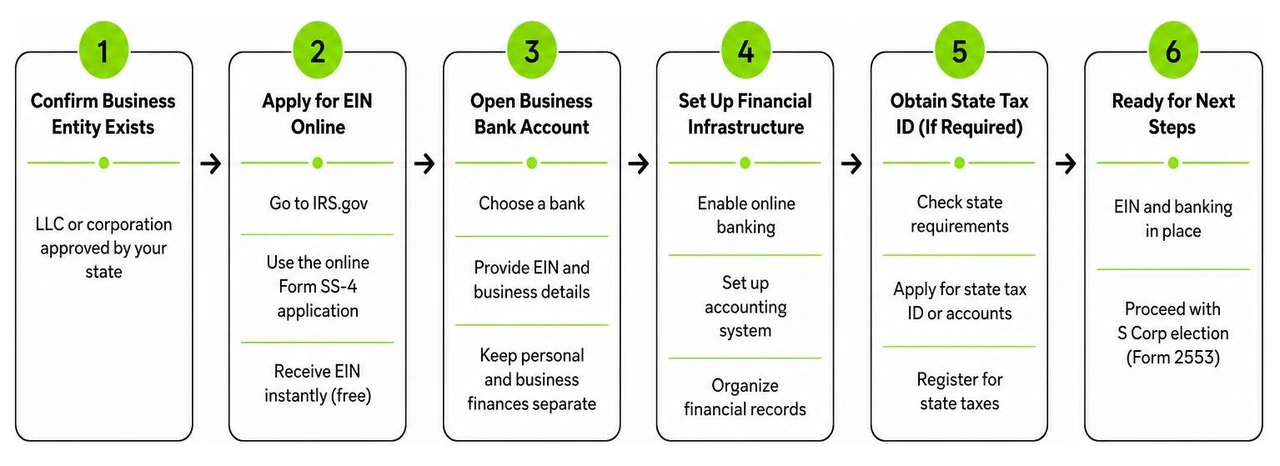
You can get an EIN instantly and completely for free by applying online at IRS.gov using the online Form SS-4 application tool. Do not pay third-party filing websites $100 or more to pull an EIN for you.
Having your official EIN in hand allows you to establish a dedicated business bank account. Keeping your personal and business finances strictly separated is essential to protecting your corporate liability shield. Review our breakdown of the full S-Corp setup process to see how financial accounts integrate with your corporate structure.
Step 3 File IRS Form 2553 for S Corp Tax Election
Filing IRS Form 2553 (Election by a Small Business Corporation) is the critical junction where your business officially assumes S Corp status. The IRS does not charge a filing fee to process Form 2553.
Pay strict attention to these timing rules and filing mechanics:
- The Strict 2 Month 15 Day Window. To take effect for the current tax year, existing calendar-year entities must file Form 2553 no later than 2 months and 15 days after the beginning of the tax year. For a calendar tax year starting January 1, that deadline falls on March 15. If your business is brand new, your window opens on your legal formation date and closes 2 months and 15 days later.
- Required Signatures (Column K). Every single owner or shareholder holding equity must sign Column K of Form 2553. Missing even one signature will cause the IRS to reject your application.
- How to Submit Form 2553. As of 2026, the IRS does not support filing Form 2553 electronically. You must mail or fax the form to the appropriate IRS service center for your state. We strongly advise faxing your form because it provides an immediate transmission confirmation report to prove you filed on time.
- Relief for Late Elections. If you miss your strict deadline, don't panic. Under Rev. Proc. 2013-30, the IRS offers late election relief for up to 3 years and 75 days after the intended effective date. You must provide a reasonable cause statement explaining why your election was late and write "FILED PURSUANT TO REV. PROC. 2013-30" at the top of Form 2553.
To learn more about keeping your filings organized, check our complete S-Corp formation checklist.
Step 4 Establish Compliant Owner Payroll and Corporate Governance
Filing your tax election is only half the battle. Once approved, you must act like a real corporation by maintaining internal governance and establishing payroll.
You must pay yourself a "reasonable salary" through a formal W-2 payroll service before taking any distributions. Setting your salary to $0 while taking $100,000 in distributions is a guaranteed way to invite an aggressive IRS audit.
Typical monthly payroll processing costs for an S Corp run around $45 per month.
In addition to payroll, you should draft formal corporate governance documents. If you operate an LLC electing S Corp status, draft an Operating Agreement that explicitly respects the single class of stock rule. If you operate a traditional corporation, create corporate bylaws, appoint directors, issue stock certificates, and record minutes for your annual organizational meeting. Review these vital S-Corp payroll rules to ensure your compensation split remains fully compliant.
DIY S Corp Risks and Mistakes to Avoid

Asking can i set up an s corp myself often leads to another question: should I do it alone? Thousands of business owners file their own paperwork successfully every year, but costly mistakes are common.
Here are the most common DIY pitfalls we see:
- Missing the Form 2553 Filing Window. Missing your deadline pushes your S Corp status back an entire tax year unless you successfully qualify for late election relief.
- Missing Shareholder Signatures. Forgetting to collect signatures from all required owners invalidates your election request.
- Skimping on Reasonable Compensation. Setting your W-2 wage far below industry averages to maximize tax savings triggers IRS reclassification penalties, interest, and back payroll taxes.
- Creating a Prohibited Second Class of Stock. Writing uneven distribution rules into your Operating Agreement can unintentionally eliminate your eligibility.
- Neglecting State-Level Filings. Assuming your federal Form 2553 covers state taxes can be a costly mistake. For instance, California levies an $800 annual minimum franchise tax plus a 1.5% net income tax on S Corps regardless of federal election status.
For state-specific compliance guidelines, consult state resources like the Delaware Division of Corporations, the Colorado Secretary of State filing FAQ, or general guides like how to start an S Corp step-by-step.
Can I Set Up an S Corp Myself Without Hiring a CPA
Technically, yes, you can handle the initial setup without hiring an attorney or CPA. Online resources such as this S Corp set up online guide show how accessible the basic steps have become.
However, running an active S Corp without professional advice increases your long-term legal and operational risk.
While filing Form 2553 is free and straightforward, long-term compliance is where many self-directed business owners stumble.
S Corps must file an annual federal tax return using Form 1120-S and issue Schedule K-1 forms to all shareholders. Failing to file Form 1120-S on time incurs steep monthly per-shareholder penalties from the IRS. For more insights on ongoing tax strategy, explore our S-Corp tax planning guide 2026.
Converting an Existing Business Entity Without Dissolving It
A common misconception among business owners is that converting an existing business to an S Corp requires dissolving the original entity and starting fresh.
You do not need to dissolve your existing LLC. When an active LLC files Form 2553, its state-level legal identity stays completely intact. You keep your original EIN, bank accounts, contracts, client relationships, and business history.
Only your federal tax election changes. For a detailed breakdown of how entity classifications shift under IRS rules, read our analysis on is an LLC a sole proprietorship or corporation.
Frequently Asked Questions About S Corp Setup
How Much Does It Cost to Set Up an S Corp Yourself
Setting up an S Corp yourself typically costs between $100 and $750 in total startup expenses.
Your exact cost depends heavily on your state's Secretary of State formation fees for establishing your foundational legal entity (LLC or Corporation). The IRS charges a $0 fee to file Form 2553.
Ongoing costs include payroll processing software (roughly $45 per month) and potential state annual report fees.
What Is the Filing Deadline for Form 2553 in 2026
For calendar-year businesses seeking S Corp status for the 2026 tax year, your filing deadline is March 17, 2026 (since March 15 falls on a Sunday).
If you form a brand-new business entity during 2026, you have 2 months and 15 days from your official formation date to file Form 2553. If you miss your window, you can submit a late election request under Rev. Proc. 2013-30.
Do I Need a Reasonable Salary as an S Corp Owner
Yes. The IRS explicitly requires every S Corp shareholder-employee who provides significant services to the business to receive W-2 wages subject to payroll taxes.
Your salary must reflect market value for your specific role, industry, and region. The IRS audits S Corps that distribute profits while underpaying owner-operators.
Conclusion
Can you set up an S Corp yourself? Absolutely. The initial mechanics of registering your LLC, securing an EIN, and faxing Form 2553 to the IRS are easily within reach for most business owners.
However, navigating complex S Corp regulations like reasonable salary calculations, monthly W-2 payroll, separate accounting, and Form 1120-S compliance requires ongoing diligence. One misplaced signature or forgotten tax form can wipe out your hard-earned tax savings in IRS penalties.
At Core Group, we provide financial management, bookkeeping, and tax services designed specifically for creative entrepreneurs. Our no-fluff, profit-first playbook guarantees complete peace of mind, freeing you from financial administration so you can focus entirely on scaling your creative vision.
If you are ready to explore S Corp status without the headache of managing compliance alone, review our guide on how to form S-Corp or reach out to our team today.