Is Your Creative Cloud Tax-Deductible? A Guide to Business Expenses
Why Creative Business Expenses Matter for Your Bottom Line

Creative business expenses are the costs you incur while running your creative enterprise—and understanding which ones are tax-deductible can save you thousands of dollars each year. Whether you're a filmmaker, photographer, designer, or content creator, the IRS allows you to deduct expenses that are both "ordinary and necessary" for your business.
Quick Answer: What Are Deductible Creative Business Expenses?
- Digital tools: Software subscriptions, website hosting, domain names, marketing costs
- Workspace: Home office deduction, studio rent, utilities, equipment
- Professional services: Freelancers, accountants, legal fees, bookkeepers
- Travel: Business trips, lodging, transportation (with specific meal limits)
- Education: Courses that improve existing skills, conference fees, trade publications
- Equipment: Cameras, computers, lighting (via depreciation or Section 179)
- Insurance: Business liability, professional equipment coverage
- Vehicle: Business mileage at 70 cents per mile for 2025, or actual expenses
If you're self-employed and operating as a sole proprietor or LLC, you'll report these deductions on Schedule C of your Form 1040. The key is ensuring each expense is ordinary (common in your industry) and necessary (helpful and appropriate for your business)—not indispensable, just genuinely useful.
Most creative entrepreneurs leave money on the table at tax time. According to IRS Publication 535, an expense doesn't need to be required to qualify—it just needs to be helpful and appropriate for your trade. That means your Creative Cloud subscription, that industry conference ticket, and even the simplified home office deduction at $5 per square foot all count.
The challenge isn't knowing these deductions exist. It's tracking them throughout the year, categorizing them correctly, and proving they're business-related if questioned. As one source notes, many small business owners are so focused on daily operations that they miss out on significant tax savings simply because they don't keep organized records.
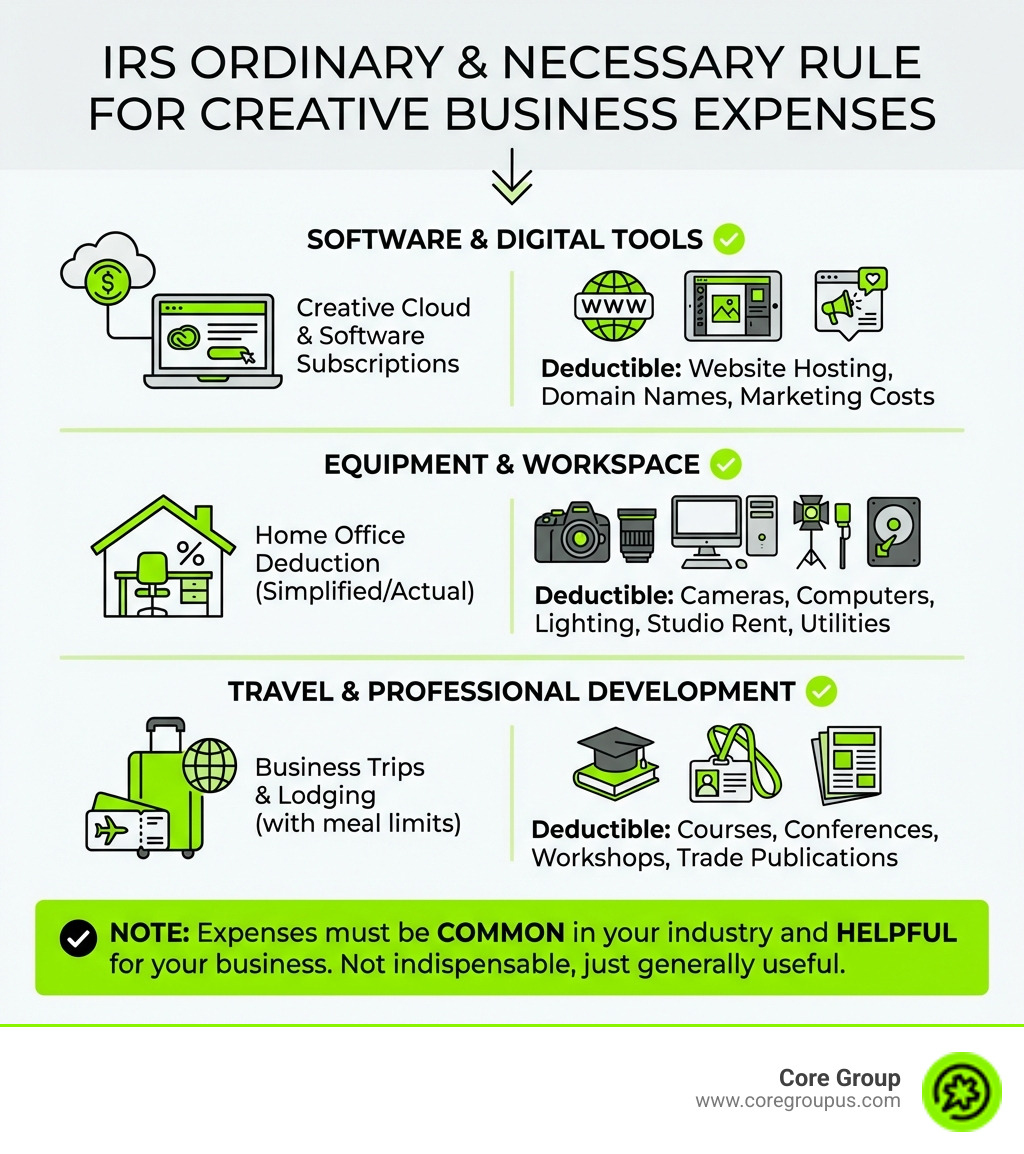
Understanding the Ordinary and Necessary Rule for Creative Business Expenses

When we talk about taxes, the phrase "ordinary and necessary" is the golden rule. But what does it actually mean for someone who spends their day editing 4K video or designing brand identities?
According to IRS Publication 535, an ordinary expense is one that is common and accepted in your specific field of business. For a graphic designer, a high-end monitor is ordinary. For a videographer, a gimbal or a drone is ordinary.
A necessary expense is one that is helpful and appropriate for your trade. You don't have to prove that you couldn't survive without it; you just have to show that it assists in your business's operation. However, the IRS is strict about the profit motive. If your creative work is just a hobby and you aren't trying to make money, you generally cannot deduct these expenses. To be considered a business, you should ideally show a profit in at least three out of the last five tax years.
Reporting Income and Deductions
To claim these creative business expenses, you’ll need to get familiar with a few specific forms. Most of us in the creative world operate as sole proprietors or single-member LLCs. This means we use Form 1040, our individual income tax return, and attach Schedule C to report our profit or loss.
Schedule C is where the magic happens. It’s where you list your total income and subtract all those beautiful deductions we're discussing. Additionally, because we are our own bosses, we have to pay self-employment tax (which covers Social Security and Medicare). This is calculated on Schedule SE. The silver lining? You can actually deduct 50% of your self-employment tax as an adjustment to your income on Schedule 1 of Form 1040.
Standard versus Itemized Deductions
There is often confusion between "itemizing" personal deductions and deducting business expenses. As a business owner, you can almost always deduct your business expenses on Schedule C, regardless of whether you take the standard deduction on your personal return.
For the 2024 tax year, the standard deduction is $14,600 for singles and $29,200 for married couples filing jointly (increasing slightly for 2025). You only "itemize" personal deductions (like mortgage interest and medical bills) on Schedule A if they exceed those amounts. However, your creative business expenses are deducted from your business gross income first. This lowers your Adjusted Gross Income (AGI), which can further reduce your overall tax liability. For a deeper dive into how this works for different structures, check out our LLC Tax Deductions Guide 2026.
Digital Infrastructure and Software Subscriptions
A creative's "office" is often entirely virtual. Your digital infrastructure is the backbone of your business, and the costs associated with it are prime candidates for deductions.
Building a professional presence online isn't cheap. Website costs can reach into the thousands when you factor in professional design, premium themes, and specialized plugins. The IRS allows you to deduct these marketing and advertising costs because they directly promote your business and create brand awareness.
Interestingly, even domain name parking is deductible. If you buy a domain name related to your brand to prevent a competitor from taking it or to use it for a future project, that is a legitimate business cost to protect your digital assets.
Software and Digital Tools as Creative Business Expenses
Is your Creative Cloud subscription tax-deductible? Yes. If you use Photoshop, Premiere Pro, or After Effects for your client work, it is a 100% deductible business expense. This applies to any Software as a Service (SaaS) tool, from project management apps like Monday.com to cloud storage like Dropbox.
If you are outsourcing software development to build a custom app for your business or a client, those costs are also deductible. Furthermore, don't forget your communication tools. We’ve put together a specific guide on the Business Phone Deduction to help you navigate how to split personal and business use on your smartphone bill.
Professional Services and Freelance Creative Business Expenses
No creative is an island. Sometimes you need to hire a freelance illustrator to help with a project or a developer to fix a bug. Fees paid to independent contractors are fully deductible. Just remember: if you pay a contractor $600 or more in a year, you are generally required to issue them a Form 1099-NEC.
Legal and professional fees are also on the list. This includes what you pay for a Bookkeeping for Creatives Complete Guide or professional accounting services. Keeping your books clean is a "necessary" expense that saves you from the headache of an audit later.
Studio Space and Equipment Deductions
Where you create is just as important as what you create. Whether you rent a commercial studio or work from a spare bedroom, those housing costs can be leveraged at tax time.
If you rent a dedicated studio, your rent, utilities, and insurance for that space are fully deductible. If you are a homeowner using part of your house for business, you can deduct a portion of your mortgage interest, property taxes, and home insurance. For those in the film industry, we have a specialized list of Filmmaker Tax Deductions that covers specific studio needs.
Calculating the Home Office Deduction
To claim a home office, the space must be used regularly and exclusively for your business. You can't claim your dining room table if you also eat dinner there. You have two ways to calculate this:
| Feature | Simplified Method | Actual Expense Method |
|---|---|---|
| Calculation | $5 per square foot (up to 300 sq. ft.) | Percentage of home used for business |
| Max Deduction | $1,500 | No set limit (based on actual costs) |
| Record Keeping | Minimal | High (must track all utilities, repairs, etc.) |
| Form Used | Schedule C | Form 8829 |
If you use the Actual Expense method and your office occupies 10% of your home's square footage, you can deduct 10% of your electricity, water, gas, and even home repairs.
Depreciation and Section 179 Expensing
Creatives often own expensive gear. When you finance camera equipment or buy a $4,000 MacBook Pro, you usually don't deduct the whole cost at once. Instead, you "depreciate" it over its useful life (typically 5 years for computers and cameras).
However, Section 179 is a powerful tool that allows you to deduct the entire purchase price of qualifying equipment in the year you buy it, rather than spreading it out. For 2025, the deduction limit for Section 179 is a massive $2,500,000. This is a game-changer for photographers and content creators looking to upgrade their setup.
Travel and Professional Development
Business travel is often a highlight of the creative life—whether it's a gallery opening, a film festival, or a client shoot in another state. To qualify as a deduction, the trip must be primarily for business and require you to be away from your "tax home" for longer than a normal workday.
Deductible travel expenses include:
- Airfare, train tickets, or bus fares
- Lodging (hotels or Airbnbs)
- Dry cleaning and laundry while away
- Tips for services related to any of these expenses
The IRS warns that none of the expenses can be "lavish or extravagant." You don't need to stay in a hostel, but a five-star penthouse might raise eyebrows unless your business income justifies it. To find out what the government considers "reasonable" for meals and lodging, you can check the GSA’s website for per diem rates.
Business Meals and Entertainment Rules
The rules for meals have changed recently. For 2024 and 2025, business meals are generally 50% deductible. This includes meals while traveling or meals with a client where business is discussed. To claim this, you or an employee must be present, and the meal cannot be lavish.
There are a few 100% deductible exceptions:
- Food provided for a company holiday party or picnic.
- Food given away to the public as a promotional tool (like snacks at a gallery opening).
- Meals provided to employees as taxable compensation.
Entertainment (like taking a client to a concert or a golf game) is generally 0% deductible under current law. Stick to the dinner meeting if you want the tax break!
Education and Training Costs
The creative world moves fast. If you take a course to learn a new skill—like a photographer learning 3D rendering—that cost is fully deductible. The rule is that the education must maintain or improve skills in your current business. It cannot be used to qualify you for a completely new career.
Other deductible professional development costs include:
- Subscriptions to trade journals (like Variety or Communication Arts).
- Membership dues for professional organizations (like AIGA).
- Fees for your local Chamber of Commerce.
- Books and eBooks related to your craft.
Frequently Asked Questions about Creative Business Expenses
How do I deduct vehicle expenses for my personal car?
If you use your personal car to drive to client meetings, equipment rentals, or film sets, you can deduct those costs. You have two choices:
- Standard Mileage Rate: This is the easiest method. For the 2025 tax year, the rate is 70 cents per mile (up from 67 cents in 2024). You simply track your business miles and multiply.
- Actual Expense Method: You track every penny spent on gas, oil changes, tires, insurance, and repairs, then multiply by the percentage of the car's use that was for business.
Regardless of the method, you can also deduct parking fees and tolls for business trips. Pro tip: Use an app to track your mileage in real-time so you don't have to guess at the end of the year.
What startup costs can I deduct in the first year?
Starting a new creative agency or freelance business comes with upfront costs. The IRS allows you to deduct up to $5,000 in startup costs and another $5,000 in organizational costs (like LLC formation fees) in your first year of operation.
Deductible startup costs include:
- Market research on potential locations or audiences.
- Advertising for your grand opening.
- Training for employees before you officially open.
- Travel costs to find suppliers or distributors.
If your total startup costs exceed $50,000, the $5,000 deduction starts to phase out dollar-for-dollar.
Are health insurance premiums tax deductible?
Yes! If you are self-employed and have a net profit for the year, you can usually deduct 100% of the health insurance for you and your family. This is an "above-the-line" deduction, meaning it reduces your AGI even if you don't itemize.
You can also include:
- Dental and vision insurance.
- Long-term care insurance (subject to age-based limits on Form 7206).
- Medicare premiums.
One catch: You cannot take this deduction for any month you were eligible to participate in a subsidized health plan through your spouse's employer. While you're at it, consider if Life insurance for your employees is a good fit, as those premiums are also generally deductible.
Conclusion
Navigating creative business expenses doesn't have to be a source of stress. By understanding the "ordinary and necessary" rule and staying organized throughout the year, you can significantly lower your tax bill and reinvest that money back into your craft.
At Core Group, we specialize in helping creative entrepreneurs like you master your finances. Our "no-fluff, profit-first playbook" is designed to give you peace of mind and save you time, so you can focus on what you do best—creating. We’re so confident in our ability to streamline your business that we even offer a MacBook Pro guarantee.
Don't let another tax season pass without maximizing your deductions. Whether you are an influencer or run a large marketing agency, we are here to help you grow.