The Ultimate Guide to Global Payroll Solutions for Growing Teams
Why Global Payroll Solutions Matter for Growing Teams
Global payroll solutions are systems or services that help businesses pay employees and contractors across multiple countries from one centralized platform, while staying compliant with local tax and labor laws.
Here is a quick breakdown of what they cover and who needs them
| What They Do | Who Needs Them |
|---|---|
| Centralize multi-country payroll data | Companies hiring in 2+ countries |
| Automate local tax and statutory deductions | Remote-first or distributed teams |
| Ensure compliance with local labor laws | Businesses without local legal entities |
| Support multi-currency payments | Teams paying contractors globally |
| Replace fragmented spreadsheet systems | Any org scaling international headcount |
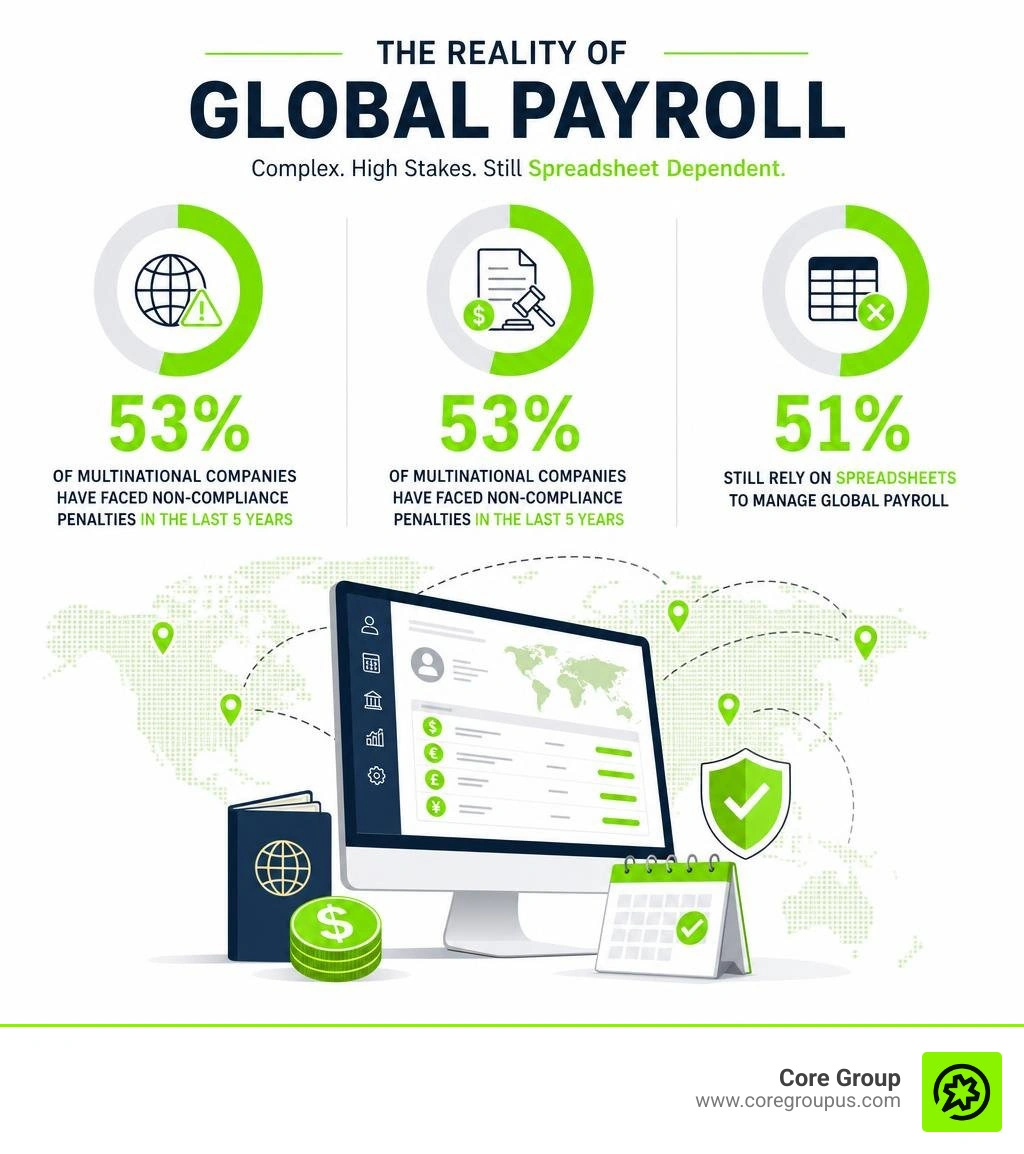
Running payroll across borders is genuinely hard. Local tax rules change constantly. Currencies fluctuate. Labor laws differ country by country. And the stakes are high because 53% of multinational companies have faced non-compliance penalties in the last five years, while 51% still rely on spreadsheets to manage global payroll.
That is a recipe for costly mistakes.
For creative entrepreneurs and growing media businesses, the problem is even more personal. You are already juggling client work, production schedules, and creative decisions. The last thing you need is a payroll error triggering a foreign tax penalty or delaying a contractor payment in another time zone.
The good news is that the global payroll landscape has matured significantly. Whether you have two overseas contractors or two hundred full-time employees across a dozen countries, there are purpose-built solutions designed to take this complexity off your plate.
We will walk you through everything you need to know to choose the right approach for your team.
Global payroll solutions concepts to explore
Understanding Global Payroll Solutions and Key Challenges
A global payroll solution is an integrated ecosystem of software, financial payment rails, and in-country regulatory expertise designed to centralize workforce compensation across multiple jurisdictions. Instead of running separate payroll systems in every country where you hire, a unified platform consolidates data into a single operational system of record.
Expanding a workforce across international borders introduces severe operational hurdles. Every new country brings distinct statutory deduction rules, unique reporting schedules, and complex labor standards. Managing these processes without standardized tools leads to operational drag, expensive human errors, and legal risk.
Establishing effective global workforce governance requires aligning multi-currency disbursements with localized statutory rules. When businesses scale internationally, managing localized benefits, paid leave tracking, and mandatory pension contributions becomes overwhelming. Partnering with structured software platforms and staying informed on payroll compliance for remote teams ensures your expansion stays smooth and predictable.
For broader international tax context, resources from the OECD on tax administration can help leadership understand why local payroll rules require ongoing monitoring.
Primary Challenges in Overseas Payroll Compliance
Navigating international tax authorities is one of the most perilous aspects of scaling a global team. Operating across jurisdictions means obeying local tax codes, mandatory employer contributions, social security payments, and strict worker privacy mandates like GDPR.
Spreadsheet dependency remains a glaring vulnerability for growing firms. Over half of international businesses still handle cross-border payments using manual spreadsheets. Manual data entry creates high risk for formula errors, missed payment windows, and missing tax filings. A single incorrect calculation on statutory withholdings can result in substantial financial penalties.
Worker misclassification presents another major hazard. Classifying a worker as an independent contractor when local law views them as a full-time employee leads to back taxes, retroactive benefits liability, and legal fines. Maintaining strict adherence to local labor laws and maintaining rigorous payroll tax compliance is essential for avoiding regulatory audits.
Core Features of Modern Global Payroll Solutions
Modern multi-country systems combine powerful calculation engines with intuitive user interfaces. Modern payroll engines handle gross to net calculations automatically, converting raw working hours and contractual base salaries into exact localized payouts after withholding statutory taxes and pension funds.
Unified reporting dashboards grant leadership complete visibility into cross-border spend. Executive teams can analyze localized headcount costs, exchange rate impacts, and statutory tax burdens in real time across all operating regions.
Modern solutions rely on pre-built API integrations to connect directly with your core HR human capital management software and financial accounting general ledgers. Self-service portals empower workers to download localized payslips, update banking details, and manage time-off requests without creating extra administrative work for your internal team.
Delivery Models for International Workforce Compensation
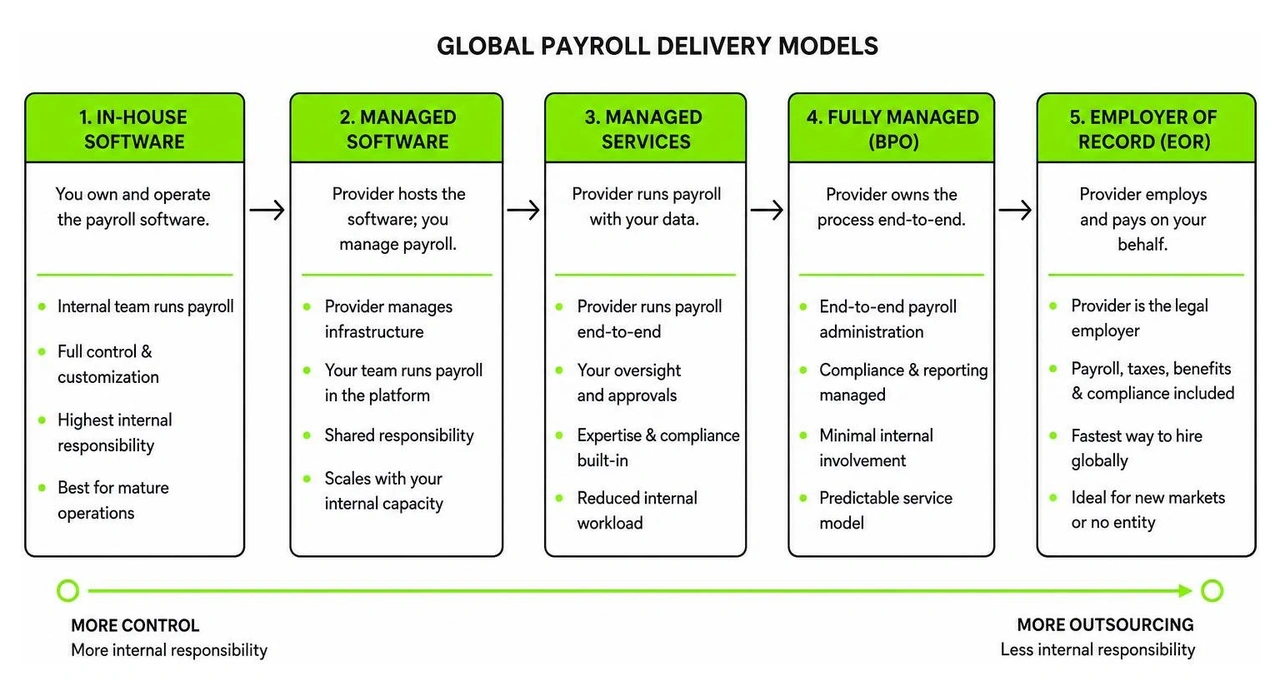
Selecting the right delivery model depends on your international headcount, existing corporate structures, and internal bandwidth. Market research firms like Gartner identify several core global payroll delivery models, including software management suites, managed services, business process outsourcing, aggregation networks, and Employer of Record platforms.
Understanding how these frameworks deliver localized support helps businesses choose a model aligned with their growth trajectory.
Owned Entity Versus Aggregator Frameworks
When choosing among international global payroll providers, businesses generally choose between owned entity architectures and partnership based aggregator models.
Owned entity providers maintain direct local subsidiaries and fully owned in-country processing engines in each operating territory. This direct delivery framework provides tighter data security, uniform processing quality, and direct oversight, though geographic expansion into smaller markets can take longer.
Aggregator models utilize a centralized software application to route payroll processing through third-party localized vendors or in-country providers under a master service agreement. Aggregators offer broad country coverage quickly, though working through local third-party partners can introduce variance in processing turnaround times.
| Operational Feature | Owned Entity Provider Model | Aggregator Partner Model |
|---|---|---|
| In Country Infrastructure | Direct legal subsidiaries | Network of localized third party partners |
| Data Processing Speed | Faster direct engine calculation | Dependent on local partner upload windows |
| Geographic Coverage | Focused on major business hubs | Expansive global coverage across 150+ countries |
| Cost Structure | Predictable direct service fees | Variable third party markup and processing fees |
| Service Level Consistency | High standardized operational delivery | Varies depending on local vendor execution |
Software Versus Managed Global Payroll Solutions
Software-based platforms act as a central unification layer. They consolidate employee records, calculate gross to net adjustments, and integrate with existing accounting tools while leaving local operational execution to your internal HR team or local tax agents. Software tools offer high flexibility, lower ongoing software costs, and full control over internal approval workflows.
Managed global payroll solutions offer full end-to-end operational execution. Dedicated in-country experts calculate net pay, review regulatory updates, process local tax withholdings, and file statutory documentation directly with regional tax agencies.
For growing mid-sized businesses, a hybrid delivery model offers the ideal balance. Hybrid setups combine cloud-based automation software for central oversight with localized managed services to handle complex tax filings in key operating regions. Enterprise software tools showcase how managed service models help lower administrative overhead while maintaining international legal standards.
Navigating Employer of Record Models and Local Compliance
An Employer of Record or EOR acts as the legal employer for your international team members in countries where you do not own a registered business entity. The EOR handles localized HR tasks, compliant employment contracts, statutory benefits administration, and tax withholdings, while you direct the worker's daily work and creative output.

Using an EOR bypasses the major financial and legal burdens of foreign entity setup. Setting up a local entity standardly requires registering local legal business structures, establishing local corporate bank accounts, and retaining local legal advisors. An EOR allows businesses to hire full-time overseas talent legally in days rather than months. Dedicated software platforms simplify this process by unifying EOR workflows and direct entity payroll processing inside a single interface.
When to Transition from EOR to Direct Entities
While an EOR provides unmatched speed for entering new international markets, it is rarely the most cost-effective long-term framework for large regional teams. EOR services typically charge a monthly flat fee per employee, which can add up as local team size grows.
Businesses generally consider transitioning away from an EOR to direct entity ownership when hitting key operational thresholds
- Headcount Growth when local headcount in a single foreign country reaches 10 to 15 full-time workers, direct corporate entity establishment becomes significantly more cost effective than paying ongoing EOR per employee fees.
- Permanent Establishment Risks if high-level executive or sales personnel negotiate local commercial contracts, foreign tax authorities may declare permanent establishment status, requiring official corporate registration regardless of EOR usage.
- Long-Term Commercial Commitment establishing direct local legal entities demonstrates deep corporate commitment to key regional markets, making it easier to secure foreign business licenses and commercial banking relationships.
- Strategic Operations Control direct entity ownership gives enterprise operations total authority over localized company benefit plans, equity incentive distribution, and corporate culture integration.
Technological Infrastructure Security and Automation Standards
Global payroll networks handle highly sensitive employee financial data, bank account routing details, and legal documentation. Ensuring elite cybersecurity and statutory compliance requires platforms backed by strict international standards.
Top-tier software platforms maintain certified security frameworks including ISO 27001 certification along with SOC 1 Type 2 and SOC 2 Type 2 compliance audits. Robust infrastructure protects confidential worker data via role-based user permissions, multi-factor authentication, single sign-on tools, and end-to-end data encryption in transit and at rest.

Maintaining high regulatory compliance also requires adhering to international privacy frameworks like GDPR. Combining central financial security with a comprehensive payroll bookkeeping complete guide 2026 establishes strong internal controls for international financial accounting.
Automation and Gross to Net Calculations
Artificial intelligence and automated validation tools are transforming multi-country payroll management. Modern validation engines cross-reference pre-payroll inputs against local tax codes, working hour limits, and company deduction policies before funds ever leave your account.
AI powered variance checking highlights unexpected month-over-month pay discrepancies, alerting team leaders to potential errors before disbursement. Integrated payment rails automate local bank distributions, automatically converting primary currencies into regional disbursements for workers and local government tax authorities.
Automated general ledger tools export precise accounting journal entries directly into enterprise accounting platforms, maintaining clean audit trails across all operational territories.
Frequently Asked Questions About International Payroll
What is the difference between global payroll and local payroll
Local payroll handles employee compensation, tax deductions, and statutory reporting within a single country through local payment systems.
Global payroll unifies multi-country operations into a single management platform. It standardizes employee data, handles multi-currency transactions, automates cross-border compliance, and grants enterprise executives real-time spend visibility across all international locations.
Do companies need a local legal entity to pay overseas workers
No, businesses do not always need a foreign legal entity to hire and pay overseas workers legally.
Companies can engage international workers as independent contractors if their day-to-day duties pass classification rules. Alternatively, businesses can partner with an Employer of Record that legally employs workers on their behalf, allowing rapid global hiring without foreign corporate entity registration.
How do businesses prevent tax penalties in cross border operations
Preventing foreign tax penalties requires working with platforms backed by dedicated in-country statutory legal experts.
Businesses should automate regulatory updates to catch localized tax code changes instantly, replace error-prone spreadsheets with validated gross to net engines, and conduct periodic multi-country worker classification audits to stay fully compliant with foreign labor standards.
Conclusion
Managing an international team should fuel corporate expansion, not drag down executive focus. Moving away from manual spreadsheets and adopting modern global payroll solutions gives growing firms the security, speed, and accuracy needed to hire top talent worldwide.
At Core Group, we provide expert financial management, bookkeeping, and business tax strategy tailored for ambitious creative entrepreneurs and media companies. Our core mission is giving business owners absolute confidence over their numbers through our simple, no-fluff, profit-first playbook.
We deliver complete financial clarity so you can focus on building your team and growing your business, all backed by our peace-of-mind service promise and unique MacBook Pro guarantee. Explore our comprehensive payroll services small business guide 2026 to see how we help streamline your operations today.