Global Payroll Providers: Who Actually Delivers on Compliance?
When Paying International Teams Gets Complicated Fast
Global payroll providers are third-party services that help businesses pay employees and contractors across multiple countries while staying compliant with local tax and labor laws.
If you need a quick answer, here is how the top-rated provider categories compare in 2026 based on industry feedback.
| Provider Category | Typical Rating | Best For |
|---|---|---|
| Unified HR and IT Platforms | 4.8/5 | US companies managing HR and IT together |
| Self-Serve Global Platforms | 4.7/5 | Speed and self-serve international hiring |
| Enterprise Payroll Solutions | 4.6/5 | Enterprise multi-country payroll |
| Legacy Enterprise Services | 4.5/5 | Large enterprises with existing legacy setups |
| Mid-Market HR Consolidation | 4.1/5 | Mid-market HR and payroll consolidation |
One scenario that comes up constantly in this space is when a candidate signs an offer, then the hiring team realizes there is no legal entity in that country, no compliant contract, and no way to legally run payroll. It happens more than most businesses expect.
Getting payroll wrong internationally is not just an HR headache. It can trigger fines, back taxes, and even force you to shut down operations in a country entirely.
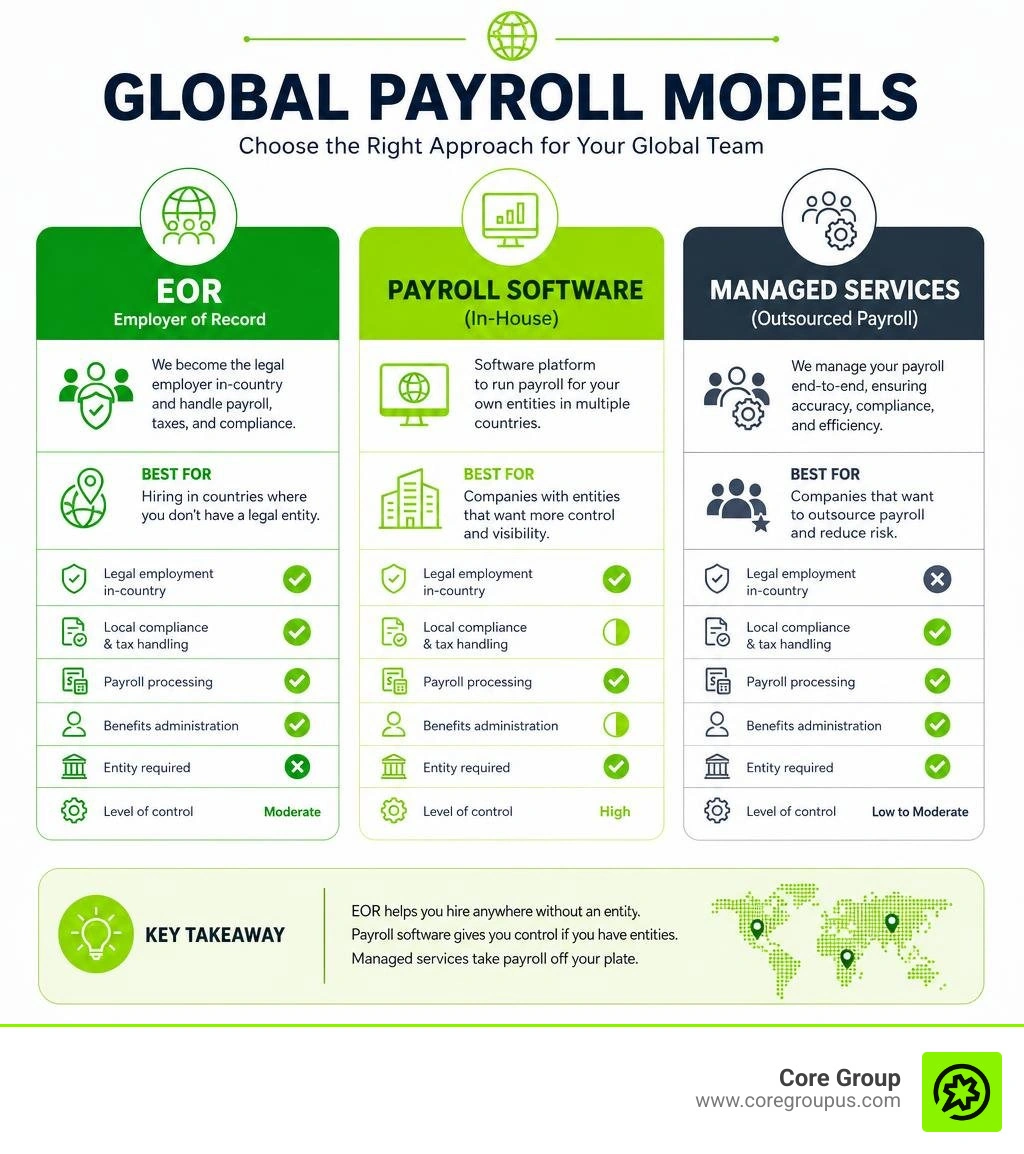
The challenge is that not every provider solves the same problem. Some are software tools that assume you already have a legal entity abroad. Others act as the legal employer on your behalf. And some are fully managed outsourcing services.
Knowing which model fits your situation is the difference between a smooth global expansion and a compliance nightmare.
Global payroll providers helpful reading...
Understanding the Models of Global Payroll Providers
Navigating the international employment landscape requires a clear understanding of the different service delivery models. If you choose the wrong model, you could face severe compliance issues or pay for services you do not actually need.
When we look at how businesses manage international teams, we generally see three primary models. There is also a lesser-known fourth option called foreign employer registration. Each model impacts your business structure, your software ecosystem, and your overall legal liability.
To keep your business protected, you must understand how Payroll Tax Compliance works and how it ties into Payroll and Benefits globally. Choosing the wrong setup can leave you vulnerable to local labor audits and massive tax penalties.

When to Use Global Payroll Software Alone
Global payroll software is a technology layer. It is designed to consolidate your payroll operations into a single dashboard. However, there is a major catch. This software assumes that you already have a registered, legal business entity in the country where your employees live.
If you have already gone through the process of setting up a local entity in Canada or the United Kingdom, you do not need an intermediary to employ your workers. You just need a system to calculate taxes, process local direct deposits, and generate localized payslips. This is where global payroll software shines.
Using software alone gives you complete control over your brand and your employee experience. It also keeps your monthly software fees relatively low. If you are looking to understand how this fits into your broader financial operations, our Online Payroll Guide Small Business 2026 outlines the foundational steps for setting up efficient payroll systems.
When Your Business Needs an Employer of Record
What happens if you find the perfect graphic designer in Germany or a senior developer in Spain, but you do not have a local business entity there? Setting up a foreign entity can easily cost upwards of thirty thousand Euros. It also takes months of administrative work.
In this situation, you need an Employer of Record, which is commonly referred to as an EOR. An EOR acts as the legal employer of your international worker. They handle the local payroll, draft a compliant employment contract, administer statutory benefits, and file all necessary tax documents.
Even though the EOR is the legal employer on paper, the worker still reports to you and performs their daily tasks for your business. This model allows you to hire globally in days rather than months. For smaller businesses managing a mix of local and international talent, our Payroll Guide Small Business Owners 2026 offers practical advice on balancing these operational demands.
Key Criteria for Evaluating Global Payroll Providers
Selecting the right partner from the many global payroll providers in the market requires a systematic evaluation. You cannot simply rely on marketing claims about global coverage. You must look at how these providers actually deliver on compliance, how they structure their pricing, and how they handle data.
A great starting point is ensuring your internal financial records are structured correctly. Our Payroll Bookkeeping Complete Guide 2026 explains how to sync your payroll data with your general ledger to maintain pristine business books.
When you evaluate international providers, focus on these four critical pillars.
- Compliance Depth. Does the provider have dedicated, in-country compliance experts who monitor local legislative changes, or do they rely entirely on automated software scripts?
- Entity Ownership. Does the provider own the local entities in each country, or do they outsource employment to third-party partner networks? Owned-entity models generally offer better support and fewer communication delays.
- Onboarding Speed. How quickly can the provider transition a candidate from a signed offer letter to an active, compliant payroll run?
- Pricing Transparency. Look for providers that offer flat-rate pricing rather than percentage-of-salary models, which can penalize you as your employees earn raises.
Mandatory Features in Modern Global Payroll Software
If you are choosing a software platform to manage your international team, several features are non-negotiable. Modern platforms must do more than just send bank transfers. They need to act as an automated compliance shield.
First, the software must offer automated gross-to-net pay calculations. This means it should automatically calculate local income taxes, social security contributions, and pension deductions based on the employee's specific region.
Second, robust integration capabilities are essential. Your payroll software should connect seamlessly with your existing time-tracking systems, expense management tools, and accounting software. This is a core focus when setting up Payroll for SMB to avoid manual data entry errors.
Third, the platform must hold enterprise-grade security certifications. Because you are handling sensitive personal and financial data across borders, look for providers with ISO 27001 certification and SOC 2 Type 2 compliance reports.
Why Enterprises Choose Established Global Payroll Providers
Large enterprises have complex international workforces that require white-glove service and highly resilient systems. While a startup might be comfortable using a self-serve platform, an enterprise typically needs a provider with decades of experience and massive global infrastructure.
Established providers offer deep global compliance networks. They can handle complex tax scenarios, stock option distributions, and union agreements across dozens of countries simultaneously. They also provide dedicated account managers and robust business continuity plans to ensure payroll is never delayed, even during global banking disruptions.
Comparing the Top Global Payroll Providers in 2026
To help you make an informed decision, we have analyzed the top categories in the global payroll and EOR market for 2026. These options vary significantly in their target audience, pricing models, and service delivery structures.
| Provider Category | Core Model | Typical Starting Price | Key Strength |
|---|---|---|---|
| Unified HR and IT Platforms | Unified HR, IT, and Payroll | Custom pricing | Excellent device and app management alongside payroll |
| Self-Serve Global Platforms | Self-Serve Global Platform | $599 per employee per month | Fast onboarding and massive country coverage |
| Owned-Entity Providers | Owned-Entity Global Payroll | $599 per employee per month | Strong IP protection and in-house country experts |
| Enterprise Payroll Solutions | Enterprise Payroll and Payments | $499 per employee per month | Embedded payment rails and advanced business intelligence |
| Low-Cost EOR Services | Low-Cost EOR | $400 per employee per month | Cost-effective entry point for startups |
| Legacy Enterprise Services | Enterprise Managed Services | Custom enterprise pricing | Unparalleled legacy infrastructure and global scale |
| Region-Specific EORs | Region-Focused EOR | €499 per employee per month | Highly specialized compliance for regional hiring |
| Distributed Team Platforms | Distributed Team Platform | $699 per employee per month | Great resources for remote-first workplace cultures |
Strengths and Weaknesses of Modern Platforms
Each of these platform types has distinct advantages and disadvantages depending on your business size and operational goals. Understanding how these tools fit into your daily workflow is crucial, and our guide on HR and Payroll for Small Business can help you align your software choices with your team size.
Let's look at the specific profiles of the top modern platform categories.
Unified HR and IT Platforms
Unified platforms stand out because they integrate HR, IT, and Finance into a single system of record.
- Strengths. You can onboard an international employee and automatically ship them a pre-configured laptop, set up their email, and add them to global payroll in just a few minutes. The platform is incredibly user-friendly and highly automated.
- Weaknesses. It can be expensive if you need to purchase multiple add-on modules for IT and device management. The global payroll services often require you to use their core HRIS platform.
- Ideal Use Case. US-based companies that want to manage employee payroll, benefits, and physical IT hardware in one unified dashboard.
Self-Serve Global Platforms
Self-serve platforms are built for speed and have become highly popular for fast-growing companies.
- Strengths. They offer incredibly fast onboarding and support contractor payments in over 150 countries. Their interface is highly intuitive, making it easy for managers to approve invoices and run payroll.
- Weaknesses. Some users report that customer support can be slow during peak payroll cycles. Because they have grown so quickly, they may rely on third-party partners in certain smaller markets, which can lead to compliance communication delays.
- Ideal Use Case. Scaling businesses that need to hire and pay a mix of international contractors and EOR employees quickly.
Owned-Entity Providers
Owned-entity providers pride themselves on owning and operating their local business entities in almost every country they support.
- Strengths. Because they do not outsource to third-party partners, they offer superior intellectual property protection and reliable compliance support. Their pricing is transparent, and they have excellent in-house country experts.
- Weaknesses. Their owned-entity model means they may have slightly less geographical coverage in very niche or emerging markets compared to aggregators.
- Ideal Use Case. Mid-market companies that prioritize IP protection and want a direct, high-quality relationship with their global payroll provider.
Enterprise Payroll Solutions
Enterprise-grade platforms focus heavily on automated validation and global payments.
- Strengths. They have built their own embedded payment rails in partnership with major global banks. This allows you to fund your entire global payroll in one currency and have the platform distribute local currencies directly to workers and tax authorities.
- Weaknesses. The platform has a steeper learning curve compared to self-serve options. It is less suited for small startups with only one or two international employees.
- Ideal Use Case. Large organizations with complex, multi-country payroll needs that require advanced business intelligence and ERP integrations.
Legacy Enterprise Services
Legacy providers are the giants of the payroll industry, with decades of experience operating across more than 140 countries.
- Strengths. Unmatched regulatory expertise and highly resilient compliance infrastructure. They are recognized globally as leaders in enterprise payroll.
- Weaknesses. Implementation fees can be incredibly high, sometimes reaching hundreds of thousands of dollars for complex enterprise setups. Onboarding times can take months, and the software interface can feel outdated compared to modern SaaS platforms.
- Ideal Use Case. Multinational corporations that already use legacy systems domestically and want to scale their operations globally.
Common Failures and Complaints in User Reviews
While marketing materials present a flawless experience, real-world user reviews highlight common pain points that you should actively try to avoid. Understanding these pitfalls is a core part of evaluating SME Payroll Solutions before signing a long-term contract.
The most frequent complaint involves unexpected billing discrepancies. Many users find that their monthly invoices are higher than anticipated due to hidden currency exchange markups, local administrative fees, or out-of-cycle payroll run charges.
Another common failure is slow customer support during payroll emergencies. If a bank transfer fails or an employee's pay is delayed, waiting 48 hours for an email response from a general support queue is unacceptable.
Finally, compliance gaps are occasionally discovered after onboarding. Some providers use generic employment templates that do not fully comply with local collective bargaining agreements, leaving the client company vulnerable to legal disputes.
The Real Costs of Hiring Global Payroll Providers
Understanding the true financial commitment of global payroll requires looking past the basic sticker price. Many businesses focus solely on the flat per-employee monthly fee, only to be surprised by the total cost of ownership.
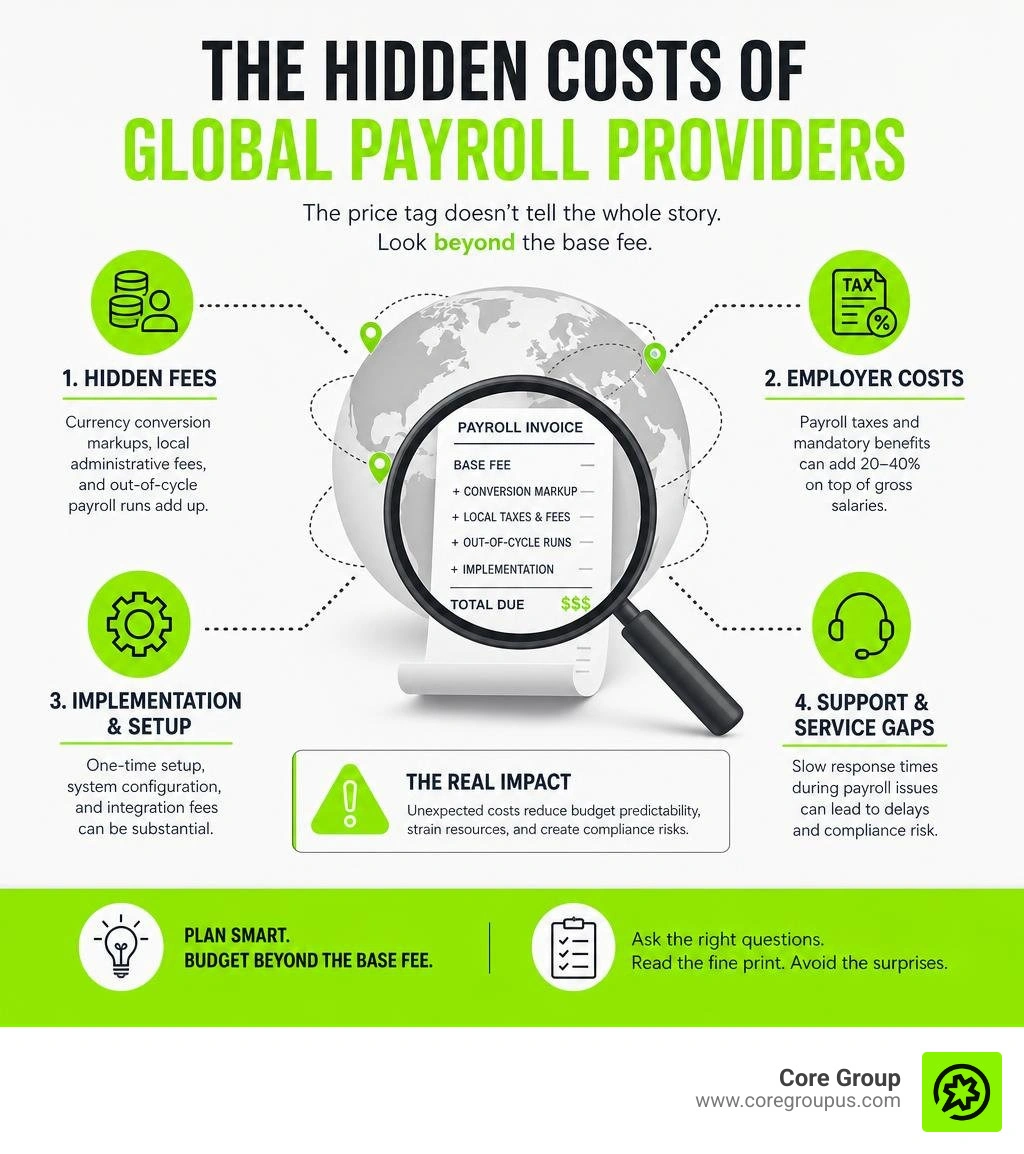
When budgeting for international hiring, you must account for these four financial components.
- Per-Employee Fees. For EOR services, expect to pay between $400 and $700 per employee per month. Contractor management is significantly cheaper, typically ranging from $5 to $49 per contractor per month.
- Employer Contributions. In many countries, employer payroll taxes and mandatory benefits can add an extra 20% to 40% on top of the employee's gross salary.
- Implementation and Setup Fees. Some legacy enterprise systems charge substantial setup fees to configure your multi-country payroll dashboard.
- Currency Conversion Markups. Many providers charge a hidden fee of 1% to 3% when converting your funding currency into local payout currencies.
For a comprehensive breakdown of domestic and international payroll structures, our Payroll Services Small Business Guide is an invaluable resource.
How to Transition Between Global Payroll Providers Without Errors
If you are unhappy with your current provider, switching to a new system can feel incredibly daunting. A sloppy migration can lead to delayed payments, tax filing errors, and frustrated employees.
To execute a seamless transition, you need a structured migration strategy. First, do not cancel your existing service until the new platform is fully configured and tested. We highly recommend running parallel payroll systems for at least one pay cycle to ensure all calculations match perfectly.
Second, prioritize data consistency. Gather all historical payroll data, local tax registration numbers, and employee banking details before you begin the migration. If you are operating in specific states like California, navigating local regulations requires special attention. Our Payroll Services California Guide offers specific insights into state-level compliance during transitions.
Frequently Asked Questions About International Payroll
What is the difference between an Employer of Record and global payroll
An Employer of Record acts as the legal employer of your worker, taking on all employment liability and managing local compliance without requiring you to set up an entity. Global payroll, on the other hand, is a system used to pay workers through your own registered local entities.
If you are only paying a single international worker, the administrative overhead of setting up an entity is rarely worth the cost. You can learn more about managing small-scale teams in our guide on Small Business Payroll One Employee.
How much do global payroll services typically cost
Standard global payroll software for businesses that already own local entities typically costs between $20 and $50 per employee per month. If you need an EOR service because you do not have a local entity, the cost generally ranges from $400 to $700 per employee per month.
While some platforms offer very cheap entry points, there are no truly free options for global compliance. For a broader look at payroll pricing structures, check out our analysis on Does Anyone Offer Free Payroll Services for Very Small Businesses.
Do I need a local entity to pay international employees
No, you do not need a local entity if you use an Employer of Record. The EOR hires the employee on your behalf through their own established local business entities. Alternatively, you can look into foreign employer registration, which allows you to register as an employer in a foreign country without establishing a full corporate entity.
Understanding these corporate structures is similar to navigating domestic business rules. For example, our guide on S-Corp Payroll Rules explains how business structure impacts payroll requirements.
Conclusion
Managing a global team is an exciting milestone for any growing business, but it introduces significant compliance and financial complexities. Choosing the right global payroll provider is the first step toward building a highly efficient, legally protected international workforce.
At Core Group, we specialize in providing elite financial management, bookkeeping, and tax services specifically tailored for creative entrepreneurs. We understand that you want to focus on creating amazing work and growing your business, not untangling international tax codes or managing fragmented spreadsheets.
Our no-fluff, profit-first playbook is designed to guarantee complete peace of mind and save you hours of administrative headache every single week. We are so confident in our ability to streamline your financial operations that we back our services with our signature MacBook Pro guarantee.
Let us handle the numbers so you can focus on the big picture. If you are ready to simplify your business finances and build a highly profitable creative company, explore our Payroll Services Small Business Guide 2026 and reach out to our team today.