How to Calculate Qualified Overtime for Your 2026 Taxes
What the Qualified Overtime Deduction Means for Your 2026 Taxes
Knowing how to calculate qualified overtime correctly can save you real money on your 2026 federal tax return, but most workers get it wrong from the start.
Here is the quick answer
- Find your regular hourly rate from your pay stub or offer letter.
- Count only the hours over 40 in each workweek (FLSA threshold).
- Multiply regular rate x 0.5 x total qualifying overtime hours = deductible premium.
- Shortcut if your employer shows only total overtime pay, divide that number by 3 (for time-and-a-half) or by 4 (for double-time) to get the deductible amount.
- Apply the cap $12,500 maximum for single filers, $25,000 for married filing jointly.
- Check the phase-out the deduction shrinks if your modified adjusted gross income (MAGI) exceeds $150,000 ($300,000 for joint filers).
The critical thing to understand is this, only the premium portion counts, which is the extra "half" on top of your regular rate, not your full overtime paycheck.
For example, if you earn $20 per hour and work 45 hours in a week, you have 5 qualifying overtime hours. Your deductible premium is $20 x 0.5 x 5 = $50 for that week, which is not the $150 in total overtime pay you received.
This deduction is available for tax years 2025 through 2028 under the One Big Beautiful Bill Act (OBBBA). It applies only to federal income tax. FICA taxes (Social Security and Medicare) still apply to every dollar you earn.
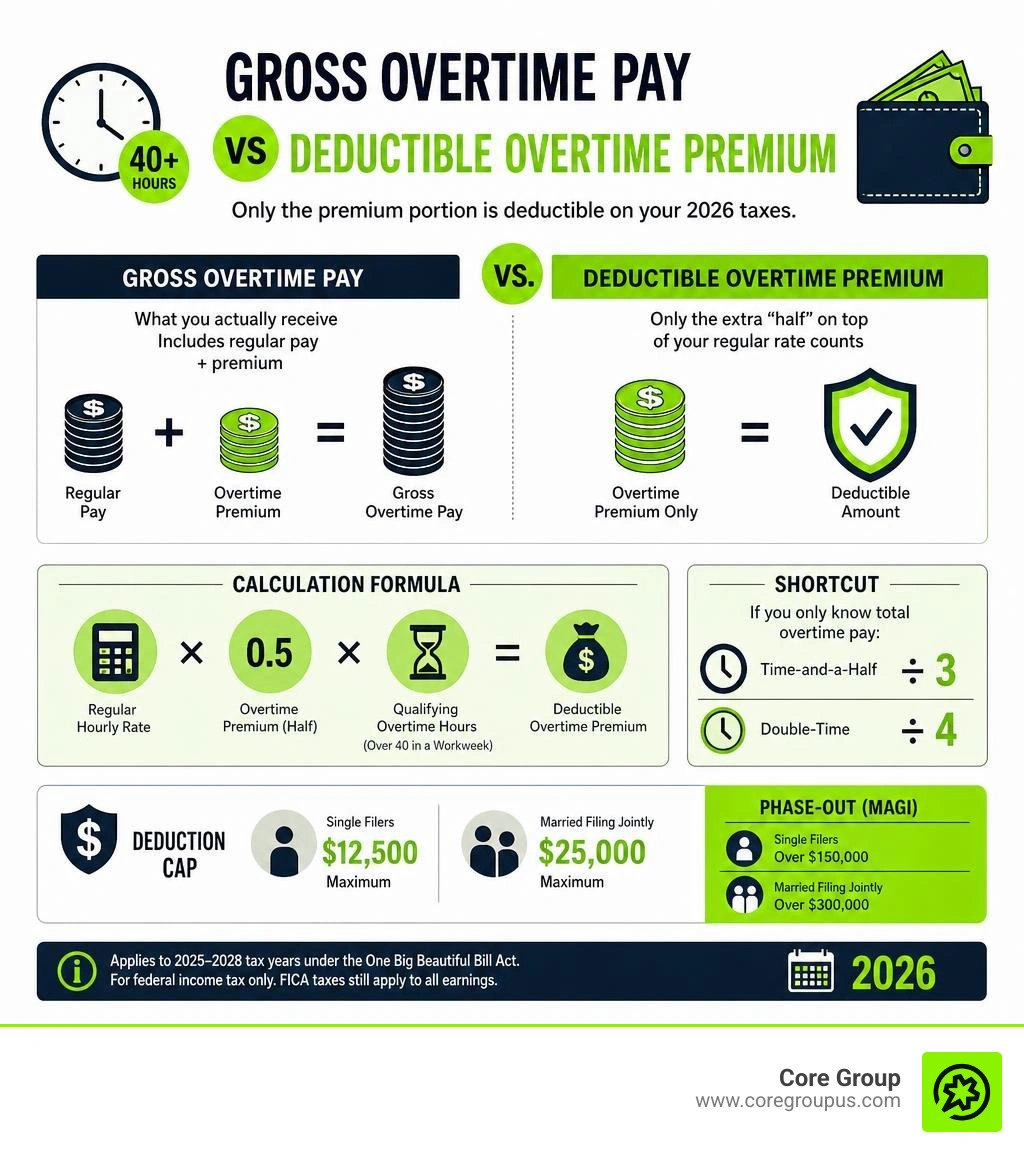
How to calculate qualified overtime terms you need
Understanding the No Tax on Overtime Rules under the OBBBA
The One Big Beautiful Bill Act, which we lovingly refer to as the OBBBA, has introduced one of the most talked about tax changes in recent history. Signed into law to provide relief to hardworking Americans, the OBBBA establishes a temporary federal income tax deduction for qualified overtime compensation. This tax break is active for tax years 2025 through 2028, meaning that as we navigate the 2026 tax year, we are right in the prime window to maximize these savings.
However, the slogan of no tax on overtime has caused a bit of confusion in breakrooms and payroll offices across the country. Many workers believe their entire overtime check is suddenly tax-free. We want to clarify that this is not a complete tax holiday.
First, the deduction applies exclusively to federal income tax. It does not touch your payroll taxes. You will still see the standard FICA taxes deducted from every single overtime hour you work. This means the 6.2 percent Social Security tax and the 1.45 percent Medicare tax remain fully active. If your earnings place you in the high-income bracket, the additional 0.9 percent Medicare surtax still applies as well.
Second, this is a below-the-line deduction that you claim on your federal income tax return. It is reported on Schedule 1-A and does not reduce your Adjusted Gross Income. This means your overtime is still taxed at the payroll level when you receive your paycheck. You get the money back as a deduction when we help you file your annual tax return.
To qualify under the OBBBA, the overtime must meet the strict standards of the Fair Labor Standards Act, or FLSA. The FLSA is the federal law that governs wages and hours in the United States. To understand how these federal standards shape your potential tax savings, you can read more about How Overtime Pay Works in the US to see how the government defines standard work periods.
Step by Step Guide on How to Calculate Qualified Overtime
To get the maximum benefit from this deduction, we must look at the specific mathematical formulas approved by the IRS. You cannot simply guess or use your gross overtime earnings.

We must first establish your regular rate of pay. Under federal guidelines, your regular rate is not always just your base hourly rate. It is calculated by taking your total straight-time compensation for the workweek and dividing it by the total hours actually worked in that week.
When establishing your regular rate, we must include several types of compensation that go beyond your base pay. These include
- Shift differentials, such as an extra two dollars per hour for working the night shift
- Nondiscretionary bonuses, which are bonuses promised to you for meeting specific performance or production targets
- On-call pay and certain non-cash payments like lodging provided by your employer
We must exclude discretionary bonuses, which are unexpected gifts from your employer, and payments for hours not actually worked, such as paid vacation, sick leave, or holidays.
Once we have your regular rate, we can isolate the overtime premium. This premium is the extra half-time amount paid for hours worked over the federal threshold. If you want to dive deeper into the tax rates applied to these earnings, you can learn how to calculate overtime tax rate to see the financial impact.
For those who want an official government tool to verify their basic overtime calculations, the FLSA Overtime Calculator Advisor provides an interactive way to double-check your weekly hours and rates.
How to Calculate Qualified Overtime for Time and a Half Pay
For the vast majority of hourly workers, overtime is paid at the standard rate of time-and-a-half. Under the OBBBA, only the premium portion, which represents the 0.5 multiplier of your regular rate, is qualified for the tax deduction. The straight-time portion, which is the 1.0 multiplier, remains fully taxable as regular income.
We can use a simple three-step process to calculate this manually.
- Determine your regular rate for the week by including any shift differentials or nondiscretionary bonuses.
- Identify your qualifying overtime hours, which are only the hours worked beyond 40 in a single workweek.
- Multiply your regular rate by 0.5, and then multiply that result by your qualifying overtime hours.
Let us look at a real-world scenario. Imagine an employee who has a base rate of $20 per hour. During a busy week, they work 48 hours.
First, we calculate their regular rate. Since they have no bonuses or differentials, their regular rate is $20. Second, we find the qualifying hours. They worked 48 hours, which gives them 8 hours of overtime.Third, we calculate the premium. We multiply $20 by 0.5 to get a premium rate of $10 per hour. We then multiply $10 by the 8 overtime hours to get $80 of qualified overtime.
If your pay stub does not separate the premium portion and only shows your total overtime pay, we can use the IRS-approved divide-by-three shortcut. For standard time-and-a-half pay, you can take your total overtime earnings for the week and divide them by 3.
In our example, the worker received $30 per hour for their 8 overtime hours, resulting in $240 of total overtime pay. If we divide $240 by 3, we get $80. The math matches perfectly.
To review the foundational rules of standard overtime calculations, you can read the guide on How to Calculate Employee Overtime Pay for more details on tracking hourly wages.
How to Calculate Qualified Overtime for Double Time and Special Rates
Some employers offer double-time pay for working on Sundays, holidays, or during emergency shifts. If you receive double-time, the calculation for your qualified overtime deduction changes slightly.
Under the OBBBA regulations, even if you are paid double-time, the qualified overtime premium is still limited. The IRS guidelines state that for double-time hours, the qualified premium is calculated using a 1.0 multiplier of your regular rate rather than the standard 0.5 multiplier.
If your employer reports your earnings as a lump sum of double-time pay, we can use the divide-by-four shortcut to find the deductible premium. You simply take your total double-time overtime pay and divide it by 4.
Let us look at another example. A technician earning $30 per hour works 5 hours of double-time during a weekend emergency. Their total double-time pay for those hours is $300, which is $60 per hour multiplied by 5 hours. To find the qualified premium portion, we divide the $300 total by 4, giving us $75 of qualified overtime.
This same logic applies to public safety workers, such as police officers and firefighters, who operate under alternative work periods. Under FLSA Section 7(k), public safety departments can establish work periods ranging from 7 to 28 days. For these employees, overtime is not calculated on a simple weekly basis. Instead, it is triggered after meeting specific hour thresholds within their designated work period.
For example, a police officer on a 14-day work period might only earn overtime after working 86 hours. Once that threshold is crossed, we apply the same calculation rules to isolate the premium portion of those overtime hours.
Federal versus State Rules for Overtime Deductions
A major trap for many taxpayers is the difference between federal FLSA rules and state-mandated overtime laws. For the purpose of the OBBBA federal tax deduction, only overtime that is required and paid under federal FLSA standards qualifies.
This is highly relevant for workers in states with daily overtime laws. Under the federal FLSA, overtime is strictly calculated on a weekly basis, meaning hours worked beyond 40 in a fixed 168-hour workweek. The federal government does not care if you work 12 hours in a single day, as long as your total hours for the week do not exceed 40.
However, several states have daily overtime rules. In California, for example, employers must pay time-and-a-half for any hours worked beyond 8 in a single workday, even if the employee works fewer than 40 hours in the entire week.
If you receive daily overtime under state law, that pay does not automatically qualify for the federal tax deduction. We must ignore the daily overtime rules and apply the federal 40-hour weekly threshold to find your qualified overtime.
| Overtime Type | Federal FLSA Rule (Qualifies for Deduction) | State Daily Rules (Excluded from Deduction) |
|---|---|---|
| Weekly Overtime | Required for hours exceeding 40 in a workweek | May co-exist with daily rules |
| Daily Overtime | Not required federally | Required in states like California after 8 hours |
| Double-Time | Not required federally except in rare cases | Required in California after 12 hours |
| PTO and Holidays | Hours not worked do not count toward the 40-hour limit | Some states or union contracts allow PTO to count |
To illustrate this, let us look at a worker in California. During a weekly pay period, this employee works 10 hours on Monday, 10 hours on Tuesday, and then takes the rest of the week off. Under California law, they earned 4 hours of daily overtime because they worked 2 extra hours on both Monday and Tuesday. Their total hours worked for the week was 20.
Because their total weekly hours did not exceed the federal 40-hour threshold, their qualified overtime for the OBBBA deduction is exactly zero. The daily overtime they received is fully taxable at the federal level.
If you are working in the Golden State, you can read about is overtime taxed at a higher rate in California to understand how state tax brackets handle these earnings. For official state guidelines, you can also consult the California Department of Industrial Relations Overtime FAQ to see how daily overtime is calculated under state labor codes.
Reporting and Recordkeeping Requirements for Employers and Employees
To claim this deduction successfully, both employers and employees must understand the reporting requirements that change between the 2025 and 2026 tax years.
For the 2025 tax year, the IRS provided transition relief under IRS Notice 2025-62. Because the OBBBA was passed mid-year, employers were not penalized if they failed to separate and report qualified overtime on 2025 W-2 forms. For 2025, employees have been allowed to use reasonable methods, such as utilizing their final pay stubs or manual calculations, to estimate their qualified overtime premium when filing their returns.
However, for the 2026 tax year and beyond, the rules are much stricter. Employers are now required to track and report qualified overtime compensation separately.
The primary reporting method for 2026 is using Form W-2. Employers must report the total qualified overtime premium in Box 12 using the new Code TT. If your employer is unable to use Box 12 due to system limitations, the IRS allows them to report the amount in Box 14 with a clear label such as OT or QualOT.
For businesses, preparing for these requirements depends heavily on your payroll setup.
- If you use automated payroll software, you must coordinate with your vendor to ensure your system isolates the FLSA overtime premium and automatically populates Box 12 Code TT.
- If you rely on manual timekeeping, you must establish separate earning codes in your ledger to track the base rate and the premium portion of every overtime hour worked throughout the year.
As an employee, you should keep copies of all your pay stubs and year-end earnings statements. If your employer made an error on your W-2, these records will be vital to substantiate your deduction. If you want to understand how these reporting requirements fit into the broader picture of payroll taxes, you can explore our resources on tax on overtime pay for a complete overview.
Limits and Phaseouts for the Overtime Tax Deduction
While the OBBBA offers fantastic savings, the federal government has placed clear caps and income limits on who can claim the deduction.
The maximum annual deduction you can claim on your tax return is
- $12,500 for single filers and heads of household
- $25,000 for married couples filing jointly
- $0 for those who file as married filing separately, as this filing status is completely excluded from the deduction
In addition to these caps, the deduction features a phase-out range based on your Modified Adjusted Gross Income, or MAGI. The phase-out begins once your MAGI exceeds
- $150,000 for single filers and heads of household
- $300,000 for married couples filing jointly
For every $1,000 your MAGI exceeds these thresholds, your maximum allowable deduction is reduced by $100. This means the deduction is completely phased out and reduced to zero once your MAGI reaches $275,000 for single filers or $550,000 for joint filers.
Let us look at a quick example. A single taxpayer has a MAGI of $160,000 for the year. This is $10,000 over the $150,000 phase-out threshold. Because they are $10,000 over the limit, their maximum allowable deduction of $12,500 is reduced by $1,000, leaving them with a maximum deduction of $11,500.
To determine if your overtime earnings might push you into a higher tax bracket or trigger these phase-outs, you can read our analysis on does overtime get taxed at a higher rate to help plan your working hours.
Frequently Asked Questions about Overtime Taxes
Does the overtime deduction apply to state income taxes
No, the OBBBA overtime deduction is strictly a federal tax benefit. As of the 2026 tax year, state governments have not conformed to this federal deduction. This means that even if you successfully deduct your qualified overtime premium on your federal return, you will still owe state income tax on those earnings if you live in a state with an income tax.
To understand how federal tax rates compare to state rates when it comes to extra hours, you can read about what is the federal tax rate on overtime to see how your tax bill is split between federal and state authorities.
How does compensatory time off affect the overtime deduction
Compensatory time, commonly known as comp time, is an arrangement where an employee receives paid time off instead of cash overtime pay. Under federal law, private sector employers are strictly prohibited from offering comp time to nonexempt employees. However, public sector employers, such as government agencies, are allowed to use comp time.
If you are a public sector employee who receives comp time, it can impact your qualified overtime deduction. Under IRS guidelines, when you are paid for accrued comp time, only one-third of those wages are considered qualified overtime compensation.
For example, if a municipal worker receives $4,500 in wages for taken comp time, they can include $1,500 as qualified overtime on their tax return.
Are salaried employees eligible for the overtime deduction
Only employees who are covered by and nonexempt under the FLSA are eligible for the overtime deduction. Salaried employees who are classified as exempt do not qualify because they are not legally entitled to FLSA overtime pay.
To be classified as exempt, an employee must meet the salary basis test, earn at least the federal salary threshold of $1,128 per week, and meet the specific duties tests for executive, administrative, or professional exemptions. If you are a salaried nonexempt employee, meaning you earn a salary but your job duties do not qualify for an exemption, you are still entitled to overtime pay and can claim the deduction on your qualified premium.
Conclusion
Calculating your qualified overtime deduction for your 2026 taxes does not have to be a headache. By understanding the math behind the overtime premium, ignoring state-level daily overtime traps, and keeping accurate pay stubs, you can secure significant federal tax savings.
At Core Group, we specialize in helping creative entrepreneurs and busy professionals keep their finances simple. Our no-fluff, profit-first playbook is designed to give you complete peace of mind and save you valuable time, allowing you to focus on growing your business. We are so confident in our services that we back them with our unique MacBook Pro guarantee.
If you want to make sure your payroll is compliant or need help maximizing your personal tax deductions, we are here to help. You can read more about how we analyze the overtime tax rate to keep your business profitable and your taxes low. Reach out to us today to get started.