The Complete Guide to LLC 1099 Payments
When LLCs Get 1099 Payments in 2026
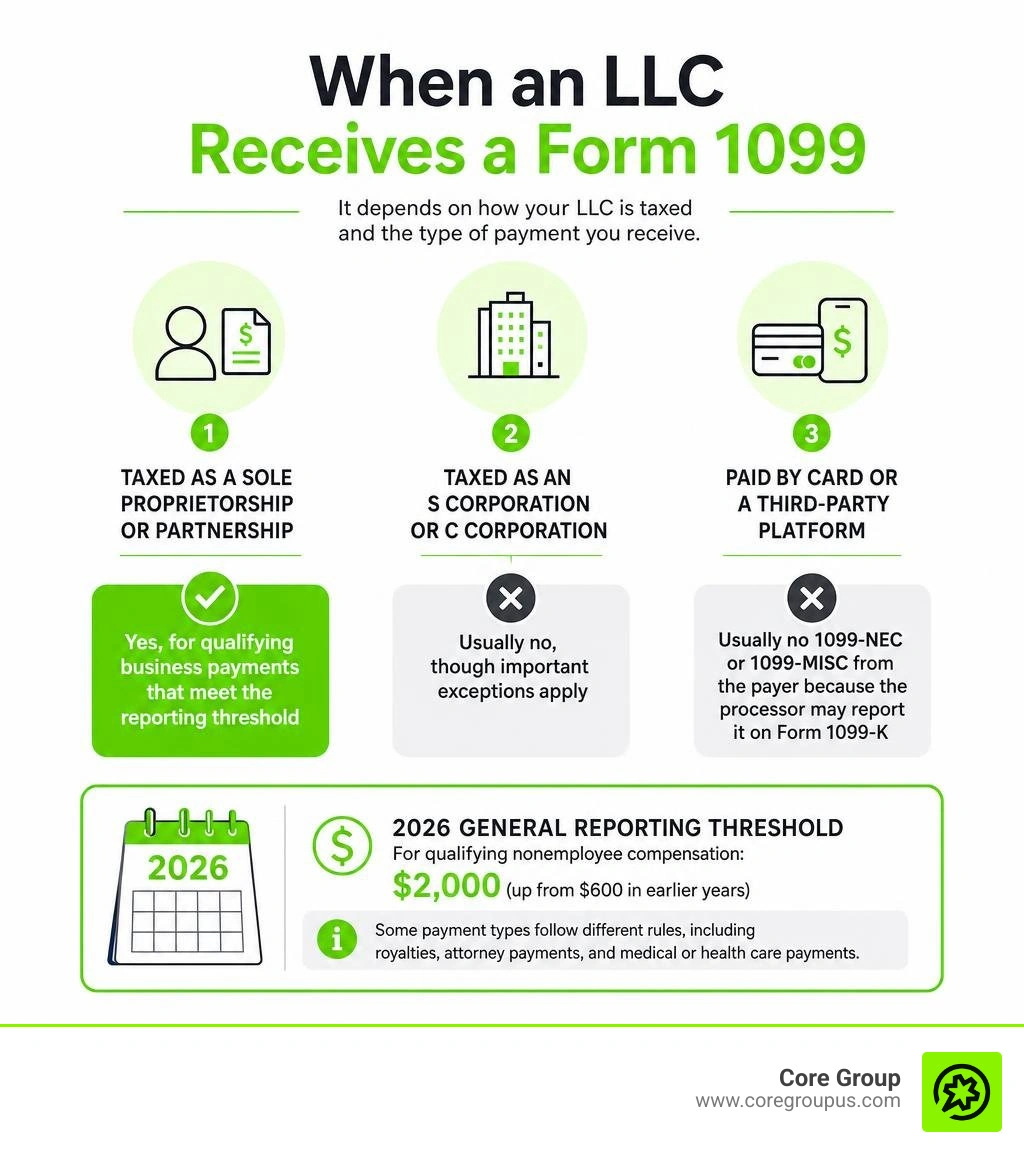
Whether llc get 1099 payments depends on the LLC's federal tax classification and the kind of payment it received, not simply on the fact that it is an LLC.
| If the LLC is taxed as | Does the payer usually send a 1099 |
|---|---|
| A sole proprietorship or partnership | Yes, for qualifying business payments that meet the reporting threshold |
| An S corporation or C corporation | Usually no, though important exceptions apply |
| Any tax classification paid by card or a third-party platform | Usually no 1099-NEC or 1099-MISC from the payer because the processor may report it on Form 1099-K |
For the 2026 tax year, the general reporting threshold for qualifying nonemployee compensation rises to $2,000, up from $600 in earlier years. But some payment types follow different rules, including royalties, attorney payments, and medical or health care payments.
This can feel like one more administrative task competing with your creative work. Still, getting the classification, payment method, and records right helps prevent missed forms, duplicate reporting, and costly penalties.
I'm Christian Brim, and next we'll clarify how an LLC's tax status shapes its 1099 reporting rules.
Llc get 1099 payments terminology
Do LLC Get 1099 Payments Based on Tax Classification
When small business owners ask us if an LLC gets a 1099 form, we always start with one fundamental truth. A limited liability company is a legal entity structure created under state law, but the Internal Revenue Service does not treat LLC as a distinct tax classification. Instead, the IRS looks at how the business has elected to be taxed at the federal level.
This distinction surprises many business owners who assume that formed LLC entities are treated identically across the board. In reality, whether an llc get 1099 payments reportable on tax documents hinges entirely on federal tax status. Unincorporated entities like sole proprietorships and partnerships generally receive 1099 forms when they provide services to another trade or business. On the flip side, businesses operating under corporate tax status usually enjoy a broad reporting exemption.
To understand how this works in practice, check out the official Instructions for Forms 1099-MISC and 1099-NEC. You can also review our comprehensive Single Member LLC 1099 Guide 2026 for deeper details on individual setups.
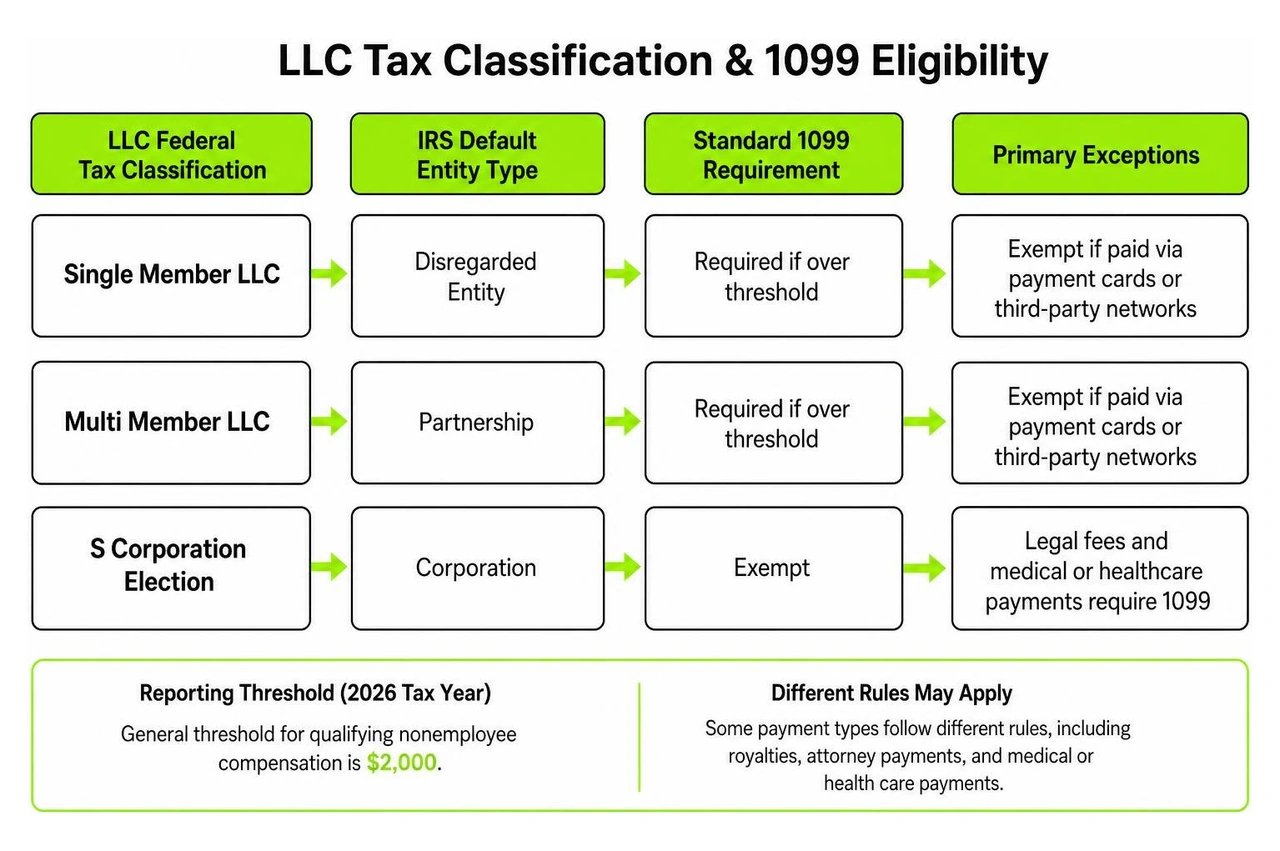
| LLC Federal Tax Classification | IRS Default Entity Type | Standard 1099 Requirement | Primary Exceptions |
|---|---|---|---|
| Single Member LLC | Disregarded Entity | Required if over threshold | Exempt if paid via payment cards or third-party networks |
| Multi Member LLC | Partnership | Required if over threshold | Exempt if paid via payment cards or third-party networks |
| S Corporation Election | Corporation | Exempt | Legal fees and medical or healthcare payments require 1099 |
| C Corporation Election | Corporation | Exempt | Legal fees and medical or healthcare payments require 1099 |
How Single Member LLC Get 1099 Payments
Single member LLCs default to disregarded entity status for federal income tax purposes. This means the federal government ignores the separate legal structure of the business when collecting income taxes, passing all business revenue directly through to the individual owner.
When a client pays a single member LLC for qualifying business services, they must issue a 1099 form if total payments meet the annual reporting threshold. The client will list the individual owner name on the top line of the information return, followed by the LLC business name on line two. For a complete breakdown of filing logistics, read our guide on Single Member LLC 1099 Reporting.
How Multi Member Partnerships and Corporations Receive 1099 Forms
Multi member LLCs that have not filed special corporate tax elections are classified as partnerships by default. Like single member entities, partnership LLCs are not exempt from standard information reporting. When another business pays a partnership LLC for trade or business services, the payer must report those transactions on Form 1099-NEC once the minimum threshold is crossed.
The landscape changes dramatically when an LLC files Form 2553 or Form 8832 to elect status as an S Corporation or C Corporation. Corporations are generally exempt from receiving Form 1099-NEC and Form 1099-MISC. However, the IRS enforces specific corporate exemption carve outs. Payers must issue 1099 forms to corporate LLCs whenever payments are made for legal services, gross proceeds paid to attorneys, or medical and healthcare services.
Key 2026 Reporting Thresholds and Payment Types
Understanding when an llc get 1099 payments requires staying on top of changing federal dollar limits. For tax year 2026, major threshold updates take effect that adjust how businesses track vendor disbursements.

Whether you are issuing forms or receiving them, knowing these amounts prevents accounting headaches. Check our analysis of the LLC Get 1099 Minimum for detailed calculation examples.
Nonemployee Compensation and Services Threshold Increase
For tax year 2026, the standard reporting threshold for nonemployee compensation jumps to $2,000 for qualifying service payments. In earlier tax years, businesses had to file Form 1099-NEC whenever payments to an unincorporated contractor reached $600.
This $2,000 threshold applies to independent contractor compensation, professional service fees, creative project commissions, and maintenance labor provided in the normal course of trade or business. If your trade or business pays an unincorporated LLC $1,950 during 2026, no Form 1099-NEC is required. If that total reaches $2,000 or more, filing becomes mandatory. Review our detailed overview on Nonemployee Compensation to see what qualifies.
Legal Fees Medical Payments Rents and Royalties
Not every payment type follows the general $2,000 nonemployee compensation rule. Payers must pay close attention to specialized rules for specific spending categories on Form 1099-MISC and Form 1099-NEC.
- Legal fees paid for professional services require Form 1099-NEC once payments reach $2,000 in 2026, even if the law firm operates as a C Corp or S Corp LLC.
- Gross proceeds paid to attorneys in connection with legal settlements require Form 1099-MISC Box 10 reporting starting at $600, with no corporate exemption available.
- Medical and health care payments made to doctors or medical service LLCs require Form 1099-MISC Box 6 reporting once they reach $2,000, regardless of corporate entity status.
- Commercial rent paid to an LLC property manager or landlord requires Form 1099-MISC Box 1 when cumulative payments meet the $2,000 limit.
- Royalty payments maintain a strict $10 reporting limit on Form 1099-MISC Box 2.
Essential Form W-9 Collection and Third Party Payment Rules
Determining whether an llc get 1099 payments requires accurate vendor data before issuing payments. Collecting a completed Form W-9 from every business vendor is the single most important step in your tax administration routine.

Form W-9 Protocols and Backup Withholding Procedures
We recommend a strict policy for every small business. Never issue a check or bank transfer until you have a signed, current Form W-9 on file. Line 3a of Form W-9 displays the payee federal tax classification, indicating whether the entity is a sole proprietor, partnership, C corporation, S corporation, or single-member LLC.
To prevent reporting errors, run TIN verification through the IRS TIN Matching service before tax season arrives. If a vendor refuses to provide a Taxpayer Identification Number or provides incorrect details, tax law requires your business to initiate 24 percent backup withholding on future disbursements. To protect your business from costly oversight, take a look at our breakdown of common LLC Get 1099 Mistakes.
Credit Cards and Third Party Payment Networks
A common point of confusion arises when paying LLC vendors through payment processors. Payments made via credit card, debit card, PayPal, Stripe, or other payment settlement entities fall under distinct IRS rules.
Payers do not issue Form 1099-NEC or Form 1099-MISC for transactions processed through card processors or third-party networks. Instead, responsibility shifts to the payment processor to report qualifying settlement volumes on Form 1099-K. For official details on processor rules, read Understanding your Form 1099-K. Issuing a 1099-NEC for credit card payments creates duplicate reporting for the payee, leading to unnecessary tax disputes.
Deadlines Penalties and Electronic Filing Rules
Staying compliant means tracking key submission dates and administrative thresholds established by federal tax law.
For complete timeline details, review our guide on When Are 1099s Due.
- Form 1099-NEC recipient statements and IRS filings are due by January 31 following the reporting year.
- Form 1099-MISC recipient statements are due by January 31, while IRS filings are due February 28 for paper submissions or March 31 for e-filing.
- Electronic filing is mandatory for any business submitting 10 or more information returns in aggregate across all forms.
- E-filing can be handled for free through the official IRS Information Returns Intake System portal.
Late Filing Penalties and Intentional Disregard
Failing to submit required information returns leads to non-negotiable penalties from the IRS. State tax agencies enforce separate fines, such as those detailed in the 1099 Guidelines and Instructions.
- $60 per form for returns filed within 30 days of the deadline.
- $130 per form for returns filed after 30 days but on or before August 1.
- $340 per form for returns filed after August 1 or not filed at all.
- $680 per form for intentional disregard of tax filing obligations, with no maximum annual cap.
How an Unincorporated LLC Get 1099 Payments and Track Income
If you run an unincorporated LLC, receiving 1099 forms is a standard part of doing business. However, your actual tax liability depends on accurate recordkeeping rather than the face value of received forms.
Always reconcile received 1099 statements against your internal general ledger accounts. You must report all taxable income earned during the year, even if a client failed to send a required 1099 form. Partnership owners should ensure reported revenues align with Schedule K-1 allocations from Form 1065 filings. To optimize your bottom line, use our 1099 Contractor Profit Tracking Guide to log allowable tax deductions and operating expenses.
Frequently Asked Questions About LLC 1099 Reporting
Does an LLC Automatically Receive a 1099 Form
An LLC does not automatically receive a 1099 form. Form issuance depends on the federal tax classification elected by the LLC and whether payments were made in the course of a trade or business. LLCs taxed as S Corporations or C Corporations are generally exempt from standard 1099 reporting unless the payments involve legal or medical services.
What Are the 2026 Reporting Thresholds for LLCs
For the 2026 tax year, the general reporting threshold for nonemployee compensation on Form 1099-NEC increases to $2,000. Rent and medical payments on Form 1099-MISC also follow a $2,000 minimum limit. Gross proceeds paid to attorneys require reporting at $600, while royalty payments carry a $10 threshold.
Do Credit Card Payments to an LLC Require Form 1099-NEC
Credit card payments made to an LLC do not require Form 1099-NEC. Payments settled via payment cards or qualifying third-party settlement networks are reported separately by the payment processing bank on Form 1099-K. Business payers should exclude card and digital platform transactions from their annual 1099-NEC filings.
Conclusion
Managing 1099 reporting rules does not have to overwhelm your daily business operations. By collecting Form W-9 documents upfront, verifying federal tax classifications, and tracking payment methods carefully, you can maintain full compliance while protecting your trade or business from costly IRS fines.
At Core Group, we provide comprehensive financial management, bookkeeping, and tax services tailored specifically for creative entrepreneurs. Our no-fluff profit-first playbook guarantees complete peace of mind, freeing up your valuable time so you can focus on building your business. If you need help structuring your vendor workflows or filing accuracy checkups, review our resources on Single Member LLC 1099 Reporting and reach out to our team today.