The Ultimate LLC 1099 Guide: Steer Clear of These IRS Red Flags
Why LLC Get 1099 Mistakes Cost Businesses More Than They Expect
LLC get 1099 mistakes are more common than most business owners realize, and they can trigger IRS notices, penalties, and even disallowed deductions before you know what hit you.
Here is a quick snapshot of the most common mistakes to avoid
- Wrong tax classification - assuming all LLCs are exempt from receiving a 1099 (they are not)
- Missing W-9s - paying a vendor without collecting their tax info first
- Wrong form type - using 1099-MISC when 1099-NEC is required, or vice versa
- TIN mismatches - filing under a DBA name or the wrong identification number
- Late or missing filings - missing the January 31 deadline for 1099-NEC
- Wrong payer info - filing under a personal SSN instead of your LLC's EIN
- Skipping corrections - ignoring errors after the IRS has already accepted your forms
If you are a creative entrepreneur running a film, media, or production business, tax compliance probably is not where you want to spend your mental energy. But one overlooked 1099 can snowball into IRS notices, backup withholding at 24%, and penalties ranging from $60 to $680 per form.
The tricky part is that an LLC is not a tax category. The IRS does not recognize "LLC" as a filing status. Whether your vendor's LLC gets a 1099 depends entirely on how that LLC is taxed, which is something you can only find out by collecting a W-9.
That is where most mistakes begin.
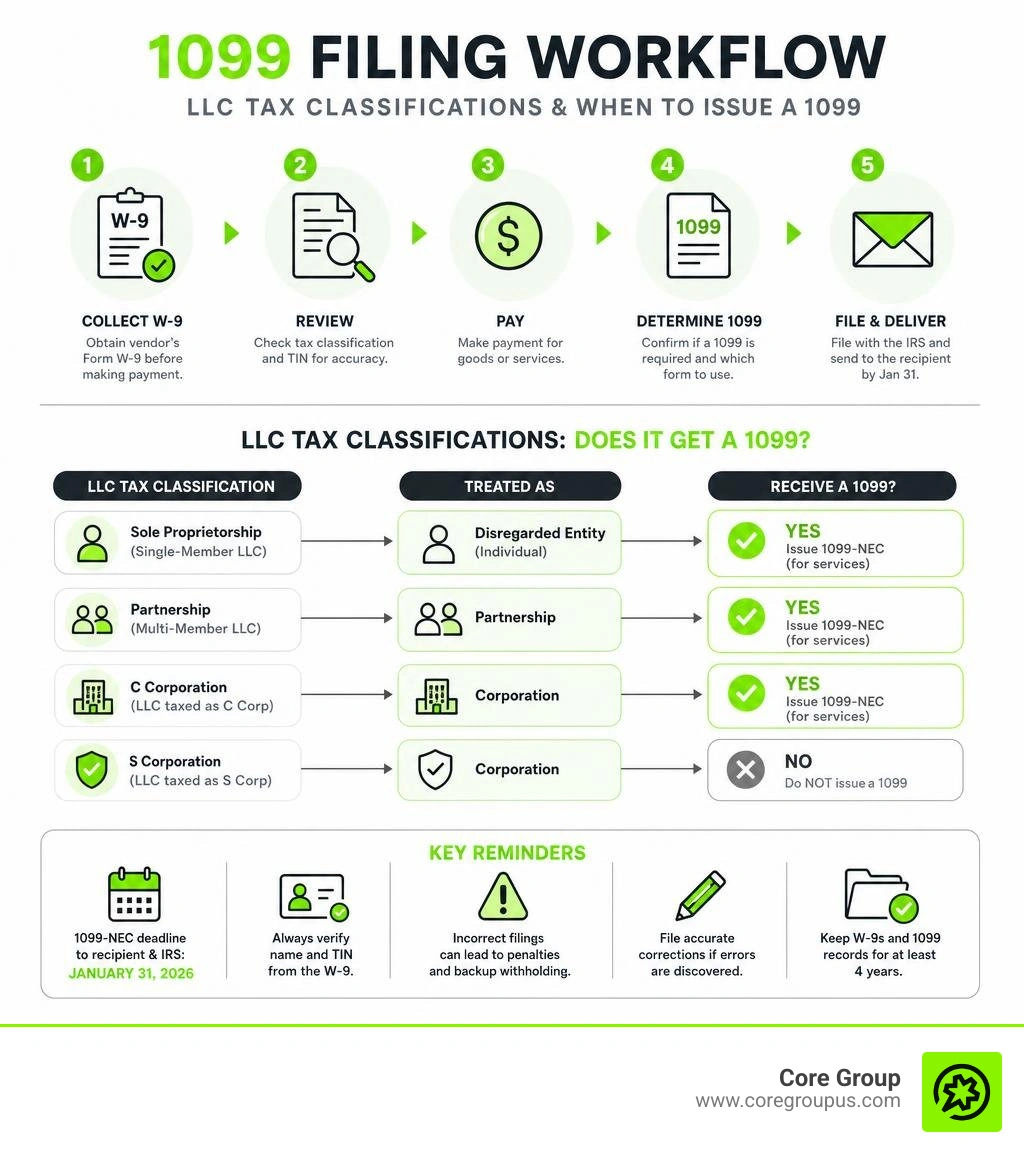
Common llc get 1099 mistakes vocab
Common LLC Get 1099 Mistakes That Trigger Audits
When we manage payments to independent contractors, we often overlook the administrative details that keep the IRS happy. Filing the wrong forms or missing deadlines does not just result in minor fines. It can trigger an audit. The IRS actively matches information returns against individual and business tax returns using automated programs. If there is a mismatch, the system flags it.
One of the most frequent errors is using the wrong form. Many business owners still use Form 1099-MISC for all vendor payments. However, payments for independent contractor services must be reported on Form 1099-NEC. To understand this division, you can read our guide on 1099 NEC Explained.
Using the incorrect form type or putting the nonemployee compensation in the wrong box on Form 1099-MISC will lead to processing delays and potential penalties. For instance, Form 1099-MISC is reserved for rent, royalties, and other specific miscellaneous income, whereas Form 1099-NEC is strictly for services performed by nonemployees. State departments of revenue also track these forms closely. If you operate in states with active reporting requirements, you must ensure you comply with guidelines such as the 1099-NEC Filing - Alabama Department of Revenue rules or the Important Information About the 1099-NEC updates.
Why Relying on the Business Name Leads to LLC Get 1099 Mistakes
We often see business owners look at a vendor name like Creative Studio LLC and immediately assume they do not need to file a 1099. This is a massive mistake. The letters LLC at the end of a business name do not reveal how that business is registered with the IRS.
An LLC can be taxed as a sole proprietorship, a partnership, an S Corporation, or a C Corporation. If the LLC is a single-member disregarded entity or a partnership, you must issue a 1099 if your payments cross the LLC Get 1099 Minimum threshold. For the 2026 tax year, the reporting threshold for Form 1099-NEC is $2,000, while the threshold for Form 1099-MISC is $600 for rents and other payments. Relying on the business name instead of looking at a signed Form W-9 is a surefire way to make costly reporting mistakes.
How to Avoid LLC Get 1099 Mistakes with Proper W9 Verification
The absolute best practice to prevent compliance issues is to establish a strict onboarding policy. We advise our clients to never send a payment to a vendor until they have a completed and signed Form W-9 on file.
During onboarding, you should verify the taxpayer identification number or TIN. The IRS offers a TIN matching service that allows you to double-check that the name and number provided on the W-9 match official records. If a vendor refuses to provide a valid TIN, you are legally required to begin backup withholding at a rate of 24% on future payments.
By implementing these onboarding steps, you protect your business from future penalties. For more details on managing your income records, check out our comprehensive LLC 1099 Income Guide 2026.
How LLC Tax Classification Determines Your 1099 Obligations
To navigate 1099 reporting without errors, we must understand how federal tax classification overrides state-level business structures. The IRS views an LLC as a flexible entity that can choose its tax treatment.
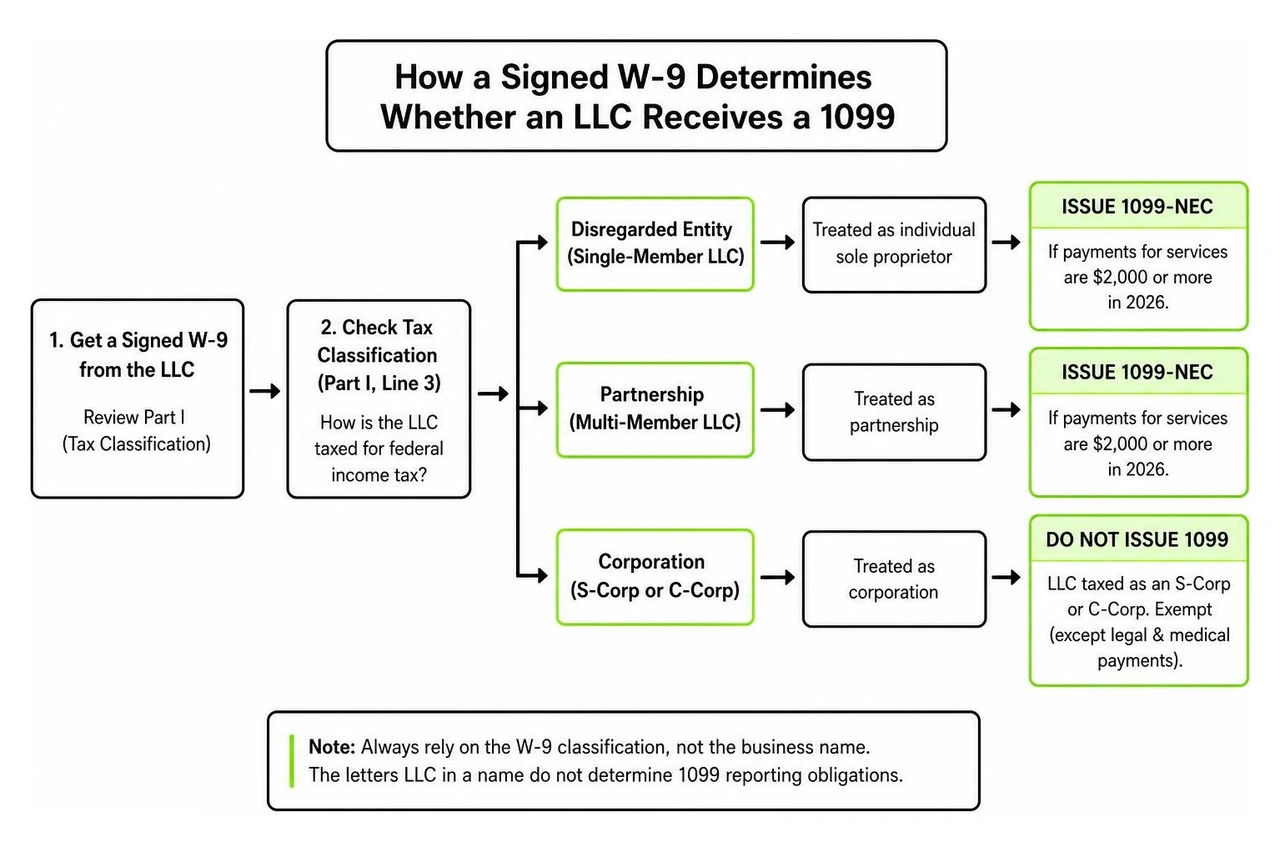
Here is a quick breakdown of how these classifications affect your filing requirements under the general tax rules
- Single-Member LLC - Taxed as a disregarded entity. You must issue a 1099-NEC if you pay them $2,000 or more for services in 2026.
- Multi-Member LLC - Defaulted to a partnership. You must issue a 1099-NEC if you pay them $2,000 or more for services in 2026.
- LLC taxed as an S-Corp - Exempt from receiving a 1099, except for legal and medical payments.
- LLC taxed as a C-Corp - Exempt from receiving a 1099, except for legal and medical payments.
Single Member LLCs and Disregarded Entities
A single-member LLC is treated as a disregarded entity for federal tax purposes. This means the IRS treats the business and the owner as one and the same.
When you prepare a 1099 for a disregarded entity, you must use the owner's individual name and Social Security Number or individual EIN on the form. A common mistake is using the LLC's business name and the LLC's separate EIN. This mismatch triggers IRS B-Notices because the IRS database cannot match the LLC's EIN directly to a sole proprietor's Schedule C. You can read more about these unique rules in our article on Single Member LLC 1099 Reporting.
Multi Member LLCs and Partnerships
Multi-member LLCs that have not elected corporate status default to partnership taxation. This means they are not exempt from 1099 reporting.
If you pay a partnership LLC for services, you must report these transactions. The payments represent Nonemployee Compensation and must be filed under the partnership's registered business name and EIN. Do not confuse these payments with guaranteed payments made to partners, which are handled internally on the partnership's Schedule K-1.
S Corporations and C Corporations
If an LLC has elected to be taxed as an S Corporation or a C Corporation, they are generally exempt from receiving a 1099. This is known as the corporate exemption.
However, there are critical exceptions that override this rule. The most common exception is for legal services. You must issue a 1099 to any law firm or attorney, even if their LLC is structured as an S-Corp or C-Corp. Medical and healthcare payments also override the corporate exemption. If you paid an LLC for legal or medical services, you must file a 1099 regardless of their corporate status. To learn more about how these classifications work across different business types, read Do LLCs Get a 1099? Complete Answer by LLC Type (2026).
Step by Step Guide to Correcting 1099 Errors
If you discover that you made a mistake on a filed 1099, you must act quickly to correct it. The IRS accepts electronic corrections, which process much faster than paper forms.
When you make corrections, you should follow the same filing method you used for the original return. If you filed the original return on paper, you must file the correction on paper and include a new Form 1096. If you e-filed, you must submit the correction electronically. To keep your records accurate, make sure you are using robust 1099 Contractor Expense Tracking systems.
Type 1 Errors for Incorrect Amounts
A Type 1 error occurs when you enter incorrect money amounts, use the wrong checkboxes, or file the wrong form type. To correct a Type 1 error, follow these steps
- Prepare a new Form 1099.
- Enter the payer, recipient, and account number exactly as they appeared on the original incorrect form.
- Check the CORRECTED box at the top of the form.
- Enter the correct financial amounts in the appropriate boxes.
- If you are paper filing, prepare a new Form 1096 and mail the package to the IRS.
These steps ensure the IRS system updates the previous incorrect entry with your new, accurate data. For tracking your payments accurately throughout the year, refer to our 1099 Contractor Profit Tracking Guide.
Type 2 Errors for Wrong Payee Name or TIN
A Type 2 error happens when you file a 1099 with the wrong recipient name or the wrong Taxpayer Identification Number. This requires a two-step correction process because you must completely void the original incorrect filing before submitting the correct one.
Step one is to void the incorrect return
- Prepare a new Form 1099.
- Enter the payer, recipient, and TIN exactly as they appeared on the original incorrect form.
- Check the CORRECTED box at the top of the form.
- Enter 0.00 for all money amounts.
- File this form to zero out the original record.
Step two is to file the correct return
- Prepare a brand-new Form 1099.
- Do not check the CORRECTED box. This is treated as a new original return.
- Enter the correct recipient name and the correct TIN.
- Enter the actual payment amounts.
- File this form along with a new Form 1096 if paper filing.
For additional administrative insights on corrections, you can review the advice on The Most Common Form 1099 Filing Mistakes (and how to correct).
Type 3 Errors for Incorrect Payer Information
A Type 3 error occurs when you file 1099s using the wrong payer name or the wrong payer EIN. For example, if you filed all your contractor 1099s under your personal name and SSN instead of your LLC's name and EIN, you have a Type 3 error.
You cannot fix a Type 3 error by filing a corrected 1099 form. Instead, you must write a physical letter to the IRS. In this letter, explain the mistake, provide the incorrect payer information that was filed, list the correct payer information, and include details of the affected returns.
IRS Penalties and E Filing Mandates for 2026
The IRS has significantly tightened its electronic filing rules. Under the latest regulations, if you file 10 or more information returns in a calendar year, you must file electronically. This 10-return threshold is an aggregate of almost all information returns, including W-2s, 1099-NECs, and 1099-MISCs. Failing to e-file when required can result in a penalty of up to $340 per form.
It is critical to meet the official deadlines. You can read more about these dates in our guide When Are 1099s Due.
If you file late, the IRS applies a tiered penalty system
- Filed within 30 days of the due date - $60 per form
- Filed more than 30 days late but by August 1 - $130 per form
- Filed after August 1 - $340 per form
- Intentional disregard of filing requirements - $680 per form with no maximum limit
State agencies also enforce their own penalties and timelines. Be sure to check state-specific resources like the 1099 Guidelines and Instructions – Arkansas Department of Finance or the W-2 and 1099 Form FAQs - Division of Revenue - State of Delaware to ensure complete regional compliance.
Frequently Asked Questions About LLC 1099 Filings
Do credit card payments to LLC vendors require a 1099 form
No, you should not report payments made to LLC vendors via credit cards, debit cards, or third-party payment networks like PayPal on Form 1099-NEC. These transactions are tracked and reported by the payment processors themselves on Form 1099-K. If you include these card payments on your Form 1099-NEC, you will cause duplicate income reporting for the vendor, which can lead to administrative headaches and IRS mismatch notices.
What happens if I completely miss the 1099 filing deadline
Completely missing the 1099 filing deadline puts your business at risk of severe financial penalties. Beyond the standard late-filing fees, the IRS can disallow the business deductions you claimed for those contractor payments on your income tax return. This would significantly increase your tax liability. Furthermore, failing to file required information returns raises flags in the IRS system, which increases your overall audit risk.
How long should my business keep 1099 records
We recommend keeping all 1099 records, signed W-9 forms, and proof of filing for at least six years. While the standard IRS statute of limitations for audits is three years, it extends to six years if there is a substantial omission of income. Keeping a clean, digital audit trail of your tax documents ensures you can quickly answer any IRS inquiries and prove your compliance.
Conclusion
Managing independent contractors and navigating tax forms does not have to be a source of constant stress. At Core Group, we help creative entrepreneurs simplify their financial management, bookkeeping, and tax preparation. Our no-fluff, profit-first playbook is designed to guarantee peace of mind and save you hours of administrative work, letting you focus on growing your business. We are so confident in our services that we back them with our MacBook Pro guarantee.
Do not let administrative errors put your creative business at risk. If you want to protect your business from audit risks, read our deep dive on Single Member LLC 1099 Reporting and reach out to our team today to get your finances on the right track.