From Revenue to Net Profit: A 1099 Contractor's Guide
Why 1099 Contractor Profit Tracking is Essential for Your Business
1099 contractor profit tracking is how independent contractors turn raw revenue numbers into a clear picture of what they actually keep after taxes, expenses, and fees.
If you landed here wanting a quick answer, here it is
How to track your 1099 contractor profits
- Separate your finances by opening a dedicated business bank account and never mixing personal and business spending
- Record every dollar in by logging all client payments, noting the source, date, and amount
- Capture every expense by scanning receipts immediately and categorizing them using Schedule C line items
- Calculate your net profit by subtracting all business expenses from gross revenue to find your taxable net profit
- Set aside 25-30% for taxes by moving that amount to a separate savings account with every payment you receive
- Pay quarterly by submitting estimated taxes to the IRS by April 15, June 15, September 15, and January 15
Here is the hard truth most creative freelancers learn too late. The invoice you sent for $8,000 is not $8,000. By the time the IRS takes self-employment tax, federal income tax, and state taxes, that number shrinks fast. Contractors who fail to track mileage and expenses alone leave an average of $4,000 in deductions unclaimed every year.
If you work in film, media, or any creative field, you already know the grind of chasing invoices and juggling projects. The financial side can feel like a completely different job. But without a clear system to track what comes in and what goes out, you are essentially flying blind on your own profitability.
This guide walks you through every step, from understanding the tax drag on your earnings to the tools and habits that make profit tracking simple.
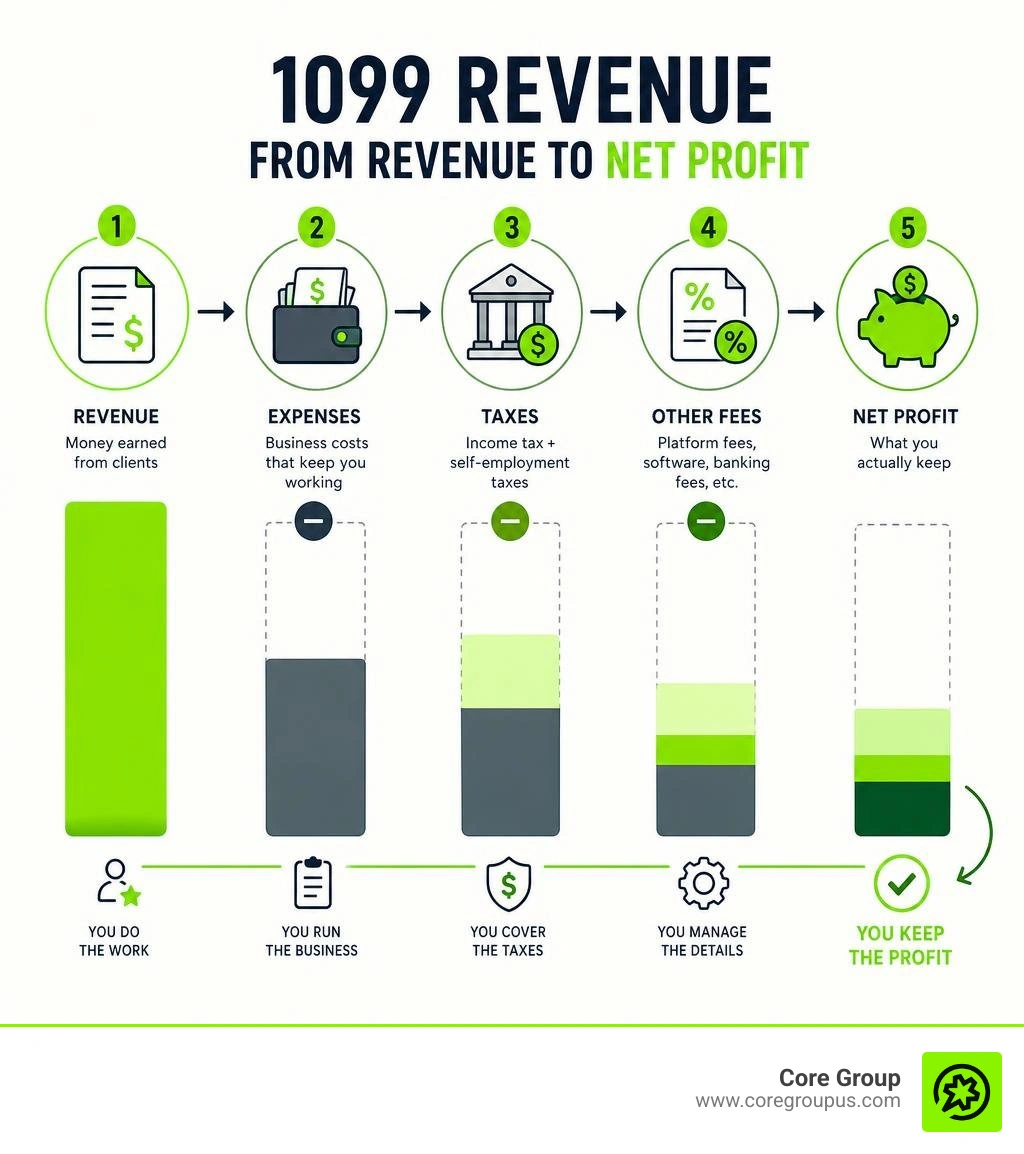
1099 contractor profit tracking terms to know include
When you work as an independent contractor, gross revenue is a vanity metric. You might celebrate a month where you bring in ten thousand dollars, but if your expenses and tax liabilities eat up eight thousand of that, your actual take-home pay is much lower than you think. This is why consistent tracking is the foundation of healthy cash flow management.
Without a reliable system, you cannot make informed decisions about your business. You will struggle to set accurate prices for your services because you will not know your true cost of doing business. Effective financial planning requires you to look beyond the total amount deposited into your account and analyze your actual margins.
One of the simplest and most powerful actions you can take is opening a dedicated business bank account. Self-employed individuals who maintain separate business bank accounts report fifty percent fewer tax filing errors. When you mix personal grocery bills with business software subscriptions, your financial records become a tangled mess. Keeping them completely separate ensures that every business expense is visible and easily documented.
By staying on top of your numbers, you can easily reference an independent contractor tax guide to confirm you are handling your obligations correctly. Accurate bookkeeping also helps you evaluate whether your hourly rates or project fees are actually covering your hidden expenses, which in turn allows you to scale your business with confidence.
Understanding the Tax Drag on Your Net Profit
As an independent contractor, you do not have an employer withholding taxes from your paycheck. Instead, you are responsible for paying both the employer and employee portions of FICA taxes. This is known as the self-employment tax, and the rate is 15.3 percent.
This 15.3 percent tax rate consists of two parts. First, 12.4 percent goes to Social Security, which applies to the first $184,500 of net self-employment income in 2026. Second, 2.9 percent goes to Medicare. If your income exceeds $200,000 as a single filer, you will also face an additional 0.9 percent Medicare surtax.
To help visualize how this differs from traditional employment, let us compare the tax structures.
| Tax Category | W2 Employee Structure | 1099 Contractor Structure |
|---|---|---|
| Social Security Tax | 6.2 percent paid by employee and 6.2 percent paid by employer | 12.4 percent paid entirely by the contractor |
| Medicare Tax | 1.45 percent paid by employee and 1.45 percent paid by employer | 2.9 percent paid entirely by the contractor |
| Income Tax Withholding | Automated based on Form W4 | Managed manually by the contractor through quarterly payments |
| Primary Tax Forms | Form W2 and Form 1040 | Form 1099-NEC and Schedule C |
To make things slightly easier, the IRS permits you to calculate your self-employment tax on 92.35 percent of your net business earnings rather than the full one hundred percent. You are also allowed to deduct half of your self-employment tax as an adjustment to your income on your personal tax return. Even with these adjustments, the tax drag on your business is significant, which is why proactive tax planning for freelancers is so critical.
Calculating and Setting Aside Money for Quarterly Taxes
To avoid a massive surprise bill in April, you must pay your taxes throughout the year. The IRS expects you to make quarterly estimated tax payments using IRS Form 1040-ES if you expect to owe $1,000 or more in federal taxes for the year.
The deadlines for these payments are fixed every year. For 2026, the quarterly due dates are as follows
- April 15, 2026 for the first quarter
- June 15, 2026 for the second quarter
- September 15, 2026 for the third quarter
- January 15, 2027 for the fourth quarter
If you fail to make these payments on time, the IRS can assess underpayment penalties, which currently run at approximately 7 to 8 percent annualized on the shortfall. To avoid these penalties, you should aim to meet the safe harbor rules. This means paying at least 90 percent of your current year tax liability or 100 percent of your prior year tax liability divided into four equal payments. If your adjusted gross income was over $150,000 in the prior year, you must pay 110 percent of that amount to meet the safe harbor.
We recommend setting aside 25 to 30 percent of your net income in a separate savings account the moment a client pays you. This ensures that you always have the necessary cash on hand when the quarterly deadlines arrive. Knowing when 1099s are due and tracking your income in real time keeps you ahead of the game.
Maximizing Your Business Deductions
The key to reducing your tax bill and keeping more of your hard-earned revenue is maximizing your business deductions on Schedule C. Every dollar you deduct reduces your taxable income, which directly lowers both your self-employment tax and your income tax.
The IRS allows you to deduct expenses that are ordinary and necessary for your trade or business. An ordinary expense is one that is common and accepted in your industry. A necessary expense is one that is helpful and appropriate for your work. By keeping clean records, 1099 contractors who track business expenses can reduce their taxable income by an average of 15 to 20 percent through legitimate deductions.
Different states have different regulations regarding independent work. For example, you can check the guidelines from the Colorado Department of Labor and Employment or the rules in Connecticut to understand how local agencies define independent contractors and how that might impact your business operations.
How to Maximize Deductions with 1099 Contractor Profit Tracking
With proper 1099 contractor profit tracking, you can easily identify and claim valuable deductions that many freelancers miss.
First, the home office deduction is available if you use a portion of your home regularly and exclusively for your business. You can use the simplified method, which allows you to deduct $5 per square foot of dedicated business space up to 300 square feet, resulting in a maximum deduction of $1,500. Alternatively, you can use the actual expense method to deduct a percentage of your rent, mortgage interest, utilities, and home maintenance.
Second, tracking your business mileage is incredibly lucrative. The IRS standard mileage rate for 2026 is 72.5 cents per mile, which is an increase of 2.5 cents from the previous year. Independent contractors who fail to track mileage and expenses leave an average of $4,000 in deductions unclaimed annually. To claim this, you must maintain a written mileage log documenting the date, origin, destination, business purpose, and total miles for every trip.
Third, the Section 199A Qualified Business Income deduction allows eligible self-employed individuals to deduct up to 20 percent of their net business income. This deduction is a powerful way to reduce your federal tax burden.
Finally, you can deduct one hundred percent of your health insurance premiums for yourself, your spouse, and your dependents, provided you are not eligible to participate in an employer-subsidized health plan. Utilizing a comprehensive creative deduction maximization guide can help you uncover even more write-offs, such as professional development, software subscriptions, and specialized equipment.
Best Practices for 1099 Contractor Profit Tracking and Bookkeeping

To make tax season stress-free, you need to build consistent financial habits. Freelancers who use automated expense tracking tools report spending 70 percent less time on bookkeeping compared to manual spreadsheets.
Here are the best practices we recommend for keeping your books in order
- Capture receipts digitally. Take photos of your paper receipts immediately using a smartphone app. This prevents lost documentation and ensures you have digital copies saved to support your deductions during an audit.
- Use dedicated business cards. Swipe your business card only for business purchases. This simple habit keeps your personal spending completely separate from your business expenses.
- Log your mileage automatically. Use GPS tracking apps to log your drives in real time, ensuring you never miss a deductible trip.
- Review your accounts weekly. Spend fifteen minutes every week reviewing your transactions, categorizing expenses, and confirming that your records are up to date.
By implementing these steps, you can establish a solid foundation for your business finances, making bookkeeping for small business a breeze.
Strategic Financial Decisions for Growing Contractors

As your freelance business grows, your financial structure should evolve too. Many contractors start out as sole proprietors, which is the default business structure. However, once your net profits reach a certain level, it may be beneficial to elect S-corporation status.
An S-corp election can save you thousands of dollars in self-employment taxes. Instead of paying 15.3 percent self-employment tax on your entire net profit, an S-corp allows you to split your business income into two parts. You pay yourself a reasonable W-2 salary, which is subject to standard payroll taxes, and take the remaining profit as business distributions, which are not subject to self-employment tax.
This strategy typically makes sense once your net profit is between $40,000 and $80,000 per year. Below this threshold, the administrative costs of running an S-corp, such as payroll processing and filing separate corporate tax returns, will likely outweigh the tax savings.
When you are ready to explore these advanced strategies, understanding single member LLC 1099 reporting is an important step in making the transition smoothly.
Frequently Asked Questions about Freelancer Finances
What is the self employment tax rate in 2026
The self-employment tax rate in 2026 is 15.3 percent. This rate consists of 12.4 percent for Social Security and 2.9 percent for Medicare. Social Security tax applies to the first $184,500 of net self-employment income in 2026, while the Medicare portion has no income limit.
How do I avoid IRS underpayment penalties
You can avoid IRS underpayment penalties by making timely quarterly estimated tax payments. To meet the safe harbor rules, you must pay at least 90 percent of your current year tax liability or 100 percent of your prior year tax liability in four equal installments. If your adjusted gross income was over $150,000 in the prior year, you must pay 110 percent of that amount.
When should I switch from a sole proprietorship to an S corp
You should consider switching to an S-corp when your net business profits are high enough to support a reasonable salary while still leaving room for distributions. This transition typically becomes financially beneficial when your net profit reaches the range of $40,000 to $80,000, as the tax savings on your distributions will outweigh the added payroll and bookkeeping costs.
Conclusion
Managing your finances as an independent contractor does not have to be a source of constant anxiety. By implementing a consistent system for 1099 contractor profit tracking, you can protect your cash flow, maximize your deductions, and make tax season a non-event.
At Core Group, we help creative entrepreneurs navigate the complexities of bookkeeping, taxes, and financial planning. Our no-fluff, profit-first playbook is designed to give you complete peace of mind and save you valuable time, allowing you to focus on doing the work you love. We back our services with our MacBook Pro guarantee, ensuring you receive top-tier support every step of the way.
If you are ready to take control of your business finances and optimize your tax strategy, learn more about how we handle single member LLC 1099 reporting and let us help you keep more of what you earn.