Calculate Your Extra Earnings Easily with an Overtime Paycheck Calculator
What a Paycheck Calculator with Overtime Actually Shows You
A paycheck calculator with overtime takes your hourly rate, hours worked, and tax details to show you exactly how much you will take home after every deduction. Here is the quick version of how it works.
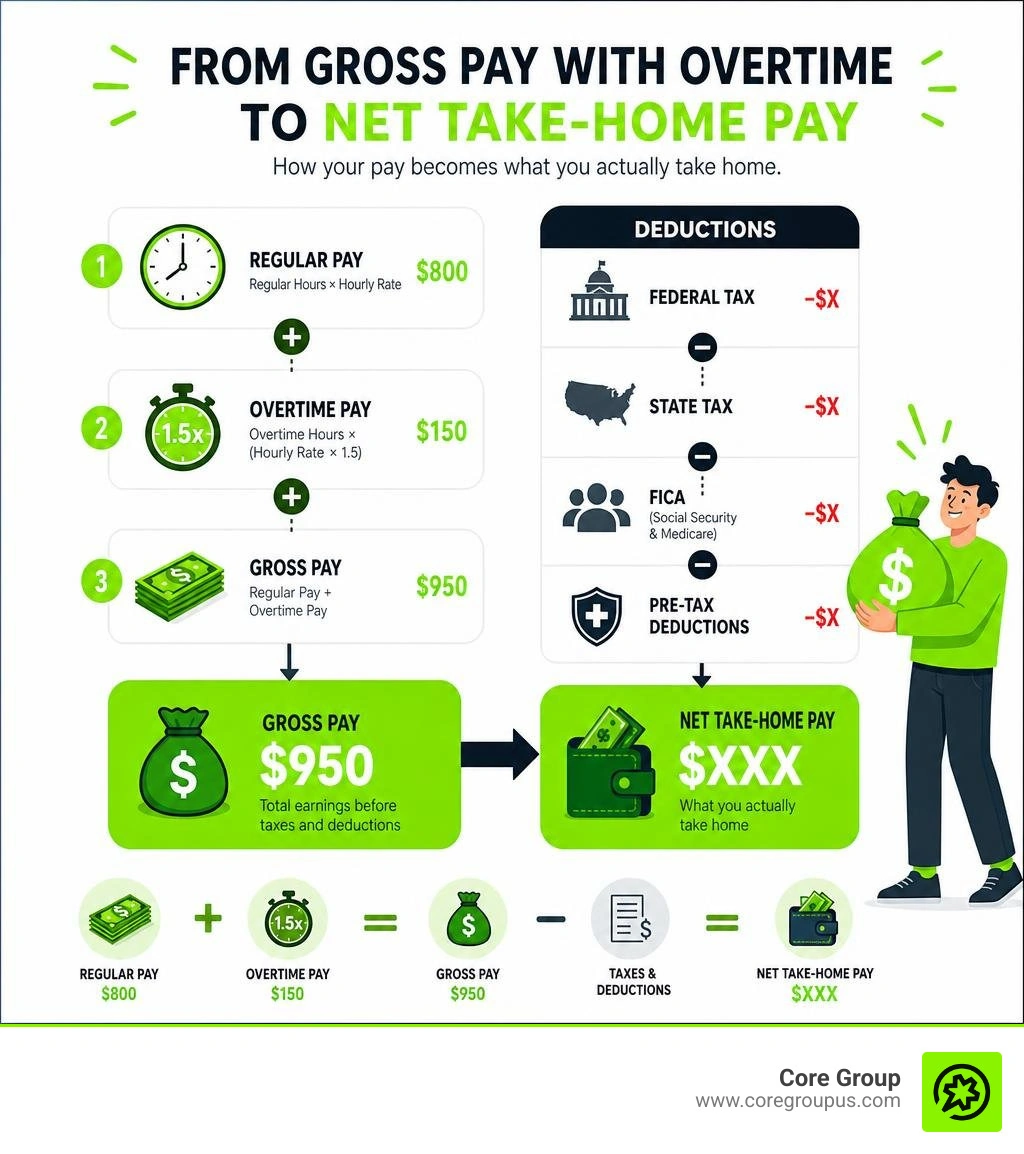
How overtime take-home pay is calculated.
- Regular pay equals regular hours multiplied by hourly rate, such as 40 hours multiplied by $20 which equals $800
- Overtime rate equals hourly rate multiplied by 1.5, such as $20 multiplied by 1.5 which equals $30 per hour
- Overtime pay equals overtime hours multiplied by overtime rate, such as 5 hours multiplied by $30 which equals $150
- Gross pay equals regular pay plus overtime pay, which equals $950
- Net pay equals gross pay minus federal tax, state tax, and FICA deductions
If you work in film, media, or any creative field, your hours are rarely predictable. One week it is 40 hours. The next it is 55. That kind of income variation makes budgeting feel almost impossible.
And yet, knowing your actual take-home pay before the check arrives changes everything. It lets you plan, not just react.
The problem is that calculating overtime pay is not as simple as multiplying extra hours by your hourly rate. Federal and state taxes, FICA contributions, and pre-tax deductions all shrink that number before it hits your bank account. The U.S. median household income hit $83,730 in 2024, but what people actually keep is a very different figure.
That is exactly where an overtime paycheck calculator earns its keep.
Paycheck calculator with overtime terms to learn include the following.
Understanding the Paycheck Calculator with Overtime and How It Works
At its core, a paycheck calculator with overtime is a digital tool designed to translate your hard work into an accurate estimate of your net pay. To understand how it works, we must first look at the difference between gross pay and net pay. Gross pay is the total amount of money you earn before any taxes or benefits are taken out. Net pay, often called take-home pay, is the actual amount that lands in your bank account on payday.
For creative professionals, freelancers, and hourly employees, extra earnings from overtime can make up a significant portion of monthly income. However, without a reliable calculator, trying to estimate these earnings can lead to frustrating surprises. Online overtime calculators do the heavy lifting by automatically applying federal, state, and local tax formulas to your gross earnings.
Using these tools is a game-changer for financial planning and budgeting. When you know exactly how much of your overtime money will survive the tax gauntlet, you can make smarter decisions about saving, investing, or upgrading your creative gear. It helps you move away from guesswork and toward real financial clarity.
How to Calculate Overtime Pay and Input Your Information
Calculating your overtime pay manually is a great way to verify that your employer is paying you correctly. The standard formula relies on your regular hourly rate, your regular hours, your overtime multiplier, and your overtime hours. Under federal law, the standard overtime multiplier is 1.5, which is commonly referred to as time and a half.

To find your overtime rate, you simply multiply your standard hourly wage by 1.5. If you earn $25 per hour, your overtime rate is $37.50 per hour. If you worked 10 hours of overtime in a weekly pay period, your overtime pay would be 10 multiplied by $37.50, which equals $375. You then add this to your regular gross pay of $1,000 to get a total gross pay of $1,375.
To make this process effortless, you can use specialized tools like the Overtime Calculator Free OT Pay Calculator for All 50 US States to quickly run the numbers.
Step by Step Guide to Using a Paycheck Calculator with Overtime
Using a digital calculator is simple when you have the right information ready. Follow these steps to get an accurate estimate of your take-home pay.
First, enter your basic pay details. This includes your regular hourly wage and the number of regular hours you worked during the pay period.
Second, input your overtime hours. Specify the number of hours worked beyond the standard 40-hour workweek, and ensure the calculator is set to the correct multiplier, which is usually 1.5.
Third, enter your tax filing status. You will need to select whether you file as single, married filing jointly, married filing separately, or head of household. This determines your federal withholding rates.
Fourth, input your state and local details. Select your state to ensure the calculator applies the correct state withholding rules. If you live in a city or county with local income taxes, make sure to enter those details as well.
Fifth, add any voluntary deductions. This includes pre-tax contributions like retirement savings or health insurance premiums, which reduce your taxable income.
Common Mistakes to Avoid When Using a Paycheck Calculator with Overtime
While paycheck calculators are incredibly accurate, they are only as good as the data you enter. One of the most common mistakes is entering incorrect hours. It is easy to confuse your total hours worked with your regular hours. Always separate your regular hours from your overtime hours before typing them in.
Another frequent error is selecting the wrong tax filing status. Your filing status on your W-4 form must match what you select in the calculator, or your estimated net pay will be incorrect.
Ignoring local taxes is another oversight that can throw off your calculations. Many municipalities levy their own income taxes, which can quietly chip away at your take-home pay.
Finally, miscalculating pre-tax deductions can lead to inaccurate results. If you contribute a flat dollar amount to your retirement plan but enter it as a percentage, or vice versa, your taxable income calculation will be wrong. Taking your time to double-check these details ensures your estimate is as close to your actual paystub as possible.
Federal and State Rules for Overtime Calculations
Overtime is not just a perk; it is a legal right protected by federal and state laws. The primary federal law governing overtime is the Fair Labor Standards Act, which mandates that non-exempt employees must receive overtime pay for all hours worked over 40 in a workweek.

However, federal law is only the baseline. Many states have established their own overtime regulations that are more generous to workers. When federal and state laws differ, employers must follow the law that provides the higher rate of pay or the greater benefit to the employee.
Some states require daily overtime pay, which means you earn time and a half after working a certain number of hours in a single day, regardless of whether you exceed 40 hours in the week. Others even require double time, which is twice your regular hourly rate, for exceptionally long shifts. Because of these variations, state salary paycheck calculators and state hourly paycheck calculators must be updated regularly to reflect changing state tax withholding rules and labor laws.
To see how these rules apply in your specific area, you can explore tools like the Alabama Paycheck Calculator ADP, the Arizona Paycheck Calculator ADP, or the Arkansas Paycheck Calculator ADP.
Key Differences in State Overtime Laws
State-level overtime rules can vary significantly, making it crucial to know the specific regulations in your state.
In California, the rules are some of the most protective in the nation. Workers earn overtime after 8 hours of work in a single workday, as well as for the first 8 hours worked on the seventh consecutive day of work in a workweek. Additionally, double-time pay kick in after 12 hours of work in a single day. You can use the 2026 California Salary Paycheck Calculator · PaycheckCity or the California Paycheck Calculator ADP to calculate these complex scenarios.
In Colorado, employees are entitled to overtime for any hours worked over 40 per workweek, over 12 per workday, or over 12 consecutive hours. You can estimate these earnings using the 2026 Colorado Salary Paycheck Calculator · PaycheckCity or the Colorado Paycheck Calculator ADP.
Alaska also has a daily overtime standard, requiring time and a half for any hours worked beyond 8 in a single day for employers with four or more employees. Tools like the 2026 Alaska Hourly Paycheck Calculator - PaycheckCity help workers in the state keep track of their earnings.
Other states, such as Connecticut and Delaware, generally follow the federal 40-hour workweek standard but have their own unique tax withholding structures. You can check your potential take-home pay in these states using the Connecticut Paycheck Calculator ADP and the Delaware Paycheck Calculator ADP.
How Taxes and Deductions Impact Your Take Home Pay
When your gross pay increases due to overtime, your taxes and deductions change too. The primary payroll taxes deducted from your paycheck are FICA taxes, which stand for the Federal Insurance Contributions Act. FICA taxes total 15.3% of your gross wages, with the employee and employer each paying 7.65%.
The employee portion of FICA consists of a 6.2% Social Security tax and a 1.45% Medicare tax. For the 2026 tax year, the Social Security tax cap is $184,500, meaning you do not pay the 6.2% tax on any earnings above this threshold. However, there is no wage cap for the Medicare tax. In fact, an Additional Medicare Tax of 0.9% applies to wages exceeding $200,000 for single filers and $250,000 for married taxpayers filing jointly.
Federal income taxes are progressive, meaning that as you earn more money, your income is taxed at higher marginal rates. These rates range from 10% up to 37% for the highest earners. When you earn overtime, that extra income is stacked on top of your regular earnings, meaning it is often taxed at your highest marginal tax bracket.
To learn more about how this works, you can read about the overtime tax rate and discover how to calculate overtime tax rate.
Understanding Pre Tax and Post Tax Deductions
Deductions are another major factor that determines your final take-home pay. These are divided into pre-tax and post-tax deductions, and they affect your taxes in very different ways.
Pre-tax deductions are taken out of your gross pay before taxes are calculated. This lowers your taxable income, which in turn reduces the amount of federal and state income tax you owe. Common examples include traditional retirement contributions, health savings accounts, and health insurance premiums.
Post-tax deductions are taken out after taxes have been calculated. While they do not reduce your tax liability, they are often used for convenient savings or necessary expenses. Examples include Roth contributions and wage garnishments.
| Deduction Type | Tax Savings | Common Examples |
|---|---|---|
| Pre-Tax Deductions | Yes, lowers taxable income | Traditional 401k, HSA, Health Insurance |
| Post-Tax Deductions | No, taken after taxes | Roth 401k, Roth IRA, Garnishments |
For the 2025 and 2026 tax years, the annual contribution limit for an employee 401k is $23,500 for those under 50, and $31,000 for those 50 and older. Additionally, the HSA contribution limits are $4,150 for individual coverage and $8,300 for family coverage. Utilizing these pre-tax benefits is an excellent way to keep more of your hard-earned overtime money.
Frequently Asked Questions About Overtime Pay
Understanding the mechanics of overtime pay can raise a lot of questions, especially when taxes get involved. Here are the answers to some of the most common questions we hear.
Is Overtime Taxed at a Higher Rate Than Regular Pay
This is one of the most common myths in payroll. The short answer is no, overtime is not taxed at a higher rate than regular pay over the course of the entire year. All of your earned income is subject to the same progressive tax brackets at the end of the year.
However, it can feel like it is taxed higher because of how tax withholding works. If your employer pays your overtime as a separate bonus or supplemental payment, they might use a flat supplemental tax rate of 22% for federal withholding. If the overtime is included in your regular paycheck, the payroll software might assume you make that higher amount every single pay period, pushing you into a higher temporary withholding bracket. Any over-withheld taxes will be returned to you as a refund when you file your tax return.
To dive deeper into this topic, you can read our guides on does overtime get taxed at a higher rate, check out what is the federal tax rate on overtime, and learn if there are state-specific rules in is overtime taxed at a higher rate in california.
How Do Different Pay Frequencies Affect Overtime Calculations
Your pay frequency determines how often you get paid, but it does not change the legal definition of a workweek for overtime purposes. Under the Fair Labor Standards Act, a workweek is a fixed, recurring period of 168 consecutive hours.
Whether you receive weekly pay, biweekly pay, semimonthly pay, or monthly pay, your employer must calculate overtime based on each individual workweek. They cannot average your hours over two or more weeks. For example, if you work 50 hours in week one and 30 hours in week two of a biweekly pay period, you must be paid 10 hours of overtime for the first week, even though your total hours for the pay period average out to 40 per week.
Can Salaried Employees Earn Overtime Pay
Yes, salaried employees can absolutely earn overtime pay, depending on their classification. Employees are divided into two categories, exempt and nonexempt.
Exempt employees are not legally required to receive overtime pay. To be classified as exempt, an employee must earn at least a specific salary threshold and perform specific professional, administrative, or executive job duties as defined by the law.
Nonexempt employees must be paid overtime, regardless of whether they are paid by the hour or receive a salary. If a salaried employee earns less than the federal salary threshold, they are automatically nonexempt and must receive overtime pay for any hours worked over 40 in a workweek. To calculate their overtime rate, you divide their weekly salary equivalent by 40 to find their regular hourly rate, then multiply that rate by 1.5.
Conclusion
Managing your finances as a creative entrepreneur or hourly professional does not have to be a guessing game. When you use a paycheck calculator with overtime, you take control of your financial planning and gain the peace of mind that comes with knowing your exact take-home pay.
At Core Group, we understand that your time is best spent creating, not drowning in payroll formulas and tax compliance. That is why we offer a no-fluff, profit-first playbook designed specifically for creative entrepreneurs. We handle the financial heavy lifting, from bookkeeping to complex payroll management, all backed by our MacBook Pro guarantee.
If you want to simplify your business operations, check out our Payroll Services Small Business Guide and our comprehensive Payroll Guide Small Business Owners 2026. Whether you are looking for payroll for SMB solutions or managing small business payroll one employee setups, we are here to help.
To take the next step toward stress-free financial management, visit our overtime tax rate guide or reach out to us today to see how we can bring clarity to your business.