DIY vs. CPA: What Should S-Corp Bookkeeping Actually Cost You?
What S-Corp Bookkeeping Near Me Actually Costs You
If you're running an S-corp, finding reliable s-corp bookkeeping near me is one of the most important financial decisions you'll make. Here is a quick answer to help you get started.
To find and evaluate S-corp bookkeeping services near you, follow these steps
- Search for bookkeepers or CPAs with specific S-corp experience, not just general small business accounting
- Expect to pay between $300 and $600 per month for basic bookkeeping, plus $100 to $200 for payroll
- Look for someone who handles payroll, shareholder distributions, and quarterly estimated taxes
- Ask about their experience with reasonable salary requirements for S-corp owners
- Check reviews and ask for referrals from other business owners in your industry
S-corps are the most common type of corporation in the U.S., with over 4.5 million returns filed with the IRS every year. That popularity makes sense. When set up and managed correctly, an S-corp can save you $4,000 to $8,000 per year in self-employment taxes compared to operating as a sole proprietor.
But here's the catch. Those savings only happen with accurate, consistent bookkeeping and payroll. Nearly 70% of small businesses that fail point to poor cash flow management and weak bookkeeping as a root cause. For creative entrepreneurs juggling projects, clients, and deadlines, the books are often the last thing on the to-do list until tax season hits.
That's exactly the gap this guide is designed to close. I'm Christian Brim, and I'll walk you through what professional S-corp bookkeeping actually costs, how it compares to doing it yourself, and how to find the right financial partner so you can get back to the work you love.
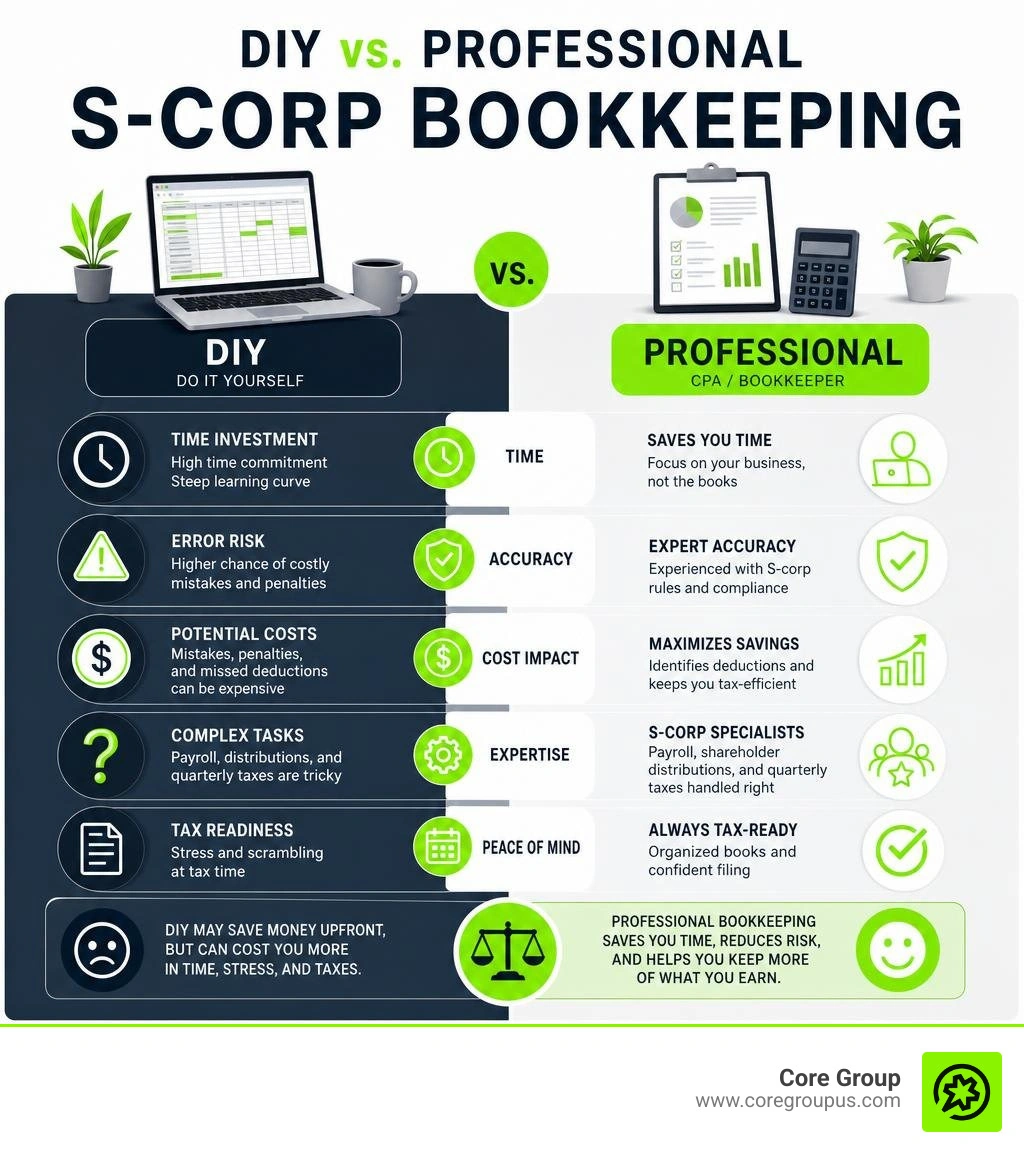
Useful terms for S-corp bookkeeping near me include the following.
Understanding S-Corp Bookkeeping and Why It Differs From Other Structures

Operating as an S-corporation brings incredible tax advantages, but it also introduces a completely new set of financial rules. Unlike a simple sole proprietorship or a basic single-member LLC, an S-corp is treated as a unique corporate entity by the IRS. You can learn more about this on the IRS S Corporation Page. This status requires a much more disciplined approach to your monthly financial tracking.
To understand why your bookkeeping must level up, we need to look at how the IRS views your income. When you run a standard sole proprietorship, all your business profit is subject to self-employment tax. When you transition to an S-corp, your income is split into two distinct categories.
The first category is your salary. As an S-corp shareholder who actively works in the business, the IRS requires you to pay yourself a reasonable salary through regular payroll. This salary is subject to standard payroll taxes. The second category is shareholder distributions. Any profit left over after paying your business expenses and your reasonable salary can be distributed to you as a shareholder. These distributions are not subject to self-employment taxes, which is where those massive tax savings of $4,000 to $8,000 per year come from.
However, you cannot just move money around whenever you feel like it. You must follow strict guidelines to keep the IRS happy. For a deeper dive into how this works, you can read our S-Corporations Guide to understand the foundational structure.
Properly tracking these separate payment streams is the core of S-corp bookkeeping. You must run a formal payroll system and file quarterly payroll tax returns. You also need to keep pristine records of your shareholder distributions. If you misclassify a distribution as a loan or pay yourself a salary that is too low, you risk triggering an expensive IRS audit. To make sure you are staying compliant with payroll regulations, check out our breakdown of the S-Corp Payroll Rules.
The Real Cost of Professional S-Corp Bookkeeping Near Me
Many business owners hesitate to hire professional help because they worry about the ongoing cost. They wonder if they can just handle it themselves using basic accounting software. While DIY bookkeeping seems free at first, it often costs you more in lost time, missed tax deductions, and costly mistakes.
When you look for s-corp bookkeeping near me, you will find that pricing generally falls into predictable ranges based on the size of your business and the complexity of your transactions.
Here is a breakdown of what you can expect to pay for different levels of bookkeeping support.
| Service Level | Monthly Bookkeeping Cost | Payroll Processing Fees | Software Subscriptions |
|---|---|---|---|
| Do It Yourself | $0 plus your personal time | $40 to $80 per month | $30 to $90 per month |
| Basic Professional Bookkeeping | $300 to $600 per month | $100 to $200 per month | Often included in package |
| Premium Full Service Accounting | $700 to $1,200 per month | Included in package | Included in package |
Basic professional bookkeeping services typically range from $300 to $600 per month. This service ensures your bank accounts are reconciled, your expenses are categorized correctly, and your financial statements are ready for tax season. Payroll processing is often an additional $100 to $200 per month because of the extra tax filings required for S-corp owners.
If you are trying to decide which route is best for your business, reading our Bookkeeping Services Complete Guide will help you understand the different options available. For those ready to hand off their financial tasks to experienced professionals, our Expert Bookkeeping Services offer a seamless way to protect your time and keep your business compliant.
How to Choose the Right Financial Partner for Your Business

Choosing a bookkeeper is not just about finding the lowest price. It is about finding a long-term financial partner who understands your industry and can help you make smart business decisions. You want a team that looks at your numbers proactively rather than just recording historical data after the year has ended.
When you work with a professional who understands the big picture, your bookkeeping becomes a tool for tax reduction. If you want to maximize your deductions and keep more of your hard-earned cash, you should look into our Tax Planning Services Near Me to see how bookkeeping and tax strategy work together.
Finding Reliable S-Corp Bookkeeping Near Me
To find the best local financial partners, start by asking other successful business owners in your area for recommendations. Peer referrals are incredibly valuable because they give you an honest look at what it is like to work with a specific firm.
You can also search online for local bookkeeping firms and read through client reviews. Look for firms that have experience working with S-corporations and creative businesses. The Small Business Administration provides excellent resources for understanding local compliance, and you can consult the official SBA Small Business Guide to learn more about local business requirements.
What to Look for in S-Corp Bookkeeping Near Me
When you are interviewing potential bookkeeping partners, you should ask specific questions to gauge their expertise.
- Do they have deep experience with S-corporations and understand the reasonable salary rules
- What accounting software do they use and will you have real-time access to your financial data
- Do they offer proactive tax planning throughout the year or do they only talk to you during tax season
- Will they provide audit support if the IRS ever questions your business filings
Answering these questions upfront will save you from hiring a firm that only does basic data entry without understanding the unique tax needs of an S-corporation.
Common S-Corp Bookkeeping Mistakes and How to Avoid Them
Many business owners make simple mistakes that complicate their tax filings and cost them money. By understanding these pitfalls, you can set up your financial systems to avoid them entirely.
The most common mistake we see is commingling personal and business funds. It is incredibly tempting to use your business debit card for a quick personal purchase, but this practice blurs the line between your personal life and your corporate entity. To maintain the liability protection of your S-corp, you must keep your personal and business finances completely separate.
Another frequent error is setting up payroll incorrectly. Some owners try to skip payroll entirely and just take shareholder distributions to avoid payroll taxes. This is a massive red flag for the IRS. You must run a formal payroll system using reliable software like QuickBooks Online or Xero to process your salary and file the necessary quarterly payroll taxes.
Neglecting monthly bank reconciliations is also a major issue. If you do not reconcile your books every month, errors can pile up quickly. This makes it difficult to know your true cash flow and complicates your year-end tax filing.
Frequently Asked Questions About S-Corp Bookkeeping
Can I do S-Corp bookkeeping myself
You can technically manage your own S-corp bookkeeping using modern software, but it is rarely the best use of your time. The learning curve for managing payroll, tracking shareholder distributions, and staying compliant with corporate tax rules is steep. The time you spend wrestling with spreadsheets and software is time you could spend generating revenue for your business. There is also a high risk of making an error that could result in IRS penalties.
What records do I need to keep for S-Corp tax compliance
To maintain compliance, you must keep detailed records of all financial transactions. This includes your business bank statements, credit card statements, payroll records, and receipts for all business expenses. You will also need to keep copies of your W2 forms, shareholder distribution records, and the Schedule K1 forms that distribute the corporate income to your personal tax return.
How often should I reconcile my S-Corp books
You should reconcile your books at least once a month. Monthly reconciliation allows you to catch errors early, monitor your cash flow in real time, and make informed business decisions based on accurate financial data.
Conclusion
Managing the financial side of an S-corporation does not have to be a source of stress. At Core Group, we offer a specialized profit-first playbook designed specifically for creative entrepreneurs. We handle your bookkeeping, payroll, and tax planning so you can focus on growing your business and doing the creative work you love.
We are so confident in our ability to streamline your finances and give you peace of mind that we back our services with a unique MacBook Pro guarantee. If you are ready to take control of your business finances and set up your S-corp the right way, explore our guide on how to form an S-corp and let our team handle the heavy lifting for you.