Tax Planning Services Near Me and How to Choose the Right One
Why Finding the Right Tax Planning Service Near You Matters
If you have been searching for tax planning services near me, here is a quick answer to help you decide what you actually need.
What to look for in a local tax planning service includes
- A proactive advisor, not just a filer who works with you year-round, not only at tax season
- CPA credentials because CPAs can represent you in audits and appeals, whereas not all preparers can
- Services that match your situation whether individual, freelance, small business, or complex and high income
- Transparent pricing that is flat-fee or clearly tiered, so there are no surprises
- Local knowledge and familiarity with your state and local tax rules
Most people only think about taxes in April. But by then, the decisions that could have saved you money have already been made.
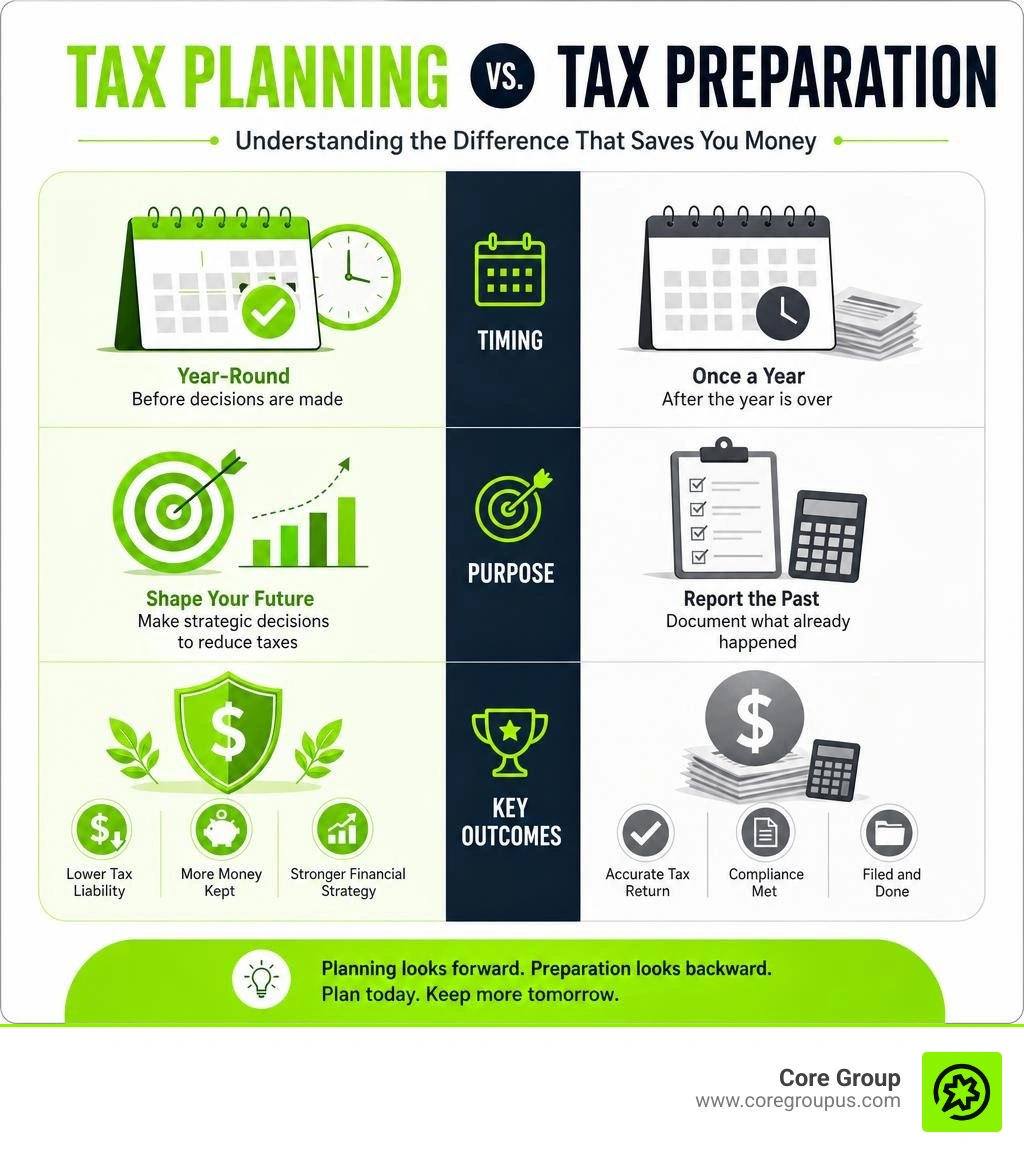
Tax planning is different from tax preparation. Preparation is looking backward. It records what already happened. Planning is looking forward. It shapes what happens next, before the year closes.
For creative entrepreneurs especially, this distinction is huge. Irregular income, project-based work, and blurred lines between personal and business spending make proactive planning not just useful but essential.
The right local advisor can help you reduce what you owe, avoid unexpected bills, and build a financial strategy that actually fits how you work and earn.
Understanding Tax Planning Services Near Me
When searching for the right financial help, many people use the term tax preparation and tax planning interchangeably. However, understanding the difference is the first step toward real financial freedom. Proactive tax analysis is the core of true tax planning. It allows you to look at your financial landscape throughout the fiscal year and make structural changes before December 31. This is vastly different from simply gathering your W2s and 1099s in April to report history.
Working with local financial advisors who understand your specific market helps in several ways. They do not just fill out forms. Instead, they focus on tax liability reduction and tax refund optimization. They look at your current income streams, business structure, and personal goals to find legal paths to keep more of your hard-earned money.
If you want to understand how these two services compare, look at the fundamental differences in timing, focus, and overall value.
| Feature | Tax Preparation | Tax Planning |
|---|---|---|
| Timing | Once a year, usually between January and April | Year-round, with active strategy sessions |
| Perspective | Historical, looking at the previous calendar year | Forward-looking, projecting future income and events |
| Primary Goal | Compliance with IRS rules and filing returns | Reducing tax liability and maximizing wealth |
| Approach | Reactive, reporting what has already occurred | Proactive, shaping transactions before they happen |
| Outcome | A filed tax return and a bill or refund | A customized roadmap to reduce future tax burdens |
By taking a proactive approach, you can discover custom methods on how to save on taxes rather than waiting until it is too late to make a difference.
What is Included in Tax Planning Services Near Me
A comprehensive tax planning package goes far beyond basic filing. When you hire a professional team, they will look at your entire financial ecosystem. This includes setting up an accurate system for estimated tax payments. If you are self-employed or run a business, making quarterly payments is required to avoid IRS underpayment penalties. A dedicated planner calculates these payments precisely based on real-time earnings, rather than relying on safe-harbor estimates that might leave you with a massive bill or an overpaid refund.
Withholding adjustments are another critical piece of the puzzle. If you are an employee or pay yourself a salary through an S-Corporation, your planner will help you adjust your tax forms to ensure you are not giving the government an interest-free loan or setting yourself up for a penalty.
Furthermore, your advisor will perform a deep tax credit evaluation. Tax credits are highly valuable because they reduce your tax bill dollar-for-dollar, unlike deductions which only lower your taxable income. From energy-efficient business upgrades to research and development credits, a local expert knows which incentives apply to your industry.
Finally, life event planning is integrated into your strategy. Major milestones like marriage, having a child, buying real estate, or starting a business completely change your tax profile. Your planner will help you navigate these transitions smoothly. For business owners, this also involves structured business year-end tax planning to ensure all business expenses, equipment purchases, and bonuses are timed perfectly before the clock strikes midnight on December 31.
Key Strategies and Services Offered by Local Advisors

Local tax planners use a variety of advanced methods to protect your income. Here are the most common tax planning strategies used by top-tier CPAs and financial firms
- Strategic Entity Selection to choose whether to operate as a Sole Proprietorship, LLC, S-Corporation, or C-Corporation to minimize self-employment taxes.
- Income and Expense Timing by shifting income into future years or accelerating deductible business expenses into the current year based on tax bracket projections.
- Maximizing Depreciation through utilizing Section 179 and bonus depreciation to write off the cost of business equipment and technology immediately.
- Retirement Account Optimization to determine the ideal mix of traditional and Roth contributions to lower current taxable income while building tax-free wealth.
- Tax-Loss Harvesting by selling underperforming investments to offset capital gains realized throughout the year.
Implementing these systems requires a deep understanding of tax law. For instance, entity selection is not a one-time decision. As your business grows, transitioning from a standard LLC to an S-Corporation can save you thousands of dollars in self-employment taxes by allowing you to split your income between a reasonable salary and shareholder distributions.
Timing your income and expenses is another powerful tool. If you know your income will be significantly higher next year, it may make sense to delay billing clients until January or prepay certain business expenses in December to stay in a lower tax bracket. By exploring professional tax planning strategies, you can build a systematic plan that grows with your business. This is especially vital for independent creators, which is why specialized tax planning for freelancers focuses on maximizing home office deductions, tracking mileage, and managing write-offs.
Wealth Integration and Retirement Planning
Your tax strategy should never exist in a vacuum. It must be fully integrated into your overall wealth management plan. One of the easiest ways to reduce your current tax burden while building security is through retirement contributions. Contributing to a Traditional IRA, 401k, or Simplified Employee Pension plan reduces your adjusted gross income dollar-for-dollar in the year you make the contribution.
Investment tax efficiency is another critical area. Different types of investments are taxed at different rates. For example, long-term capital gains and qualified dividends enjoy lower tax rates than ordinary income. An experienced tax planner will help you structure your investment portfolio so that highly taxed assets are held inside tax-advantaged retirement accounts, while tax-efficient assets are kept in taxable accounts.
For those looking to preserve wealth for the next generation, estate planning and gift tax strategies are essential. The federal estate and gift tax rules are highly complex and constantly changing. By utilizing trusts, lifetime gifting strategies, and family partnerships, you can transfer wealth to your heirs with minimal tax exposure. Understanding estate and investment tax planning ensures that your personal wealth, business assets, and legacy are fully protected under current tax codes.
How to Choose the Best Tax Planner in Your Area

Finding the right professional requires looking beyond a basic web search. You need to understand how local tax laws and state regulations impact your financial strategy. Tax rules vary wildly from state to state. For example, states like California and New York have complex state tax brackets and compliance rules, while states like Texas and Florida have no state income tax but unique business franchise taxes. A local expert will be intimately familiar with these regional nuances.
There is a massive benefit to working with a local tax advisor versus a national chain. National tax chains are built for high-volume, transactional tax preparation. They often hire temporary workers with basic training during tax season to input data into software. In contrast, a local CPA or specialized tax firm offers year-round, principal-led advisory relationships. They take the time to understand your personal story, your business model, and your long-term dreams.
When evaluating a potential partner, look for highly qualified professionals in your region who understand regional business environments. If you are on the west coast, you might look into a specialized tax planner to navigate complex state regulations. For those in other regions, dedicated local accountants can provide the local expertise you need.
To protect your business and personal assets, you must understand what should be considered in tax planning before signing an agreement. By focusing on qualified credentials and local experience, you can implement proven strategies to minimize taxes that are fully compliant with both federal and state laws.
The Cost of Tax Planning Services Near Me
Understanding how tax planners bill for their expertise will help you budget effectively and measure your return on investment. Firms generally use one of three pricing models
- Flat-Fee Pricing where you pay a set monthly or annual fee for a bundle of services, which typically includes tax planning, year-round consultations, and tax return preparation. This model is highly popular because it eliminates billing surprises and encourages open communication.
- Hourly Rates where you are billed for the exact amount of time the professional spends working on your file. While this can work for simple, one-off questions, it can quickly become expensive for complex, ongoing planning.
- Value-Based Billing where the fee is determined by the complexity of your situation and the overall value or tax savings the firm delivers.
Many modern accounting firms offer clearly defined tax preparation pricing tiers based on complexity. For example, basic personal tax preparation might start around 850 dollars, while advanced returns involving rental properties or S-Corporation distributions can start around 1250 dollars. For high-net-worth individuals and complex businesses, comprehensive packages involving quarterly strategy sessions and advanced planning often start at 2500 dollars or more.
It is important to view these costs as an investment rather than an expense. A single strategic decision can save you far more than the cost of the planning service. For businesses, this involves integrating corporate tax planning and strategy to optimize business deductions. If you operate with partners, specialized tax planning strategies for partnerships can help structure equity and profit distributions in the most tax-efficient way possible.
Frequently Asked Questions About Local Tax Advisors
Navigating professional tax services can bring up many questions. Below are some of the most common inquiries regarding tax compliance, professional credentials, and ongoing advisory relationships.
How often should I review my tax plan
You should review your tax plan at least once a year, but a quarterly or mid-year review is highly recommended for business owners and high-income earners. Waiting until December to look at your financial numbers leaves you with very little time to implement key strategies.
Regular updates are crucial because your financial situation is constantly evolving. Significant life changes, such as getting married, purchasing a home, having a child, or experiencing rapid business growth, will immediately impact your tax bracket and eligibility for certain deductions. A mid-year check-in allows your advisor to adjust your estimated payments and withholding strategies, ensuring you do not face any surprises when it is time to file. You can also review general federal guidance through the IRS tax withholding estimator when preparing for a conversation with your advisor.
What happens during an initial consultation
An initial consultation is a mutual discovery meeting designed to see if you and the tax planning firm are a good fit. During this meeting, the advisor will review your recent financial documents, including your past two years of tax returns, profit and loss statements, and current investment profiles.
You will discuss your personal and business goals, such as plans to expand your business, buy real estate, or prepare for retirement. The advisor will highlight immediate opportunities for tax savings and explain their fee structure, helping you understand exactly what is included in their service packages before you make any commitments.
What is the difference between a CPA and a tax preparer
The primary differences lie in their education, credentials, and representation rights. Anyone with a Preparer Tax Identification Number can register to prepare tax returns, but their ability to support you during a dispute is highly limited.
A Certified Public Accountant has completed rigorous accounting education, passed a comprehensive national exam, and met strict state licensing requirements. Crucially, CPAs have unlimited representation rights before the IRS. This means they can represent you, handle audits, and manage appeals on your behalf. Additionally, CPAs are trained to provide advanced, strategic guidance throughout the year, whereas basic tax preparers generally focus on data entry during tax season.
For those looking for basic filing options, national retail tax preparation chains can handle simple returns. However, if you run a growing business or have a complex financial situation, working with a dedicated CPA firm is essential for long-term planning.
Conclusion
Making strategic financial decisions throughout the year is the only way to legally minimize your tax burden and build lasting wealth. When you move away from reactive tax preparation and embrace proactive tax planning, you gain complete control over your financial future.
At Core Group, we understand that creative entrepreneurs, freelancers, and growing businesses need more than just standard accounting. They need a clear, actionable path to profitability without the confusing financial jargon. That is why we offer our signature, no-fluff, profit-first playbook. Our system is designed to save you time, eliminate tax-season stress, and guarantee ultimate peace of mind. We are so confident in our ability to streamline your financial management that we back our services with our unique MacBook Pro guarantee.
Do not wait until tax season to wish you had a plan. Explore our comprehensive Core Group tax planning resources today and schedule a consultation with our team to start keeping more of what you earn.