S-Corp Business Deductions: From Startup Costs to Client Dinners
What S-Corp Owners Can Actually Write Off
S-corp business deductions let you reduce your company's taxable income by writing off legitimate costs, from your own salary and health insurance to equipment, travel, and home office expenses.
Here are the main categories of deductions available to S-corps.
| Deduction Category | Examples |
|---|---|
| Owner compensation | W-2 salary, payroll taxes |
| Health and retirement | Insurance premiums, 401(k), SEP IRA |
| Home office | Utilities, rent, mortgage interest |
| Vehicle and travel | Mileage, flights, hotels |
| Daily operations | Rent, software, professional fees |
| Equipment and assets | Section 179, bonus depreciation |
| Startup costs | Legal fees, market research |
| Pass-through benefits | QBI deduction, charitable contributions |
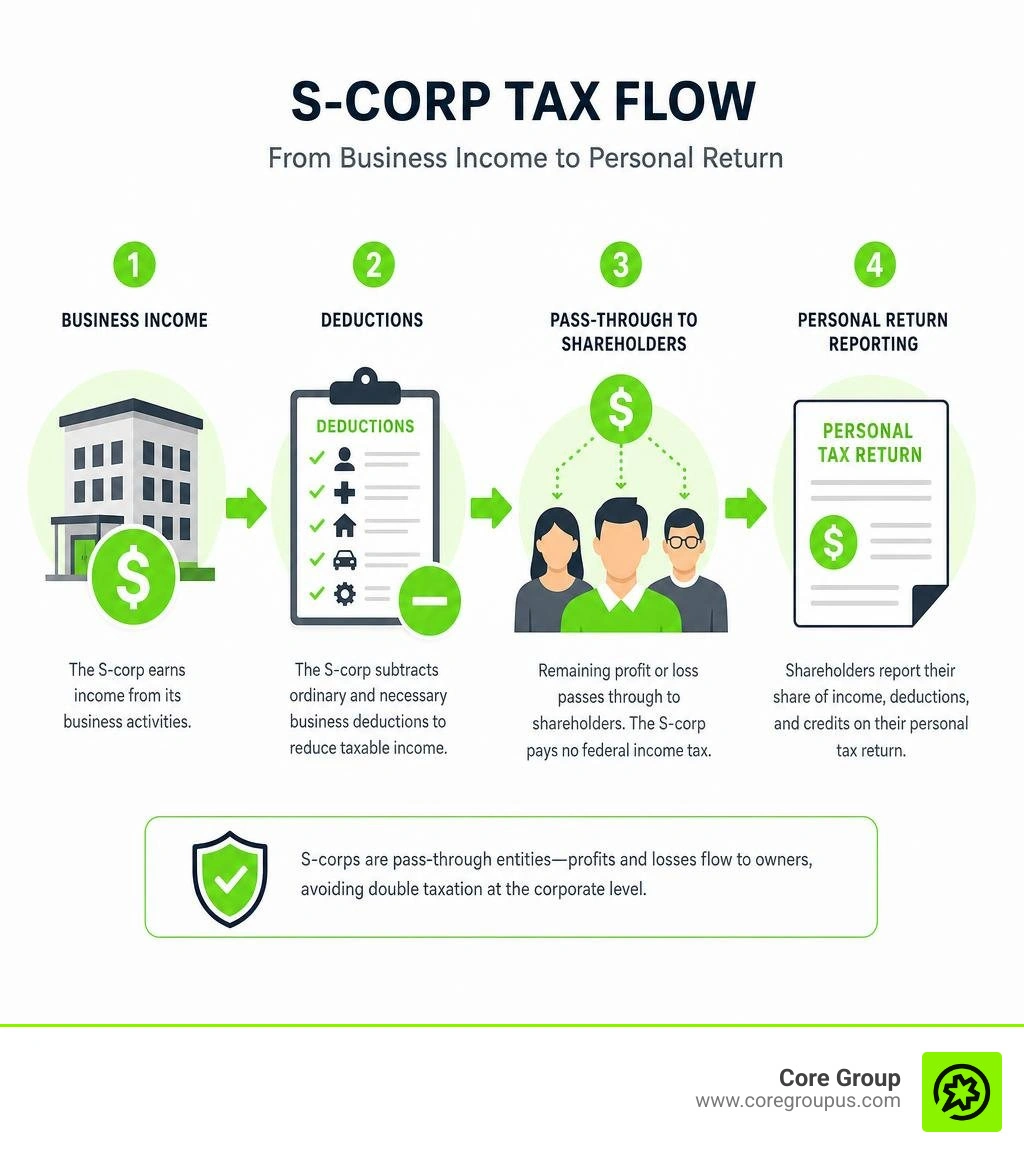
S-corps are pass-through entities. That means the business itself pays no federal income tax. Instead, profits and losses flow through to shareholders, who report them on their personal returns.
That structure creates real tax advantages. But only if you know which deductions apply and how to claim them correctly.
According to a QuickBooks survey, over 40% of small business owners overpaid their taxes by missing eligible deductions. Nearly 90% of entrepreneurs miss write-offs simply because of poor record tracking.
If you run a creative business, juggling client projects while staying on top of receipts and tax rules can feel overwhelming. The good news is that understanding your core deductions makes the whole process much less stressful.
S-Corp Business Deductions and the Reasonable Salary Rule
When you run an S-corp, you wear two hats. You are a shareholder who owns the business, and you are also an employee who runs it. This dual status is the foundation of the S-corp tax structure, but it comes with strict rules.
Unlike a sole proprietorship or a standard limited liability company, you cannot just take cash out of your business whenever you feel like it and call it a day. The IRS requires S-corp owners to pay themselves a reasonable W-2 salary.
By paying yourself a W-2 salary, your business gets to claim a deduction for employee compensation and payroll taxes. The remaining business profit can then be distributed to you as shareholder distributions.
The major tax planning benefit here is that shareholder distributions are not subject to self-employment taxes, which include Social Security and Medicare taxes. This can save you thousands of dollars every year. However, you cannot simply set your salary to zero to avoid payroll taxes.
The IRS actively audits S-corporations that pay little or no salary while distributing large amounts of cash to their owners. To stay compliant, you must determine what constitutes a reasonable salary. The IRS looks at several factors to evaluate this, including your training, your experience, the nature of your duties, the time you devote to the business, and what comparable businesses pay for similar services in your area.
Many business owners use a benchmark like the 60-40 rule, where 60% of the business profit is allocated to W-2 salary and 40% is taken as distributions. However, your salary must always be defensible based on real world facts. For a deeper dive into managing your payroll compliance, check out our guide on S-Corp Payroll Rules. If you are still deciding whether this structure fits your business, you can also review the S-Corp Eligibility Requirements.
Essential S-Corp Write-Offs for Daily Operations
To qualify as a deduction, the IRS states that a business expense must be ordinary and necessary. An ordinary expense is one that is common and accepted in your industry. A necessary expense is one that is helpful and appropriate for your trade or business.
For creative entrepreneurs, daily operational expenses form the backbone of your s-corp business deductions. These daily costs include office rent, utility bills, and professional service fees paid to accountants, lawyers, and consultants. It also includes marketing costs like website hosting, software subscriptions, and social media advertising.
If you previously operated as an LLC, many of these operational deductions will feel familiar. You can see how these compare by reading our LLC Tax Deductions Guide 2026. If you want to understand how your entity structure changes your overall tax liability, you can read about Federal Income Tax LLC and Single Member LLC Taxes to help map out your financial strategy.
Maximizing S-Corp Business Deductions with Accountable Plans
One of the most common mistakes S-corp owners make is trying to deduct home office expenses or personal vehicle use directly on their personal tax returns. Because you are an employee of your S-corp, you cannot claim these deductions on Schedule C like a sole proprietor would.
Instead, your S-corp must establish a written Accountable Plan. This plan allows the corporation to reimburse you tax-free for the business use of your home, personal vehicle, and travel expenses. The corporation then deducts these reimbursements as business expenses, which reduces the business income flowing to your K-1.
To be considered valid by the IRS, your Accountable Plan must meet three strict rules. First, there must be a clear business connection. The expenses must have been paid or incurred while performing services as an employee. Second, there must be timely substantiation. You must provide receipts, mileage logs, and home office calculations within a reasonable timeframe. Third, you must return any excess reimbursement to the corporation within a reasonable period.
For your home office, you can calculate the business use percentage of your rent, mortgage interest, utilities, and internet based on the square footage of your dedicated workspace. This workspace must be used regularly and exclusively for your business. For vehicles, you can track your business miles and reimburse yourself using the standard mileage rate, which is 70 cents per mile for the 2025 tax year and adjusted annually for 2026. Alternatively, you can track actual expenses like gas, insurance, and maintenance, and reimburse the business use percentage.
Health Insurance and Retirement Benefits
Setting up health insurance and retirement benefits through your S-corp is an excellent way to secure your financial future while building up powerful deductions. However, the IRS has unique rules for health insurance when it comes to shareholders who own more than two percent of the company.
Under the two percent shareholder rule, the S-corp must pay the health insurance premiums for the owner, their spouse, and their dependents. The S-corp deducts these premiums as an employee benefit. However, the cost of the premiums must be included on the owner's W-2 form as taxable wages in Box 1.
Even though this amount is included as W-2 wages, it is not subject to Social Security or Medicare taxes. The owner can then claim an above-the-line deduction for self-employed health insurance on Form 1040 Schedule 1. This creates a highly tax-efficient double benefit for the business and the owner.
Additionally, S-corps can establish robust retirement plans. These plans include Solo 401(k) plans, SEP IRAs, and SIMPLE IRAs. For 2026, employee deferral limits and employer contributions can allow you to shelter up to $70,000 or more of your income from taxes, depending on your age and salary levels. This is a core part of advanced Tax Planning Strategies and Business Tax Optimization designed to keep more of your hard-earned cash in your pocket.
Capital Expenditures and Equipment Purchases
When you buy physical assets for your business, such as computers, office furniture, studio equipment, or vehicles, you are making capital expenditures. Normally, these assets must be depreciated over their useful lives. However, S-corporations can leverage Section 179 expensing and bonus depreciation to write off the entire cost in the year of purchase.
Section 179 allows you to deduct the full purchase price of qualifying equipment and software placed in service by December 31 of the tax year. For 2026, the Section 179 deduction limit is approximately $2.5 million, with a phase-out threshold beginning when your total equipment purchases exceed $4 million.
It is important to note that Section 179 cannot create or increase a net business loss. If your business has a tax loss before claiming the deduction, the excess carries forward to future years.
Bonus depreciation is another powerful tool. Unlike Section 179, bonus depreciation can create or increase a net operating loss. Under current tax laws, the bonus depreciation percentage has experienced phase-downs, but qualifying assets placed in service can still provide significant first-year write-offs.

How Asset Depreciation Impacts S-Corp Business Deductions
If you choose not to use Section 179 or bonus depreciation, or if your purchases exceed the annual limits, you must use the Modified Accelerated Cost Recovery System, also known as MACRS, to depreciate your assets.
MACRS assigns different types of assets to specific class lives. For example, computers, copiers, and technological devices typically have a five-year class life. Office furniture and fixtures have a seven-year class life.
To keep track of these assets and ensure your S-corp claims the correct depreciation deductions each year, you must maintain an accurate fixed asset ledger. This ledger tracks the purchase date, original cost, business-use percentage, and accumulated depreciation for every major asset.
For smaller purchases, you can use the de minimis safe harbor rule. This rule allows you to directly expense any equipment or software purchases under $2,500 per invoice in the year of purchase, bypassing the need for depreciation entirely.
State Level Variations and Compliance Requirements
While S-corporations enjoy pass-through status at the federal level, state tax treatments can vary significantly. Failing to understand how your state treats S-corps can lead to unexpected tax bills and compliance penalties.
Some states do not fully recognize S-corporation status and impose entity-level taxes directly on the business. For example, California imposes a 1.5% franchise tax on S-corporation net income, with a minimum annual payment of $800, which is managed through the S corporations Business type - Franchise Tax Board - CA.gov.
Other states, like Delaware, require S-corporations to pay an annual franchise tax and file corporate reports, as outlined by the Filing Corporate Income Tax - Division of Revenue - State of Delaware.
Here is a quick look at how S-corporations are treated across several states where our clients operate.
| State | Entity-Level Tax or Fee | Key Filing and Compliance Details | |
|---|---|---|---|
| Alabama | Yes, Business Privilege Tax | Taxable income computed per [PDF] 810-3-161 computing taxable income of an alabama s corporation | |
| Alaska | No state income tax | Compliance managed under legislative guidelines like [PDF] Senate Bill 114 - Alaska Legislature | |
| Arizona | Yes, optional Pass-Through Entity tax | File corporate returns as detailed by [Corporate Income Tax | Arizona Department of Revenue](https://azdor.gov/business/corporate-income-tax) |
| Arkansas | Yes, requires state-specific election | Handled via Small Business Corporate (Sub-S) | |
| California | Yes, 1.5% tax, minimum $800 | Franchise Tax Board rules apply | |
| Colorado | Yes, optional Pass-Through Entity tax | Managed via [Business Income Tax | Organizational Structure - Colorado Taxes](https://tax.colorado.gov/business-organizational-structure) |
| Connecticut | Yes, mandatory Pass-Through Entity tax | Rules adjusted based on SN 98(3), Effect of Recent Federal Tax Law Changes on ... - CT.gov | |
| Delaware | No state corporate income tax, annual fee | Franchise tax and corporate filing required |
Frequently Asked Questions about S-Corp Deductions
Navigating tax compliance for an S-corporation often brings up specific questions. Here are the answers to the most common questions S-corp owners ask.
Can an S-corp deduct startup and organizational costs
Yes, your S-corp can deduct startup and organizational costs, but you cannot write them all off at once. The IRS allows you to deduct up to $5,000 in business startup costs and $5,000 in organizational costs in the first year your business active operations begin.
Startup costs include market research, travel to find a location, and early advertising. Organizational costs include state incorporation fees and legal fees for drafting corporate bylaws.
However, if your total startup or organizational costs exceed $50,000, the immediate $5,000 deduction begins to phase out dollar-for-dollar. Any remaining costs that cannot be deducted in the first year must be amortized and written off evenly over a 15-year period.
How does the Qualified Business Income deduction work for S-corps
The Qualified Business Income deduction, also known as the QBI deduction or Section 199A, allows eligible S-corp owners to deduct up to 20% of their qualified business income on their personal tax returns.
Because QBI is a pass-through tax benefit, the deduction is calculated on your personal return, but it is heavily driven by how your S-corp is run. The deduction is subject to phase-out thresholds based on your taxable income. For service-based businesses, once you cross these thresholds, the deduction begins to phase out.
Additionally, the deduction may be limited by the amount of W-2 wages your S-corp pays. This highlights the importance of balancing your reasonable salary and distributions. You can learn more about how this deduction works by reading our detailed breakdown of the QBI Deduction Explained.
What happens if personal and business expenses are mixed
Mixing personal and business expenses, also known as commingling funds, is one of the fastest ways to trigger an IRS audit and lose your corporate compliance protection.
When you form an S-corp, you create a separate legal entity. If you use your business bank account to pay for personal groceries, vacations, or non-business utilities, you risk piercing the corporate veil. If this happens, courts can strip away your personal liability protection, exposing your personal assets to business lawsuits.
From an IRS perspective, accidental personal deductions will be disallowed, and you will face back taxes, interest, and accuracy-related penalties. Always maintain completely separate business bank accounts and credit cards, and use an Accountable Plan to handle personal reimbursements.
Conclusion
Maximizing your s-corp business deductions is not about finding loopholes. It is about setting up clean, compliant systems that work for you throughout the year. When you manage your salary, establish accountable plans, and track your operational expenses properly, you protect your business and keep more money in your pocket.
At Core Group, we provide financial management, bookkeeping, and tax services specifically for creative entrepreneurs. Our no-fluff, profit-first playbook is designed to give you peace of mind and save you time. We want you to focus on your creative work, which is why we even back our services with a MacBook Pro guarantee.

If you are ready to get your S-corp structured correctly, let us help you build a solid foundation. You can start by exploring the S-Corp Setup Process or tuning into The Essential Guide to S-Corporations to learn how to optimize your business finances.