How to Overcome Your S-Corp Operating Agreement Fears
Draft an S-Corp Operating Agreement That Protects Your Election
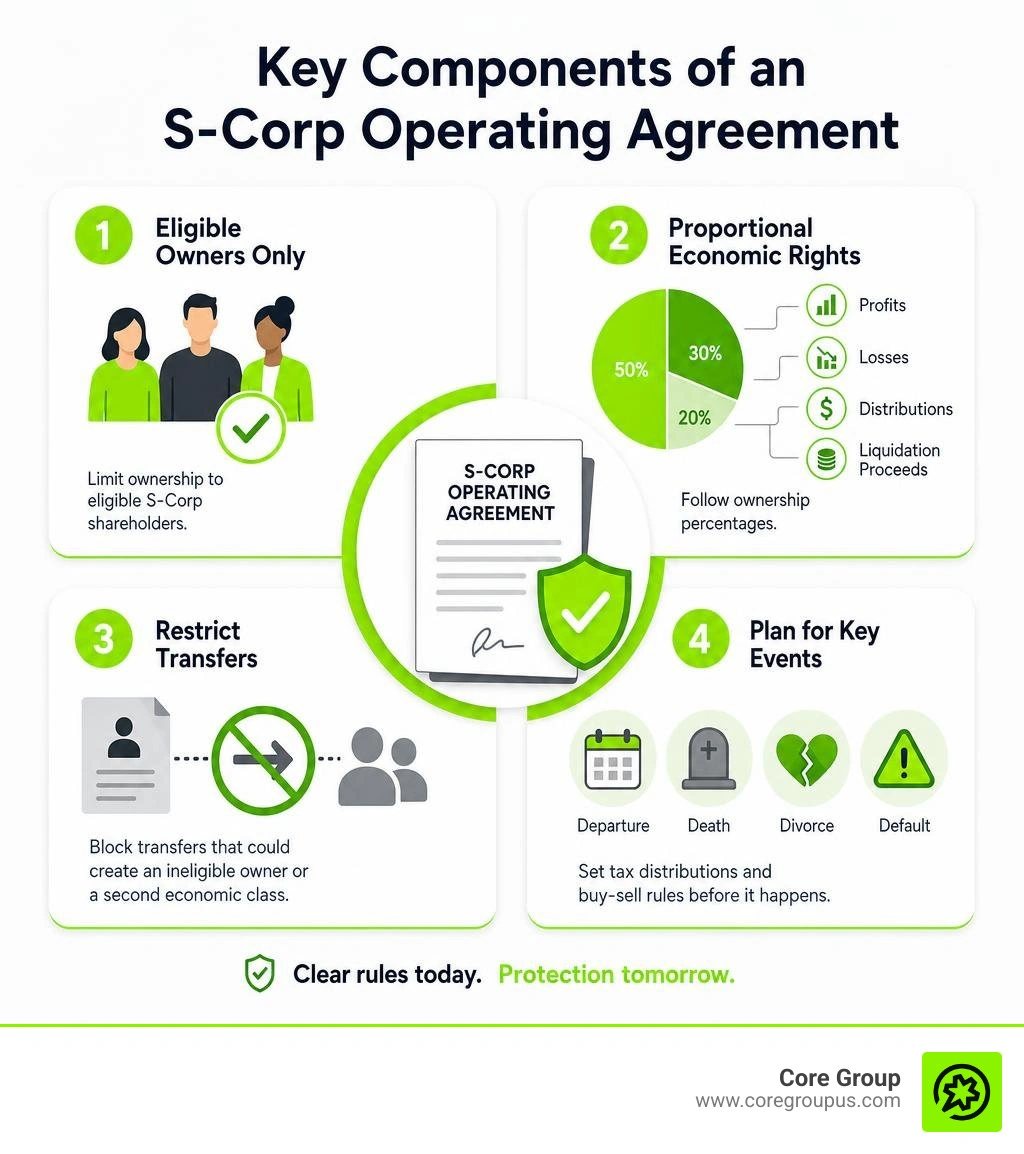
To draft an s-corp operating agreement for an LLC, start by putting four protections in writing.
- Limit ownership to eligible S-Corp shareholders under IRC Section 1361.
- Require profits, losses, distributions, and liquidation proceeds to follow ownership percentages.
- Block transfers that could create an ineligible owner or a second economic class of equity.
- Set tax distributions and buy-sell rules before a member leaves, dies, divorces, or defaults.
This is not just paperwork. An LLC that elects S-Corp tax treatment remains an LLC under state law, so it needs an operating agreement. But a standard partnership-style LLC agreement can create serious tax problems if it permits special allocations, preferred returns, or unequal liquidation rights.
For creative business owners, the goal is simple. You want the flexibility of an LLC, the potential tax benefits of an S-Corp election, and clear rules that keep ownership disputes from pulling focus away from your work.
I am Christian Brim, and the next sections will help you turn those four protections into an agreement that supports both compliance and peace of mind.
S-corp operating agreement terms made easy
Understanding the S-Corp Operating Agreement and Why It Matters
Running a creative agency, production house, or design studio requires legal armor and tax efficiency. When you operate as an LLC that elects Subchapter S tax treatment, you bridge two different legal worlds. State law recognizes your company as a limited liability company, which provides limited liability protection to shield your personal assets from corporate debts and lawsuits. At the federal level, the IRS treats your company as a pass-through entity under Subchapter S.
This dual identity makes your internal governance document essential. Without a customized agreement, default state statutes take over your business decisions. More dangerously, your company could fail basic IRS operational tests, causing the government to pierce the corporate veil or invalidate your tax status entirely. Your operating agreement confirms that all members respect pass-through tax rules while maintaining operational clarity.
How an S-Corp Operating Agreement Differs from Standard LLC Documents
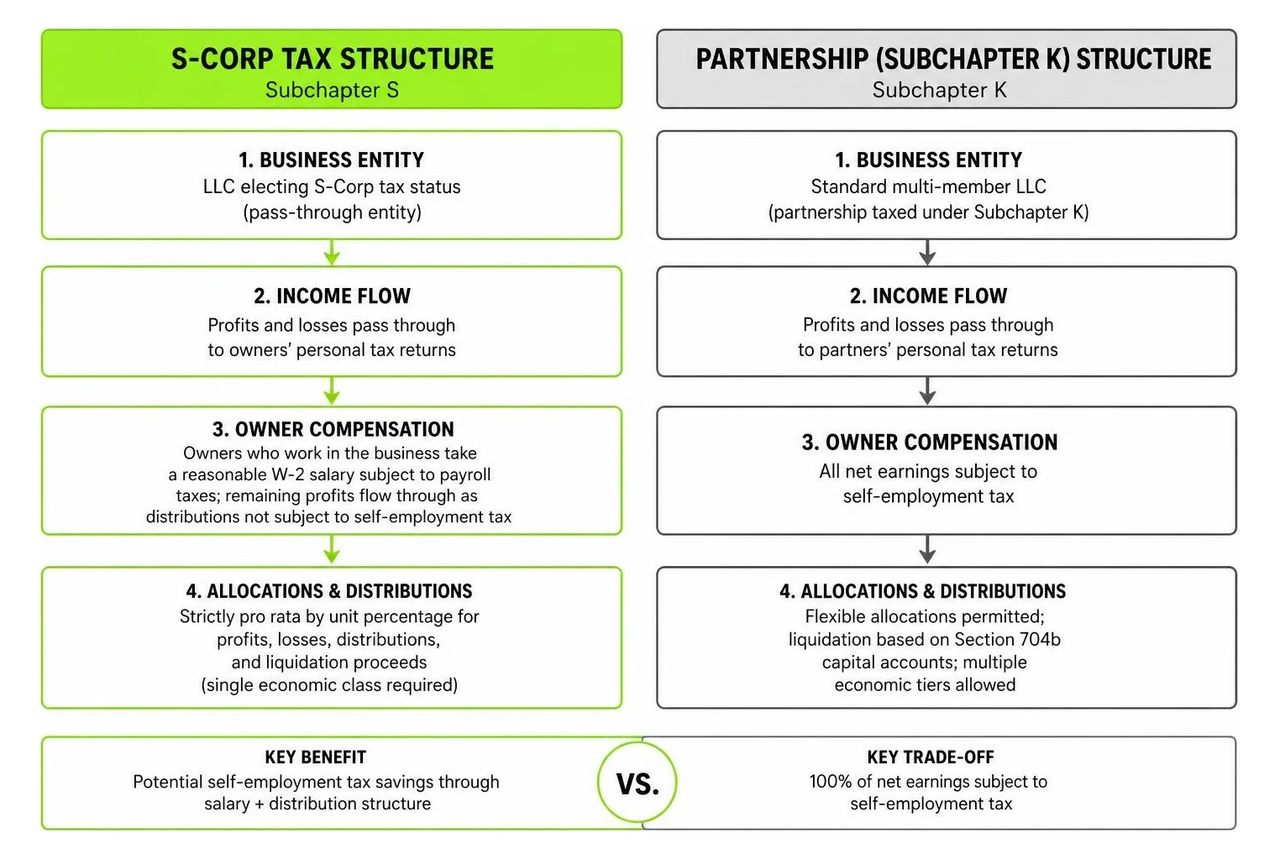
Many business owners make the mistake of using a standard multi-member LLC contract. Standard LLCs are taxed under Subchapter K partnership rules. Under Subchapter K, members can use special allocations, grant preferred distribution returns, and maintain fluctuating capital accounts under Section 704b regulations.
Subchapter S strictly forbids these features. Every dollar of profit, loss, operating distribution, and liquidation proceeds must flow strictly pro rata based on the percentage of units owned. If your document contains standard partnership provisions like liquidating according to positive capital account balances, you create an inadvertent second class of stock under federal tax law.
| Agreement Feature | Standard Partnership LLC | S-Corp Electing LLC | Corporate Bylaws |
|---|---|---|---|
| Tax Regime | Subchapter K | Subchapter S | Subchapter C or S |
| Profit and Loss Allocations | Flexible special allocations permitted | Strictly pro rata by unit percentage | Strictly pro rata by share percentage |
| Liquidation Proceeds | Based on Section 704b capital accounts | Strictly pro rata by unit percentage | Strictly pro rata by share percentage |
| Document Legal Role | Internal contract for LLC members | Internal contract tailored for S-Corp rules | Procedural rules for board and officers |
| Stock Class Flexibility | Multiple economic tiers allowed | Single economic class strictly required | Single economic class for S-Corps |
Unlike corporate bylaws that only set high-level administrative rules such as officer election timelines and meeting notices, your operating agreement governs the true economic reality between equity holders.
Tax Advantages and Compliance Risks for Creative Businesses
The primary motivation for choosing S-Corp status is self-employment tax optimization. As a sole proprietor or standard LLC partner, 100% of your net business earnings face self-employment taxes for Medicare and Social Security. Under an S-Corp, owners who work in the business take a reasonable W-2 salary subject to standard payroll taxes, while remaining profits flow through as dividend distributions free from self-employment taxes. For instance, on $500,000 of net earnings split between a $120,000 salary and a $380,000 distribution, a creative business can save nearly $15,000 annually in employment taxes.
However, these benefits come with strict compliance obligations. The IRS aggressively audits owner compensation. If you fail to run proper payroll or if your operating agreement authorizes disproportionate distributions, you risk losing your tax classification. An inadvertent termination forces your company back into C-Corporation tax status, triggering double taxation on corporate earnings and imposing a five-year waiting period before you can re-elect Subchapter S status. Learning whether should creative entrepreneurs become an s-corp helps you weigh these tax benefits against governance rules.
Essential Clauses to Preserve Your S-Election Under IRC Section 1361
To keep your pass-through status secure, your governing agreement must align with federal eligibility requirements under Internal Revenue Code Section 1361. Over 70% of multi-owner S-Corporations rely on written agreements specifically to enforce these ownership boundaries.

Reviewing the baseline s-corp eligibility requirements before drafting will save you significant legal headaches. Your agreement must mandate the following rules.
- An absolute maximum of 100 members.
- Ownership limited strictly to US citizens, permanent resident individuals, qualifying estates, and specific domestic trusts such as Qualified Subchapter S Trusts or Electing Small Business Trusts.
- Complete prohibition on ownership by partnerships, non-qualifying corporate entities, and non-resident aliens.
- Application of family attribution rules, which allow family members spanning up to six generations from a common ancestor to count as a single member toward the 100-owner threshold.
You can inspect standard corporate framework styles using a Delaware LLC sample operating agreement to see how statutory entity rules blend with contractual terms.
Protecting the Single Class of Stock Requirement
Under Treasury Regulation 1.1361-1, an S-Corporation can have only one economic class of stock. This means every equity unit must confer identical legal rights to distribution timing and liquidation proceeds.
You are legally permitted to create voting and non-voting units without violating this rule. For example, you can designate Class A units with voting rights and Class B units without voting rights so founding creatives retain management authority over non-founding investors. However, if Class A receives $2 per unit in distributions while Class B receives $1, or if Class A holds a liquidation preference during a company sale, the single class of stock rule is breached immediately. Your operating agreement must completely eliminate Subchapter K capital account language to maintain absolute economic parity.
Structuring Mandatory Tax Distributions for Members
In a pass-through entity, profits are reported on each member's personal tax return via Schedule K-1 regardless of whether the business actually distributes cash. Without specific contractual protections, a controlling majority could choose to retain 100% of the profits inside the company, leaving minority owners with phantom income and massive personal tax bills they cannot afford.
To prevent this unfair burden, include a mandatory quarterly tax distribution clause. This clause requires the manager to distribute sufficient cash to each member to cover their estimated federal and state tax liabilities. The distribution calculation should assume the highest combined marginal individual tax bracket and must execute prior to quarterly tax deadlines. Companies that implement mandatory tax distribution provisions experience 40% fewer internal shareholder tax disputes. Pairing this clause with an ongoing s-corp tax planning guide 2026 ensures your business reserves appropriate cash throughout the year.
Transfer Restrictions and Buy-Sell Provisions to Protect Ownership
Approximately 25% of all S-Corporation tax status terminations stem from accidental equity transfers to ineligible owners. A multi-owner business cannot risk letting an outgoing partner sell their stake to an unvetted third party.

Your operating agreement must include strict transfer restrictions and a robust Right of First Refusal process. Under a standard Right of First Refusal, any member wishing to sell their equity must first provide formal written notice and allow the company 30 days to purchase the units. If the company declines, the remaining individual members have an additional 15 days to buy the units pro rata. You can observe how publicly registered private entities document ownership governance in filings like the Untitled agreement exhibit.
Preventing Inadvertent Terminations with Void Ab Initio Clauses
The strongest weapon against an accidental disqualification is a void ab initio clause. This clause states that any attempted equity transfer to an unapproved or ineligible party, such as a foreign citizen or an unapproved corporation, is completely void from the beginning.
Under this language, legal title never passes to the buyer, and the transfer attempt is legally invalid. If an inadvertent transfer slips through, the company must immediately petition the IRS for relief under IRC Section 1362f. While the IRS often grants relief if the mistake was accidental and corrected promptly, the remediation process requires substantial filing fees, detailed accounting adjustments, and significant legal expenses.
Crucial Drafting Rules for Your S-Corp Operating Agreement
Nearly 60% of multi-owner S-Corporations that omit buy-sell mechanics face costly litigation or mediation within five years of an owner's death or departure. To keep your creative business resilient, your agreement must address specific triggering events and management boundaries
- Involuntary Transfers. Provide immediate corporate buyout options upon an owner's death, permanent disability, personal bankruptcy, or divorce settlement to prevent non-working ex-spouses or bankruptcy trustees from seizing voting units.
- Regulatory and Professional Unsuitability. If your firm requires professional licensing or specialized regulatory clearance, mandate an automatic equity redemption if an owner loses their license or is deemed unsuitable by a regulatory body.
- Mandatory Capital Calls and Dilution. When the company needs emergency funding, set a 30-day notice window. If a member fails to contribute, authorize non-defaulting members to cover the shortfall with a 125% dilution multiplier applied against the defaulting owner's equity.
- Manager Authority and Supermajority Voting. Require supermajority approval, such as 66.7% or 75%, for major decisions like taking on large debts, issuing new equity, selling company assets, or revoking the S-election.
For a complete framework on assembling these terms, explore our ultimate operating agreement template guide.
Frequently Asked Questions About S-Corp Governance
Does an LLC Electing S-Corp Tax Status Need Corporate Bylaws or an Operating Agreement
An LLC electing S-Corp status needs a customized LLC operating agreement, not corporate bylaws. Because your entity is organized as an LLC under state law, state statutes recognize your operating agreement as the binding governance contract. Corporate bylaws apply to businesses incorporated as state-level corporations. Your operating agreement simply needs to incorporate Subchapter S tax language to satisfy IRS rules while preserving LLC statutory benefits.
Can an S-Corp LLC Issue Profits Interests to Key Employees
No. Standard profits interests, which grant employees a right to future appreciation without current capital ownership, are unique to Subchapter K partnerships. Granting a profits interest in an S-Corp LLC violates the single class of stock rule because it creates equity units with different distribution and liquidation rights. Instead of traditional profits interests, creative agencies reward key employees using synthetic equity models, such as phantom stock plans, stock appreciation rights, or structured performance bonuses.
What Happens If an Ineligible Shareholder Acquires Units in an S-Corp LLC
If an ineligible shareholder successfully acquires ownership, the entity's S-Corp election terminates immediately on the date of the transfer. The company automatically converts to a taxable C-Corporation, creating unexpected double taxation on profits and distributions. To fix this, the company must immediately repurchase the units, restore qualifying ownership, and file an inadvertent termination relief request with the IRS under IRC Section 1362f.
Conclusion
Drafting a solid governing document removes the stress and fear of running an S-Corp. When your operating agreement accurately reflects federal tax laws, eliminates partnership-style capital accounts, and establishes ironclad transfer restrictions, you protect your business and keep ownership conflicts from derailing your momentum.
At Core Group, we provide financial management, bookkeeping, and tax services specifically for creative entrepreneurs. We use a no-fluff, profit-first playbook designed to guarantee complete peace of mind, backed by our MacBook Pro guarantee. We handle your financial numbers and tax compliance so you can focus 100% of your energy on building your creative work.
Ready to structure your business for sustainable, tax-advantaged growth? Review our comprehensive walkthrough on how to form s-corp and take control of your financial structure today.