All About S Corporations for Beginners
What Is an S Corporation and Why Does It Matter
What is an S corporation? It is a federal tax status that an eligible corporation or LLC can elect so that business income, losses, deductions, and credits generally pass through to the owners' personal tax returns.
In plain English, the business still has its own legal structure, but it usually does not pay federal income tax like a standard C corporation. Instead, shareholders report their share of profit or loss on their individual returns.
For creative business owners, S corporation status can be worth exploring when your work is profitable enough to support payroll, cleaner bookkeeping, and more formal tax planning. It can offer tax benefits, but it also brings rules around owner pay, shareholder eligibility, and annual filings.
I am Christian Brim, and this guide will help you understand the basics before deciding whether an S corporation fits your business.
What is an s corporation terms to learn
Understanding What Is an S Corporation
When business owners ask us what is an s corporation, they are often surprised to learn that an S corp is not actually a distinct business entity created at the state level. You do not go down to your local Secretary of State office and register an S corp from scratch. Instead, an S corporation is a legal business entity, usually a regular corporation or a limited liability company, that elects special tax treatment under Subchapter S of the Internal Revenue Code.
Congress added Subchapter S to the tax code back in 1958. The goal was simple. Lawmakers wanted to help small business owners enjoy the limited liability protection of a corporate entity without subjecting them to the burden of corporate double taxation. Before this provision existed, operating as a corporate enterprise meant paying federal corporate income taxes on company profit, plus individual income taxes whenever those earnings were distributed to shareholders.
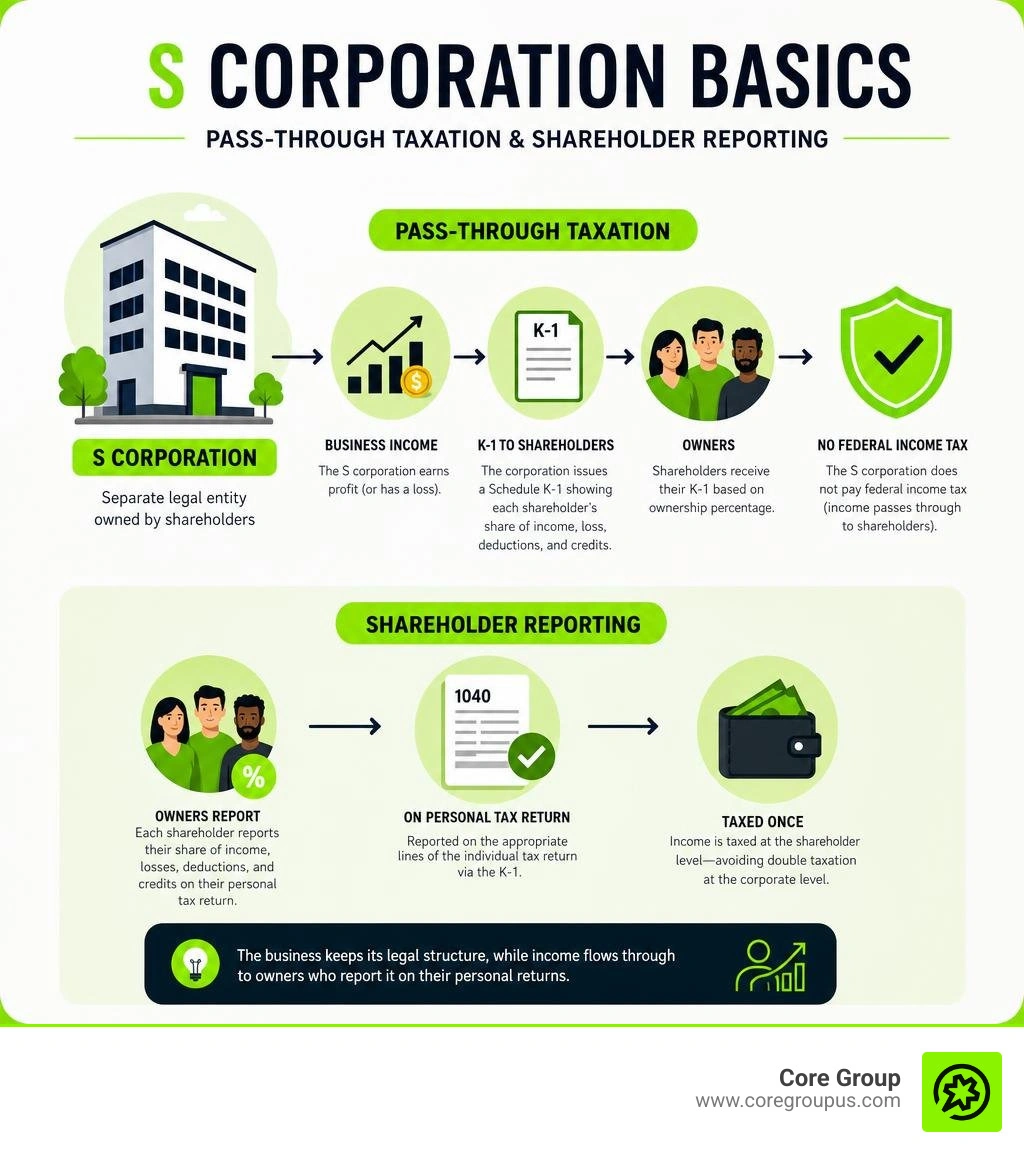
By making an S corp election, a business becomes what the IRS classifies as a flow through entity. Instead of calculating and paying tax at the corporate level, the entity passes net corporate revenue, deductions, credits, and capital losses through to the owners. Understanding this distinction is foundational for creative entrepreneurs. The state gives you legal liability protection through your legal charter, while the IRS applies Subchapter S tax rules based on your tax election. You can read the formal legal parameters in the S corporation statutory definition provided in federal tax code.
Pass Through Taxation Mechanics
Pass through taxation forms the operational core of the S corporation framework. Rather than acting as a separate taxable entity that owes federal income taxes directly to Uncle Sam, the S corp acts as a conduit. Every year, the company tracks its revenues and operational expenses, calculating total net business earnings.
To report these numbers to the federal government, the company files an annual informational tax return known as Form 1120-S. This form details the operational results of the business, but it does not accompany a corporate tax payment check in most cases. Alongside Form 1120-S, the business generates a Schedule K-1 for each shareholder. The Schedule K-1 breaks down each owner's pro rata share of profit, loss, tax credits, and deductions based strictly on their ownership percentage in the business.
When individual owners complete their personal income tax returns on Form 1040, they transfer the figures from their Schedule K-1 onto Schedule E. The earnings then combine with any other personal income and are taxed at individual federal personal income tax rates, which currently range between 10% and 39.6%. This mechanism allows small business owners to Avoid Double Taxation that typically plagues regular C corporations.
What Is an S Corporation Reasonable Compensation Rule
One of the most essential concepts to master when exploring what is an s corporation is the reasonable compensation rule. If you work actively in your business as an officer or operational worker, the IRS does not treat you merely as a passive shareholder. IRS rules require owner-employees to receive reasonable W-2 wages before receiving profit distributions.
This requirement exists because profit distributions pass to shareholders free of self employment taxes, while W-2 wages are subject to federal payroll taxes. Some business owners attempt to minimize their tax burden by taking zero salary and claiming all net profits as tax free distributions. The IRS monitors this practice closely and actively audits S corporations that fail to pay their working shareholders a fair wage.
Determining what qualifies as reasonable compensation depends on various factors including industry standards, geographic location, hours worked, complex skills required, and comparable market salaries for similar roles. Businesses frequently utilize job board statistics, Bureau of Labor Statistics data, or accounting benchmarks to justify officer wages. We guide our clients through these determinations by following established S-Corp Payroll Rules so they remain fully compliant while maximizing legitimate tax efficiency.
Advantages and Disadvantages of S Corporation Status
Selecting the right tax classification requires weighing the financial upside against the administrative responsibilities. While an S corporation offers substantial financial benefits for growing firms, it also imposes operational restrictions that do not exist for sole proprietorships or standard partnerships.
Key Advantages of S Corp Tax Status
The primary attraction of S corporation status is saving money on self employment taxes. Self employed individuals operating as sole proprietors or standard LLC owners pay a 15.3% self employment tax on all net earnings. This tax consists of 12.4% for Social Security up to the annual wage ceiling, which stands at $184,500 in 2026, plus 2.9% for Medicare on all business profit.
Under S corporation taxation, only your W-2 reasonable salary is subject to FICA taxes. Remaining profit distributions pass through to owners without being subjected to the 15.3% self employment tax burden. For example, if your company earns $150,000 in net net profit and you set a reasonable officer salary of $90,000, the remaining $60,000 taken as profit distributions is exempt from the 15.3% self employment tax. That single strategy can save business owners thousands of dollars annually.
In addition to payroll tax savings, S corp shareholders can leverage the Qualified Business Income deduction created under the Tax Cuts and Jobs Act. This provision allows eligible pass through business owners to deduct up to 20% of qualified earnings from their federal personal tax return, lowering effective income tax rates significantly. Learn how this applies to your situation through our detailed QBI Deduction Explained breakdown. Furthermore, S corps maintain strong corporate veil protections, shielding individual personal assets like homes and savings from business liabilities.
Potential Limitations and Disadvantages
Despite the clear financial perks, S corp status carries real limitations that business owners must understand before filing. Maintaining an S corporation demands higher administrative overhead and strict ongoing legal compliance. You must run formal payroll using standard withholding schedules, pay unemployment taxes, issue W-2 forms, and submit regular payroll reports to federal and state taxing authorities.
Additionally, tax preparation for Form 1120-S is far more complex than filing a standard Schedule C on a personal tax return, resulting in higher annual accounting and legal costs. You also face rigid stock distribution rules. Unlike LLCs where profit allocations can be customized among partners, S corporation distributions must strictly follow ownership percentages. If you own 60% of the shares, you must receive exactly 60% of all distributed profit.
Fringe benefits represent another area of restriction. Shareholders owning more than 2% of S corp stock cannot deduct company provided fringe benefits like health insurance or Health Savings Account contributions in the same tax favored manner as regular employees. Instead, health insurance premiums paid on behalf of 2% shareholders must be reported as W-2 taxable wages. Certain states also levy unique entity level taxes on S corps, such as California imposing a 1.5% net income franchise tax with an $800 annual minimum fee. Check out our comprehensive S-Corp Tax Planning Guide 2026 to prepare for these nuances.
S Corporation Eligibility Rules and Filing Procedures
The federal government restricts S corporation tax status to specific types of businesses that meet strict statutory criteria. Failing to maintain these requirements at any point during the year can automatically terminate your S corp election, reverting your company to a standard corporate structure with severe tax consequences.
What Is an S Corporation Shareholder Limit and Requirement
To qualify under federal rules, a business must satisfy strict eligibility criteria enforced by the Internal Revenue Service. First, the business must be a domestic entity organized under state law. Second, the entity cannot have more than 100 allowable shareholders. Under special tax provisions, family members spanning up to six generations can elect to be aggregated as a single shareholder, helping multi generational family firms stay below the 100 stockholder limit.
Ownership restrictions also dictate who can hold shares in an S corporation. Allowable shareholders include individual U.S. citizens and permanent resident aliens, as well as certain qualifying trusts and estates. Partnerships, foreign citizens residing abroad, and regular corporations are explicitly barred from owning S corporation shares. This restriction prevents venture capital firms and institutional funds from taking equity in S corps.
Furthermore, an S corporation can only issue one single class of stock. While variations in voting rights among common stock shares are permitted, all shares must confer identical economic rights regarding profit distributions and liquidation proceeds. Preferred stock carrying preferential dividends is strictly prohibited. Review our complete list of S-Corp Eligibility Requirements and check the official IRS S corporation guidelines to verify your eligibility before applying.
Electing S Corp Status with Form 2553
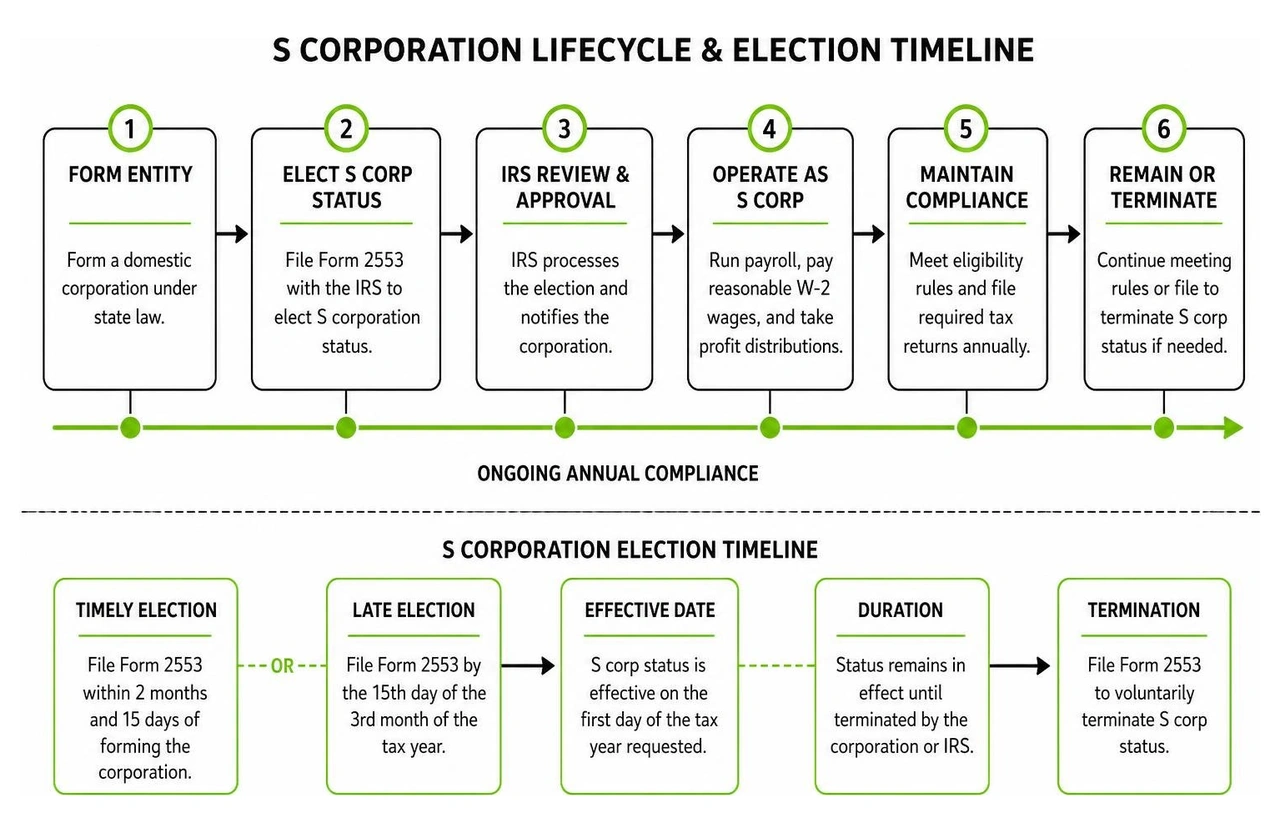
Once you confirm that your company satisfies all federal qualification rules, you must formally submit an election to the federal government using IRS Form 2553, titled Election by a Small Business Corporation. This document requires specific business details, including your Employer Identification Number, legal entity name, effective tax date, and unanimous signatures from every individual shareholder owning stock in the entity.
Timing is critical when submitting Form 2553. To make the S corp election effective for the current tax year, the business must file Form 2553 no later than two months and 15 days after the beginning of that tax year. For businesses operating on a standard calendar year, this deadline falls on March 15. If you launch a brand new corporate entity on January 7, your 2 month and 15 day window closes on March 21.
Missing this strict window does not necessarily mean you have lost out forever. The IRS offers late election relief under Revenue Procedure 2013-30. If your firm missed the filing deadline due to reasonable cause, you can request retroactive S corp status up to three years and 75 days after the intended effective date by filing Form 2553 with an attached statement explaining the oversight. Walk through every step seamlessly with our S-Corp Formation Checklist.
Comparing S Corporations to LLCs and C Corporations
Choosing the best operational structure for your business requires comparing the core attributes of C corporations, limited liability companies, and S corporations side by side.
| Feature | C Corporation | Limited Liability Company | S Corporation |
|---|---|---|---|
| Federal Tax Status | Separate Taxable Entity | Pass Through Entity Default | Pass Through Tax Election |
| Double Taxation Risk | Yes Corporate and Dividend | No Pass Through | No Pass Through |
| Shareholder Ownership Limits | Unlimited Shareholders | Unlimited Members | Maximum 100 Shareholders |
| Ownership Eligibility | Anyone Foreign or Corporate | Anyone Foreign or Corporate | US Citizens and Residents Only |
| Classes of Stock | Multiple Classes Allowed | Flexible Ownership Classes | Single Class of Stock Only |
| Self Employment Tax | N/A Wages Paid | Applies to Full Net Profit | Applies Only to W-2 Wages |
| Investor Flexibility | High Ideal for VC Funding | High Flexible Agreements | Low Restricted Stock Rules |
S Corporation versus C Corporation
When comparing an S corporation to a standard C corporation, the primary distinction lies in how profits are taxed at the federal level. A C corporation is a standalone taxable legal entity that pays tax directly on corporate profits at the flat federal rate of 21%. When the C corp distributes remaining post tax profits to shareholders as dividends, those dividends are taxed a second time on individual owner returns, resulting in double taxation.
In contrast, an S corporation eliminates entity level federal taxation entirely, passing net revenue through to owners directly. However, C corporations enjoy distinct advantages when raising external growth capital. C corps can issue multiple classes of common and preferred stock, sell equity to institutional venture capital funds, and host an unlimited number of international investors.
If your strategic business model relies on attracting venture capital funding, executing an eventual initial public offering, or retaining large corporate cash reserves inside the entity for long term reinvestment, maintaining a C corp structure makes economic sense. But for closely held businesses focused on owner earnings and profit distributions, S corp tax status offers superior tax savings. Review the structural trade offs further in our guide to S-Corp Business Structure.
S Corporation versus LLC
Comparing an S corporation to a limited liability company often leads to confusion because an LLC can actually choose to be taxed as an S corporation. An LLC is a flexible state legal structure created to protect personal assets from business liabilities. By default, single member LLCs are taxed as sole proprietorships, while multi member LLCs are taxed as partnerships.
Under default LLC tax treatment, all net profits flow directly to individual tax returns and face the full 15.3% self employment tax burden. When an LLC grows profitable, electing S corporation tax status allows the business owners to keep their flexible state legal structure while converting to S corp pass through rules.
This hybrid approach gives entrepreneurs the asset protection and legal flexibility of an LLC combined with the self employment tax savings of an S corporation officer salary setup. Explore these distinctions further in our article explaining Is an LLC a Sole Proprietorship or Corporation.
Frequently Asked Questions About S Corporations
We regularly answer questions from entrepreneurs curious about what is an s corporation and how it functions day to day. Here are detailed responses to common operational questions.
How does pass through taxation work for S corps
Pass through taxation works by treating the business entity as an economic conduit rather than a separate tax paying body. The S corporation tallies all income, business expenses, write offs, and tax credits at the end of the corporate fiscal year. It then files an informational return on Form 1120-S to report these financial metrics to the federal government.
The company generates a Schedule K-1 for each owner, detailing their proportional share of company profit or loss based on share holdings. Shareholders enter these K-1 figures onto Schedule E of their personal Form 1040 tax return.
Because corporate revenue passes directly to personal returns, owners pay individual income taxes on company profit regardless of whether those earnings were distributed as cash or retained inside the business bank account. To learn more about pass through mechanics, read our detailed overview of Single Member LLC Taxes.
Can an LLC be taxed as an S corporation
Yes, an LLC can certainly be taxed as an S corporation. In fact, thousands of small business owners adopt this exact corporate configuration every year. Converting an LLC to S corp tax status does not alter your underlying legal structure formed with your state Secretary of State. You retain all LLC liability protections while changing how the IRS treats your net revenues.
To make this tax election, an LLC files IRS Form 2553 signed by all members. The LLC must meet all standard S corp eligibility criteria, including the 100 shareholder limit, single class of ownership restrictions, and US residency rules.
Transitioning an LLC to S corp tax status makes financial sense when company profits consistently exceed what would be considered a reasonable officer salary for the owner, making self employment tax savings larger than the extra payroll and tax return preparation costs. Follow our step by step walkthrough in the S-Corp Setup Process guide.
What are the annual filing requirements for S corporations
S corporations must adhere to strict annual tax compliance and reporting schedules. At the federal level, an S corp must file Form 1120-S annually, which is due by March 15 for calendar year entities. The company must also prepare and issue individual Schedule K-1 documents to all shareholders by that same deadline.
Because shareholder-employees receive regular payroll, the company must file quarterly employment tax returns on Form 941, annual federal unemployment tax returns on Form 940, and issue annual W-2 forms to working owners and staff. Starting in 2024, entities required to file 10 or more total tax returns across all categories in a calendar year are required by federal mandate to submit their Form 1120-S electronically.
At the state level, S corps must submit annual reports to maintain good standing, file state income tax returns where applicable, and pay local franchise taxes. Staying compliant requires accurate ongoing financial management. Connect with reliable financial experts via S-Corp Bookkeeping Near Me to keep your records audit proof.
Conclusion
Understanding what is an s corporation is a vital milestone for any business owner looking to optimize tax efficiency, lower self employment taxes, and protect personal wealth. By converting eligible profit into shareholder distributions alongside a reasonable W-2 salary, creative entrepreneurs can save thousands of dollars every year while preserving strong corporate asset protection.
Navigating payroll processing, reasonable compensation benchmarks, Form 2553 election deadlines, and annual filing schedules can feel overwhelming when you are trying to focus on growing your business. That is where our team at Core Group comes in. We deliver clear financial management, bookkeeping, and tax strategy services tailored specifically for creative business owners. Our no fluff, profit first playbook guarantees peace of mind and frees up your valuable time, backed by our signature MacBook Pro guarantee.
Ready to take control of your small business taxes and discover if S corporation status is right for you? Explore our step by step roadmap on How to Form S-Corp and get in touch with our team today.