The Ultimate Guide to S-Corp Profit Distribution Rules
How S-Corp Profit Distributions Are Taxed
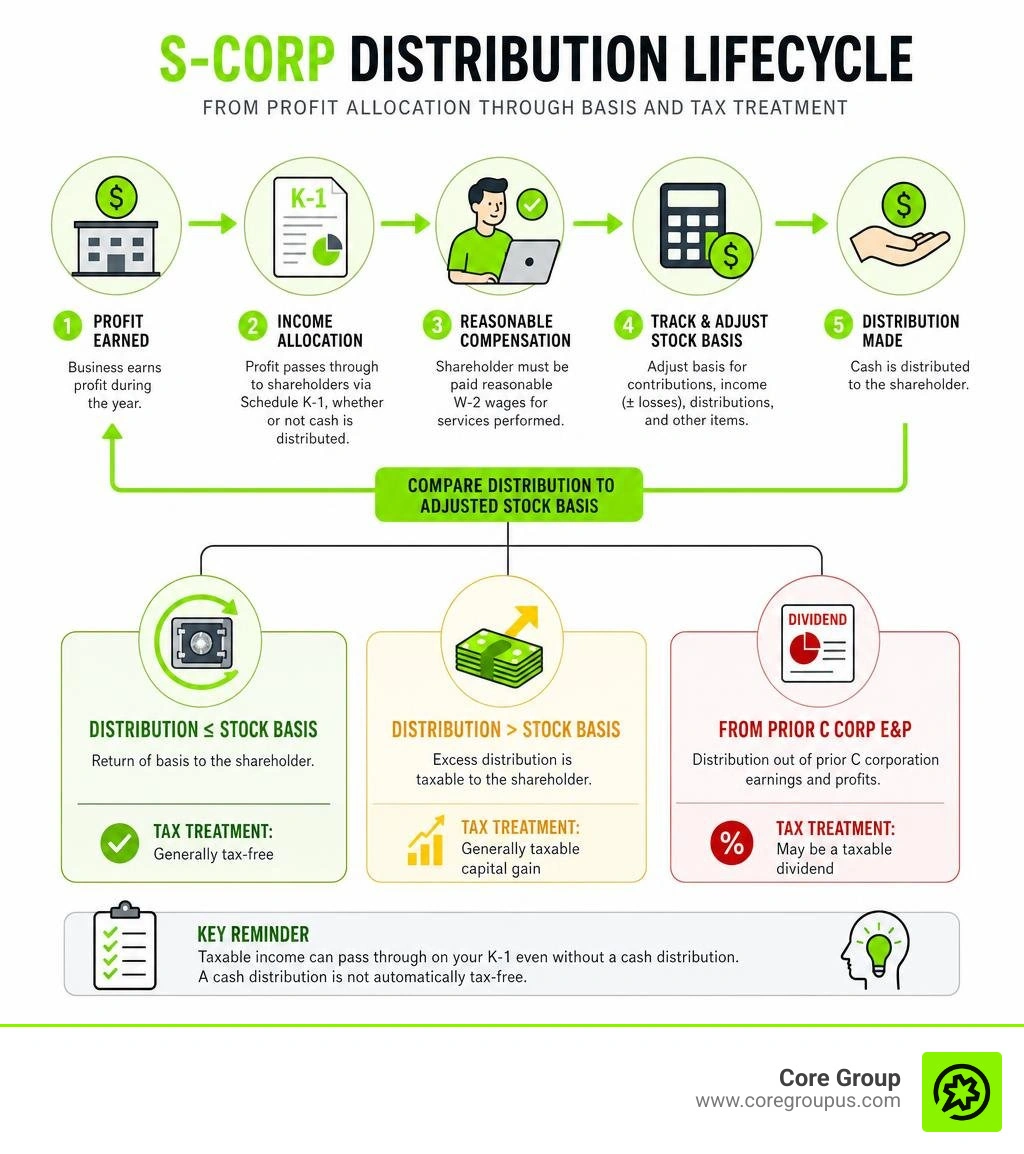
An s-corp profit distribution is usually tax-free only up to each shareholder's stock basis. First, confirm the owner has been paid reasonable W-2 compensation for work performed. Then track stock basis each year, apply current-year income before distributions, and compare the cash paid out with the shareholder's adjusted basis.
- Distribution up to stock basis is generally a tax-free return of basis
- Distribution above stock basis is generally taxable capital gain
- Distribution from prior C corporation earnings and profits may be a taxable dividend
The key point is simple. Your business can pass taxable income to you on a Schedule K-1 even when it does not distribute cash. And a cash distribution is not automatically tax-free just because the company is profitable.
For creative business owners, this is where cash flow and tax planning often collide. Good records help you decide what can safely be distributed, what must stay in the business, and whether a withdrawal could create an unexpected tax bill.
I'm Christian Brim, and I help business owners make these rules practical so they can spend less time worrying about the numbers and more time building their work.
S-corp profit distribution terms explained
Fundamentals of S-Corp Profit Distribution Mechanics
Running a business through an s-corp business structure lets business owners pass income, losses, and deductions straight to their personal tax returns to avoid double taxation. However, taking money out of the corporate account requires careful attention to tax classifications. When cash leaves the company bank account and goes to a shareholder, it falls into one of three tax tiers.
The first tier is a tax-free return of basis. If you have sufficient investment in your company stock, cash distributions up to that amount are entirely tax-free because you are merely withdrawing money you already paid taxes on or invested directly.
The second tier occurs when a distribution exceeds your available stock basis. Any dollar distributed beyond that basis limit is treated as a taxable capital gain from the deemed sale of your stock. If you held the stock for more than twelve months, this amount qualifies for favorable long-term capital gains tax rates.
The third tier applies to businesses that hold accumulated earnings and profits from past operations as a standard C corporation. Distributions pulled from those historical earnings trigger taxable dividend income, reported to shareholders on Form 1099-DIV rather than passing through as ordinary business cash flow.
Federal tax regulations strictly mandate that an S corporation can maintain only a single class of stock. This rule requires all distributions to be strictly proportional to share ownership percentages. If two equal partners own fifty percent each, every dollar distributed to one must be matched with an identical payout to the other. Disproportionate payouts can endanger the federal tax status of the entire entity. To maintain proper compliance, shareholders report annual stock basis adjustments on IRS Form 7203.
| Distribution Type | Tax Status | IRS Reporting Form | Impact on Stock Basis |
|---|---|---|---|
| Return of Basis | Tax-free | Schedule K-1 Box 16D, Form 7203 | Reduces basis dollar-for-dollar |
| Capital Gain | Taxable (Capital Gains Rates) | Form 8949, Schedule D | Leaves basis at zero |
| Taxable Dividend | Taxable (Ordinary or Qualified) | Form 1099-DIV Box 1a/1b | Does not alter S corporation stock basis |
Stock Basis Versus Debt Basis in Distribution Calculations
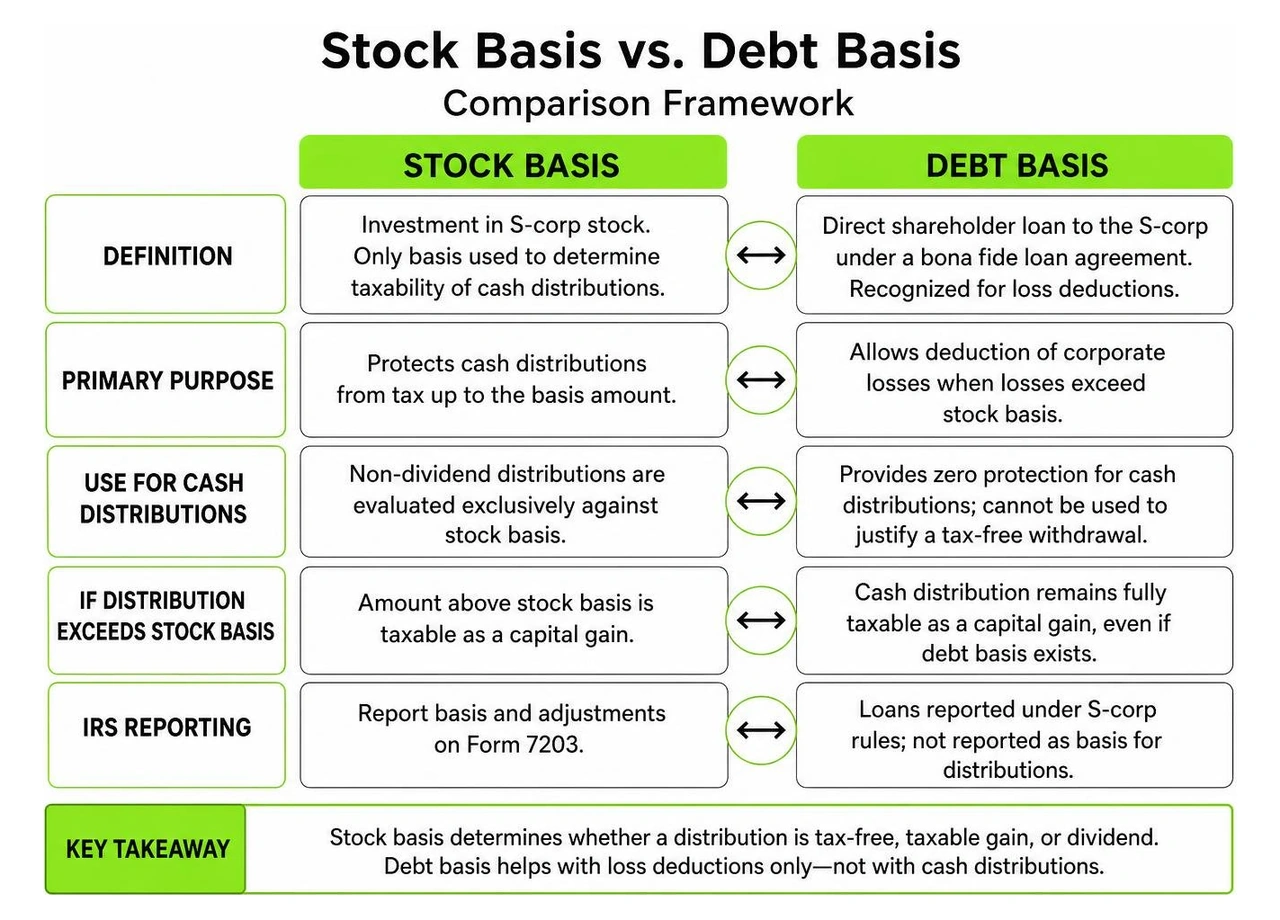
Many owners confuse stock basis with debt basis. When you lend personal funds directly to your company through a bona fide loan agreement, you create debt basis. Debt basis allows you to deduct corporate operating losses on your personal tax return when losses exceed your stock basis. Direct shareholder loans are recognized by the Internal Revenue Service for loss deductions under the official rules for S corporations.
Debt basis provides zero protection for cash distributions. You cannot use debt basis to justify a tax-free withdrawal. Non-dividend distributions are evaluated exclusively against your stock basis. If you withdraw cash exceeding your stock basis while holding substantial debt basis from a direct loan, that cash distribution remains fully taxable as a capital gain.
S-Corp Profit Distribution Ordering Rules for Stock Basis
Determining whether a profit distribution is taxable requires applying the four-step statutory ordering rules at the close of each tax year. Implementing sound business tax optimization means adjusting your stock basis in the exact sequence required by the Internal Revenue Code.
First, increase stock basis for all income items, including ordinary business income, capital gains, and tax-exempt income.
Second, reduce stock basis for any non-dividend distributions taken throughout the tax year. This vital rule protects owners by allowing cash distributions to absorb basis before operational losses eat it up.
Third, decrease stock basis for nondeductible corporate expenses such as non-deductible penalties or business entertainment expenses.
Fourth, decrease stock basis for current-year deductible operational losses and deductions.
Because distributions sit second in the statutory hierarchy, an owner can withdraw prior-year profits tax-free even if the company experiences a substantial operating loss during the current year.
Special Tax Rules for Entities with Prior C Corporation History

Businesses that began operations as traditional C corporations before electing S corporation status carry unique historical attributes. When preparing long-term projections through our s-corp tax planning guide 2026, CPAs must verify whether historical earnings survived the conversion.
When a company transitions from a C corporation to an S corporation, its pre-existing earnings do not simply vanish. The business preserves these balances, which alter the standard distribution rules until those historical reserves are fully emptied.
Managing an S-Corp Profit Distribution When Accumulated E and P Exists
Under the framework established by the Subchapter S Revision Act of 1982, modern S corporations do not generate current earnings and profits. However, accumulated earnings and profits (E and P) from prior C corporation tax years or tax-free corporate reorganizations remain on the balance sheet. Executing clean corporate tax planning and strategy requires distinguishing S corporation profits from legacy C corporation balances.
When a company carries accumulated E and P, distributions follow an expanded four-step hierarchy.
- Payouts come tax-free from the corporate Accumulated Adjustments Account up to the shareholder's stock basis.
- Payouts exceeding the Accumulated Adjustments Account come directly from accumulated E and P and are taxed as ordinary dividends reported on Form 1099-DIV.
- Payouts exceeding accumulated E and P are treated as a tax-free return of remaining stock basis.
- Any remaining payouts are taxed as capital gains.
The Critical Role of the Accumulated Adjustments Account
The Accumulated Adjustments Account (AAA) is a corporate-level account that tracks cumulative gross income and deductible expenses earned while operating as an S corporation. It functions as the entity-level meter that determines how much cash can be distributed before tapping into taxable C corporation earnings. State agencies such as the California Franchise Tax Board enforce strict accounting for these balances on state tax returns as outlined in guidance for S corporations Business type - Franchise Tax Board - CA.gov.
Unlike personal stock basis, corporate AAA can drop below zero if operational losses exceed earnings. However, cash distributions cannot create or increase a negative balance in AAA. When AAA is exhausted, subsequent distributions pull directly from accumulated E and P, turning ordinary withdrawals into taxable dividend income for the recipients.
Structuring Tax Distributions and Shareholder Agreements

Because S corporations pass taxable income directly to owners regardless of whether cash is distributed, shareholders face personal income tax bills on corporate earnings. Smart business owners deploy proactive tax planning strategies by writing mandatory tax distribution clauses into their shareholder operating agreements.
A tax distribution provision requires the company to distribute sufficient cash to enable owners to pay their resulting federal and state tax liabilities. These legal agreements must be drafted carefully to respect existing bank loan covenants, which may restrict cash withdrawals during tight liquidity periods. All tax distributions must remain strictly proportionate to share ownership to prevent violating the single-class-of-stock requirement.
Key Clauses to Negotiate in Distribution Provisions
Drafting clear shareholder agreements requires aligning legal language with everyday accounting realities. Working through tax planning and tax management with experienced advisors helps prevent costly shareholder disputes down the road.
Shareholder agreements should address four essential terms.
- Income Definition sets whether tax distributions are calculated on annual taxable net income or cumulative net taxable income. Cumulative models prevent distributing cash in a profitable year if prior-year operational losses have not yet been recovered.
- Tax Rate Benchmarks establish an agreed-upon composite tax rate that reflects the highest combined federal and state income tax brackets among all shareholders.
- State Tax Withholding incorporates terms allowing the entity to pay mandatory composite or nonresident withholding taxes for out-of-state shareholders without violating single-class-of-stock parity.
- Timing of Payouts schedules distributions ahead of quarterly estimated tax due dates in April, June, September, and January.
Shareholder Basis Tracking Pitfalls and Suspended Losses
A frequent misconception among business owners is that the corporation tracks their personal stock basis. In reality, basis tracking is solely the responsibility of each individual shareholder. While corporate financial records reflect company-level accounts, each owner must track their own basis annually on Form 7203.
Many creative entrepreneurs integrate our profit first method to set aside routine profit distributions and reserve accounts. However, failing to track your personal stock basis can turn an otherwise healthy profit withdrawal into an unexpected taxable event.
Handling Suspended Losses During Profitable Distribution Years
When corporate losses exceed a shareholder's available basis, Internal Revenue Code Section 1366 suspends those losses indefinitely. These suspended losses carry forward to future tax years until the shareholder generates sufficient basis to absorb them. Maintaining orderly bookkeeping for small business ensures these numbers are tracked accurately across consecutive tax years.
When the business returns to profitability, the statutory ordering rules dictate that current-year income increases stock basis first. Next, any cash distributions taken during the year reduce that basis. Only the remaining basis balance can be used to absorb prior-year suspended losses. If total distributions consume all the newly generated basis, prior suspended losses remain locked and must carry forward to the next tax year.
Frequently Asked Questions About S-Corp Distributions
What happens when an S-corp distribution exceeds stock basis
When a non-dividend cash distribution exceeds a shareholder's adjusted stock basis, the excess portion is treated as a capital gain from the deemed sale of stock. The shareholder reports this gain on Form 8949 and Schedule D of their personal Form 1040. If the shareholder owned the stock for longer than one year, the gain receives preferential long-term capital gains tax treatment.
Does Schedule K-1 indicate whether a distribution is taxable
No. Schedule K-1 Box 16 Code D reports the total gross amount of non-dividend cash distributions paid to the shareholder during the corporate tax year. The K-1 does not indicate whether any portion of that cash is taxable. Determining the taxable portion requires the shareholder to independently compute their stock basis on IRS Form 7203.
Can debt basis prevent tax on excess distributions
No. Debt basis created through direct shareholder loans cannot make cash distributions tax-free. Debt basis exists exclusively to allow the deduction of business operating losses and deductions on personal tax returns. Cash withdrawals that exceed stock basis will always trigger taxable capital gains, even if the shareholder holds substantial debt basis from unreturned company loans.
Conclusion
Managing profit distributions in an S corporation requires balancing corporate profitability, reasonable owner compensation, and individual basis tracking. Clear communication, clean accounting, and routine legal reviews keep your entity fully compliant with federal and state pass-through tax regulations.
At Core Group, we help creative entrepreneurs streamline their finances, eliminate administrative stress, and protect their profits with simple, transparent guidance. If you are ready to structure your business for sustainable long-term success, learn how to form s-corp systems that align your cash flow with your business goals.