How to Fill Out Schedule C, Even When You Don’t Feel Like It
What the Schedule C Form Does for Your Business Taxes
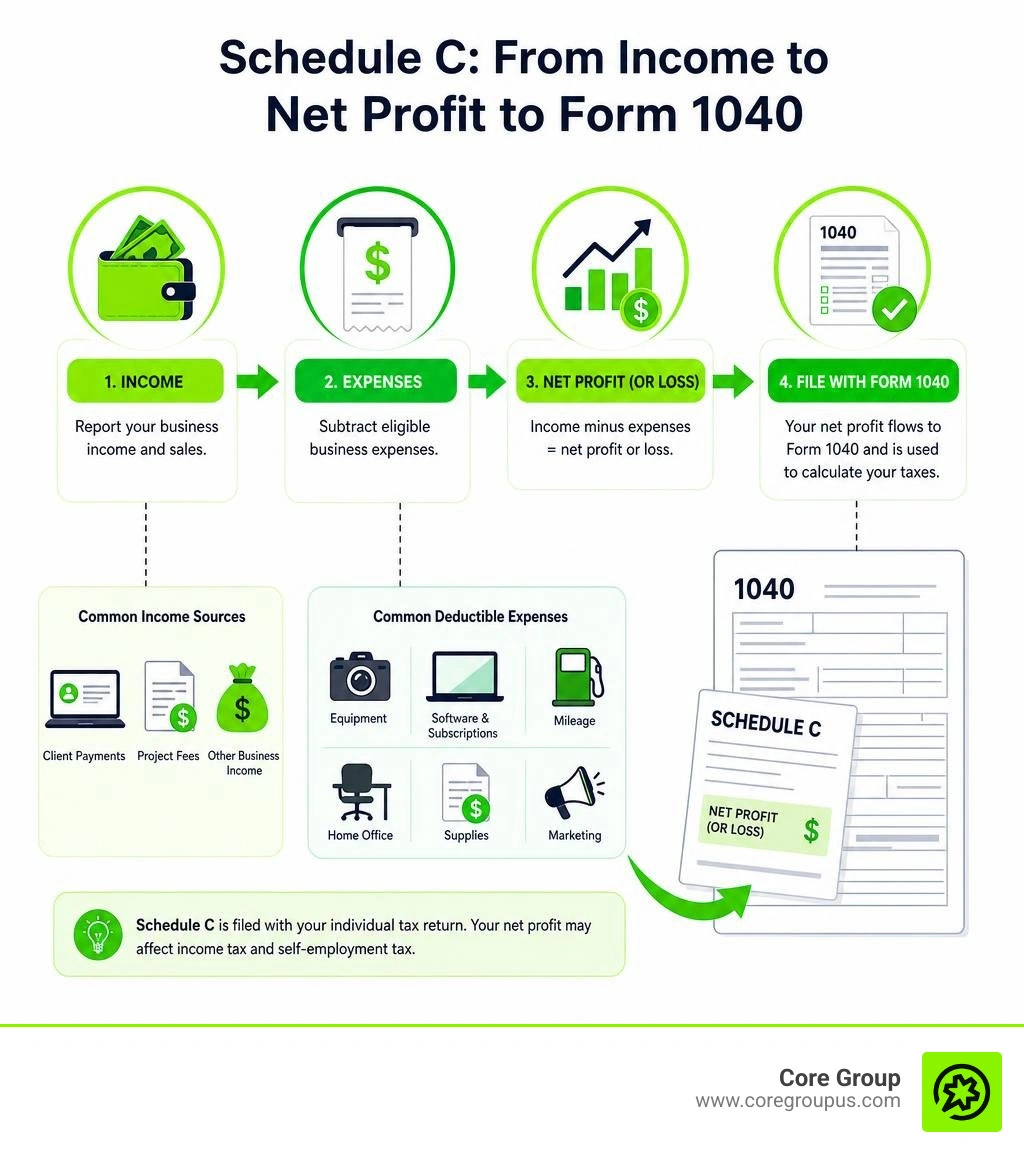
The schedule c form is the IRS attachment sole proprietors use to report business income, deduct eligible expenses, and calculate their net profit or loss for Form 1040.
| Quick answer | What it means |
|---|---|
| Who uses it | Freelancers, independent contractors, sole proprietors, and many single-member LLC owners |
| What it reports | Business sales, income, and deductible operating costs |
| Where it goes | It is filed with your individual federal tax return |
| Why it matters | Your net profit can affect income tax and self-employment tax |
For a filmmaker, designer, producer, or other creative professional, Schedule C is where client payments, equipment costs, software subscriptions, mileage, and other business records come together. It can feel like a lot when your books are behind, but the form follows a clear path from income to expenses to profit or loss.
I am Christian Brim, and this guide will help you understand what belongs on Schedule C before you start filling it out.
Explore more about schedule c form
- Single Member LLC Taxes
- Single Member LLC 1099 Reporting
- Is an LLC a Sole Proprietorship or Corporation
Understanding Who Must File the Schedule C Form
Understanding who needs to file the schedule c form comes down to how you earn your working income. If you offer creative services, sell handmade goods, consult, or drive for a ride-share platform without incorporating as a corporation, the IRS generally expects you to report that activity on Schedule C.
The primary test centers on having a profit motive combined with continuous and regular operation. You do not need a formal corporate charter or an official office storefront to trigger a filing requirement. If you perform work independently for compensation and your net earnings exceed 400 dollars, you must file Schedule C along with Schedule SE to pay self-employment tax. You can find detailed statutory requirements directly on the official IRS Schedule C Guidance page.
We often work with creative entrepreneurs who assume that because they did not receive a formal Form 1099 from every single client, they do not need to report that revenue. Federal law requires reporting all earned business income regardless of whether a client issued a information return or paid you in cash.
Business versus Hobby Classification
Distinguishing between a legitimate trade or business and a personal hobby is one of the most heavily scrutinized areas in tax administration. The fundamental distinction relies on your primary purpose for conducting the activity. A business is conducted with the explicit intent to earn a profit, whereas a hobby is pursued primarily for sport, recreation, or personal pleasure.
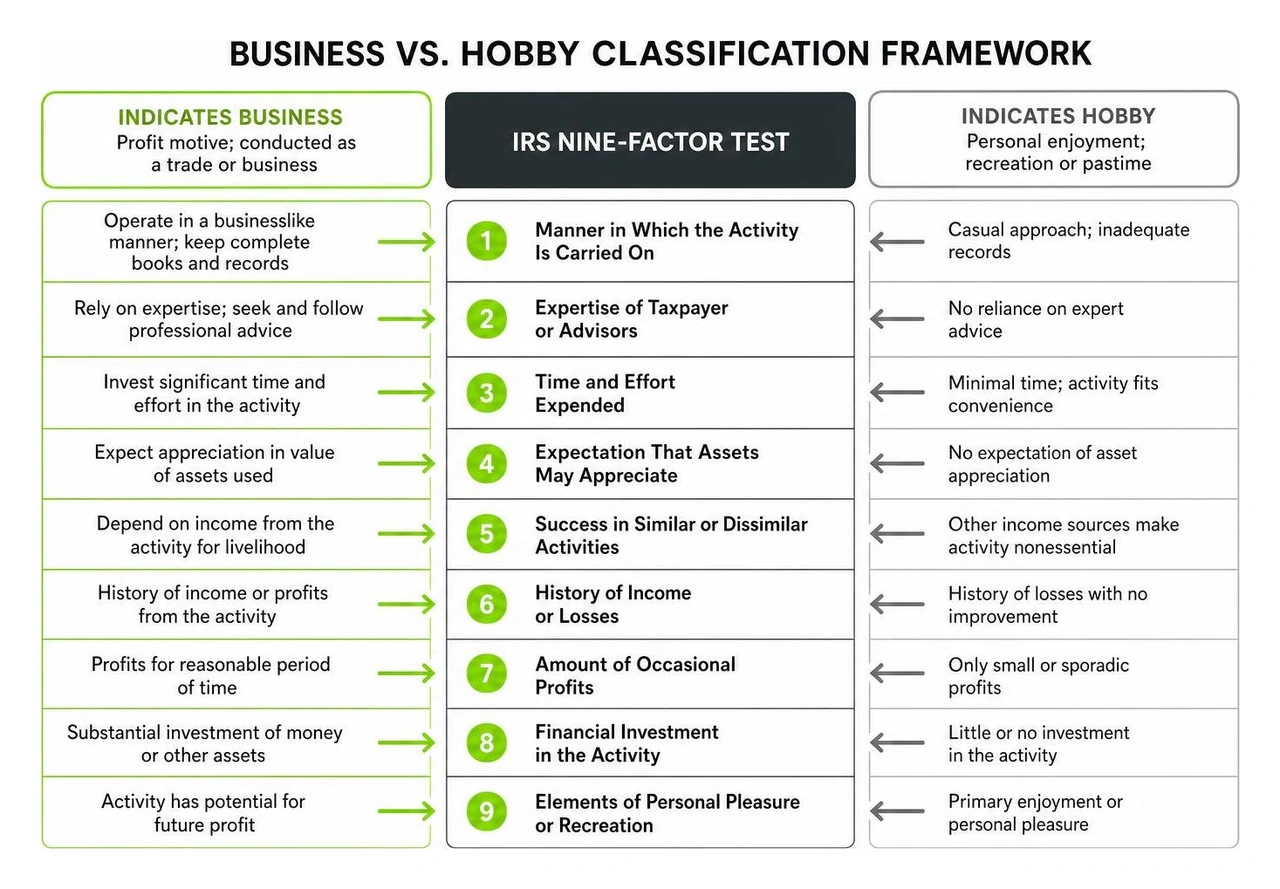
The IRS utilizes a nine factor test to evaluate whether your pursuit qualifies as a trade or business.
- The manner in which you carry on the activity, including maintaining complete and accurate books and records
- The expertise of the taxpayer or their trusted advisors
- The time and effort expended in carrying on the activity
- The expectation that assets used in the activity may appreciate in value
- The success of the taxpayer in carrying on other similar or dissimilar activities
- The history of income or losses with respect to the activity
- The amount of occasional profits, if any, which are earned
- The financial status of the taxpayer
- The elements of personal pleasure or recreation involved in the venture
If the IRS classifies your endeavor as a hobby, you must still report all gross income derived from it. However, under current tax guidelines, you cannot deduct hobby expenses against that income. This creates a severe tax disadvantage, making it vital to establish clear business practices, dedicated bank accounts, and systematic financial recordkeeping from day one.
Sole Proprietorships and Single Member LLCs
Many self-employed individuals wonder how forming a Limited Liability Company (LLC) alters their tax reporting obligations. For federal income tax purposes, a single-member LLC is treated by default as a disregarded entity. This means the IRS looks straight through the corporate structure for tax calculations, requiring you to report your profit or loss on the exact same schedule c form as an un-incorporated sole proprietor.
The legal protection offered by an LLC remains intact at the state level, but your tax mechanics do not change unless you make an explicit election to be taxed as an S Corporation or C Corporation. For further details on how state law and entity structures interact with tax filings, read our comprehensive guide on Single-Member LLC Taxes.
Married couples co-owning an unincorporated business can sometimes elect Qualified Joint Venture (QJV) status. This election allows each spouse to submit a separate Schedule C attached to their joint Form 1040, allocating income and expenses according to their respective ownership shares. This ensures both partners receive proper Social Security credit without needing to complete a complex partnership return on Form 1065. Spouses operating through a state law LLC generally do not qualify for QJV treatment and must evaluate partnership tax rules instead.
Key Income Types and Accounting Methods
Accurate income tracking forms the backbone of any reliable tax filing. Gross receipts include all monies, property, or services received through your trade or business. Whether a client pays via check, wire transfer, online merchant platform, or peer-to-peer mobile payments, every dollar must be accounted for on Line 1 of your return.
Maintaining clean sales journals and reconciled bank feeds is essential for tracking your gross income. If you issue refunds or provide customer allowances, those figures are subtracted to establish your net business receipts. You can review detailed rules for contract compensation in our Individual, Sole Proprietor, or Single-Member LLC 1099 Guide.
Cash versus Accrual Accounting Methods
When setting up your business bookkeeping, you must select an accounting method that accurately reflects your annual financial activity. Most freelancers and sole proprietors operate under the cash accounting method due to its simplicity.
Under the cash method
- Income is recognized in the tax year you physically or constructively receive payment.
- Expenses are deducted in the tax year you actually pay them.
Under the accrual method
- Income is recognized when the obligation is earned, regardless of when cash arrives.
- Expenses are recognized when the liability is incurred, regardless of when payment is sent.
For creative businesses with minimal physical inventory, cash accounting usually aligns best with actual cash flow. If you decide to switch your accounting method in a future year, you must obtain IRS consent by filing Form 3115 and calculating any required Section 481(a) adjustments to prevent income or expenses from being omitted or duplicated.
Reporting Gig Economy Income and Special Payments
Modern creative work frequently involves varied income sources, including platform-based gig work, statutory employee wages, and specialized government payments. Each source requires specific placement on your tax return.
If you are classified as a statutory employee, your employer will issue a Form W-2 with Box 13 checked. Unlike standard W-2 employees who cannot deduct job-related expenses on federal returns, statutory employees can report their W-2 earnings on Schedule C Line 1 and deduct associated business expenses in Part II.
Gig economy workers often receive Form 1099-NEC for nonemployee compensation or Form 1099-K from payment processors. All gross earnings from these forms must be consolidated on Schedule C Line 1. Certain specialized payments, such as qualified Medicaid waiver payments, may be excludable from gross income under Notice 2014-7, though specific reporting procedures must be followed to reflect the exclusion properly while maintaining eligibility for relevant tax credits.
Navigating Deductions and Expense Categories

Lowering your taxable profit legally relies on claiming all ordinary and necessary business expenses. An expense is ordinary if it is common and accepted in your trade, and necessary if it is helpful and appropriate for your business activities.
We always advise keeping receipts, digital invoices, and canceled checks supporting every line item. Reviewing tailored resources like our guide on Tax Planning for Freelancers can help ensure you never miss eligible tax write-offs.
Vehicle Expenses and Mileage Rules
If you use your personal car, truck, or van for client meetings, studio visits, equipment transportation, or purchasing supplies, you can deduct the business portion of your vehicle costs. You have two options for calculating this deduction.
The first option is the business standard mileage rate. For the 2025 tax year, the standard mileage rate is 70 cents per mile driven for business purposes. Using this method simplifies tracking because it replaces individual calculations for gas, oil, repairs, insurance, and routine depreciation.
The second option is the actual expense method. Under this approach, you track total operating costs for the vehicle and multiply that sum by the percentage of total miles driven specifically for business operations.
Regardless of which method you choose, strict recordkeeping rules apply. The IRS requires contemporary evidence to support your deduction, meaning you should maintain a written or digital mileage log detailing these items.
- Date of each trip
- Total miles driven
- Business destination and purpose
- Starting and ending odometer readings
You can download the official document structure directly from the Official 2025 Schedule C PDF to see how vehicle information is gathered in Part IV.
Home Office and Meals Deductions
Creative professionals frequently operate from dedicated spaces inside their homes. To qualify for a home office deduction, your designated space must be used exclusively and regularly as your principal place of business or as a place where you meet clients in the normal course of work.
You can calculate this deduction using two distinct methods.
- Simplified Method. You claim a flat 5 dollars per square foot of qualified home office space, up to a maximum of 300 square feet. This yields a maximum direct deduction of 1,500 dollars without requiring detailed allocation of mortgage interest, rent, or utilities.
- Standard Method. You calculate actual home expenses using Form 8829. You determine the percentage of your home devoted to business and apply that ratio to actual costs like rent, home insurance, property taxes, utilities, and roof or maintenance repairs.
Business meals are another common deduction area. You can deduct 50 percent of the cost of food and beverages provided to clients, prospects, or business collaborators, provided the meal has a direct business purpose and is not lavish or extravagant under the circumstances.
Section 105 Health Plans and Depreciation
High-value equipment purchases, such as high-end cameras, editing suites, workstations, and studio gear, cannot always be fully expensed immediately under standard accounting rules. However, tax provisions like Section 179 allow small business owners to write off the entire cost of qualifying equipment in the year placed in service.
For 2025, the maximum Section 179 deduction limit is 2.5 million dollars, subject to a phase-out threshold beginning when total equipment placed in service exceeds 4 million dollars. Bonus depreciation provisions may also apply, depending on current federal phase-down schedules for specific tax years.
Additionally, sole proprietors who employ their spouses can set up medical reimbursement arrangements under Section 105. This framework allows the business to deduct qualified health insurance premiums and out-of-pocket medical expenses as legitimate business costs. Learn how to structure these arrangements effectively by reading our detailed guide on the Section 105 Plan for Sole Proprietors Filing Schedule C.
Completing Each Section of the Tax Return

Completing the schedule c form requires transferring your financial totals into five designated sections on the form. Organizing your profit and loss statement beforehand makes filling out the tax schedule far easier.
Step by Step Walkthrough of the Schedule C Form
The basic header of the form collects essential identification data.
- Line A asks for your primary business activity or profession.
- Line B asks for your 6 digit Principal Business Code matching your industry.
- Line C asks for your legal business name.
- Line D requires your Employer Identification Number (EIN) if you have one.
- Line F establishes your accounting method, such as Cash or Accrual.
- Line G asks whether you materially participated in the business operations.
Part I calculates your Gross Income. You begin on Line 1 with total gross receipts, subtract returns and allowances on Line 2, and factor in Cost of Goods Sold from Line 4 to reach your Gross Profit on Line 5.
Part II itemizes your business expenses across categorized lines.
- Line 8 covers advertising costs
- Line 9 covers car and truck expenses
- Line 11 covers contract labor payments
- Line 13 covers depreciation and Section 179 expenses
- Line 18 covers office expenses and software licenses
- Line 20 covers rent or lease payments on equipment and property
- Line 24a and 24b cover travel and deductible 50 percent business meals
- Line 30 covers expenses for business use of your home from Form 8829 or the simplified worksheet
Subtracting Part II expenses from Part I gross income gives your Net Profit or Loss on Line 31. This net figure transfers directly to Schedule 1 Line 3 on Form 1040. For full line explanations, consult the official Instructions for Schedule C manual.
Inventory and Cost of Goods Sold
If your business manufactures products, purchases wholesale goods for resale, or holds physical inventory that produces income, you must complete Part III of Schedule C.
Part III tracks opening inventory at the start of the year, adds inventory purchases and direct labor, subtracts closing inventory at year-end, and outputs your true Cost of Goods Sold (COGS). This calculation ensures that product costs are matched directly against the revenues generated when goods are sold.
Net Losses and Loss Limitations
If your allowable business expenses exceed your gross income, Line 31 will show a net loss. Operating at a loss can reduce your overall tax burden by offsetting income from other sources on Form 1040, but specific loss limitation rules apply.
If you checked No on Line G regarding material participation, your business is classified as a passive activity. Passive losses can generally only offset passive income, not active wages or portfolio gains. Furthermore, you must verify whether all of your business investment is fully at risk. If you have non-recourse financing or protection against loss, you must file Form 6198 to calculate how much of your loss is deductible in the current year.
Frequently Asked Questions about Filing
Navigating tax preparation often leads to practical questions regarding compliance thresholds, common errors, and supplemental documentation. Here is a clear comparison of core filing traits.
| Requirement Feature | Trade or Business | Personal Hobby |
|---|---|---|
| Primary objective | Intent to generate a profit | Personal recreation or enjoyment |
| Deductible expenses | Allowable under IRC Section 162 | Not deductible under current law |
| Net loss utilization | Offsets other earned income | Cannot create deductible tax losses |
| Reporting location | Schedule C on Form 1040 | Schedule 1 as Other Income |
Common Errors on the Schedule C Form
Tax returns can be flagged for review due to simple oversight errors. Some of the most frequent mistakes include the following items.
- Omitting gross receipts paid via electronic processing applications because no formal 1099 was issued
- Forgetting to indicate whether required 1099 information returns were filed for independent contractors paid over 600 dollars
- Deducting 100 percent of business meal expenses instead of applying the mandatory 50 percent limit
- Entering personal commuting miles as business mileage in Part IV
- Using an incorrect 6 digit Principal Business Activity code that does not match your true industry
When to Attach Form 4562 or Form 8829
You must attach Form 4562 (Depreciation and Amortization) to your return under specific conditions.
- You are claiming depreciation on assets placed in service during the current tax year.
- You are electing a Section 179 expense deduction.
- You are reporting depreciation on listed property, such as passenger automobiles or photographic equipment, regardless of when placed in service.
You must attach Form 8829 (Expenses for Business Use of Your Home) whenever you elect the actual expense method for a home office rather than using the simplified square footage method directly on Line 30. Additionally, businesses with high levels of interest debt may need to review Form 8990 to verify business interest expense limitations.
How Schedule C Connects to Schedule SE and Form 1040
The financial outcome calculated on Line 31 of Schedule C directly flows into several key tax schedules.
- Net Profit is transferred to Schedule 1 (Form 1040) Line 3, adding directly to your total adjusted gross income calculation.
- If Net Profit reaches 400 dollars or more, that exact figure is transferred to Schedule SE Line 2 to calculate your self-employment tax, covering Social Security and Medicare contributions.
- Half of the self-employment tax calculated on Schedule SE returns to Schedule 1 as an above the line deduction, lowering your taxable personal income.
Conclusion
Completing the schedule c form does not have to feel overwhelming or confusing. When you break the form down into manageable components, separating gross receipts, classifying ordinary operating expenses, maintaining reliable mileage logs, and executing key home office calculations, you regain control of your tax obligations.
At Core Group, we help creative entrepreneurs simplify complex tax workflows, eliminate tax season anxiety, and build lasting financial confidence. Our team works directly with creative business owners across the country, backed by our clear profit-first methodology and dedicated service promises.
If you are ready to stop drowning in receipts and start running a fully optimized creative enterprise, take a look at our Single Member LLC 1099 Reporting Guide or connect with our team today to streamline your accounting and business tax planning.