A Practical Guide to 2025 & 2026 401k Contribution Limits
2025 and 2026 401k Contribution Limits at a Glance
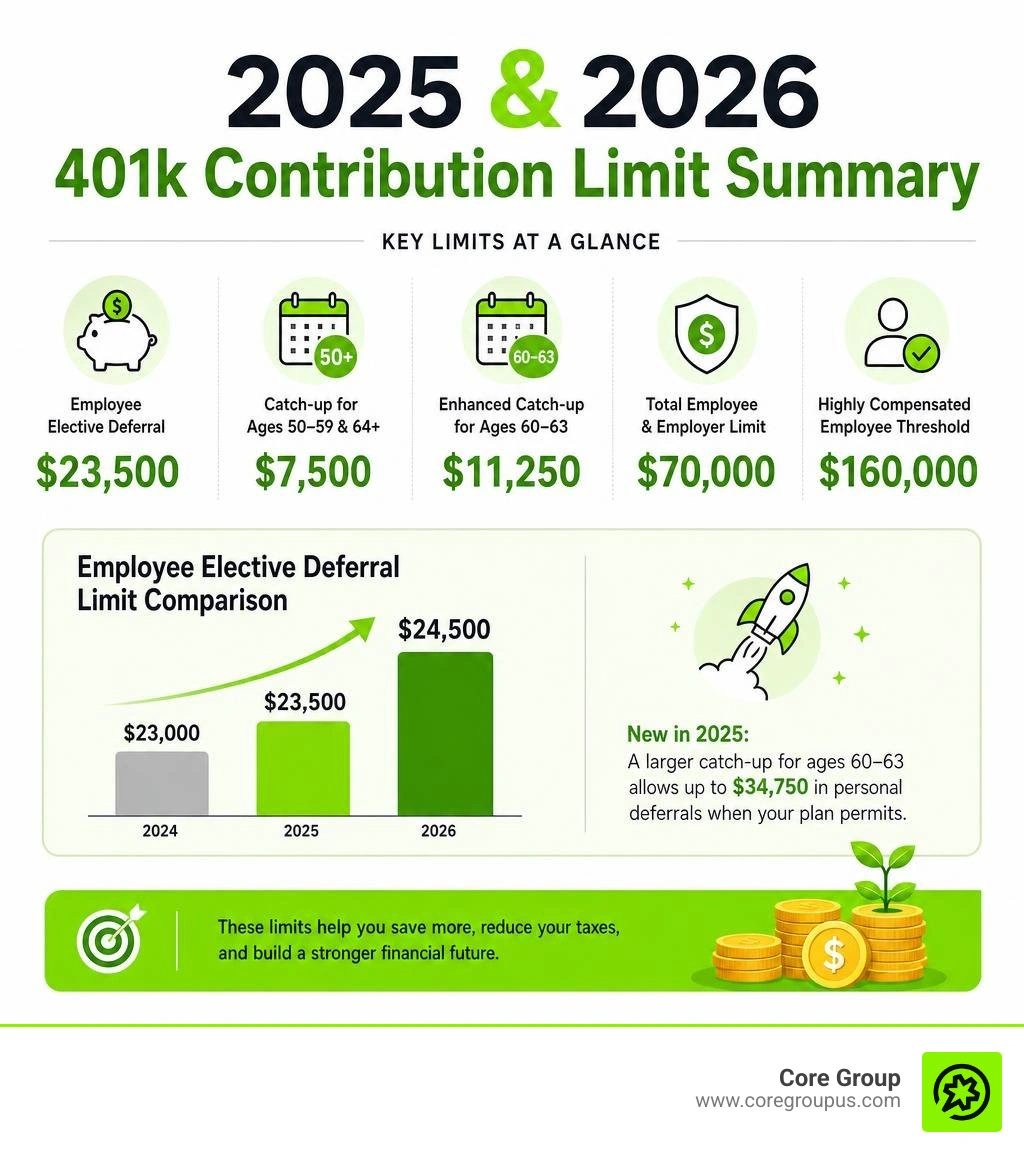
The 401k contribution limits 2025 let most employees defer up to $23,500 from paychecks into traditional and Roth 401k accounts combined. If you are building a creative business, working freelance projects, or balancing a studio job with self-employment income, knowing these caps can help you plan cash flow and reduce tax surprises.
| 2025 limit | Amount |
|---|---|
| Employee elective deferral | $23,500 |
| Catch-up for ages 50 to 59 and 64+ | $7,500 |
| Enhanced catch-up for ages 60 to 63 | $11,250 |
| Total employee and employer limit | $70,000 |
| Highly compensated employee threshold | $160,000 |
For context, the regular employee limit was $23,000 in 2024 and rises to $24,500 in 2026. The 2025 rules also introduced a larger catch-up opportunity for people ages 60 through 63, allowing up to $34,750 in personal deferrals when their plan permits it.
These numbers are more than tax trivia. They affect how much you can save, the tax deduction you may claim, and how employer contributions or Solo 401k profit-sharing fit into your plan.
I am Christian Brim, and this guide will help you make sense of the limits without letting retirement rules distract you from your work.
401k contribution limits 2025 glossary
Standard 401k Contribution Limits 2025 and 2026
Planning out your retirement contributions requires looking at how the tax code evolves each year. Inflation adjustments made by the Internal Revenue Service ensure that these savings vehicles maintain purchasing power over time. We like to view these annual updates as built in incentives to raise your savings baseline as your career or business expands.
| Tax Year | Standard Employee Limit | Age 50+ Catch Up | Ages 60 to 63 Catch Up | Combined Total Addition Cap |
|---|---|---|---|---|
| 2024 | $23,000 | $7,500 | Not Applicable | $69,000 |
| 2025 | $23,500 | $7,500 | $11,250 | $70,000 |
| 2026 | $24,500 | $8,000 | $11,250 | $72,000 |
Understanding how these tiers fit together helps you manage your personal budget and corporate expenses without throwing off cash flow.
Employee Elective Deferrals
An elective deferral is the portion of salary that an employee chooses to redirect into a retirement plan before receiving take home pay. For the 2025 tax year, the employee contribution limit stands at $23,500. This threshold represents an increase from $23,000 in 2024, providing an extra $500 in tax-deferred room. Looking ahead, the cap moves up again to $24,500 in 2026.
According to official updates in IR-2024-285 401k limit increases to $23500 for 2025 IRA limit remains $7000, this employee elective deferral ceiling applies across all workplace plans you participate in during the calendar year. Whether you contribute to a traditional pre-tax 401k, a Roth 401k, a 403(b), or a SIMPLE 401k, your aggregate employee contributions across all employers cannot cross this single threshold. If you switch jobs midway through the year, you must track your contributions carefully because a new employer payroll system will not automatically know what you deferred at your previous job. For a broader look at future benchmarks, review our analysis on 401k Maximum Contribution 2026.
Employer Match and Total Addition Caps
Beyond what you personally defer from your salary, your workplace plan can receive additional funding through employer contributions. These additions may come in the form of matching contributions, discretionary profit sharing allocations, or non-elective safe harbor contributions.
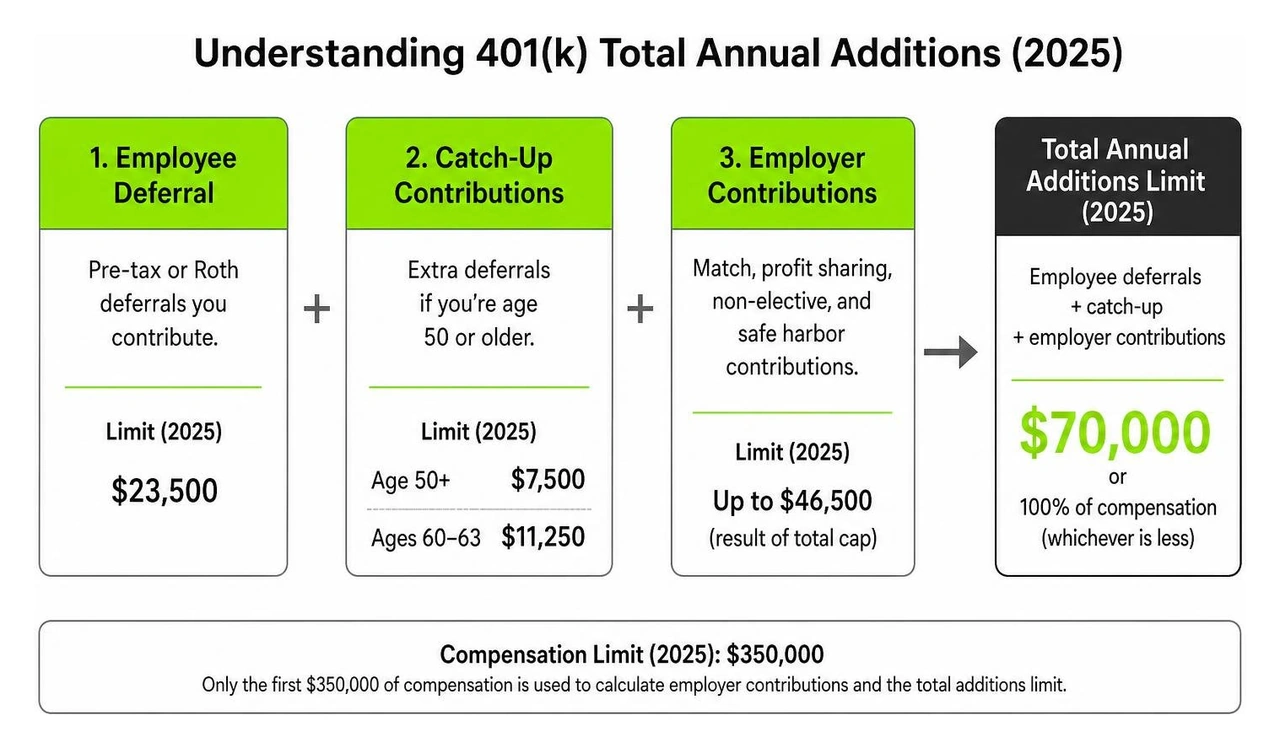
Section 415(c) of the Internal Revenue Code establishes an overarching limit on total annual additions. For 2025, the combined limit for employee elective deferrals plus employer contributions is $70,000, or 100 percent of the participant compensation, whichever is less. This maximum cap expands from $69,000 in 2024 to $72,000 in 2026. As documented in Notice 2024-80 2025 Amounts Relating to Retirement Plans and IRAs, the annual compensation cap considered for these plan calculations is $350,000 for 2025. That means any compensation earned above $350,000 cannot be used when calculating percentage-based matching or profit-sharing math.
Catch Up Contributions and SECURE 2.0 Rules

If you are closing in on retirement, statutory rules give you the opportunity to save extra money in your tax-advantaged accounts. Catch-up provisions allow older participants to contribute beyond the baseline employee elective deferral ceiling, offering a valuable boost during peak earning years.
Standard Catch Up for Age 50 and Older
Participants who reach age 50 or older by December 31 of the tax year can take advantage of standard catch-up deferrals. In 2025, the catch-up contribution cap remains steady at $7,500. When combined with the $23,500 standard employee limit, a worker age 50 or older can defer up to $31,000 into their 401k plan in 2025.
In 2026, the standard catch-up limit increases to $8,000, bringing the total personal deferral allowance for workers 50 and older to $32,500. These standard catch-up funds do not count against the standard $70,000 Section 415(c) total addition cap. Consequently, an older employee receiving a full employer allocation could see total plan additions reach $77,500 in 2025. For an in-depth breakdown on these older worker thresholds, see our guide on 2026 Maximum 401k Contribution Over 50.
Super Catch Up Provisions for Ages 60 to 63
One of the most noteworthy innovations from the SECURE 2.0 Act of 2022 is the introduction of a specialized super catch-up tier. Designed specifically to accelerate savings during the final stretch before typical retirement ages, this rule applies to workers who turn age 60, 61, 62, or 63 during the tax year.
For tax years 2025 and 2026, the super catch-up contribution limit is set at $11,250 instead of the standard catch-up limit. Combining this $11,250 super catch-up with the baseline employee deferral allows eligible participants to save big sums personally
- In 2025, workers aged 60 to 63 can defer up to $34,750 ($23,500 base plus $11,250 super catch-up).
- In 2026, workers aged 60 to 63 can defer up to $35,750 ($24,500 base plus $11,250 super catch-up).
Once a participant reaches age 64, the super catch-up window closes, and they return to the standard catch-up contribution limit. That employer retirement plans are not required to adopt super catch-up rules, so you should check with your plan administrator to ensure your company sponsor supports this provision.
Specialized Plan Rules and Strategic Options

Creative business owners, agency founders, and independent freelancers have unique options when structuring retirement savings. Depending on your corporate entity type, you can craft a retirement funding plan that delivers major tax relief.
Solo 401k Contribution Limits 2025 for Sole Proprietors
A Solo 401k, also known as a one-participant 401k or individual 401k, is designed for business owners who have no full-time common-law employees other than a spouse. This structure is very popular among self-employed designers, digital agency owners, and independent consultants because it allows you to wear two hats, acting as both the employee and the employer.
When funding a Solo 401k in 2025, you can make contributions in both roles
- Employee Elective Deferral. As the employee, you can defer 100 percent of your earned income up to $23,500, plus any applicable catch-up contributions.
- Employer Profit Sharing. As the employer, you can contribute extra non-elective profit-sharing funds. For S-Corporation owners, the maximum employer contribution is 25 percent of W-2 wages. For Sole Proprietors or single-member LLCs filing Schedule C, the effective limit is approximately 20 percent of net self-employment earnings after subtracting half of your self-employment tax.
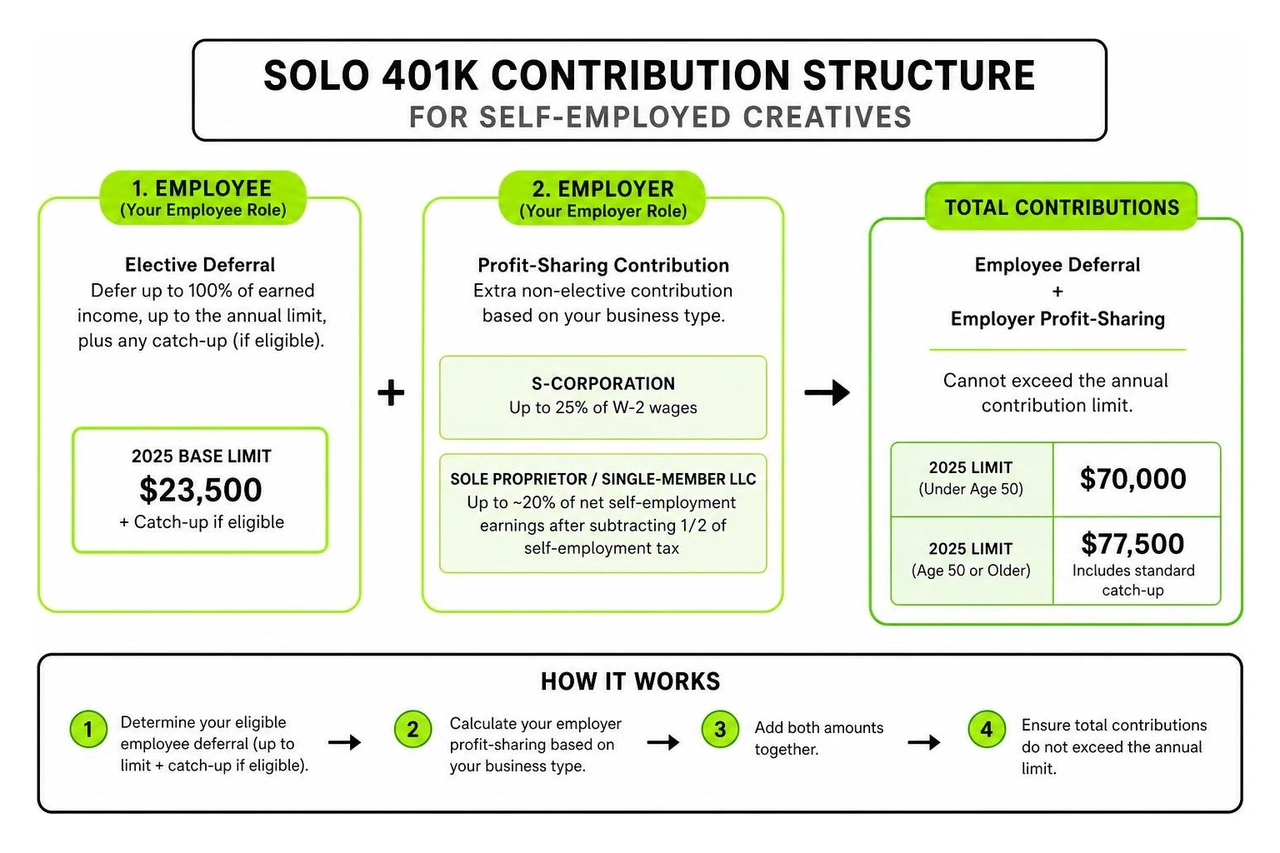
In 2025, the combined total of your employee deferral and employer profit-sharing contributions cannot exceed $70,000, or $77,500 if you qualify for standard catch-up deferrals. High-earning sole proprietors can hit the maximum aggregate cap at much lower overall earnings levels compared to traditional SEP-IRAs, making the Solo 401k an exceptional wealth building vehicle.
Navigating Roth 401k Contribution Limits 2025
A Roth 401k gives savers the ability to make post-tax contributions in exchange for tax-free withdrawals during retirement. Unlike Roth IRAs, which feature strict income eligibility phase-out caps, anyone can contribute to a Roth 401k regardless of how much money they earn.
In 2025, your personal elective deferral limit of $23,500 can be split between traditional pre-tax 401k accounts and Roth 401k accounts in whatever proportion you prefer. For creative professionals who expect their income and tax bracket to rise in future decades, allocating a portion of annual savings to a Roth 401k guarantees tax-free compound growth.
It is also vital to track impending SECURE 2.0 regulations regarding catch-up contributions. Starting in 2026, high earners who made more than $145,000 in FICA wages during the prior calendar year will be legally required to designate all age-based catch-up contributions into a Roth account rather than a pre-tax account.
Tax Benefits and High Earner Compliance
Maximizing your 401k contributions does more than prepare you for retirement, it delivers instant tax benefits today. Pre-tax contributions lower your reported gross income, directly reducing your federal taxable income for the current year.
IRA Limits and MAGI Phase Outs
Many investors like to pair a workplace 401k plan with an Individual Retirement Account. However, the IRS sets distinct contribution caps and income phase-out rules for IRAs that you must navigate.
In 2025, the annual contribution limit for traditional and Roth IRAs remains $7,000, with a $1,000 catch-up limit for individuals aged 50 and older. In 2026, the base IRA contribution limit increases to $7,500.
If you are actively covered by a workplace 401k plan, your ability to deduct traditional IRA contributions depends on your Modified Adjusted Gross Income (MAGI)
- Single filers. In 2025, the traditional IRA deduction phases out between $77,000 and $87,000 of MAGI.
- Married filing jointly. If the spouse making the IRA contribution is covered by a workplace 401k, the deduction phases out between $123,000 and $143,000.
- Roth IRA eligibility. Direct contributions to a Roth IRA phase out for single filers between $150,000 and $165,000 in 2025 ($153,000 to $168,000 in 2026). For married couples filing jointly, the Roth IRA phase-out window is $236,000 to $246,000 in 2025 ($242,000 to $252,000 in 2026).
Because pre-tax 401k salary deferrals directly lower your box 1 W-2 earnings, contributing to a 401k can drop your MAGI back down below these critical phase-out ranges. For a detailed breakdown of this income reduction mechanic, check out Do 401k Contributions Reduce Magi.
Highly Compensated Employee Thresholds
To prevent retirement plans from favoring business owners and executives over rank-and-file workers, the IRS subjects traditional 401k plans to annual non-discrimination tests. These tests examine the contribution rates of Highly Compensated Employees (HCEs) relative to Non-Highly Compensated Employees (NHCEs).
An individual is classified as an HCE if they meet either of the following criteria
- Ownership threshold. They owned more than 5 percent of the business at any time during the current or preceding tax year.
- Compensation threshold. They received compensation above the IRS statutory limit in the prior tax year.
For 2025, the compensation threshold for HCE status is $160,000 (based on look-back earnings in 2024). The HCE threshold remains $160,000 for 2026 plan testing as well. If rank-and-file participation is low, plan testing may force the company to cap HCE deferrals or refund excess executive contributions. Business owners can sidestep non-discrimination testing entirely by adopting a Safe Harbor 401k plan structure, which mandates minimum employer matching or non-elective contributions for all workers. To learn how recent regulatory shifts alter employer strategy, review 401k Changes 2026.
How to Correct Excess 401k Deferrals
Accidentally contributing too much money to your 401k can happen if you switch jobs mid-year or hold multiple positions with separate employers. Because elective deferral limits apply to you personally rather than per account, exceeding the $23,500 limit in 2025 triggers specific correction procedures.
If you overcontribute, you must notify your plan administrator immediately and request an excess deferral distribution. The plan must return the excess contribution amount plus any associated investment earnings to you by April 15 of the following tax year.
Failing to correct an excess deferral by April 15 leads to double taxation. You will pay regular income tax on the excess amount in the tax year contributed, and you will be taxed on that same amount a second time when you eventually withdraw it during retirement. Correcting the excess on time ensures that the return of your principal is taxed in the year deferred, while net earnings are reported as taxable income in the year distributed.
Frequently Asked Questions about Retirement Limits
What happens if I contribute too much to my 401k in 2025
If your combined 401k salary deferrals across all employers cross the $23,500 threshold in 2025, you have generated an excess deferral. You should contact your plan provider before April 15, 2026, to request a corrective distribution of the excess money and its investment earnings. If corrected before Tax Day, the excess deferral is taxed on your 2025 tax return, and the earnings are taxed in the year distributed. If you miss the April 15 deadline, the excess funds face double taxation, once for 2025 and again upon final withdrawal.
What is the income threshold for highly compensated employees in 2025
The income threshold for identifying a Highly Compensated Employee (HCE) for the 2025 tax year is $160,000. If an employee earned more than $160,000 in 2024, or owned more than 5 percent of the employer business, they are categorized as an HCE for 2025 plan testing. This status determines whether an employee deferral cap must be enforced under standard non-discrimination testing guidelines.
How does a 401k lower my MAGI
When you make pre-tax elective deferrals into a traditional 401k, your employer deducts those dollars directly from your gross pay before applying federal income tax withholding. This lowers your reported wages in box 1 of your Form W-2. Because Modified Adjusted Gross Income (MAGI) is calculated using your adjusted gross income as a starting point, every dollar you put into a pre-tax 401k directly lowers your MAGI. This tax reduction can help you qualify for child tax credits, avoid healthcare subsidy phase-outs, or remain eligible for Roth IRA contributions.
Conclusion
Managing retirement planning rules does not have to feel overwhelming. By taking advantage of the 401k contribution limits 2025 and anticipating the higher limits in 2026, you can optimize your personal wealth while reducing your overall corporate tax bill. Whether you are maximizing employer matching funds, funding a Solo 401k, or preparing for SECURE 2.0 catch-up updates, proactive planning puts you firmly in control of your financial future.
At Core Group, we provide financial management, bookkeeping, and tax services specifically tailored for creative entrepreneurs. We use a no-fluff, profit-first playbook that guarantees peace of mind and saves you precious time, allowing you to focus on growing your business while backed by our MacBook Pro guarantee.
If you want expert guidance on structuring your retirement strategy and keeping your tax strategy airtight, explore our detailed analysis on 401k and MAGI planning or reach out to our team today.