The Complete Guide to 401k and IRA Contribution Limits
Breaking Down the 2026 401k IRA Contribution Limits
Understanding the baseline contribution caps set by the Internal Revenue Service is the foundation of building a reliable nest egg. For the current 2026 tax year, the IRS increased annual limits to reflect cost of living adjustments. Reviewing recent 401k Changes 2026 ensures you take advantage of every allowable dollar before the calendar year closes.
Under official guidance, the 401(k) limit increases to $24,500 for 2026, IRA limit increases to $7,500 | Internal Revenue Service. This update gives savers more room to shelter wealth from immediate taxation while building compounding growth.
| Plan Type | 2025 Limit | 2026 Limit | Catch-Up Limit (Age 50+) | Total 2026 Cap (Age 50+) |
|---|---|---|---|---|
| Employee 401(k) Salary Deferral | $23,500 | $24,500 | $8,000 | $32,500 |
| Traditional / Roth IRA | $7,000 | $7,500 | $1,100 | $8,600 |
| Overall Defined Contribution (Section 415c) | $70,000 | $72,000 | $8,000 | $80,000 |
| SIMPLE IRA / SIMPLE 401(k) | $16,500 | $17,000 | $4,000 | $21,000 |
The employee deferral limit applies to traditional pre-tax contributions and Roth after-tax salary contributions combined. The Section 415c limit encompasses all employee salary deferrals, employer matching contributions, profit-sharing allocations, and optional voluntary after-tax contributions.
How Catch Up Provisions Affect 401k IRA Contribution Limits
For individuals planning their late-career accumulation phase, catching up on retirement funding becomes vital. Checking the 2026 Maximum 401k Contribution Over 50 reveals that savers aged 50 and older can set aside an additional $8,000 in elective deferrals, bringing their personal workplace contribution ceiling to $32,500.
The SECURE 2.0 legislation added unique provisions for savers in specific age bands. Participants aged 60, 61, 62, and 63 have access to a special super catch-up limit of $11,250 in workplace 401(k) plans instead of the standard $8,000 catch-up. This provision allows eligible employees in that age range to contribute up to $35,750 in elective deferrals for 2026.
Additionally, the IRA catch-up contribution is indexed for inflation, rising to $1,100 for 2026. This allows savers aged 50 and older to place up to $8,600 into an IRA.
Another SECURE 2.0 rule impacts high earners. Employees whose prior-year FICA wages from their employer exceeded $150,000 must make their age-based workplace catch-up contributions as designated Roth contributions using after-tax dollars.
Navigating Self Employed Plans and 401k IRA Contribution Limits
Creative entrepreneurs and independent business owners enjoy powerful flexibility when funding retirement. Rather than being restricted to standard employee deferrals, self-employed professionals can set up specialized plans that allow higher overall funding levels.
A Simplified Employee Pension (SEP) IRA allows business owners to contribute up to 25 percent of net adjusted self-employment compensation, capped at the overall Section 415c limit of $72,000 for 2026. Catch-up contributions are not permitted in SEP IRAs, but the contribution limit provides significant tax shelter for high-revenue business years.
A Solo 401(k), designed for business owners without full-time W-2 employees other than a spouse, allows you to contribute both as an employee and as the employer. You can make an elective salary deferral of up to $24,500 (plus applicable catch-ups) and add an employer profit-sharing contribution of up to 25 percent of net compensation, with total combined contributions capped at $72,000.
For small business owners with a modest team, a SIMPLE IRA offers a lower administrative burden, allowing employee deferrals up to $17,000 alongside an additional $4,000 catch-up for those aged 50 and over.
Traditional Versus Roth Tax Treatments Across Accounts
Selecting between traditional and Roth accounts shapes when you receive your tax break. Traditional retirement contributions are made with pre-tax dollars, reducing your current taxable income in the year you make the deposit. The money grows tax-deferred, and distributions in retirement are taxed as ordinary income.
Roth contributions are made using after-tax money. You receive no upfront deduction, but your investments compound completely tax-free. Qualified withdrawals in retirement are entirely income-tax-free, provided you are at least age 59½ and have satisfied the five-year seasoning rule for the account.
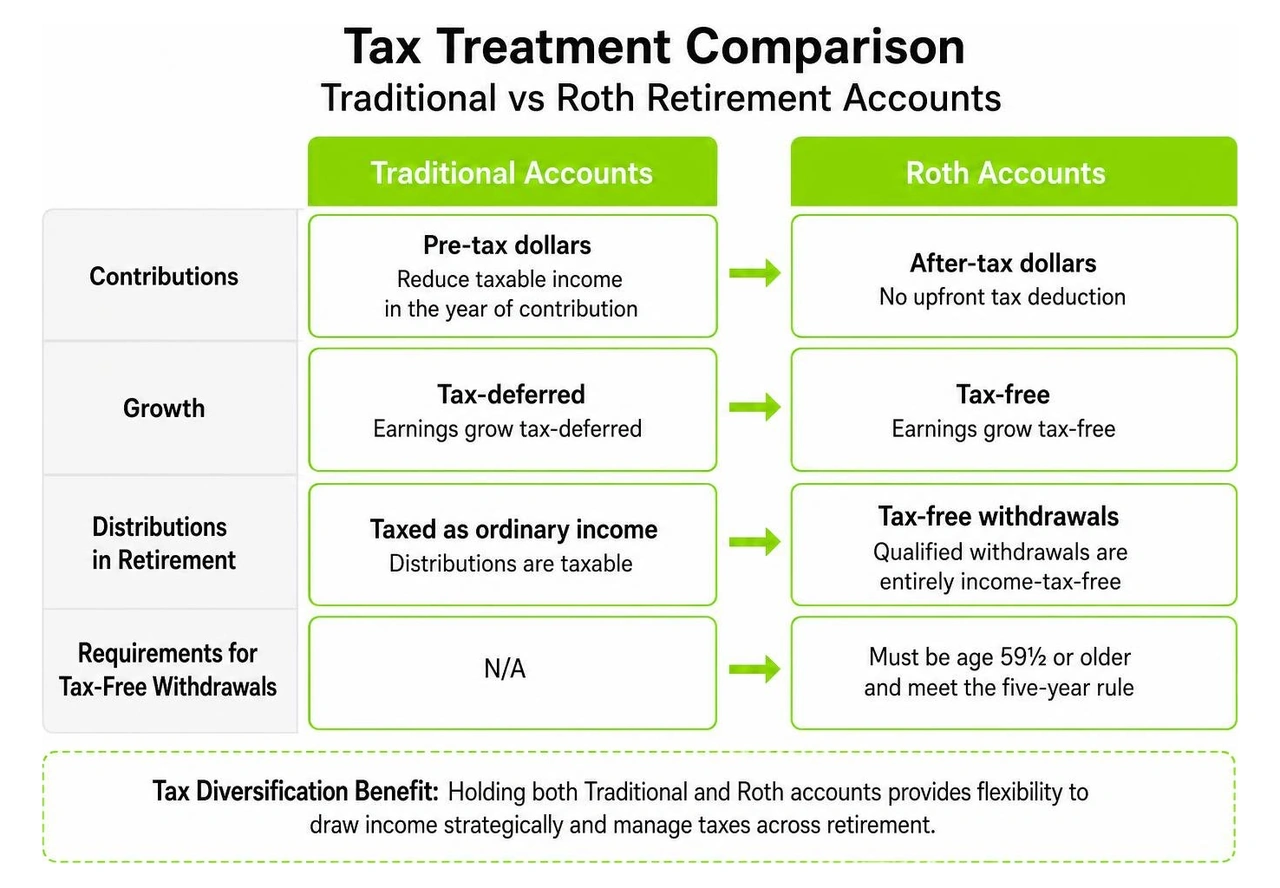
Holding both traditional and Roth accounts builds tax diversification for your retirement years. This flexibility allows you to draw income strategically from different accounts to stay within lower income tax brackets throughout retirement.
Workplace 401k Options and Company Matching
Workplace 401(k) plans offer the distinct advantage of employer contributions. Many companies provide a matching formula, such as matching dollar-for-dollar on the first three percent of your salary and fifty cents on the dollar for the next two percent.
Using a 401k Employer Match Calculator can help you quantify how much free compensation your business or employer provides each pay period. Skipping this match is essentially turning down part of your total earned compensation.
Vesting schedules determine when employer contributions become yours to keep if you leave the company. While your personal salary deferrals always remain 100 percent yours, employer contributions may vest immediately, over a graded schedule across several years, or all at once via cliff vesting.
Individual Retirement Accounts and Investment Flexibility
While a 401(k) provides higher contribution ceilings and potential company matches, an Individual Retirement Account provides superior investment freedom. Workplace plans typically limit your investment choices to a curated list of twenty to thirty mutual funds or target-date portfolios, which may carry higher administrative fees.
In contrast, you can open an IRA at almost any brokerage custodian, unlocking access to individual stocks, broad-market index funds, exchange-traded funds, and alternative asset classes. Selecting low-cost index funds within an IRA reduces investment fee drag over several decades of compounding.
Additionally, non-working spouses can build retirement assets through a Spousal IRA. As long as the working spouse has sufficient earned income to cover the contributions and the couple files a joint tax return, the non-earning partner can contribute up to the full $7,500 limit.
Income Phaseouts and Tax Deductibility Rules
While anyone with earned income can contribute to a 401(k) regardless of income level, IRAs come with strict income thresholds that govern tax deductibility and contribution eligibility. Official IRS guidelines detail how modified adjusted gross income (MAGI) impacts these accounts, as documented in the Retirement topics - IRA contribution limits | Internal Revenue Service.
If you are an active participant in an employer-sponsored retirement plan, your ability to deduct traditional IRA contributions phases out across specific income brackets for 2026.
- Single filers covered by a workplace plan experience a phaseout between $81,000 and $91,000 of MAGI.
- Married couples filing jointly where the contributing spouse is covered by a workplace plan see a deduction phaseout between $129,000 and $149,000 of MAGI.
- Married individuals where the contributor is not covered by a workplace plan but their spouse is covered face a joint phaseout between $242,000 and $252,000 of MAGI.
For individuals near these boundaries, understanding Do 401k Contributions Reduce MAGI is essential, because traditional 401(k) deferrals lower your adjusted gross income, potentially restoring your eligibility for an IRA deduction.
Roth IRA Income Ceilings and Backdoor Strategies
Direct contributions to a Roth IRA are restricted by household earnings. For the 2026 tax year, single filers and heads of household face a MAGI phaseout range between $153,000 and $168,000. For married couples filing jointly, the phaseout range is between $242,000 and $252,000. If your MAGI reaches or exceeds the upper limit, you cannot make a direct contribution to a Roth IRA.
High-earning individuals can bypass these income caps using the Backdoor Roth IRA strategy. This process involves making a nondeductible contribution to a traditional IRA and subsequently executing a conversion of those funds into a Roth IRA.
When executing a backdoor conversion, you must account for the IRS pro-rata rule. If you hold existing pre-tax balances in any traditional, SEP, or SIMPLE IRAs, the IRS calculates the taxable portion of your conversion based on the ratio of your pre-tax assets to after-tax assets across all your non-Roth IRAs.
High Earner Rules and After Tax Deferrals
For high-income professionals seeking to save beyond the standard $24,500 employee deferral, some employer plans offer after-tax contributions. Setting up a strategic 401k After Tax Contribution allows you to fund the difference between your elective deferrals plus employer matches and the overall plan ceiling of $72,000 in 2026.
Paired with in-plan Roth conversions or distributions to an external Roth IRA, this setup is known as the Mega Backdoor Roth strategy. It allows high earners to move up to tens of thousands of dollars into tax-free Roth status each year.
Strategic Contribution Order for Maximum Retirement Growth
Navigating multiple retirement vehicles requires a clear plan of action. Spreading your savings across multiple accounts without a set process can lead to missed company matching dollars or higher investment fees.
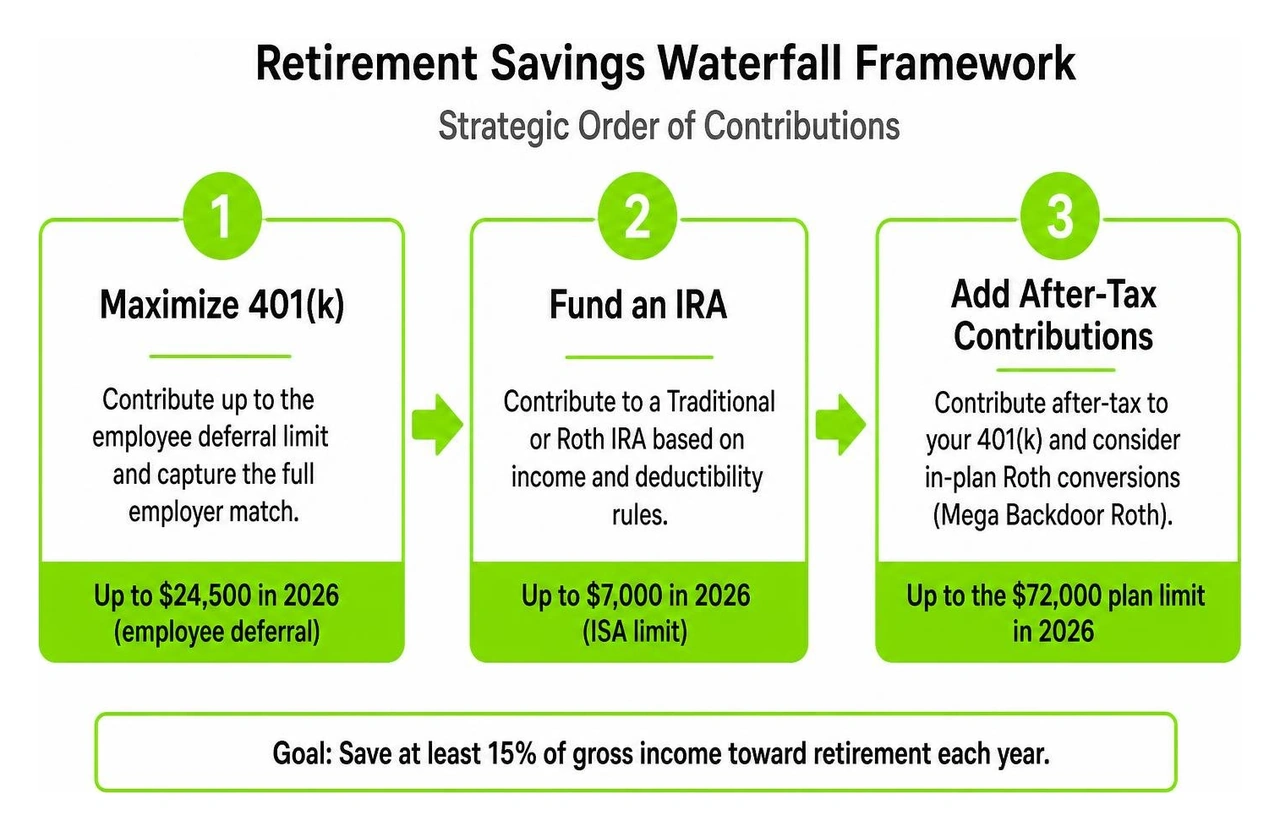
A common financial planning benchmark recommends saving at least 15 percent of your gross income toward retirement each year. Applying a structured waterfall framework ensures every dollar goes where it works hardest for your future.
Three Step Waterfall Method for Dual Account Savers
We recommend following a straightforward three-step prioritization sequence.
- Capture the Employer Match. Direct your initial payroll deferrals into your workplace 401(k) until you contribute enough to receive 100 percent of any employer matching funds. This provides an immediate return on your investment that cannot be matched elsewhere.
- Fund Your IRA. Once the full match is secured, allocate your next savings dollars into an IRA up to the $7,500 limit (or $8,600 if age 50 or older). This gives you complete freedom over your investment choices and lowers administrative fee drag.
- Return to the 401(k). If you have additional savings capacity after maxing out your IRA, return to your employer 401(k) to contribute additional elective deferrals up to the $24,500 limit (plus any catch-up allowances).
Job Transitions and Account Rollover Rules
When you change jobs, you have choices regarding the assets in your previous employer's 401(k). You can keep the funds in the existing plan if allowed, execute a rollover to your new employer's plan, roll the funds into an individual rollover IRA, or take a cash distribution.
Always execute a direct trustee-to-trustee rollover rather than an indirect rollover. With an indirect rollover, the plan administrator withholds 20 percent for federal income taxes, and you must deposit the full gross balance into your new account within 60 days to avoid early withdrawal penalties and unwanted tax liabilities.
Additionally, workers who leave a company during or after the calendar year in which they turn age 55 can utilize the Rule of 55. This rule allows penalty-free distributions from that specific employer's 401(k) prior to reaching age 59½, an option that does not apply to standard IRAs.
Frequently Asked Questions About Retirement Contribution Limits
Can You Contribute to Both a 401k and an IRA in the Same Year
Yes. You are fully permitted to fund both a 401(k) and an IRA in the same tax year. The IRS views these as separate accounts with independent contribution limits.
Participating in both accounts allows an individual under age 50 to contribute a combined total of $32,000 in personal savings for 2026 across workplace deferrals and an IRA. Your workplace plan participation only affects whether your traditional IRA contributions can be deducted on your taxes, not your eligibility to put money into the account.
What Happens if You Exceed Annual Retirement Limits
Overcontributing to a retirement plan creates tax complications that should be corrected quickly. If you contribute more than the annual employee elective deferral limit across your 401(k) accounts, you must notify your plan administrator and withdraw the excess deferrals along with associated earnings before April 15 of the following year. Failing to correct an excess 401(k) deferral leads to double taxation, where the money is taxed in the year contributed and taxed again upon withdrawal.
Excess contributions to an IRA face a recurring 6 percent excise tax penalty for every year the excess remains in the account. To avoid this penalty, withdraw the excess funds and their earnings before your tax return filing deadline, including extensions.
How Do RMDs and Early Withdrawal Rules Work
Required Minimum Distributions (RMDs) require account holders to begin taking mandatory withdrawals from pre-tax retirement accounts once they reach age 73. For individuals born in 1960 or later, the RMD age increases to 75 under SECURE 2.0 legislation.
Roth IRAs are entirely exempt from RMDs during the original owner's lifetime. Designated Roth 401(k) accounts are also exempt from lifetime RMD requirements, eliminating the need to roll Roth 401(k) assets into a Roth IRA simply to avoid required distributions.
Withdrawing funds from any traditional retirement account before age 59½ generally incurs ordinary income taxes along with a 10 percent early withdrawal penalty, unless you qualify for an IRS exception such as disability, qualified medical expenses, or separation of service at age 55 or older.
Conclusion
Managing retirement accounts, business profit allocations, and ever-changing IRS regulations can feel overwhelming for busy business owners. At Core Group, our mission is to deliver financial clarity through a clear profit-first playbook. We provide business owners with complete peace of mind, freeing up your valuable time so you can focus on growing your company.
To see how elective deferrals interact with your annual tax return, explore our resource on 401k and MAGI and start optimizing your long-term wealth strategy today.