The Ultimate Guide to 401(k) Catch-Up Contribution Rules
How to Make 401(k) Catch-Up Contributions
You can make 401k make up contributions, usually called catch-up contributions, if you turn 50 by the end of the year and your plan allows them. Check your plan rules, then ask your payroll team to increase your 401(k) deferrals before year-end.
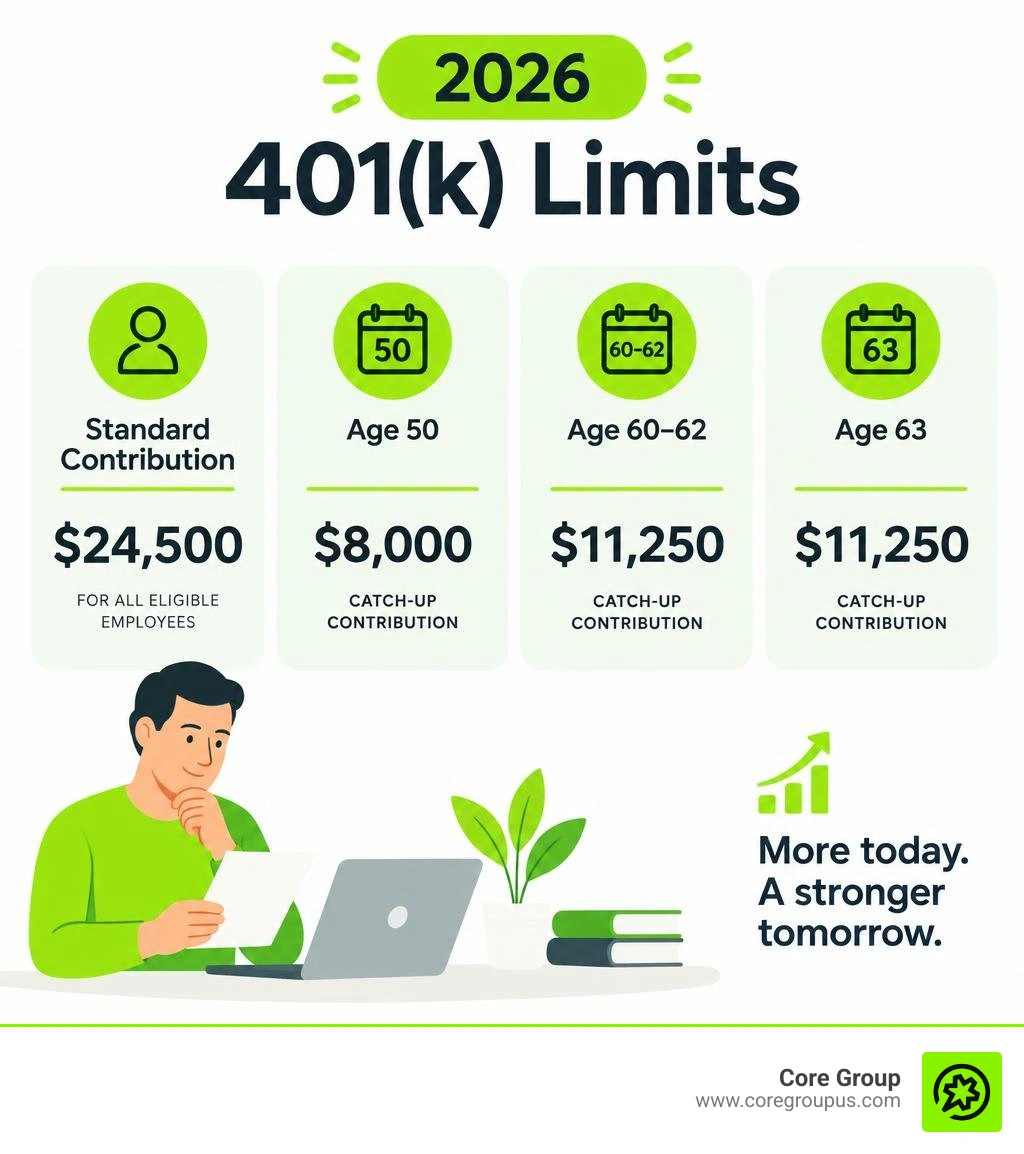
In 2026, the regular employee contribution limit is $24,500. Eligible savers can add up to $8,000, or up to $11,250 if they turn 60 through 63 and their plan permits the higher limit. Higher earners may need to make those extra contributions as Roth contributions.
I'm Christian Brim, and I'll help you sort out the rules so you can decide what fits your retirement plan.
401k make up contributions definitions
Understanding 401k Make Up Contributions and Eligibility Rules
Saving for retirement can feel like a moving target, especially for entrepreneurs and busy professionals balancing daily operations with long-term wealth building. Catch-up contributions provide an official mechanism under the tax code for workers to increase their savings rate as they get closer to retirement age. When structured as 401(k) make-up contributions, these deferrals help late-career savers close the gap between what they have saved and what they may need.
When you review the rules for Retirement topics - Catch-up contributions, you will see that these provisions allow eligible participants to defer amounts beyond standard statutory limits. For business owners and individuals, taking advantage of a 401K Over 50 Catch Up strategy creates substantial tax advantages while allowing investment earnings to compound during key earning years. Many savers refer to these as 401(k) make-up contributions because they let eligible workers make up for years when they could not save as much.
To utilize these extra deferrals, your employer-sponsored plan document must explicitly include catch-up provisions. Once established, these contributions operate directly through elective payroll deductions, lowering your current taxable income or building tax-free retirement wealth depending on your tax elections.
Age Requirements and Year-End Birthday Rules
The IRS uses a calendar-year measurement to determine eligibility for catch-up contributions. You do not need to wait until your 50th birthday to start making additional deferrals. As long as you attain age 50 by December 31 of the applicable tax year, you are deemed eligible starting on January 1 of that entire year.
This rule applies smoothly even to non-calendar fiscal plan years. According to IRS guidance in their Issue snapshot - 401(k) plan catch-up contribution eligibility, an employee who turns 50 late in the calendar year qualifies for catch-up deferrals during any plan year ending within that calendar year. This structure gives savers a full twelve months to pace their extra contributions through regular payroll cycles.
Applicable Retirement Plan Types
Catch-up contribution options extend across multiple defined contribution retirement structures. These include traditional 401(k) plans, Roth 401(k) accounts, 403(b) tax-sheltered annuity plans for educational and non-profit institutions, governmental 457(b) deferred compensation plans, the federal Thrift Savings Plan (TSP), and SIMPLE IRA and SIMPLE 401(k) plans.
Business owners operating a Safe Harbor 401K Complete Guide structure can also offer catch-up contributions to their employees and themselves without worrying about failing standard nondiscrimination tests.
Catch-Up Contribution Limits and SECURE 2.0 Super Tiers
Retirement legislation has transformed contribution limits by introducing age-tiered catch-up allowances. Understanding these limits helps business owners and participants maximize their annual elective deferrals while maintaining compliance with statutory caps under IRC Section 402(g).
The table below outlines standard and enhanced contribution limits across 2026 and 2027.
| Plan Year | Standard Employee Limit | Age 50 to 59 Catch-Up | Age 60 to 63 Super Catch-Up | Age 64 and Older Catch-Up |
|---|---|---|---|---|
| 2026 | $24,500 | $8,000 | $11,250 | $8,000 |
| 2027 | $25,500 | $8,500 | $11,750 | $8,500 |
Tracking these statutory adjustments is essential when planning your retirement savings roadmap and reviewing the broader 401K Changes 2026 enacted under federal retirement law.
Annual Limits for 401k Make Up Contributions in 2026 and 2027
For 2026, the baseline employee salary deferral limit is $24,500. Savers aged 50 and older can contribute an additional $8,000, bringing their maximum elective deferral to $32,500. When calculating total annual additions under IRC Section 415(c), which combines employee deferrals, employer matching, and profit-sharing contributions, the overall limit reaches $72,000 in 2026 before adding catch-up amounts.
Looking ahead to 2027, the baseline deferral limit increases to $25,500 with a standard catch-up limit of $8,500, setting the total maximum employee deferral at $34,000. For comprehensive guidance on structuring these deferrals, consult our 401K 2026 Contribution Guide and check the 2026 Maximum 401K Contribution Over 50 details.
Enhanced Super Catch-Up Limits for Ages 60 Through 63
A major component of recent retirement legislation is the creation of a higher catch-up tier for workers aged 60, 61, 62, and 63. In 2026, participants in this age bracket can contribute up to $11,250 in catch-up deferrals instead of the standard $8,000 amount, creating a total employee contribution cap of $35,750. In 2027, this super catch-up limit increases to $11,750, allowing total employee deferrals of up to $37,250.
Once a participant reaches age 64, their catch-up contribution limit returns to the standard age 50 and older tier. Employers must ensure their payroll systems accurately track participant birthdates to apply these enhanced limits properly.
Mandatory Roth Catch-Up Rules and Tax Strategies

Federal retirement legislation introduced a major structural change to catch-up contributions that takes effect in 2026. This rule alters how high-income earners fund their catch-up deferrals by eliminating the upfront pre-tax deduction on these amounts.
The 150000 Dollar Prior-Year Wage Rule
Beginning in 2026, any employee whose FICA-taxable wages from the plan sponsor exceeded $150,000 in the preceding calendar year must make all catch-up contributions to a designated Roth 401(k) account using after-tax dollars.
This rule relies on a one-year lookback mechanism based on Box 5 Medicare wages on Form W-2 rather than Modified Adjusted Gross Income. If your prior-year FICA compensation was $150,000 or greater, your catch-up contributions will not reduce your current taxable income. However, those funds will grow tax-free and can be withdrawn completely tax-free in retirement, provided you satisfy the five-year aging rule and are at least age 59½.
If an employer's retirement plan does not currently include a Roth feature, employees earning over $150,000 are legally prohibited from making any catch-up contributions until the plan sponsor amends the plan to add a Roth option.
Alternative Savings Options for High Earners
When high earners lose the upfront tax deduction on catch-up contributions, utilizing complementary tax-advantaged accounts helps maintain tax efficiency.
Health Savings Accounts (HSAs) let individuals enrolled in qualifying high-deductible health plans contribute pre-tax dollars that grow tax-free and can be withdrawn tax-free for qualified medical expenses. In 2026, individuals aged 55 and older can make an additional $1,000 catch-up contribution.
Traditional Nondeductible IRAs and Backdoor Roth IRAs provide another route. High-income earners who exceed the direct Roth IRA income phaseout limits can fund a traditional IRA with nondeductible dollars and convert it to a Roth IRA.
Individual Retirement Accounts (IRAs) also work as a supplement. In 2026, the IRA catch-up contribution is $1,100, allowing a total annual IRA contribution of $8,600.
These accounts operate under separate statutory sections and do not reduce your allowable 401(k) deferral limits.
Employer Matching and Operational Error Corrections

Employer matching policies vary widely by business. While employers are not legally required to match catch-up contributions, many plan sponsors calculate matches across all employee elective deferrals up to the plan's matching formula. To see how these calculations work in practice, review our 401K Employer Match Guide 2026.
Beyond voluntary savings, the term make-up contributions also refers to mandatory employer corrections when operational plan errors occur or when restoring benefits for employees returning from military leave.
Correcting Missed Plan Opportunities with Employer 401(k) Make-Up Contributions
When an employer fails to implement an employee's salary deferral election or mistakenly excludes an eligible worker from participating in the plan, the business must correct the mistake under the IRS Employee Plans Compliance Resolution System (EPCRS).
Under IRS guidelines for Fixing common plan mistakes - Correcting a failure to effect employee deferral elections, the employer must make a corrective Qualified Nonelective Contribution (QNEC) to the employee's account. This corrective contribution is paid entirely out of company funds and must be 100% vested immediately.
According to the official 401(k) plan fix-it guide - Eligible employees weren't given the opportunity to make an elective deferral election, the standard corrective QNEC equals 50% of the missed deferral opportunity plus missed employer matching contributions and lost investment earnings. Under IRS safe harbors, the 50% contribution rate can be reduced to 25% or 0% if the failure is identified and corrected quickly with proper employee notice.

Handling Military Leave Restorations and Excess Deferrals
Special make-up contribution rules apply to service members returning to civilian employment under the Uniformed Services Employment and Reemployment Rights Act (USERRA). As outlined in IRS guidance on Retirement plans FAQs regarding USERRA and SSCRA, returning veterans have up to three times their period of military service, capped at five years, to make up missed elective deferrals. Employers must also contribute any corresponding matching contributions that would have applied during that service timeframe.
If a participant contributes too much to their 401(k) across multiple jobs in a single tax year, they must take corrective action to prevent double taxation.
- Notify the plan administrator of the excess elective deferral amount.
- Request a corrective distribution of the excess deferrals along with attributable investment earnings before April 15 following the tax year of the overcontribution.
- Report the distributed excess as taxable income on the applicable tax return.
- Ensure payroll systems adjust future deferral percentages to prevent exceeding annual statutory limits.
Frequently Asked Questions about 401(k) Catch-Up Rules
Can I Make Catch-Up Contributions if My Employer Does Not Match Them?
Yes. Catch-up contributions are voluntary elective salary deferrals that you make from your earned income. They do not depend on whether your employer provides a matching contribution. Even without an employer match, catch-up contributions provide significant tax advantages and allow your investments to compound over time.
What Happens if My 401(k) Plan Does Not Offer a Roth Option and I Earn Over 150000 Dollars?
Starting in 2026, if you earned more than $150,000 in FICA wages from your employer in the prior year and your plan does not offer a Roth feature, you cannot make catch-up contributions to that plan. Employers should update their plan documents to include a Roth contribution option so high-earning employees do not lose the ability to save additional funds.
Do IRA Catch-Up Contributions Count Toward My 401(k) Limit?
No. IRAs and 401(k) plans are governed by different sections of the Internal Revenue Code and maintain separate contribution limits. In 2026, you can contribute up to $32,500 to a 401(k) if you are age 50 to 59, and you can also contribute up to $8,600 to an IRA, combining the $7,500 standard limit with the $1,100 IRA catch-up allowance.
Conclusion
Maximizing catch-up contributions is one of the most effective ways for business owners and creative entrepreneurs to build long-term financial security and optimize their tax positions. Navigating the shifting landscape of retirement regulations, including new mandatory Roth rules and super catch-up limits, requires proactive planning.
At Core Group, we provide financial management, bookkeeping, and tax services designed specifically for creative entrepreneurs. We deliver a no-fluff, profit-first playbook that guarantees peace of mind and saves you time so you can focus on growing your business, backed by our MacBook Pro guarantee. To take control of your financial strategy and see how tax-efficient retirement contributions impact your bottom line, learn more about understanding how 401k contributions affect MAGI and connect with our team today.